
After reaching out to stakeholders yesterday, many student groups were excited to report their stakeholder had replied back! Energized by the connection, students embraced the task of researching and then using their understanding of science to propose a solution to reduce the effect and frequency of harmful algal blooms on the Puget Sound ecosystem. To help guide their research efforts, students were encouraged to review the Know and Need to Know lists they assembled last week when we kicked off the Problem Based Learning task (see October 15th post). Today, students also learned that they will have a few additional days of computer-based research time, and they began thinking about how they will represent their individual projects to their stakeholders on Tuesday, November 3.
Category Archives: Homeostasis
Cells & Homeostasis: PBL Research – Day 2
For our second day of project work, student groups were tasked with identifying a primary stakeholder and then actually drafting an email to the stakeholder. The pictures below show the instructions provided to students in identifying an appropriate primary stakeholder and in crafting the email to the stakeholder. Students reached out to a wide variety of stakeholders throughout the day, including local marine scientists, restaurant owners, community groups interested in the environment, local government officials, and elementary school teachers. Student groups were then tasked with coming up with at least three different project ideas which both meet the goal of the mission and meet the needs and interests of the primary stakeholder. Students continued to document their collaborative work in the shared Google Doc.

Cells & Homeostasis: PBL Research – Day 1
Today marked the beginning of our project team work investigating the problem of reducing the frequency of harmful algal blooms (HABs) in Puget Sound. Students used their responses from the Seahurst Park pre-assessment worksheet from last Thursday to assemble into groups (questions 4 and 5). Student groups then worked together to create a single shared Google Doc per group, with each student working in the group having their own Chromebook for simultaneous editing. We concluded with groups creating a list of stakeholders and then selecting one to be the audience for their presentation.
At the start of class, I pointed out the HS-LS2-7 code written at the top of the pre-assessment. Students learned about the Next Generation Science Standards and were also reminded of the Washington State high school credit requirements for upcoming graduation classes.
Cells & Homeostasis: Cell Membrane Function Assessment
To support our school’s goal of improving the ability of students to use writing to explain, the science department gave the first of three “writing to explain” science prompts this school year. This first writing prompt serves as a baseline, with the next two prompts designed to assess growth in student ability to use writing to explain science. Although students had the entire class period to respond to the prompt, students who finished early had the remainder of the class period to complete unfinished work.
Cells & Homeostasis: Intro to Seahurst Park PBL
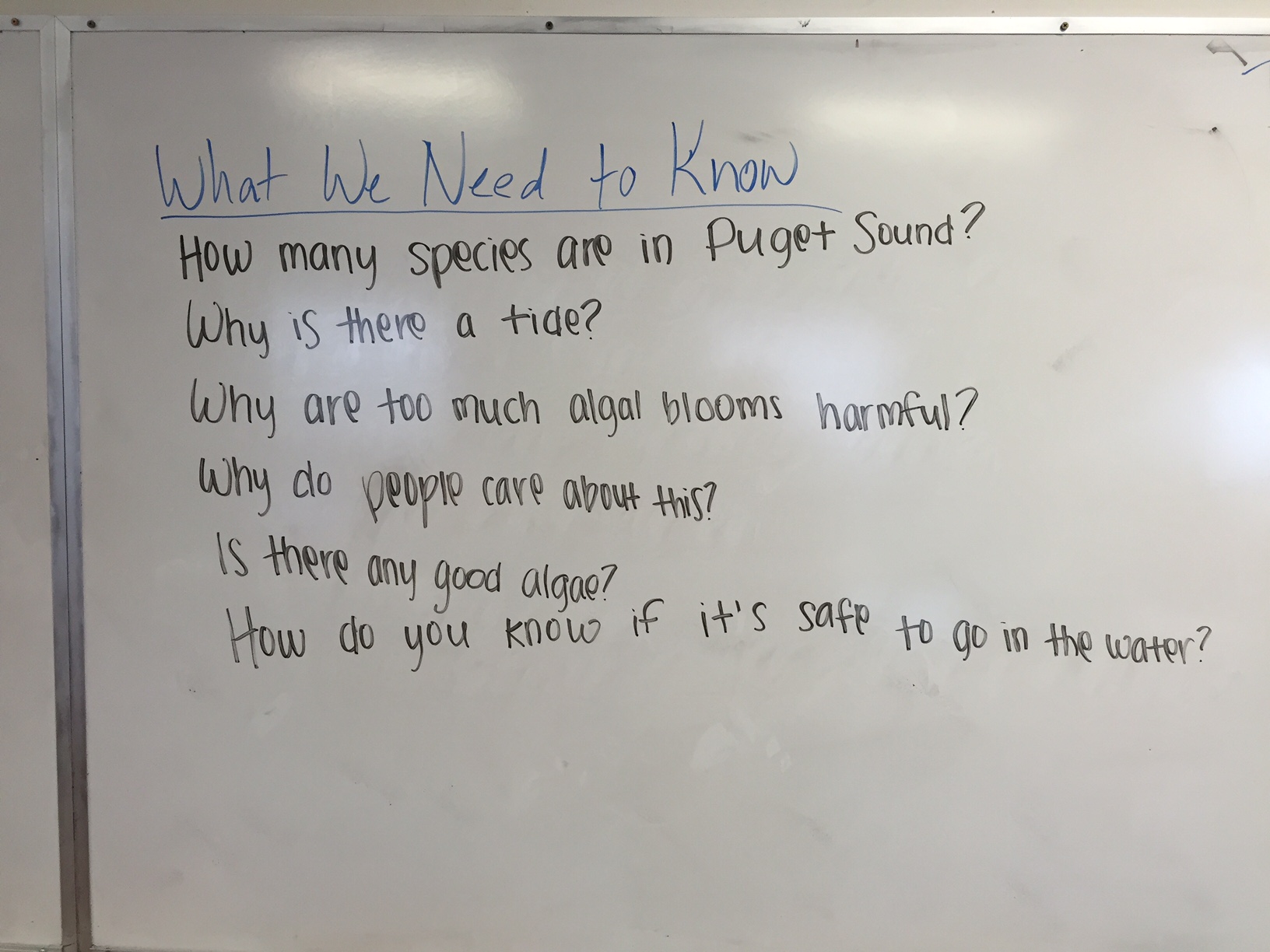
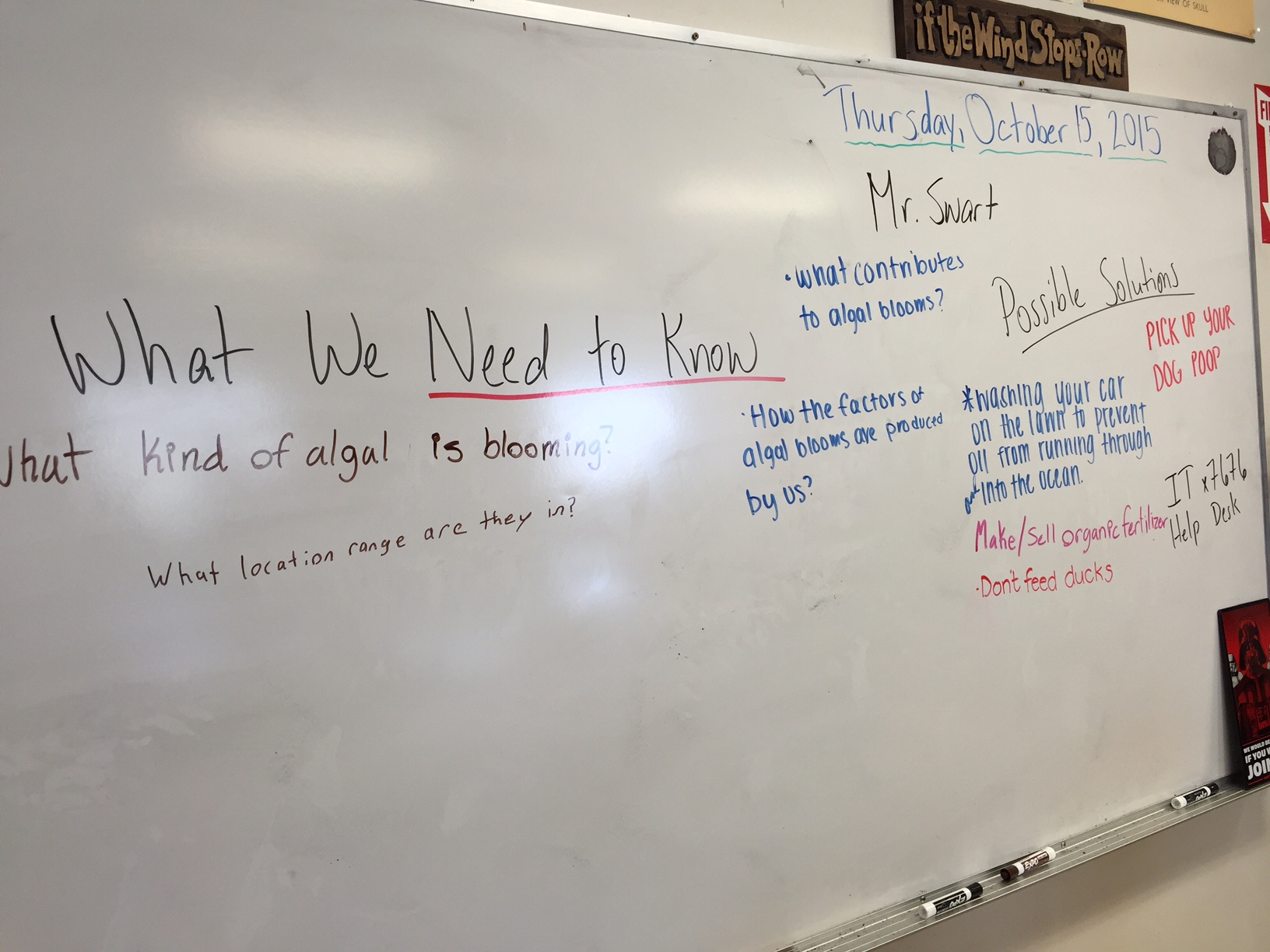
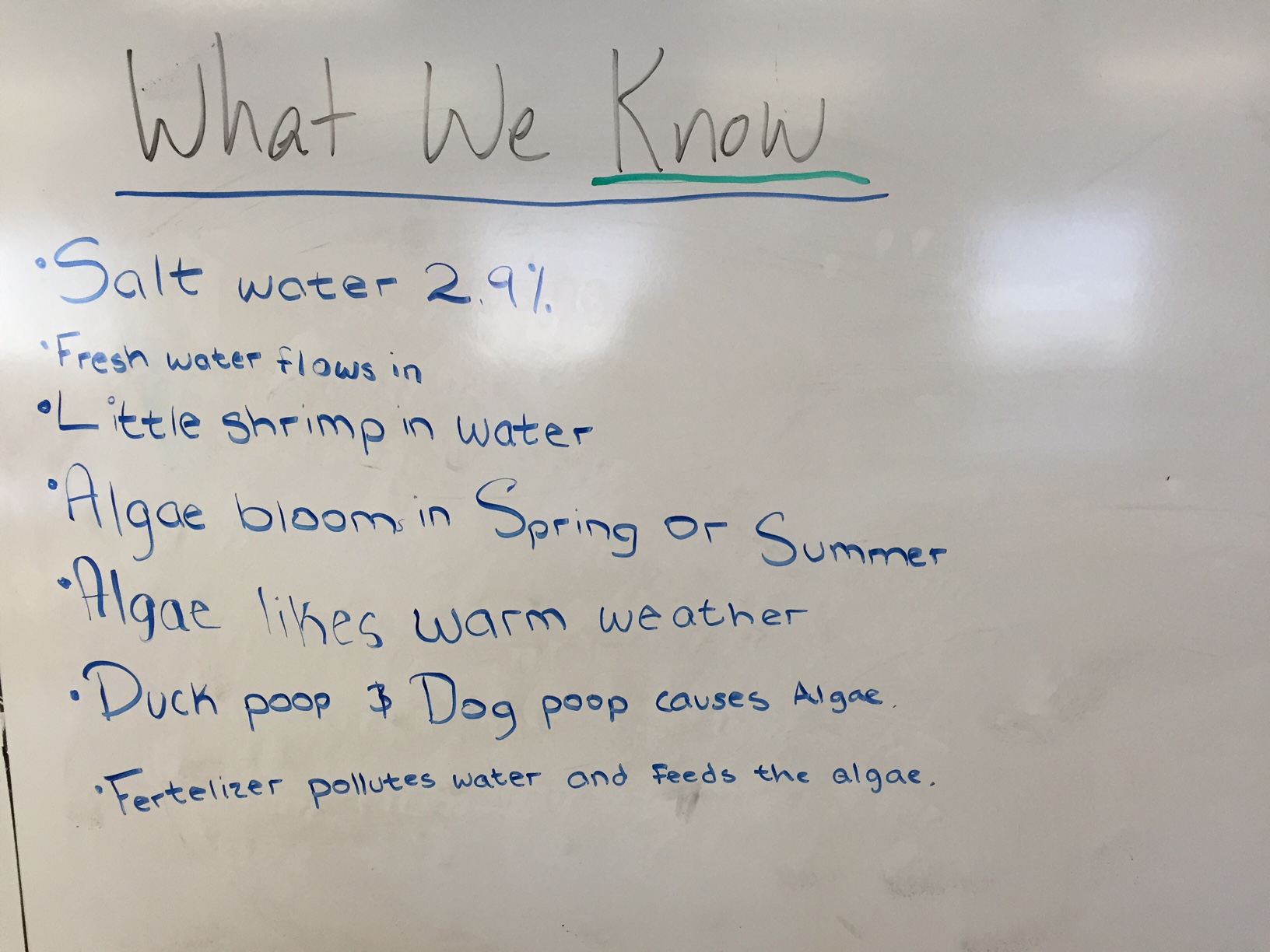
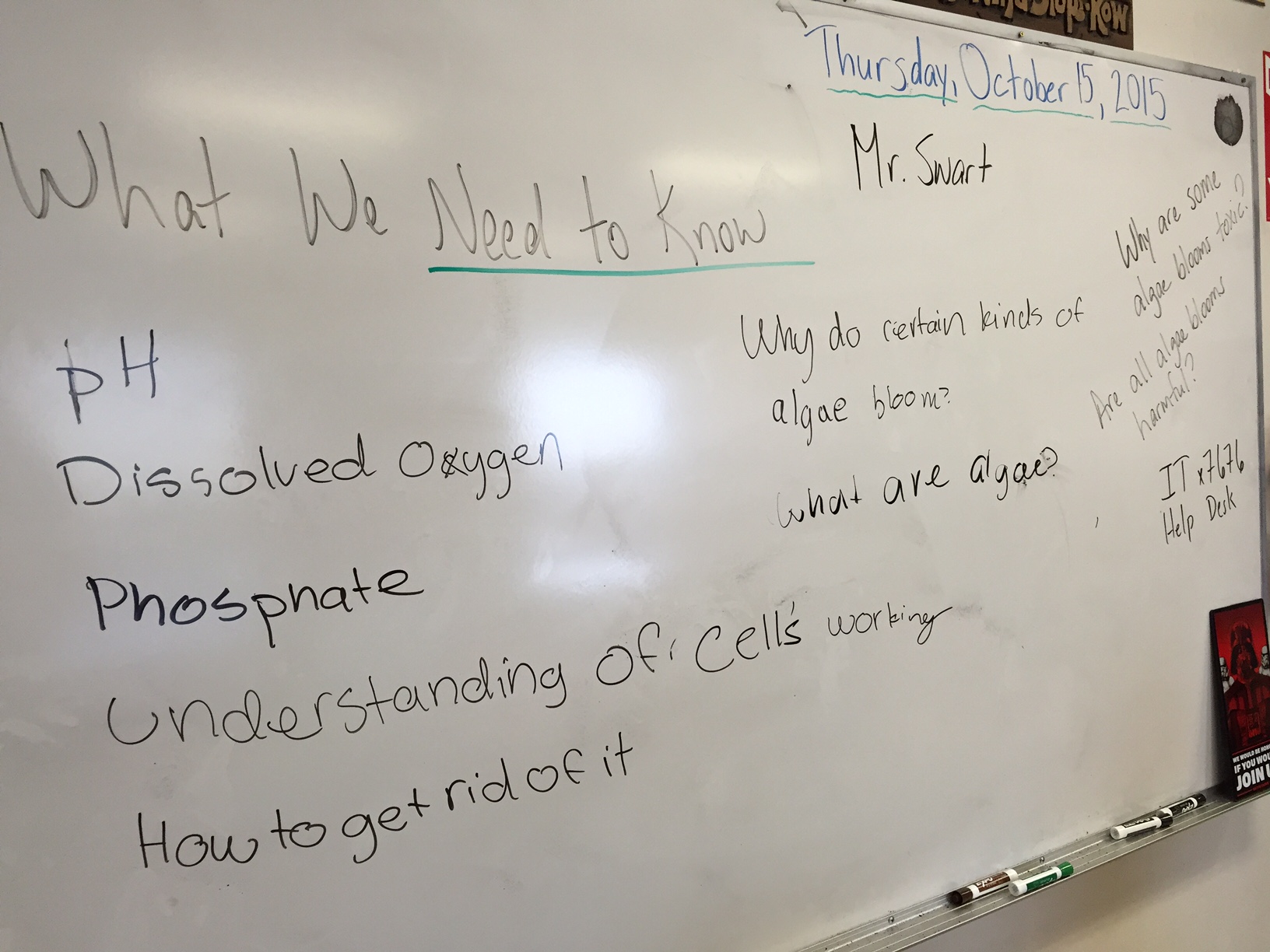
We began class with a pre-assessment of student prior knowledge of the learning targets encompassed by the final segment of our unit on cells and homeostasis. Next we launched the Seahurst Park PBL (problem-based learning) with a PowerPoint depicting a scenario familiar to students now that they have recently visited Seahurst Park and learned about harmful algal blooms locally in Puget Sound, as well as on a much larger scale off the West Coast (from Tuesday’s reading assignment). We concluded the class period with students taking the lead in creating the Know/Need to Know chart on the white boards at the front of the classroom. Student work is shown below, grouped by class period (click to enlarge).



Cells & Homeostasis: West Coast Toxic Algal Bloom
Many thanks to Mr. Stark for filling in as my substitute today. I spent the day in Shoreline for professional development as part of my Washington Alliance for Better Schools (WABS) STEM teacher externship program. In class today, students were scheduled to share their field trip experience with Mr. Stark, after which they were to receive an article to read along with a worksheet with questions about the reading and the field trip. This past June, the Seattle Times published the article Toxic algae bloom might be largest ever (or download the PDF), providing students with background content for the final phase of our unit. The worksheet of questions about the reading can be downloaded here.
Cells & Homeostasis: Extreme Environments
Today’s lesson focused on bridging student learning about extremophiles and our field trip set for this coming Monday. We set our sights on defining “extreme environments”, learning about what makes an environment extreme and also about how some organisms are specially adapted to live in such environments. The PowerPoint introduced students to the concept of a Bell-Shaped Curve, challenged them to articulate their own ideas about what constitutes extreme, and then provided an opportunity for discussion around how statisticians define “normal” and whether our own perspective about whether something is extreme necessarily involves judging an individual who looks or acts extreme. We concluded the lesson after slide 26 and will complete the slide deck tomorrow.
Cells & Homeostasis: Cell Membrane Function Quiz
As promised, students were quizzed on their understanding of the content we covered on Monday’s lesson on Membrane Function. Specifically, students needed to apply their learning of several key vocabulary terms to an example of a plant in a solution analogous to an egg in corn syrup. Because the quiz was content-rich, students were allowed to use their written notes, as well as their phones to access the PowerPoint from Monday’s lesson. As we progress into the year, supports like using notes on quizzes will be removed, with students having to improve study habits in order to commit content to memory.
Cells & Homeostasis: Egg Lab Report – Day 3
Today marked the final day of time available in class for students to write their Egg Lab reports. Reports are due to me by the end of the day Saturday, and the best way to get the report to me is for students to “share” the report via Google Docs. Students who finished early were encouraged to download the class data set (posted yesterday as an Excel spreadsheet file) and compare their individual egg lab results with those of the students in my other classes who used similar conditions. The data also enabled students who tested their egg in complex “mixtures” (three or more solutions) to see how each solution affected the egg individually, providing a context for analyzing their own results.
To prepare for tomorrow’s quiz, students should study the lesson from Monday on Membrane Function.
Cells & Homeostasis: Egg Lab Report – Day 2
Students continued the process of writing up their egg lab reports using the school Chromebooks. Notes from the white board are pictured below. Students will have one last day to use the Chromebooks tomorrow. Students who finish early should “share” their report, written in Google Docs, with me. In return, I will share access to the student egg lab data from all four of my biology classes (open in Google Sheets). Students should analyze the data for trends, patterns, and consistency, using the spreadsheet to organize the data and calculate average mass from similar experimental conditions. Want to see our class results? An Excel spreadsheet containing annonymized student data can be downloaded here.

 Science with Swart
You must be logged in to post a comment.