Category Archives: Ecosystems

Cells & Homeostasis: PBL Research – Day 2

For our second day of project work, student groups were tasked with identifying a primary stakeholder and then actually drafting an email to the stakeholder.  The pictures below show the instructions provided to students in identifying an appropriate primary stakeholder and in crafting the email to the stakeholder.  Students reached out to a wide variety of stakeholders throughout the day, including local marine scientists, restaurant owners, community groups interested in the environment, local government officials, and elementary school teachers.  Student groups were then tasked with coming up with at least three different project ideas which both meet the goal of the mission and meet the needs and interests of the primary stakeholder.  Students continued to document their collaborative work in the shared Google Doc.

IMG_0071IMG_0070

Cells & Homeostasis: PBL Research – Day 1

Today marked the beginning of our project team work investigating the problem of reducing the frequency of harmful algal blooms (HABs) in Puget Sound.  Students used their responses from the Seahurst Park pre-assessment worksheet from last Thursday to assemble into groups (questions 4 and 5).  Student groups then worked together to create a single shared Google Doc per group, with each student working in the group having their own Chromebook for simultaneous editing.  We concluded with groups creating a list of stakeholders and then selecting one to be the audience for their presentation.

At the start of class, I pointed out the HS-LS2-7 code written at the top of the pre-assessment.  Students learned about the Next Generation Science Standards and were also reminded of the Washington State high school credit requirements for upcoming graduation classes.

Cells & Homeostasis: Intro to Seahurst Park PBL

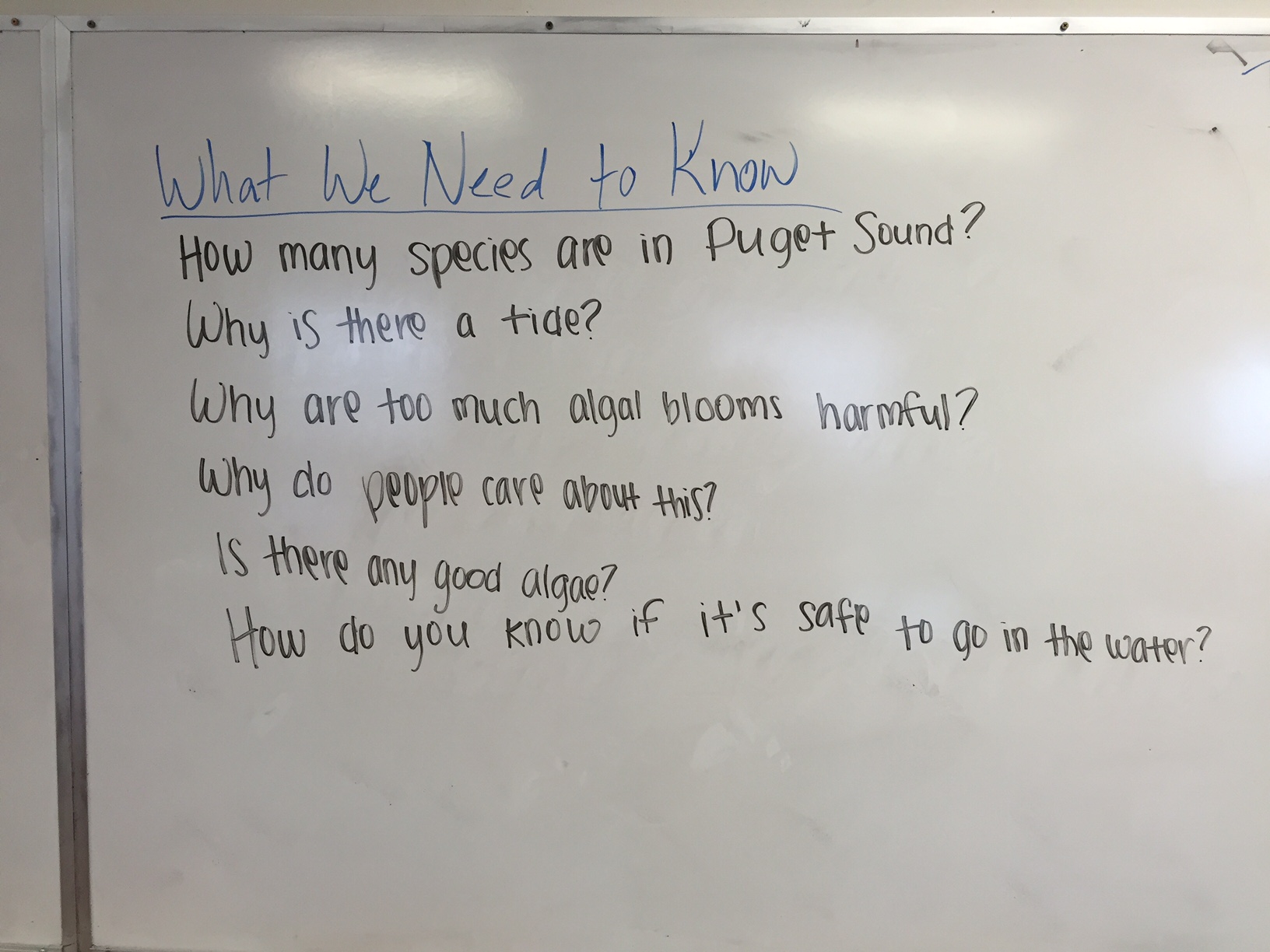
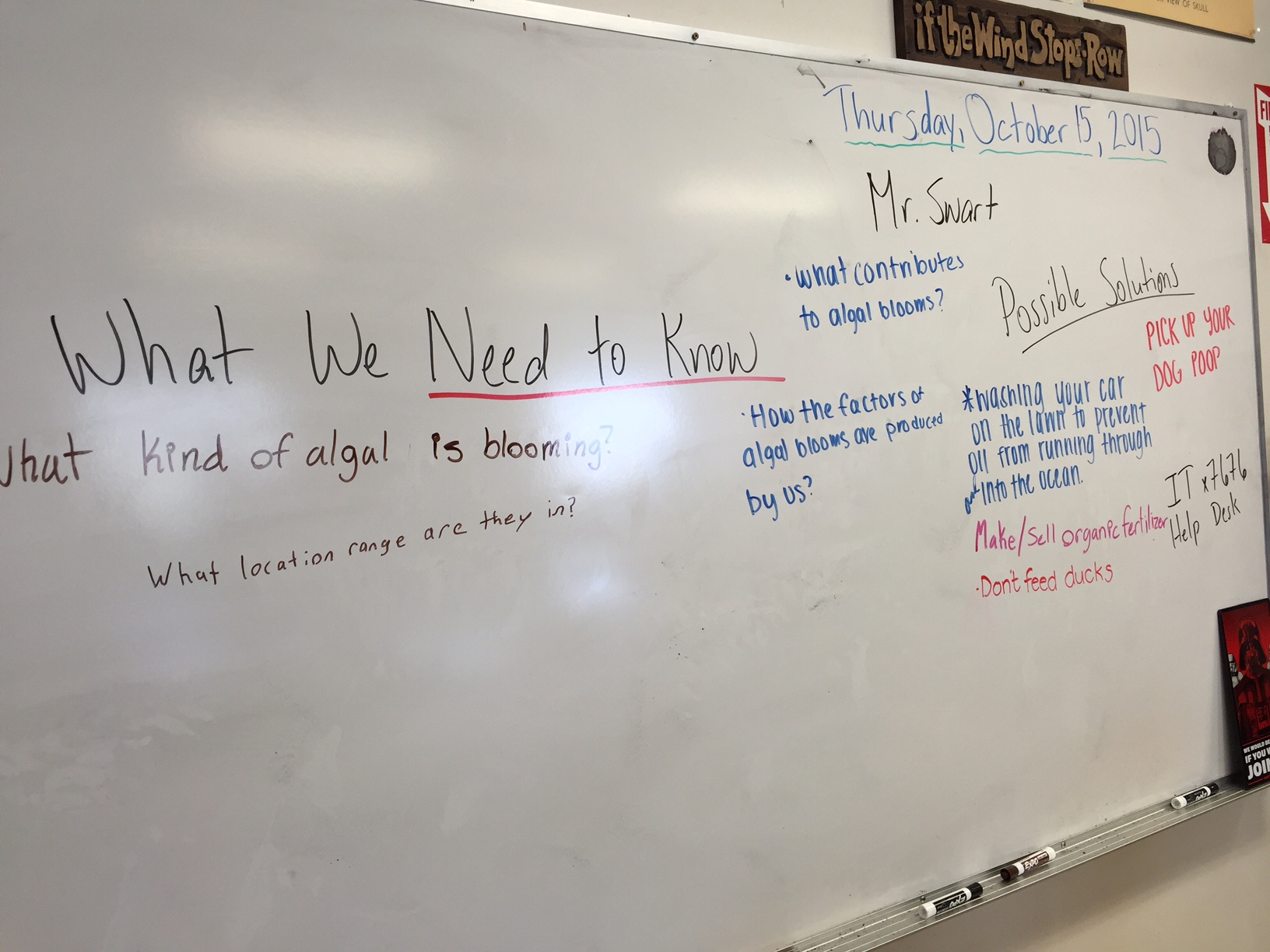
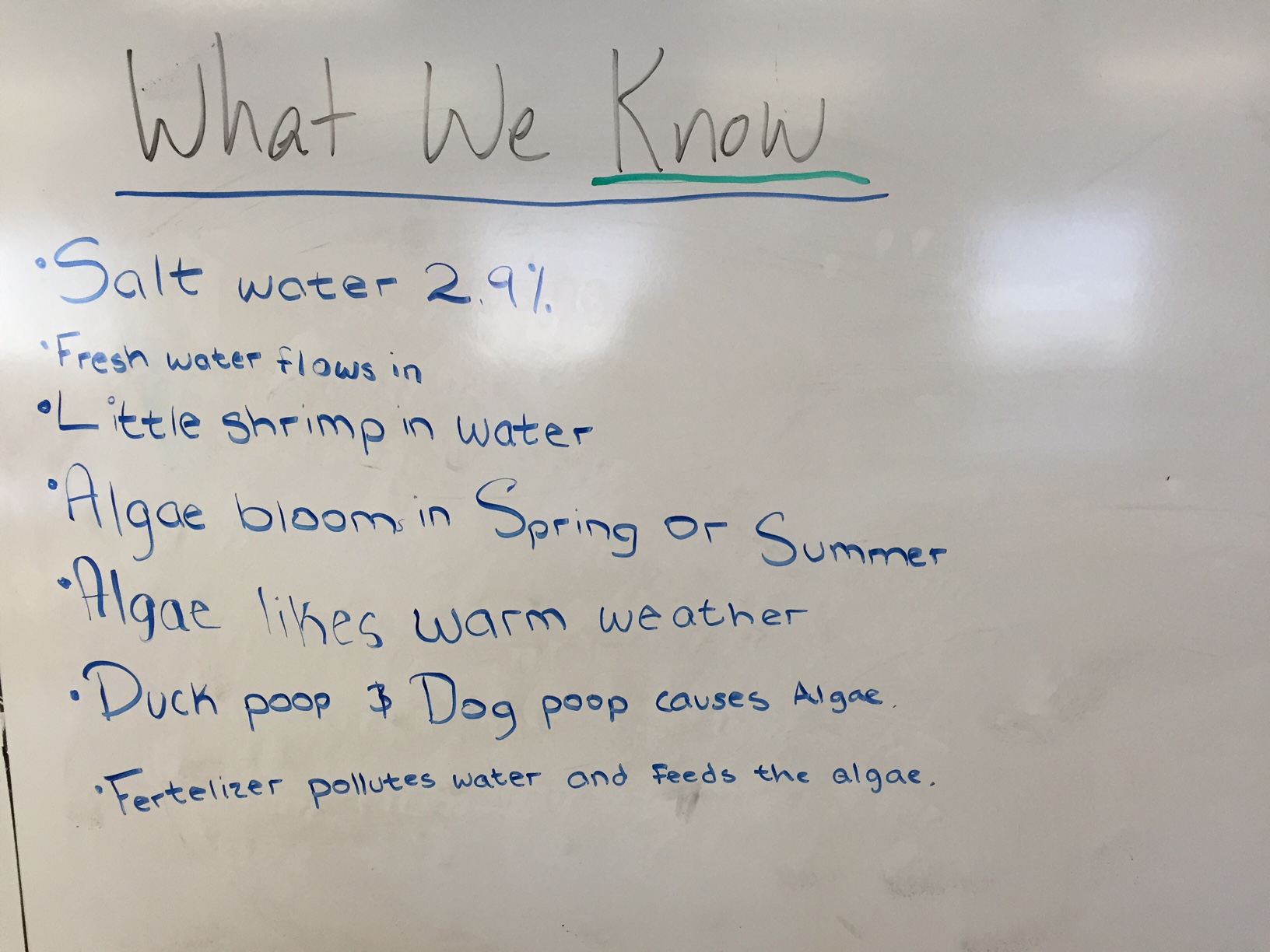
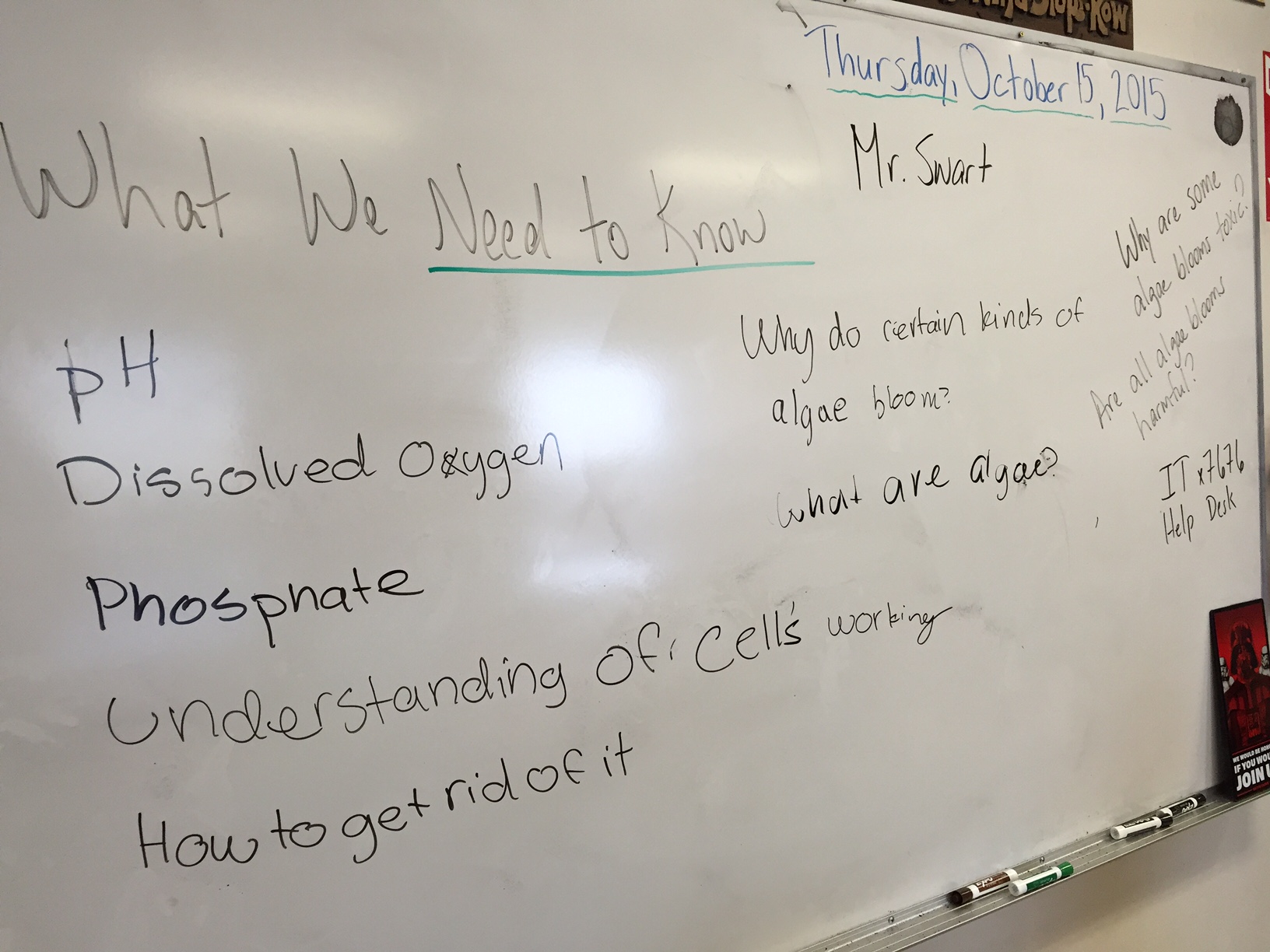
We began class with a pre-assessment of student prior knowledge of the learning targets encompassed by the final segment of our unit on cells and homeostasis.  Next we launched the Seahurst Park PBL (problem-based learning) with a PowerPoint depicting a scenario familiar to students now that they have recently visited Seahurst Park and learned about harmful algal blooms locally in Puget Sound, as well as on a much larger scale off the West Coast (from Tuesday’s reading assignment).  We concluded the class period with students taking the lead in creating the Know/Need to Know chart on the white boards at the front of the classroom.  Student work is shown below, grouped by class period (click to enlarge).

Period 2 - Know
Period 2 – Know
Period 2 - Need To Know
Period 2 – Need To Know
Period 3 - Need To Know
Period 3 – Need To Know
Period 3 - Know
Period 3 – Know
Period 4 - Know
Period 4 – Know
Period 4 - Need To Know
Period 4 – Need To Know
Period 5 - Know
Period 5 – Know
Period 5 - Need To Know
Period 5 – Need To Know

Cells & Homeostasis: West Coast Toxic Algal Bloom

Many thanks to Mr. Stark for filling in as my substitute today.  I spent the day in Shoreline for professional development as part of my Washington Alliance for Better Schools (WABS) STEM teacher externship program.  In class today, students were scheduled to share their field trip experience with Mr. Stark, after which they were to receive an article to read along with a worksheet with questions about the reading and the field trip.  This past June, the Seattle Times published the article Toxic algae bloom might be largest ever (or download the PDF), providing students with background content for the final phase of our unit.  The worksheet of questions about the reading can be downloaded here.

Cells & Homeostasis: Seahurst Park Field Trip

Today was the big Seahurst Park field trip.  Over 100 students and 12 adult chaperones traveled by bus down to the park where we met our hosts from the Environmental Science Center (ESC).  ESC staff guided groups of students through six stations, with students spending a half-hour per station.

Watersheds (with Joanna): Students used a physical model of a city to learn how buildings, vehicles, pets, and other sources all contribute to the accumulation of pollution in Puget Sound.  Students each shared one way they would personally help reduce their own impact on the environment.
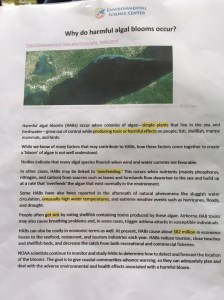
IMG_0017Water Quality Testing (with Jennifer): Students first read a brief article highlighting why harmful algae blooms occur (below).  Students then measured a variety of factors related to water quality by sampling water sources from around the park.  Students worked in groups, with each rotation measuring one of the following: dissolved oxygen, phosphate, nitrate, pH, and turbitidy.  Students compiled the data into mini lab reports, sharing out their findings with each other and then analyzing it through graphing and writing a brief conclusion.

Plankton Tow (with Kelly): Students collected samples of Puget Sound plankton using a plankton tow.  Samples were collected into cups for analysis during the Plankton Lab.
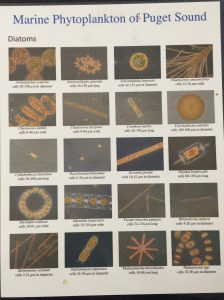
IMG_0014IMG_0015Plankton Lab (with Jarett): Before using the microscopes to see the plankton in their Plankton Tow samples, students watched two brief videos to help them better understand the scale and consequences of harmful algae blooms (HABs).  The first video, “Toxic algae blooms contaminate U.S. drinking water,” explains the impact of HABs on marine life, the fishing industry, and consumers.  The second video, “Toxic Algae Bloom Causing Seizures in Sea Lions,” shows the neurotoxic effect of the algae toxin domoic acid on a sea lion found on the Washington coast.  Students then viewed their own plankton under a microscope.  Identification cards created by the Washington Sea Grant were used to identify species of plankton observed by students.  Specifically, the Marine Zooplankton of Puget Sound card and the Marine Phytoplankton of Puget Sound card (pictured below) were provided.

Recycling (with Megan): Students learned all about how various types of common household waste can be separated into recycling, food waste, and garbage.  The CleanScapes Recology community education program emphasized the importance of properly disposing of the various types of waste, with a focus on the types of waste often generated by teenagers.

Bioaccumulation Game (with Brendan): Poker chips, bags, arm bands, a few bright orange vests, and an energetic group of students was all it took to bring to life the concept of bioaccumulation.  The game began with more than half the students (representing small fish preyed upon by salmon) scrambling around for 30 seconds to fill bags with poker chips (plankton) that had been scattered around in the grass.  Next, the salmon were released, represented by students wearing bright green arm bands.  When a “salmon” touched a smaller fish, the smaller fish gave the salmon their poker chips, representing a transfer of energy.  After another 30 seconds, the orca entered the game (two students wearing bright orange vests) and devoured most of the salmon who then turned over their poker chips to the orca.  When the game ended, the two orca had most of the poker chips.  Students were then pushed to consider what might happen to the orca if a biotoxin were present in the environment and was being consumed by species lower toward the base of the food chain.

This was such a fantastic opportunity for students to visit a beautiful local park, interact with the talented and dedicated ESC staff, and spend the day bonding with peers and staff from our school, our district central office, and our community.  There are an enormous number of people to thank for making today a success, and my students will be recognizing all of the behind-the-scenes people in the coming days.

Looking ahead, we will use our experience today as the basis for the final part of our first unit.  As students make sense of what they learned and begin to take ownership of their own power to protect our local environment, they will be challenged to publicly share their learning.  Stay tuned!

Mitosis: Biology EOC practice exam

Students had the entire class period today to take a Biology EOC practice exam.  Please review yesterday’s post for additional details. Students received 50 points for demonstrating solid and sustained effort throughout the exam.  The following information was displayed on the overhead throughout the class period:

  1. This is a practice exam
  2. Treat it exactly like the real exam:
    1. No talking
    2. No other resources (notes, phone, people, etc)
    3. Be respectful of all others in the room
  3. Do your best
  4. You receive credit for solid and sustained effort
  5. Finish early?
    1. Complete Chromosome Presentation
    2. Extra credit reading under back window

Cells and Homeostasis: GSL Case Study

We kicked off our first big lesson of the unit with a case study of the Great Salt Lake.  Back in the 1950s, a causeway was built across the Great Salt Lake, phyiscally separating the lake into two arms (the North and South Arms).  As a result, the ecosystem of the North Arm of the lake is quite different from the South Arm.  In the case study, students learned how various biotic and abiotic factors contribute to the appearance of the lake.  Within the case study, the concept of osmosis is presented, and students were assigned as homework to find the biology definitions for osmosis, diffusion, and active transport.  Students turned in the case study worksheet at the end of class.

Tomorrow, students will apply their understanding of the causeway, and the vocabulary words they learned as homework, to work in groups to devise a solution to the ecological changes caused by the causeway.  I will be in a meeting during periods 1-3, and students should work efficiently with their extreme environment groups to complete the work.

Systems Biology – Lesson 11

In this lesson, students were challenged to think outside the box.  With Odyssey sophomore and senior student defenses in full swing, students have been practicing the art of reflection.  As we transition from the study of ecosystems to the study of human body systems, we briefly returned to our study of financial ecosystems (lesson 3).  Students were introduced to the idea that our existing financial system is limited when it comes to integrating the value of natural resources.  We watched economist Pavan Sukhdev’s TED Talk “Putting a value on nature” where he explains the economic tools he uses to integrate natural resource valuations into his economic models.

We then transitioned to a discussion of cryptocurrencies as an alternative to traditional fiat currency.  I shared the final tally of the various eco-themed cryptocurrencies donated by generous members of the public in support of my biology students.  Students had previous elected to consolidate our crypto holdings into dogecoins, and I shared the news that each student could elect to receive either 5,650 dogecoins (currently valued at just under $3), $3 cash, or a free yearbook valued at $7.  About half of the students elected to receive their share of donated cryptocurrency, and I encouraged them to visit the Getting Started page.  Some students elected to set up accounts through Cryptsy, while others chose to receive their coins via the @tipdoge feature on Twitter.  Several students asked how they could spend their cryptocurrencies, so I explained that many retailers accept various currencies, including my good friend Bo Saxbe, operator of the Cheese Wizards sandwich truck.  A local news station recently profiled Cheese Wizards as part of a larger story about the first Bitcoin ATM to arrive in Seattle.  The cryptocurrency ecosystem is rapidly evolving, and it will be exciting to observe whether cryptocurrency will take hold and find a niche in the modern economy, or whether it will go extinct.


Systems Biology – Lesson 10

In lesson 10, we continued with our study of osmosis, focusing on the extreme environment of the Great Salt Lake.  Students learned that a railroad causeway was built across the lake more than 60 years ago, physically separating the lake into two sides.  Only the south side of the lake receives a continuous supply of freshwater, causing the salinity of the south side to be much lower than the north side.  As a result, the ecosystem of the south side of the lake is much more robust than the north side which is inhabited primarily be halobacteria.  Considered extremophiles because of their unique ability to live in extremely salty water, halobacteria are present in such abundance that they color the water in the north side of the lake purple (because of the rhodopsin protein they produce).  As evidence of their learning, students completed a case study worksheet and hypothesized what might happen to the existing Great Salt Lake ecosystem if the causeway were removed.

Systems Biology – Lesson 9

In lesson 9, our first lesson of the week, we circled back to osmosis, a concept students learned about early in the school year.  We connected the theme of “Water Follows Salt” with the reality that cell membranes contain pores and channels that regulate the flow of everything across the cell membrane.  We discussed the vocabulary of osmosis in the context of blood, recognizing that blood cells in plasma (isotonic) behave much differently than blood cells in water (hypotonic) or in saltwater (hypertonic).  We then thought about how salmon might be able to transition from freshwater to saltwater during their life cycle.  By connecting pore protein expression (via the Central Dogma) with evolution, students now have the foundation necessary to explain how salmon can hatch from an egg fertilized in a freshwater stream, migrate through the brackish waters of an estuary out into the Puget Sound, travel for years in the salty Pacific Ocean, and eventually find their way back to the steam from which they were born to complete their life cycle.   We wrapped up with a video about ice cave exploration, in which the concept of extremophiles was presented.  Students then transitioned to Work Time where they read an article and answered questions about extremophiles.