Category Archives: Chemistry

Matter, Atomic Structure, and Bonding: Flame Tests

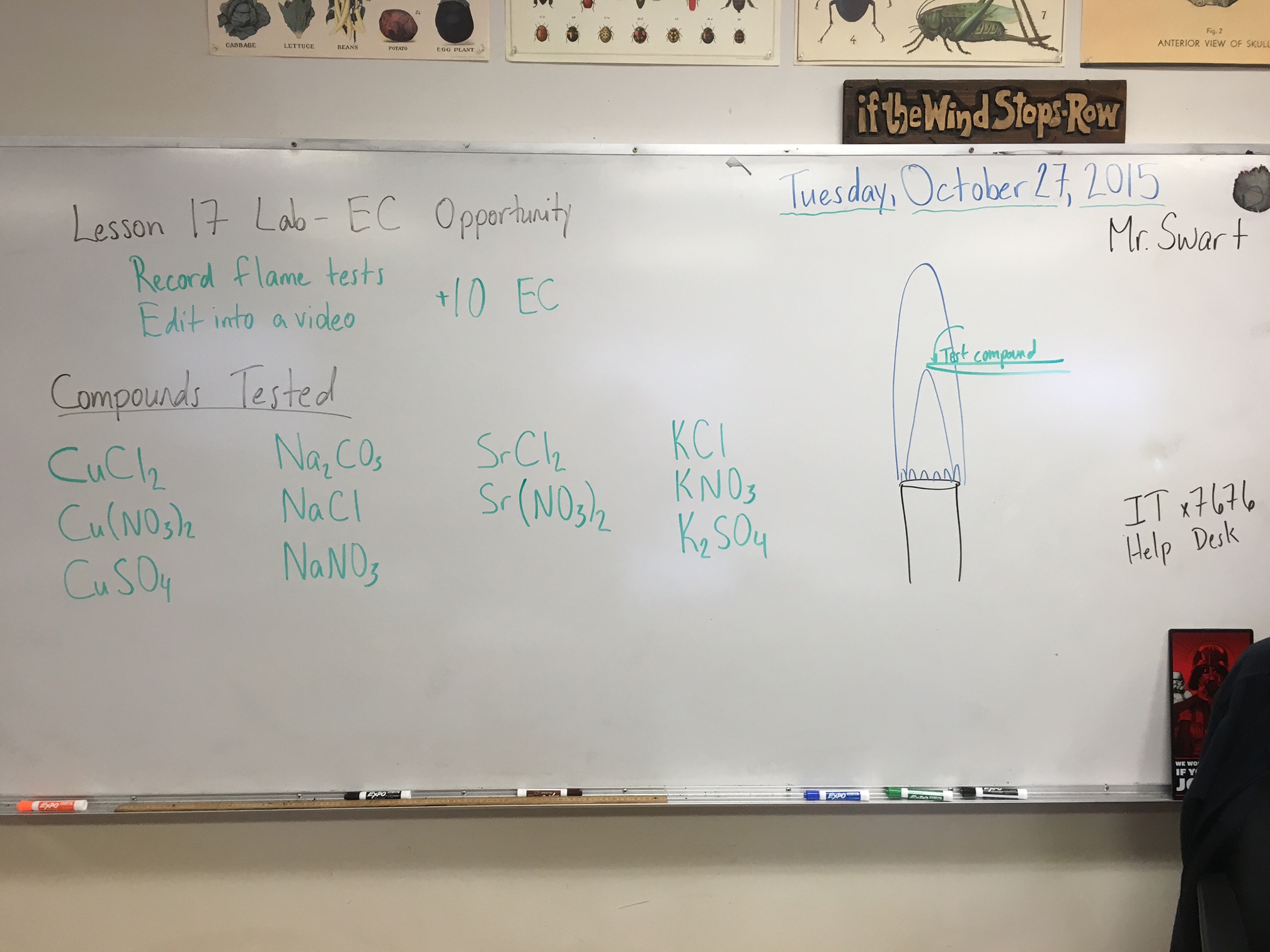
We began Chapter 4 with the Flame Test lab.  We reviewed the safety requirements and lab mechanics.  There were stations set up around the room with portable Bunsen burners, chemicals to burn, and equipment to conduct the flame test.  Students recorded their results as described on the Lesson 17 Worksheet.  Students were also offered 10 points of extra credit for taking video of the flame tests and editing them together into a video.  Students also received a print-out of the electron structure of a sodium atom, showing what happens when the outer shell electron of sodium is excited.  The lab took most of the class period, so we will discuss results tomorrow.  Students should complete as much of the Lesson 17 worksheet as possible, read Lesson 17 in the textbook, and answer questions 1 and 2 in the textbook.
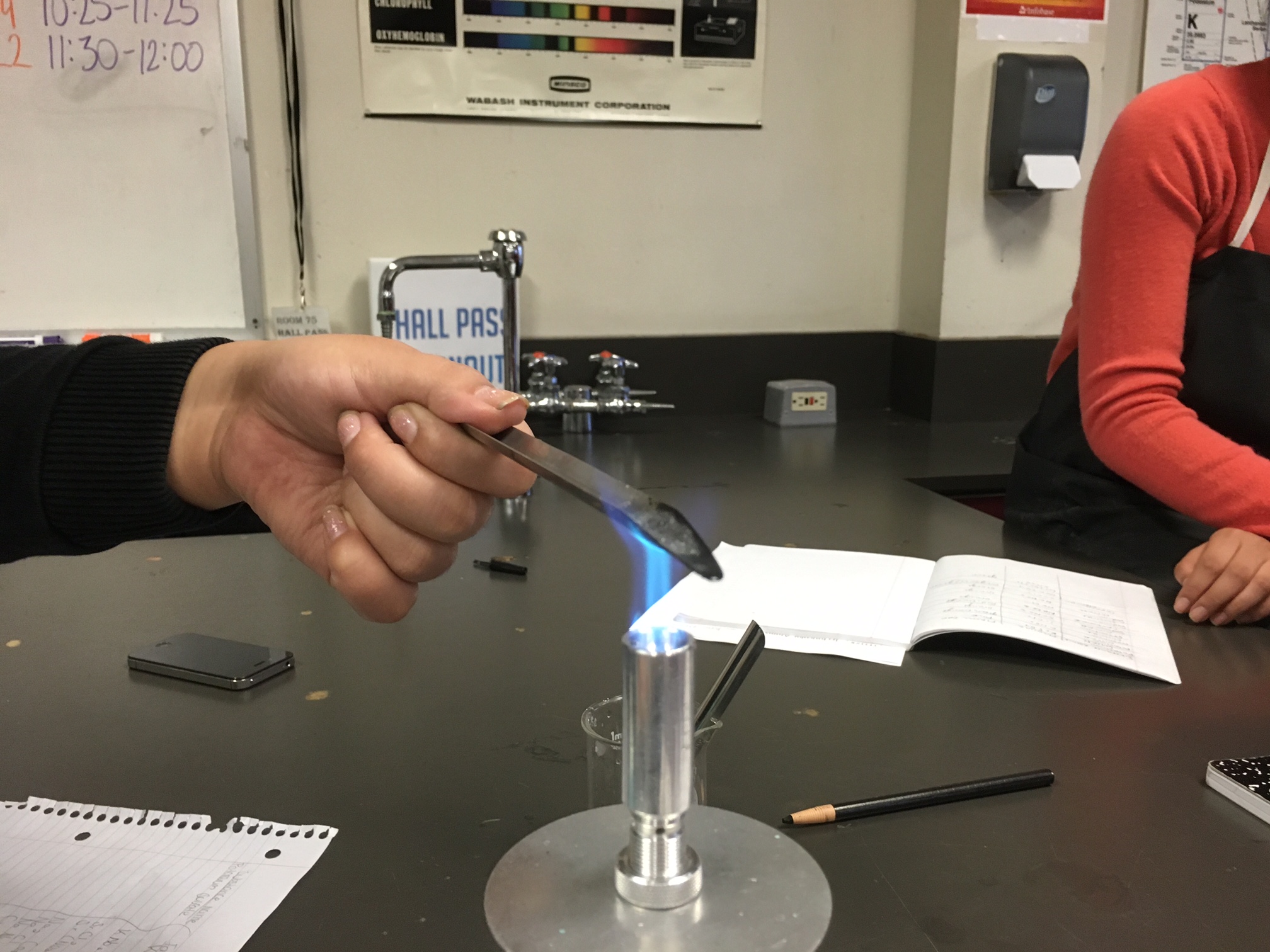
Conducting the flame test
IMG_0078
Flame Test lab safety equipment
IMG_0079
Compounds tested

Matter, Atomic Structure, and Bonding: Chapter 3 Quiz

Chapter 3 came to a close today with a quiz.  This marked the first time students were assessed with a chapter quiz without having previously seen an alternate version of the quiz.  The results varied widely, with a top score of 19/20, a low score of 4/20, and an average of 11/20. The results indicate some re-teaching may be necessary in addition to a renewed commitment by students to maintain the high level of study habits required for success in chemistry class.  It may also indicate the extended length of the current chapter made it challenging for students to maintain the focus needed to maintain content mastery.  We will discuss as a class on Monday.

Matter, Atomic Structure, and Bonding: Formation of Elements

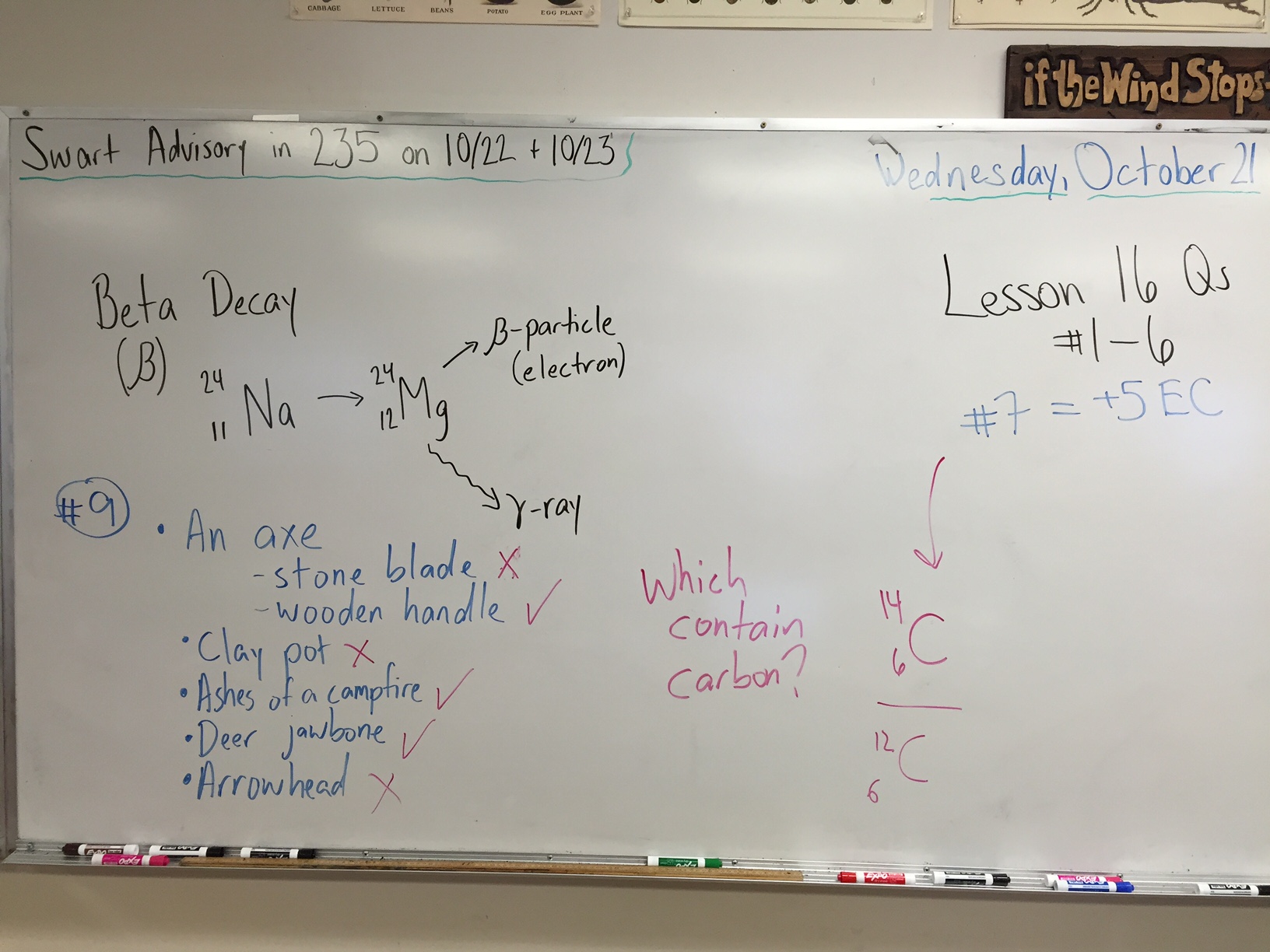
Before introducing the final lesson in Chapter 3 explains how elements are formed (through alpha and beta decay (fission) of through fusion), we reviewed student questions about Lesson 15 (pictured below):

IMG_0073IMG_0072

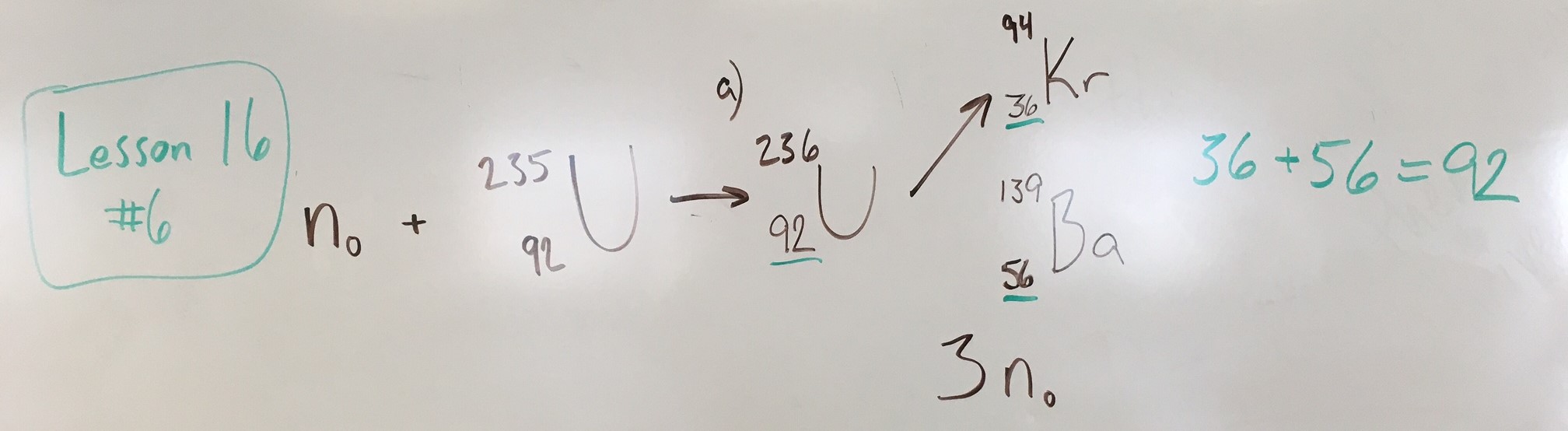
For Lesson 16, we looked through the PowerPoint and then students used the last 20 minutes of class to work on the Lesson 16 Worksheet.  Students should also complete questions 1-6 from the textbook.

IMG_0074

Matter, Atomic Structure, and Bonding: Nuclear Reactions

We continued our exploration of how the nucleus of an atom can change by launching into Lesson 15.  The lesson revolves around the Nuclear Quest board game where students learn how new elements are created.  Before launching into the game, students elected to review the Lesson 15 PowerPoint in order to better understand the key concepts and vocabulary from the textbook reading they were assigned over the weekend.  Students then had time to cut out the various game pieces (the board, the three sheets of nuclear quest cards, the two sheets of radiation cards) and look over the game instructions as preparation for playing the game and completing the Lesson 15 worksheet tomorrow.  For homework Tuesday, students should complete the Lesson 15 worksheet, Lesson 15 textbook questions (#4-12), and read Lesson 16 in the textbook.

For more information on radioactive decay, visit the Bodner Group’s website out of Purdue University.  Additional video tutorials for chemistry topics of study are available for free on Khan Academy (along with a vast range of other subjects).  Can’t get enough of the Periodic Table?  Enjoyed watching Theodore Gray on the Hunting the Elements video (he was the guy with the huge wooden periodic table who also reacted sodium and chloride to salt popcorn) – visit his interactive Periodic Table website to further explore the elements and see how they are used in the real world.

Matter, Atomic Structure, and Bonding: Writing to Explain Prompt 1

To support our school’s goal of improving the ability of students to use writing to explain, the science department gave the first of three “writing to explain” science prompts this school year.  This first writing prompt serves as a baseline, with the next two prompts designed to assess growth in student ability to use writing to explain science.  Although students had the entire class period to respond to the prompt, students who finished early had the remainder of the class period to complete unfinished work.

Matter, Atomic Structure, and Bonding: Stable and Radioactive Isotopes

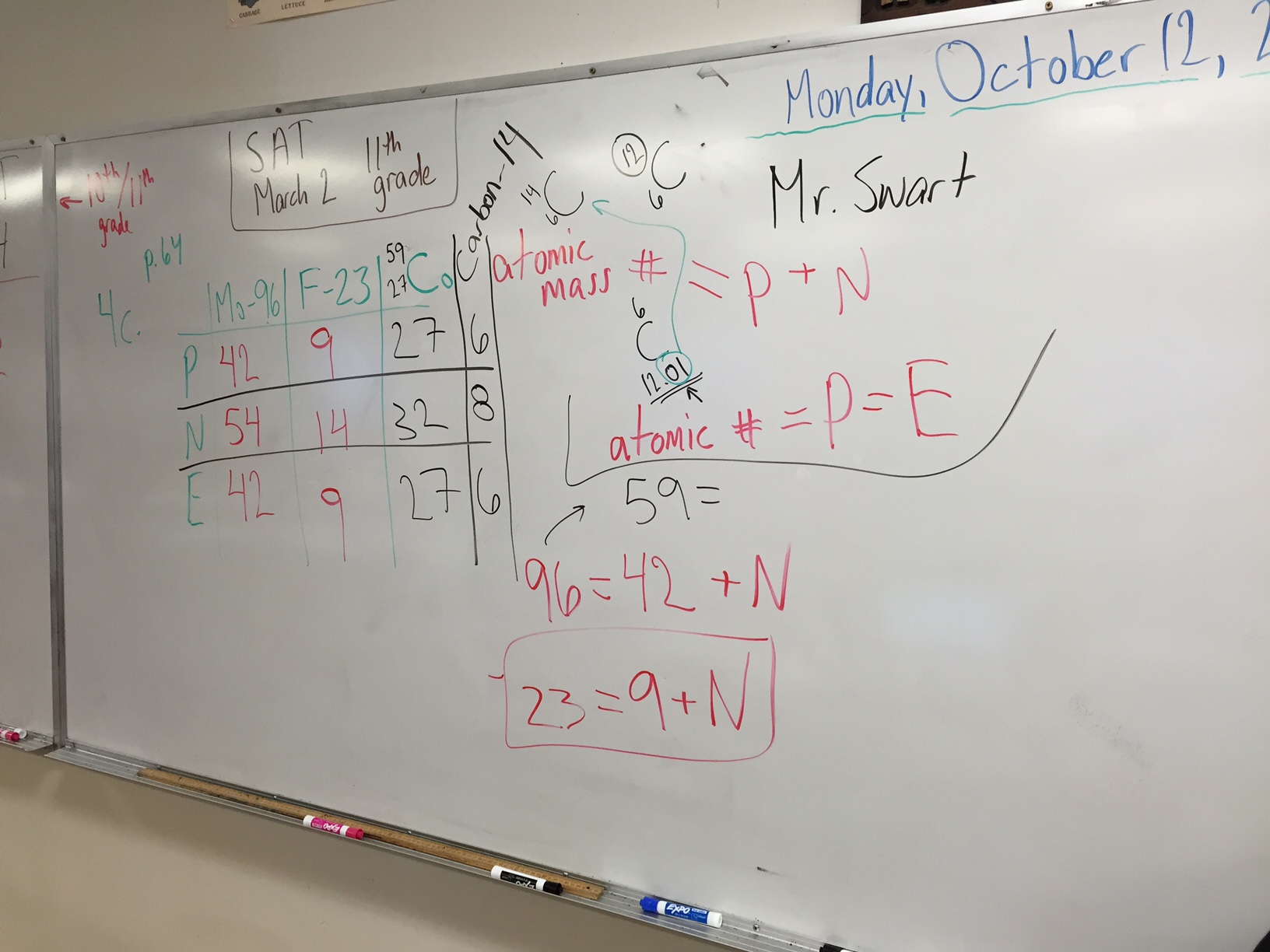
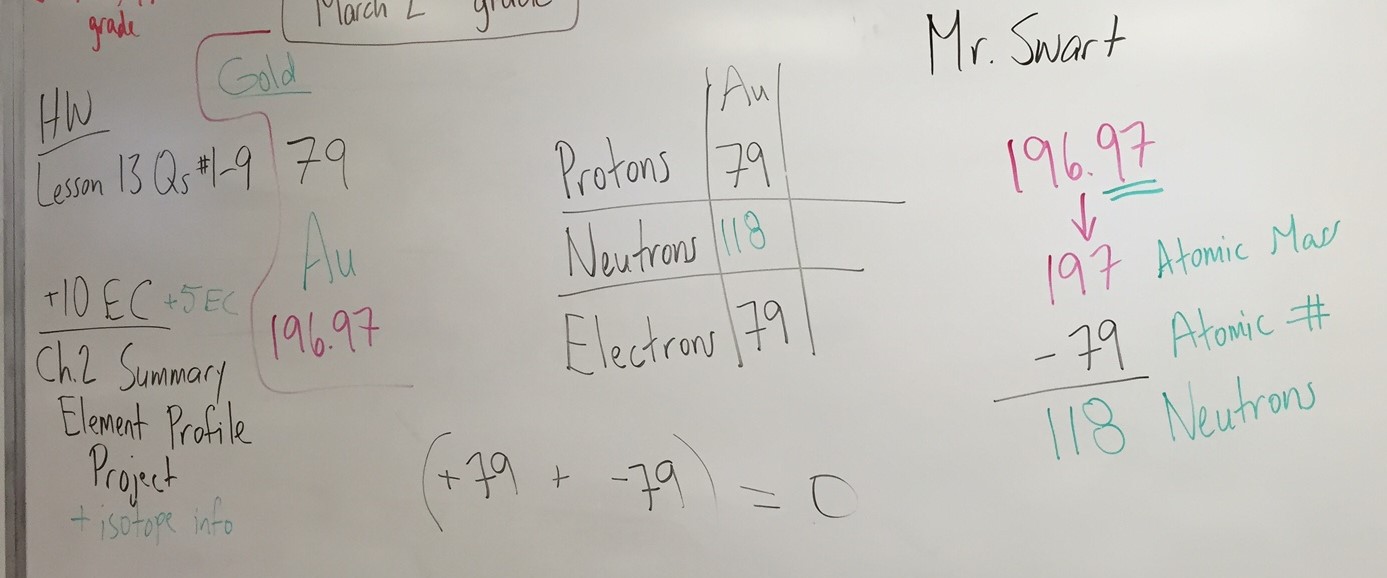
After the long weekend, we spent a majority of the class period reviewing Lesson 13.  Students had a lot of great questions focusing on how to calculate the number of protons and neutrons in a given atom, how to wrote isotopes, and how to calculate the average atomic mass of an element given the frequency of naturally occurring isotopes.  Pictures from the white board are shown below.  At the end of class, students received copies of the Lesson 14 Worksheet and the Chart of Naturally Occurring Isotopes.  Tomorrow, students will review the Lesson 14 PowerPoint, taking careful notes on slides 7-9 before working together to complete the worksheet and textbook questions 1-14.  Email me with any questions.

IMG_0011

IMG_0018

Updates: Students had a substitute on Tuesday (10/13) and then took the PSAT yesterday (10/14).  Today, we watched the final segments of Hunting the Elements (from 1:26:00 to the finish) to refresh student learning about neutrons and isotopes.  After the video, we worked through a few questions from the Lesson 14 worksheet and from the textbook.  Tomorrow (Friday) students will participate in a “write to explain” baseline assessment to support the science department’s goal of assessing how well our science students are able to clearly write scientific explanations so that we can work to improve their writing in that area.

Matter, Atomic Structure, and Bonding: Isotopes

We extended our learning about neutrons yesterday with an lesson about isotopes.  The Lesson 13 PowerPoint explains how certain elements like carbon always contain the same number of protons, but may contain different numbers of neutrons.  Students then practiced calculating the number of protons, neutrons, and electrons on the Lesson 13 Worksheet.  For homework, students should complete questions 1-9 at the end of Lesson 13 in the textbook.  For extra credit, students may earn 10 extra points by researching about one of the elements and compiling their research into an  Element Profile Project (see Chapter 2 Summary page in the textbook for instructions).  An additional 5 points may be earned by adding on a section explaining which isotopes of the selected element are naturally occurring, the proportion of each isotope, and the atomic structure of each isotope (the number of protons, neutrons, and electrons in each isotope).  If an isotope has a particular scientific use, that should also be included.  Remember, no school tomorrow.

IMG_0008

Matter, Atomic Structure, and Bonding: Atomic Number and Atomic Mass

We continued our study of the atom by learning about the relationship between atomic number and atomic mass.  Before launching into the Lesson 12 PowerPoint, we paused and reviewed student questions about the Lesson 11 Worksheet.  We focused primarily on questions 3 and 5 from the worksheet, with responses drawn on the white board (pictured below, with the answer for question 3 on the left side of the board and question 5 on the right).

IMG_0006

The questions nicely led into the Lesson 12 PowerPoint, after which students had the remainder of the class period to complete the Lesson 12 Worksheet.  Aside from reviewing Lesson 12 in the textbook and reading Lesson 13 in preparation for class tomorrow, there was no additional homework assigned for this evening.

Matter, Atomic Structure, and Bonding: Models of the Atom

Chapter 3 began with a historical study of models of the atom.  The Lesson 11 PowerPoint provides key vocabulary around the components of the atom (proton, electron, neutron, and nucleus).  To go along with the Lesson 11 Worksheet, students also received a handout explaining the five models of the atom.  Students also received a copy of the Periodic Table for reference.  For homework, students should complete questions 1-5 from the end of Lesson 11 in the textbook.