Category Archives: Central Dogma

Central Dogma: Strawberry DNA Lab Results

With the short class period, we briefly reviewed the science behind the strawberry DNA extraction solution by watching a segment of the video below (beginning at about the 3:00 mark):

Students then located their DNA samples from yesterday.  Although our microcentrifuge stopped working toward the end of 3rd period, students had the opportunity to observe their samples and use laboratory-grade micropipettes to transfer a small volume of their DNA samples to glass slides.  The samples were visualized using our class digital microscope connected to the projector for all to see.  Students in 2nd and 3rd period were able to compare findings after centrifuging their samples, while students in 4th and 5th periods had more time to prepare and observe samples under the microscope.  Notes from the whiteboard, as well as a selection of microscope pictures (some potentially showing several DNA strand clusters and others showing cellular debris with some possible DNA strand clusters), are shown below:
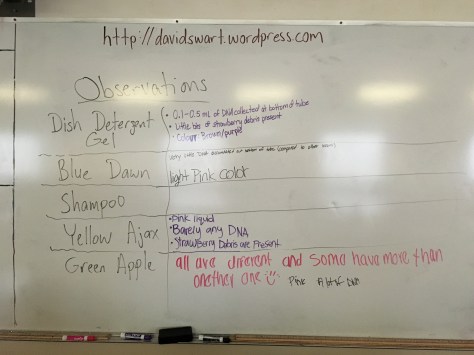
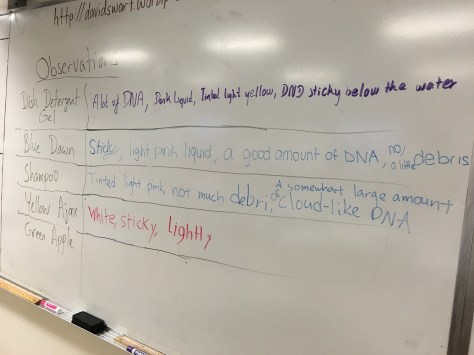
File_000
Second Period Observations
File_001
Third Period Observations


Central Dogma: Strawberry DNA Extraction Lab

With the Curriculum Fair resulting in shortened class periods, students worked incredibly efficiently in small groups to extract DNA from strawberries.  We modified the procedure written the day before such that groups of 4 students worked together to prepare 500 mL of extraction solution using one of the 5 available liquid soap products (450 mL water + 50 mL soap + 1 tsp salt).  Each student then extracted DNA from their strawberry and saved an aliquot of the extracted DNA in an Eppendorf tube labeled with the student’s initials which will be used in class tomorrow for further study and analysis.

Central Dogma: Strawberry DNA Lab Prep

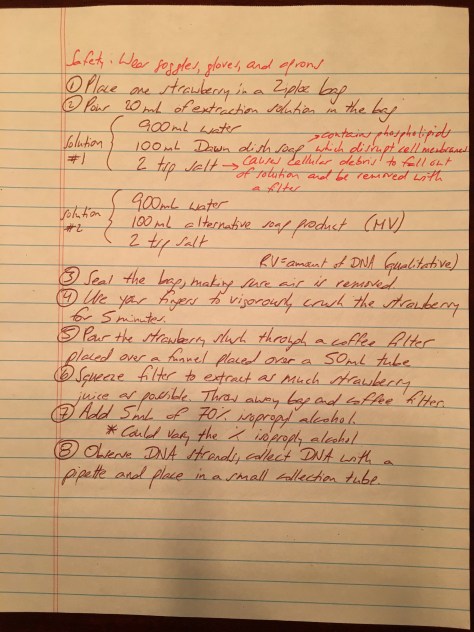
In our continued study of Central Dogma, we set our sites on extracting DNA from strawberries.  To prepare for the lab, students watched two videos explaining the DNA extraction procedure (both produced by the North Carolina Community Colleges group NCBioNetwork.org).  The first video, produced 5 years ago, provides students with a straight-forward approach to extracting DNA.  Students watched the video and wrote down as many details as they could.

After watching the video, we assembled one class procedure “crowd-sourced” from the all of the student notes. Missing from the original video are some of the details explaining how the reagents in the extraction solution actually work. NCBioNetwork recently reduced a newer version of the video, complete with dramatic effects and a really awful script. Because the content in the newer video added to student understanding, we elected to watch and then updated the class procedure after.

IMG_0540

At the end of the second video, students learned that human DNA varies by only 0.1% from person to person.  For the final segment of class, students watched a thought-provoking video about a scientist who has combined a variety of tools and technologies to turn DNA from hair into portraits using 3-D printing.

Central Dogma: The New Genetics – Chapter 1

With Mr. Frank substituting, students read chapter 1 of The New Genetics.  They were tasked with defining the vocabulary terms (the words in bold) and then answering the questions at the end of the chapter.  Students were instructed to turn in their work at the end of the class period.  Students who actively engaged in the assignment will receive participation credit, and students will have additional time in a future class period to complete the assignment as it will almost certainly take longer than the class period. For students with Internet access outside of school, the book is available to read online through the NIH’s National Institute of General Medical Sciences website.  Paper copies are available through the NIGMS website as well – for free!

Central Dogma: Molecular Bonds

We spent the first part of the class period learning about the properties of water.  Students reviewed the vocabulary of molecule and atom (as in, a molecule of water consists of two atoms of hydrogen and one atom of oxygen).  We discussed the difference between covalent bonds and hydrogen bonds, with students learning about electronegativity and partial positive and partial negative charges.  We then applied that learning to the study of DNA, with students learning how the DNA bases adenine and thymine align via hydrogen bonding, and similarly with guanine and cytosine.  Students then worked in pairs to build an A, T, C, or G molecule, and then found another group with the complementary base to visualize the hydrogen bonding sites.  Students then drew out their molecule pairs, labeling the vocabulary terms of molecule, atom, covalent bond, and hydrogen bond.  Pictures from the whiteboard are shown below.  Students wishing to review the structures can see the nucleotide pairs and hydrogen bonds by clicking here.

Central Dogma: Central Dogma

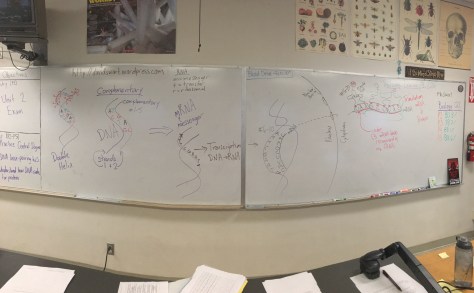
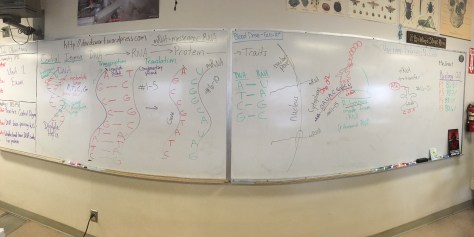
After wrapping up the discussion from the previous day’s lesson, we launched into an investigation of the process of Central Dogma.  Students learned how DNA codes for RNA which codes for protein.  We drew out the processes of transcription and translation, using a guided worksheet approach to help students understand what happens at each step of the process.  Whiteboard notes from two different classes are shown below:

IMG_0517
Notes from 2nd period
IMG_0518
Notes from 5th period

Updated: February 5, 2016

We completed the DNA base-pairing worksheet that we began yesterday.  We reviewed how DNA codes for RNA and RNA codes for protein.  We learned how RNA is read by ribosomes, with 3-base RNA sequences (codons) coding for specific amino acids.  Students were surprised to learn that that for many amino acids, there are more than one codons.  This was emphasized in questions 22 and 23 of the worksheet, where students learned to work backwards from a sequence of amino acids to figuring out one possible RNA sequence encoding that amino acid sequence, and finally figuring out the DNA sequence coding for the chosen RNA sequence.

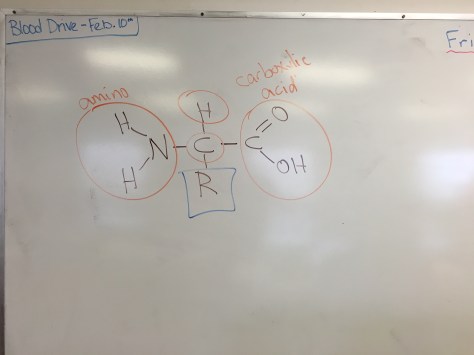
Question 26 of the worksheet asked students to notice how amino acids with multiple codons often “wobble” at the third position (click here for a brief summary, or here for a not-so-brief summary).  The picture below attempts to add some context to the discussion.

IMG_0520
Parts of an amino acid, the basic unit of proteins
IMG_0521
Some amino acids are encoded in multiple codons because of what is known is the wobble position, or more formally as “degeneracy” of the genetic code.

Central Dogma: Content Pre-assessment

We began class with an assessment of what students know and need to know about the content we will cover in Unit 3 (Central Dogma).  Students received a worksheet with a list of science standards (both Washington State and Next Generation Science Standards) as well as a list of vocabulary words.

The majority of the class period was used to guide students through the process of writing a full-credit EOC-style conclusion using the writing prompt from the Unit 2 Exam.  We thoroughly reviewed how to use the exam as a resource, how to carefully dissect the scenario and data table that are provided as part of the prompt, and how to use the provided list of bullet points to write the conclusion.  An example of the prompt (after markup) and a writing sample are provided below:

My 5th period class finished early and was treated to the following classic video of the 1971 hit video Protein Synthesis: an epic on the cellular level:

Central Dogma: Initial Ideas

We began the new semester with a review of the Unit 2 Exam from last Thursday.  Students received their graded exams and we went over how the exam was scored and how the final scores were curved.  We went over the procedure writing question in detail, with students revising their procedures to better meet the criteria for writing a successful EOC-style procedure.  The procedure for the experiment was outlined on the white board, variables were identified, and students then were instructed to add the important missing details to make the procedure reproducible.

We pivoted to a brief acknowledgement of the Iowa caucuses this evening, with students voting on whether to keep the original grading system (second semester grades = the average of third and fourth quarters) or transition to a semester-long grade book.  After the final votes were tallied, students decided bya 48-40 margin to transition to the semester-long grade book.  Finally, we concluded class with an exit task where students were instructed to write down everything they know (or think they know) about DNA, genetics, inheritance, and related concepts.  After some private think time, student ideas were captured on a class poster, where each student was asked to contribute a unique idea.  The posters will be displayed and periodically updated to reflect new student learning as we progress through the new unit.

Central Dogma: Chromosome Project – Reflection

Due to our aging technology infrastructure, many students were unable to complete their chromosome projects on Wednesday.  With all science teachers together at a district-wide meeting, the substitute will provide students with the following work options:

In order of priority:

  1. Complete the Chromosome Project and email it to me (the PowerPoint and Activity Logs).
  2. Complete and turn in Chromosome Project reflection worksheet (copies on table under blackboard).
  3. Complete and turn in Unit 4 exam and Unit 5 quiz revisions.
  4. Check grades in Illuminate, identify missing assignments, locate missing assignments on the class website, print the work, complete it, and turn it in.
  5. Complete extra credit reading.