Category Archives: Biology

Week 18

Monday, January 13, 2020 (HS-LS2-7HS-ETS1-3): Student groups have the class period to meet and write the group consensus sections of the Team Continent Project Google Doc.  By the end of today, teams should reach consensus on which three biomes they want to research for the project, and the list should be numbered in order of preference (1 = top choice, 2 = second choice, 3 = third choice).

Biome Assignments:

  • Team Africa: Savannah
  • Team Australia & Oceania: Tropical Rain Forest
  • Team South America: Alpine
  • Team Asia: Temperate Deciduous Forest
  • Team North America: Temperate Grassland

Tuesday, January 14, 2020: No school (snow day)


Wednesday, January 15, 2020 (HS-ETS1-4): One of the major learnings from our work last week is that humans have made major changes to the environment, often as a result of using the land to produce food.  As our population increases, farmers and food scientists must find ways to feed more people.  One technique being used is genetic modification.  By altering the DNA of certain crops, traits can be introduced that allow more food to be grown than was possible previously.  Students will work through the Gizmo: GMOs and the Environment.  The Gizmo is designed to “help students weigh the positive and negative effects of growing genetically modified (GM) corn in a farm setting. Students can experiment with different types of GM crops, modify pesticide amounts, and view the resulting corn yields and long-term environmental effects. This Gizmo is meant to simulate the decisions made on a farm and does not endorse the use of GMO crops.”


Thursday, January 16, 2020: Work on the “GMOs and the Environment” Gizmo from yesterday.  The Gizmo is due tomorrow at the end of class.  Students who complete the work should continue to Friday’s activity.


Friday, January 17, 2020: Complete the “GMOs and the Environment” Gizmo.  The Gizmo is due tomorrow at the end of class.  The remainder of class should be spent completing activity 8 on the Continent Team Biome Project shared Google Doc (click the link below for team docs).

Activity 8 on the Team Google Doc asks students to work with their team to complete the following work:

  1. Using BiomeViewer, navigate to your team’s continent and identify a region that includes your assigned biome.
  2. Next, select the Anthromes view and set the year to 2000.  Look for regions of overlap (biome and anthrome) that show the most human activity.
  3. Cross-reference the developed area with a map of your continent showing major cities.  You may need to conduct an Internet search for a good map of the region you are searching for.  List as many named areas as possible in the space below.
  4. Using the Anthromes view, describe how the region has changed over time.
  5. Conduct an Internet search to investigate how the way people live in the region has changed over time.  Research should include things like diet (what they eat), housing (structures they live in), clothing (common things to wear), work (common ways people earn a living), and entertainment (what people do for fun).  Include pictures as needed and include sources!


Week 17

Monday, January 6, 2020 (HS-LS2-7, HS-ETS1-3): Welcome to the first week of school in 2020!  We have a lot to accomplish, so our work today is broken down into three steps:

Step 1: Take the Continent Survey – this will inform (but does not guarantee!) group placement for our work tomorrow.

Step 2: Join Mr. Swart’s Newsela classroom.  After joining the classroom, students are instructed to read the article titled, “Earth’s Systems: What is a biome?” and highlight key ideas in the article using the highlighting feature in Newsela.

Step 3: Open the HHMI BioInteractive BiomeViewer and work through the accompanying Student Worksheet.


Tuesday, January 7, 2020 (HS-LS2-7, HS-ETS1-3): We will extend our learning of biomes from yesterday with the Ted Ed video below (Why is biodiversity so important?):

After a brief discussion about the video, students will read the Newsela article titled, “What is biodiversity?” and and highlight key ideas in the article using the highlighting feature in Newsela..

After reading the article and completing the notes, students will learn of their continent team assignment by checking their student Gmail account.  Based on data from the continent survey yesterday, students were placed into one of five different continent teams:

The first team assignment is for each team member to read the articles about the Physical Geography and Human Geography of their continent through the Newsela classroom.

After reading the articles, team members will cross-reference the content from the article with the HHMI BiomeViewer and decide as a team which biome to move forward with the research project.


Wednesday, January 8, 2020 (HS-LS2-7, HS-ETS1-3): Student groups have the class period to work on yesterday’s work.


Thursday, January 9, 2020 (HS-LS2-7, HS-ETS1-3): With the Newsela website down during class today, students had two options: complete the BiomeViewer work from Monday (required) or, if finished with the BiomeViewer work, to watch the Popped Secret video below and complete the accompanying student handout.


Friday, January 10, 2020 (HS-LS2-7, HS-ETS1-3): Today is the final day of class time for students to complete the individual work for the Continent Biome project. Students have the class period to complete the work.  Any additional time should be used to complete the BiomeViewer Student Worksheet activity from Monday or the Popped Secret bonus handout from yesterday.

The BiomeViewer worksheet is due today for full credit.  Late work will receive 60% max credit.  The Popped Secret handout is due next Friday for bonus.

Week 16

Monday, December 16, 2019: As we enter the final week of school for 2019, today marks the final day of completing and turning in all missing work.

All students should complete the Winter Break Kahoot! Prep Google Form so we can celebrate the end of the calendar year in style!

Students who are completely caught up should take the opportunity to review our work thus far in Unit 2, analyze their biogeochemical cycling posters (using the grading rubric), discuss ideas, and ask questions.


Tuesday, December 17, 2019: In preparation for the mid-unit 2 quiz tomorrow, we will review our work from unit 2, culminating with an analysis of the biogeochemical cycling posters.


Wednesday, December 18, 2019: Mid-Unit 2 Quiz


Thursday, December 19, 2019 (NGSS on pages 10-12): King County EcoConnections Biospheres workshop hosted by Jennifer Scales


Friday, December 20, 2019: Winter Break Kahoot!

Week 15

Monday, December 9, 2019 (HS-LS2-3, HS-LS2-5): Continue Biogeochemical Cycling Poster Project

For the project, students will create a poster to model the water, carbon, nitrogen, phosphorus, and sulfur cycles on a poster of Yellowstone National Park.  For our work today, students will have time to complete the Food Web and Ecosystem Gizmos from Monday and Tuesday, and then they will receive the Nutrient Cycling POGIL worksheet packet that will provide them with additional information about the process of carbon (C), water (H and O), and nitrogen (N) cycling.

Students will work in groups of 3-4 to create the biogeochemical cycling poster project.  Instructions:

  1. Create a large poster by taping together printer paper to the desired size
  2. Draw an accurate and scaled map of Yellowstone National Park
  3. Sketch and label the major must-see attractions and geographically distinct regions of the park
  4. Draw and label the carbon (C), water (H and O), nitrogen (N), phosphorus (P), and sulfur (S) cycles within the park

The poster should be nicely organized, easy to understand, and colorful!  Due date: Thursday (December 12) by the end of class.

Note 1: While not included in the POGIL, sulfur is often included as a component of the biogeochemical cycle, frequently abbreviated as the CHNOPS cycle.  Including the sulfur cycle will earn group members bonus points.

Note 2: As with the Unit 1 Ocean Acidification project, students are expected to work productively and equally within their groups.  On Tuesday, students will fill out the Individual Contribution Multiplier worksheet to to explain how each team member contributed.  The multiplier will affect individual student grades on the team project, so students must communicate early and often regarding expectations for each other.

Helpful Resources:

One Strange Rock: Nitrogen Cycle

Crash Course: Carbon and Water Cycles

Crash Course: Nitrogen and Phosphorus Cycles

Bozeman Science: Biogeochemical Cycles (includes the Sulfur Cycle)

The Carbon Cycle – a NASA Earth Observatory website with data about global carbon cycling in the land, air, and sea with actual numbers that need to be added to the student posters.

Water Cycle – USGS website providing a robust review of hydrologic (water) cycle vocabulary, a presentation of the cycle itself, and data students will need to add the actual amount of water stored in various locations on Earth.

Texas A&M University has a website with pages devoted to explaining the Nitrogen Cycle.  Additional in-depth information about the Nitrogen Cycle is available on the Nature Education Knowledge Project website.

Phosphorus Cycle – information about the cycle and a nice graphic from the Shmoop University website.

Sulfur Cycle – a presentation provided by The Environmental Literacy Council

Example poster


Tuesday, December 10, 2019 (HS-LS2-3, HS-LS2-5): Continue Biogeochemical Cycling Poster Project

Due: Nutrient Cycling POGIL (individual assignment)


Wednesday, December 11, 2019: Continue Biogeochemical Cycling Poster Project


Thursday, December 12, 2019: Complete Biogeochemical Cycling Poster Project

Due: Biogeochemical Cycling Poster (group assignment)

Poster Example:


Friday, December 13, 2019: Solidarity Days

Week 14

Monday, December 2, 2019 (HS-LS2-4): We will begin class with a reminder that we are collecting student-researched data contained within the Survival and Reproductive Strategies of (insert selected species here) in Yellowstone National Park project students worked on last week.  Select data will be entered into the Yellowstone Biomass Survey  Students were instructed to complete this work before the beginning of class today, but with insufficient data collected thus far, the deadline will be extended to the end of class today.  Students will instead work through the Food Chain Gizmo to ensure sufficient access to learning about that concept.

If all students contribute the required animal and plant biomass data to the Yellowstone Biomass Survey by the end of class today, we will move forward tomorrow constructing and analyzing a trophic pyramid of Yellowstone Park.

Note: The Yellowstone Virtual Road Trip will be graded this weekend.  Refer to the checklist provided on November 26 to ensure all work is completed.  Ask Mr. Swart if you are unsure about any required pieces of work.


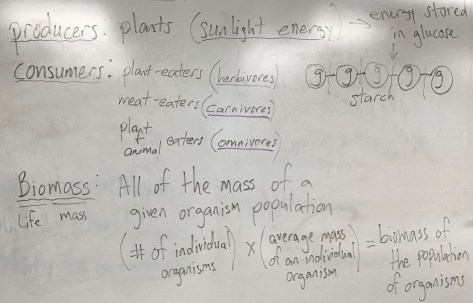
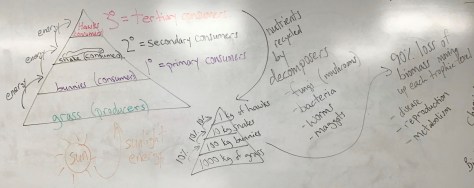
Tuesday, December 3, 2019 (HS-LS2-4): We will begin class with some interactive class notes. Students will revisit the vocabulary of producers and consumers from yesterday’s Gizmo, and we will add the vocabulary terms of primary, secondary, and tertiary consumers, as well as decomposers.  We will review the movement of energy in a food web, and discuss how organisms use (and lose) energy.  Finally, we will discuss the concept of biomass and apply the 90% rule to the trophic levels as introduced in yesterday’s Gizmo.  After completing our notes, students will work through the Forest Ecosystem Gizmo.

Notes from class:


Wednesday, December 4, 2019 (HS-LS2-3, HS-LS2-5): Now that students better understand the predator-prey relationships (energy cycling), students will work in small groups to create posters representing biogeochemical cycling.  For the project, students will create a poster to model the water, carbon, nitrogen, phosphorus, and sulfur cycles on a poster of Yellowstone National Park.  For our work today, students will have time to complete the Food Web and Ecosystem Gizmos from Monday and Tuesday, and then they will receive the Nutrient Cycling POGIL worksheet packet that will provide them with additional information about the process of carbon (C), water (H and O), nitrogen (N), and phosphorus (P) cycling.

Due Friday:

  • Yellowstone Virtual Road Trip (refer to checklist) – share Google Doc with Mr. Swart (david.swart@g.highlineschools.org)
  • Food Web Gizmo 
  • Ecosystem Gizmo
  • Nutrient Cycling POGIL (individual assignments)

Due next Thursday: Biogeochemical Cycling Poster (group project)


Thursday, December 5, 2019 (HS-LS2-3, HS-LS2-5): Students will work in groups of 3-4 to create the biogeochemical cycling poster project.  Instructions:

  1. Create a large poster by taping together printer paper to the desired size
  2. Draw an accurate and scaled map of Yellowstone National Park
  3. Sketch and label the major must-see attractions and geographically distinct regions of the park
  4. Draw and label the carbon (C), water (H and O), nitrogen (N), phosphorus (P), and sulfur (S) cycles within the park

The poster should be nicely organized, easy to understand, and colorful!  Due date: next Thursday (December 12) by the end of class.

Note 1: While not included in the POGIL, sulfur is often included as a component of the biogeochemical cycle, frequently abbreviated as the CHNOPS cycle.  Including the sulfur cycle will earn group members bonus points.

Note 2: As with the Unit 1 Ocean Acidification project, students are expected to work productively and equally within their groups.  On Tuesday, students will fill out the Individual Contribution Multiplier worksheet to to explain how each team member contributed.  The multiplier will affect individual student grades on the team project, so students must communicate early and often regarding expectations for each other.

Helpful Resources:

One Strange Rock: Nitrogen Cycle

Crash Course: Carbon and Water Cycles

Crash Course: Nitrogen and Phosphorus Cycles

Bozeman Science: Biogeochemical Cycles (includes the Sulfur Cycle)

The Carbon Cycle – a NASA Earth Observatory website with data about global carbon cycling in the land, air, and sea with actual numbers that need to be added to the student posters.

Water Cycle – USGS website providing a robust review of hydrologic (water) cycle vocabulary, a presentation of the cycle itself, and data students will need to add the actual amount of water stored in various locations on Earth.

Texas A&M University has a website with pages devoted to explaining the Nitrogen Cycle.  Additional in-depth information about the Nitrogen Cycle is available on the Nature Education Knowledge Project website.

Phosphorus Cycle – information about the cycle and a nice graphic from the Shmoop University website.

Sulfur Cycle – a presentation provided by The Environmental Literacy Council

Example poster


Friday, December 6, 2019 (HS-LS2-3, HS-LS2-5): Continue with Biogeochemical Cycling Project Poster.

Week 13

Monday, November 25, 2019: With the short holiday week, students who needed time to work on the Yellowstone Virtual Road Trip work from last week had the opportunity to do so; students who were caught up watched The Lost Worlds of Planet Earth from Season 1 of Cosmos.


Tuesday, November 26, 2019: Class began with a self-assessment with regard to work completed for the Yellowstone Virtual Road Trip project. Students evaluated their work via a checklist, turned in the checklist for assignment credit, and then received back the checklist in order to complete missing work.  Students who needed time to work had the opportunity to do so; students who were caught up watched The World Set Free from Season 1 of Cosmos.


Week 12

Monday, November 18, 2019 (HS-LS2-1): With the aquatic farming project behind us, students will begin class in their assigned seats, where they will invest in building relationships with new members of the class for the remainder of this semester when the current unit concludes.

For our entry task today, students were asked to take a brief survey about science electives they are interested in taking next school year.  Students may click this survey link or use the QR code below:

Science Elective Survey QR Code

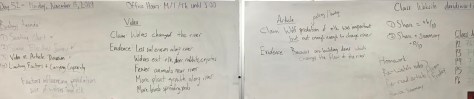
Our lesson will begin with a discussion of student learning from Friday’s work where they were assigned the task of writing a summary comparing a video and an article that present contrasting evidence about the effect of reintroducing wolves to Yellowstone National Park.  Students will share out evidence from both sources and practice the art of debating whether the evidence supports or disproves either position. Notes from class:

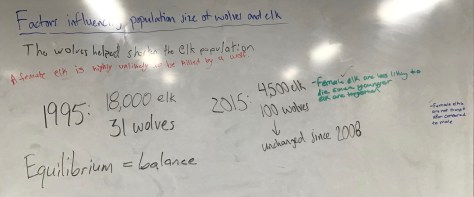
Next, we will advance our understanding of ecosystems by learning about the concepts of limiting factors and carrying capacity.  We will watch the video below as an example of how the population of one species (wolves) directly influenced the population of another species (elk) after wolves were reintroduced to Yellowstone.  During the video, students will take notes in their Google Doc focusing on factors that influence the population size of wolves and elk, and will write down facts about population sizes.


Notes from class:

Finally, students will read the article titled “Interdependence Involves Limiting Factors and Carrying Capacity” on pages 650-652 of the BSCS Biology textbook.  Students will take notes and define vocabulary in their Yellowstone Google Doc.

  • limiting factor is anything that can slow, or limit, the growth of a population.
    • Biotic factors: food supply and other organisms
    • Abiotic factors: space, raw materials, climate (the prevailing weather conditions in a given area through long periods of time), light
  • Carrying capacity is the maximum population of a particular species that the habitat can support.  It changes as environmental conditions change.
  • Population density is the number of individuals in relation to the space the population occupies.

Tuesday, November 19, 2019 (HS-LS2-2): We will continue our learning about limiting factors and carrying capacity, concepts that help explain the population size of organisms in a given ecosystem, by bringing in the concept of trophic cascades.  We will continue our study of Yellowstone, focusing on the effect of wolf reintroduction, with a guided activity where students will watch a segment (first 2:36) of Earth: A New Wild and then they will complete Part 1: Defining Trophic Cascade.

Students who complete the activity early will have the opportunity to watch the full length of the video (5:19 total) and earn bonus credit by completing Part 2: Evaluate Solutions for Maintaining Ecosystem Services and Biodiversity.

Notes from class:

IMG_0625

IMG_0626


Wednesday, November 20, 2019 (HS-LS2-8): Students who need additional time to complete Part 1 and Part 2 from yesterday will work efficiently to complete those activities before moving forward. Parts 1 and 2 are due by the end of class today for full credit.

Students who are ready will begin researching the reproductive strategies used by various organisms within Yellowstone.  Information will be collected into the Yellowstone Google Doc in a section titled “Survival and Reproductive Strategies of (insert selected species here) in Yellowstone National Park.”  Complete research will include the following (note: some information may not be available or relevant depending on species being researched):

  1. Common name and scientific name (Genus and species) of a specific organism that lives in Yellowstone National Park
    • Example: elk (Cervus canadensis)
  2. Pictures of members of a species (male, female, baby)
  3. Names given to members of a species
    • Examples: Male elk are called bulls, female elk are called cows, and baby elk are called calves
  4. Diet type and preferred food sources
    • Diet type examples: herbivore, carnivore, omnivore
    • Preferred food sources examples: Elk eat grasses in the summer and woody growth in the winter months, and they snack on dandelions, violets, hawkweed, aster, clover and mushrooms.
  5. Average life span in the wild
  6. Average height and weight when full grown
    • Males and females may have very different sizes
  7. Preferred habitat in Yellowstone
  8. Average population size
    • Number of individual members of the species living in Yellowstone (see below for helpful links)
  9. Name of group
    • Example: a group of elk are called a Gang
  10. Description of common individual behaviors
    • How do individual members of the species spend their day?
  11. Explanation of common group behaviors (type and what it means)
    • Examples of types of common group behaviors: flocking, schooling, herding, hunting, migrating, swarming
  12. Explanation of how group behavior promotes survival of  individual members of the species
  13. Reproductive strategies
    • Examples: sexual reproduction, asexual reproduction, alternation of generations
  14. Age of sexual maturity for males and females of the species
  15. Breeding season
    • What time of year do members of the species mate?
  16. Gestation time
    • How long does the reproduction process take?
  17. Typical number of offspring produced each season

Selected resources about organisms to get started:

Selected resources with population size information:

Keep searching!  If you find a great resource, let Mr. Swart know so we can add it to our lists.


Thursday, November 21, 2019 (HS-LS2-8): Continue researching!  All student research will be used to construct a food web of Yellowstone National Park.  We need as much information as possible to construct an accurate and complete food web.  Students who complete research on an organism to continue researching additional organisms.  Ideally, all students will thoroughly research the survival and reproductive strategies of at least one animal, one plant, and one extremophile (bacteria or archaea).

Remember, to receive credit for this important work, all research must be entered into the “Survival and Reproductive Strategies of (insert selected species here) in Yellowstone National Park” section of the Yellowstone Google Doc.


Friday, November 22, 2019 (HS-LS2-8): Final day for survival and reproductive strategies research.  Student work will be assessed this weekend.  Students will also complete the Student Led Conference worksheet in preparation for SLCs next Tuesday evening/Wednesday morning.

Students who finish early should add selected data from their Survival and Reproductive Strategies of (insert selected species here) in Yellowstone National Park to the Yellowstone Biomass Survey.  The data will be used to build the Yellowstone Food Web next week.

Week 11

Monday, November 11, 2019: No School (Veteran’s Day)


Tuesday, November 12, 2019: Unit 1 Final Project Presentations (4 of 6 groups)


Wednesday, November 13, 2019: Unit 1 Final Project Presentations (last 2 groups)

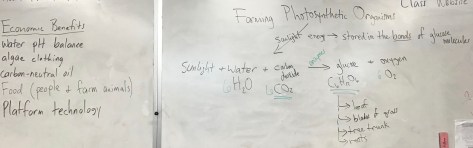
After completing the final presentations for the unit, we reviewed the major economic benefits shared by each group with respect to farming photosynthetic aquatic organisms.  We concluded with the key idea that plants use the process of photosynthesis to remove carbon dioxide from the environment in order to create glucose which they then use as both an energy store and also to build biomass.  We call this process “fixing” carbon – taking carbon dioxide from the air to build biomolecules – helps drive home the point that carbon dioxide gas (difficult to observe under everyday conditions) can be removed from the environment and utilized by photosynthetic organisms to make glucose (an energy-rich molecule) which can then be used by all organisms as a source of food and raw materials to build other biomolecules (proteins, lipids, carbohydrates, and nucleic acids).

IMG_0615

For the final few minutes of class, students watched the TedTalk video below where scientist / artist / designer Suzanne Lee shares her efforts to create clothing from fabric derived from bacteria  found in kombucha tea.  The bacteria consume glucose (produced from plants during photosynthesis) and produce cellulose fibers that may one day be engineered to have properties that make these clothes a must-have for wardrobes of the future:


Unit 2: Ecosystems

Thursday, November 14, 2019: Our ecosystem unit begins with a virtual road trip to Yellowstone National Park.  To help introduce students to Yellowstone, we watched the video below:


Working with a partner, create a Google Doc and include your responses to the following tasks:

  1. Plan your route: Map how you will travel from Burien to Yellowstone and back.
  2. Research the natural wonders of Yellowstone National Park. (Check out the Old Faithful Live-Stream)
    • List the top five non-living natural wonders you want to see while at the park.
    • List all the living things you hope to see while visiting the park.

Friday, November 15, 2019 (LS2-6):

Agenda for the day:

  1. Define biotic and abiotic factors.
  2. Watch Yellowstone video below and write down all biotic and abiotic factors observed.  Update Google Doc with any new factors.
  3. Read article by Emily Gertz (see below).
  4. Write a summary comparing the video and the article in your Google Doc (title = Effect of wolves on Yellowstone).  Does the evidence support or not support the claim that reintroduction of wolves has changed Yellowstone?  Use evidence from both sources to support your position.

Now that we have a plan to virtually travel to Yellowstone, we set our sights on the ecosystem of the park.  For today’s lesson, students will learn about how the reintroduction of wolves nearly 75 years after their extinction appears to have led to profound changes to both the biotic (living) and abiotic (not living) factors in the ecosystem of the park.

The video (below) features images about the wolves and other organisms in Yellowstone, with George Monbiot narrating.  The narration is actually a segment from a longer TED talk by Mr. Monbiot.

During the video, make a list in your Google Doc (from yesterday) of the biotic and abiotic factors you see in Yellowstone.  After watching the video, write down the claim being made by the narrator in the Google Doc, and then make of list of evidence used to support the claim.  Next, students will read an article titled Has The Reintroduction Of Wolves Really Saved Yellowstone? published on March 14, 2014 by Emily Gertz in Popular Science.  After reading the article, students will write a summary of what they learned and write down evidence presented in the article that refutes the claim that wolves have altered Yellowstone.

Week 10

Monday, November 4 (HS-ETS1-1, HS-ETS1-2): Your team is tasked with researching which species of photosynthetic organism is best suited to grow in your company’s aquatic farm. Photosynthetic aquatic organisms consume carbon dioxide during photosynthesis to produce glucose and oxygen, so aquatic farming may help reduce the amount of carbon dioxide in the water and reduce acidification of the surrounding water.

As described in detail on the Unit 1 Project Scoring Rubric, a complete project (Google Doc, Google Slides, video, web page, or poster) must include:

  • An explanation of ocean acidification and research into sources of ocean acidification.

http://www.youtube.com/watch?v=5cqCvcX7buo

Atmospheric Carbon Dioxide (GlobalChange.gov)

Ocean Acidification Chemistry (Monterey Bay Aquarium)

All credible scientific sources must be cited.

Resources provided are examples to help teams get started.  High-performing teams will find additional scientifically credible resources.

Projects will be shared with the class on Friday, November 8.


Tuesday, November 5 (HS-ETS1-1, HS-ETS1-2): By the end of class today, student groups should have the following work completion goals:

  1. Ocean acidification research completed
  2. Photosynthetic aquatic organism research completed
  3. Group agreement on how project will be shared with the class on Friday

Wednesday, November 6 (HS-ETS1-1, HS-ETS1-2): By the end of class today, students should have a clearly constructed explanation of the connection between aquatic farming and ocean acidification.  A strong explanation will include:

  • connection between photosynthesis of aquatic organisms, carbon dioxide in the atmosphere and the ocean, and ocean pH
  • rate of photosynthesis of two or more photosynthetic aquatic organisms researched

Student groups should use this data to inform their choice of organism to farm.  Once that decision has been made, groups should research at least three criteria for successfully farming their organism.  Groups should also research at least three constraints (challenges) for successfully farming their organism.


Thursday, November 7 (HS-ETS1-1, HS-ETS1-2): For the final work day, students should research the following:

  • how, when, and where the aquatic farm will be established;
  • three ways the farmed organism will contribute to the economy;
  • how long the farm will take to impact acidification

Finally, the presentation should be completed and practiced in advance of sharing with the class tomorrow.


Friday, November 8 (HS-ETS1-1, HS-ETS1-2): After working incredibly hard this week, students were rewarded with one final work day to prepare for presentations that will take place next Tuesday.  Today, students will complete a worksheet where they share their experience working with their team members, and the information will contribute to the individual scores for the project.  By the end of today, students should have presentations complete, with the following information included in the presentation:

  • Explanation how ocean acidification happens and why it is a problem
  • Research about the photosynthetic organism selected for farming
  • Connection between a) photosynthesis of the selected organism, b) carbon dioxide in the atmosphere and the ocean, c) and ocean pH
  • Where the aquatic farm will be located
  • How the farmed organism will contribute to the economy

Practice!  Practice!  Practice!  Students groups will have 5 minutes

Week 9

Monday, October 28 (HS-LS1-6): Today marks the final Monday of the 1st Quarter. We began class with a review of the Egg Lab experiment conducted last week, focusing on the data collected on Friday.  We drew models to show the flow of water across the cell membrane when the cell was placed in corn syrup.  Next, students were given an open-notes pop quiz designed to evaluate both understanding and engagement.  Students all received the Dehydration Synthesis Gizmo with remaining class time set aside to begin working on the Gizmo.  Students who complete the Gizmo by next Monday will receive bonus credit.


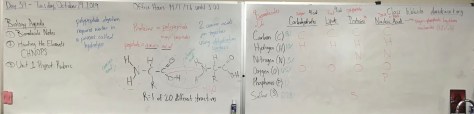
Tuesday, October 29 (HS-LS1-6): As we conclude our study of how organisms live and grow, we must answer the question: how do cells build new molecules with the nutrients they acquire following digestion?  To address this question, students consider the elements found in the four major classes of biomolecules:

  • Carbohydrates: carbon (C), hydrogen (H), and oxygen (O)
  • Lipids: carbon (C), hydrogen (H), and oxygen (O)
  • Proteins: carbon (C), hydrogen (H), oxygen (O), and nitrogen (N), and sulfur (S)
  •  Nucleic Acids: carbon (C), hydrogen (H), oxygen (O), nitrogen (N), and phosphorus (P)

To understand the process of building biomolecules with atoms of elements obtained after the digestion process, students will learn about dehydration synthesis.  Students will also learn about hydrolysis, the process of apart polymers to produce monomers while consuming water.

Notes from class:

IMG_0590

Next, we watched a segment of the NOVA video Hunting the Elements, beginning at 58:05 and ending at 1:18:00, and students were tasked with keeping track of how much of each element are present in the human body.

Finally, students will receive the grading rubric for the Unit 1 Project.


Wednesday, October 30 (HS-ETS1-1, HS-ETS1-2): As carbon dioxide levels increase in the atmosphere, the oceans absorb carbon dioxide and become more acidic. When ocean water becomes more acidic, the shells of young shelled sea creatures fail to form properly, often dissolving before the animals can mature.

With that background, we watched the video about ocean acidification below:

After the video, we took class notes:

Next, we watched the video below that focused on solutions to ocean acidification:

After a brief discussion, class ended with students tasked with reviewing the rubric in preparation for forming project teams tomorrow.


Thursday, October 31 – Friday, November 8 (HS-ETS1-1, HS-ETS1-2):

Your team is tasked with researching which species of photosynthetic organism is best suited to grow in your company’s aquatic farm. Photosynthetic aquatic organisms consume carbon dioxide during photosynthesis to produce glucose and oxygen, so aquatic farming may help reduce the amount of carbon dioxide in the water and reduce acidification of the surrounding water.

As described in detail on the Unit 1 Project Scoring Rubric, a complete project (Google Doc, Google Slides, video, web page, or poster) must include:

  • An explanation of ocean acidification and research into sources of ocean acidification.

Atmospheric Carbon Dioxide (GlobalChange.gov)

Ocean Acidification Chemistry (Monterey Bay Aquarium)

All credible scientific sources must be cited.

Resources provided are examples to help teams get started.  High-performing teams will find additional scientifically credible resources.

Projects will be shared with the class on Friday, November 8.