Ever wonder why humans spend 1/3 of our lives sleeping? Watch the PBS NOVA episode Mysteries of Sleep and learn the answer to that question and more!
Learn more about the connection between adenosine, caffeine, and sleep by watching the TedEd video below:
Turn it up to 11!
Create a sleep journal. Think about the factors that might impact your sleep each day, then track those along with how much sleep you get each night. Which factors seem to affect your sleep? Which factors don’t seem affect your sleep? Add and remove factors to help you dial in on how to get the best possible sleep each night.
Create a dream diary. Record your dreams upon waking. Write them down, draw them out, or narrate them into your phone. Notice any trends or patterns? How often are you able to recall your dreams? Does your ability to remember your dreams correlate with how long or how well you sleep? Does the content of your dreams correlate with your past, present, or future experiences? Do you have recurring dreams?
Learning to remember. Feeling tired after a long day of learning at school? Try a Power Nap and see whether it helps you remember what you learned during the day. Are you more efficient at completing homework before or after a Power Nap?
With our 11th grade students out of class today for the SAT, students had the opportunity to explore what it might be like to work as a researcher tasked with understanding and ultimately stopping the spread of infectious diseases like COVID-19. Students worked in pairs as Disease Detectives using the CDC “Solve the Outbreak” simulation.
One of the recurring questions from students yesterday was about treatment options for COVID-19. Students were reminded that people can be infected with multiple infectious diseases at the same time, such as influenza (the flu) or the common cold (rhinovirus) at the time they are infected with coronavirus. While supportive care (staying home in “self-quarantine” and having someone look after you to keep you as comfortable as possible while you are sick) is all most people need to fight off a cold or even the flu (influenza kills about 1 person for every 1000 people who are infected), getting the flu and coronavirus could cause a major health problem. To reduce the risk of influenza infection, there is a vaccine available every year which successfully prevents thousands of deaths from infection. In fact, horrible diseases that were once prevalent in our society (measles, mumps, rubella, small pox, polio, chicken pox, and more) are now quite rare thanks to vaccines.
With so many infectious diseases no longer prevalent, there has been a rise the last few decades in the number of healthy vaccinated parents who chose not to vaccinate their children. For our class today, we will watch the PBS NOVA video Vaccines – Calling the Shots and students will complete the associated worksheet. By better understanding the power of vaccines and the importance of limiting the spread of preventable diseases in order to protect those who, not by choice, lack immunity, we can also do our part to reduce our own chances of becoming infected with multiple infectious diseases at the same time.
Monday, March 2, 2020: After an intense weekend of local news covering the emerging COVID-19 outbreak in the greater Seattle area, we invested class time today learning more about the viral outbreak, resources scientists are using to monitor the outbreak, and the importance of vaccination.
Tuesday, March 3, 2020: One of the recurring questions from students yesterday was about treatment options for COVID-19. Students were reminded that people can be infected with multiple infectious diseases at the same time, such as influenza (the flu) or the common cold (rhinovirus) at the time they are infected with coronavirus. While supportive care (staying home in “self-quarantine” and having someone look after you to keep you as comfortable as possible while you are sick) is all most people need to fight off a cold or even the flu (influenza kills about 1 person for every 1000 people who are infected), getting the flu and coronavirus could cause a major health problem. To reduce the risk of influenza infection, there is a vaccine available every year which successfully prevents thousands of deaths from infection. In fact, horrible diseases that were once prevalent in our society (measles, mumps, rubella, small pox, polio, chicken pox, and more) are now quite rare thanks to vaccines.
With so many infectious diseases no longer prevalent, there has been a rise the last few decades in the number of healthy vaccinated parents who chose not to vaccinate their children. For our class today, we will watch the PBS NOVA video Vaccines – Calling the Shots and students will complete the associated worksheet. By better understanding the power of vaccines and the importance of limiting the spread of preventable diseases in order to protect those who, not by choice, lack immunity, we can also do our part to reduce our own chances of becoming infected with multiple infectious diseases at the same time.
Wednesday, March 4, 2020 (HS-LS4-2, HS-LS4-3): We began Unit 4 with a brief class discussion about what students know (or think they know) about evolution. Next, we watched the remaining 15 minutes of the Cosmos episode from last Friday which helped students connect prior learning with our work this year studying DNA, meiosis, mutations, and inheritance of traits. After completing the video, students were tasked with a “writing to explain” assignment where they compared and contrasted artificial and natural selection. The assignment asked students to explain using evidence from the Cosmos video from last Friday. Finally, students received the Natural and Artificial Selection Gizmo to work on in pairs for the remainder of the class period.
Monday, March 2, 2020: With the coronavirus (COVID-19) all over the news, we will take some time this week to better understand the science of the virus, learn about tools scientists use to study epidemiology, and investigate how treatments may eventually be developed. After providing students some time to formulate and share questions and concerns, we will watch a comprehensive overview prepared by Dr. Arnaud Fontanet of the Institut Pasteur on February 20, 2020:
During his highly informative presentation, Dr. Fontanet references several of the following websites:
Get Proactive! The data is clear: the best way to control the spread of disease is through effective hand washing. Students looking to earn bonus credit are encouraged to bring in the following supplies (+5 bonus each, +20 bonus max):
Monday, February 24, 2020(HS-LS3-1): Today is the final day of class to work on the Chromosome Project slide deck. For this project, students were tasked with investigating a chromosome and at least 5 genes located on that chromosome. A complete slide deck will include the following information:
Chromosome number
Brief description of what happens with too many or too few copies of the chromosome
For the gene you researched the most (and have trait information for):
Official Symbol
Official Name
Your own one-sentence summary of about the protein the gene codes for
Location of the gene on the chromosome
Number of exons in the gene
Length of the gene (in DNA bases)
Length of the protein (in amino acids)
Description of trait and how that is connected with your gene
Research information for the other 4 genes you investigated
Citations for the information you gathered so anyone else can repeat your findings.
Tuesday, February 25, 2020 (HS-LS3-1): It’s Chromosome Project “Poster” Walk day! Time to share what was learned about each chromosome and learn about the amazing diversity of genes on each and the traits those genes code for. Students will present their slide decks to each other in small groups while completing the poster walk handout.
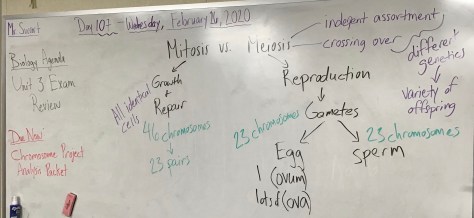
Wednesday, February 26, 2020: Unit 3 Review – Notes from class shown below
Thursday, February 27, 2020: Unit 3 Exam
Friday, February 28, 2020: To conclude Week 25, and in preparation for our next unit, we watched the first 30 minutes of Some of the Things That Molecules Do (Cosmos, episode 2), pausing periodically to answer questions on the handout students received and which will be turned in after we complete the video tomorrow. During the video, students learned:
wolves and dogs share a common ancestor (artificial selection);
brown bears and polar bears share a common ancestor (natural selection);
how random DNA mutations can occasionally produce desirable traits depending on the environment in which the organism with the mutation lives;
how all life on Earth is connected via DNA to a common ancestor (using the Tree of Life analogy);
how the evolution of sight can be traced all the way back to bacteria
Monday, February 17, 2020: No School (Mid-Winter Break)
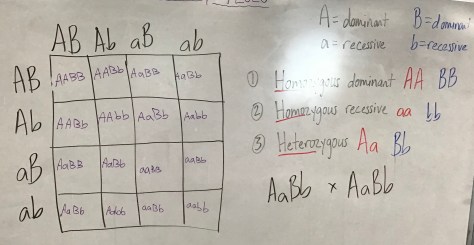
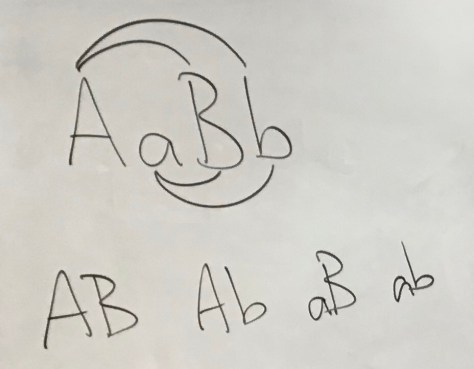
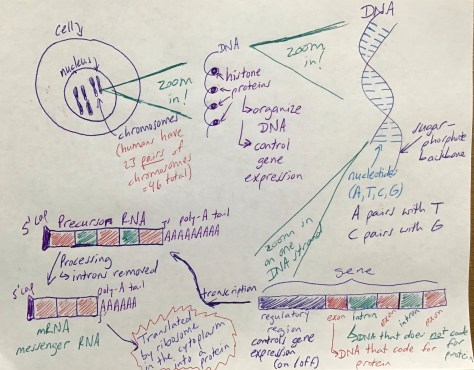
Tuesday, February 18, 2020 (HS-LS3-1): So far this unit, we have reviewed Central Dogma, reviewing how DNA codes for RNA which codes for proteins which ultimately determine our traits. We learned about the structure of genes, including the regulatory region that turns genes on and off, as well as coding regions (exons) and non-coding regions (introns) which are excised during the processing of precursor RNA to messenger RNA (mRNA). We learned that unlike mitosis (the process in which a parent cell divides to make two identical diploid copies of itself), during meiosis a parent cell divides to ultimately produce four haploid gamete cells (eggs and sperm), each with a random assortment of chromosomes that vary somewhat from each parent chromosome because of the process of crossing over. We watched a video depicting the process of fertilization, picking up the story following the introduction of male sperm into the female reproductive tract, and learning for out of 300 million sperm, only one sperm ends up fertilizing an egg, thus kicking off the process of countless rounds of mitosis to produce a new individual. Finally, we constructed one- and two-trait Punnett Squares to predict and analyze the inheritance patterns of traits passed along from two parents to their offspring.
To move our learning forward, we will focus on the chromosomes. Humans have 23 pairs of chromosomes, 22 pairs of autosomal chromosomes and 1 pair of sex chromosomes (XX = female and XY = male). During the process of mitosis and meiosis, the chromosomes are copied and moved to the newly divided cells. In mitosis, the 23 pairs of chromosomes (46 total) are copied exactly, resulting in two new cells, each with the same set of 23 pairs of chromosomes. In meiosis, the successful result of meiosis II is the production of four cells, each with individual copies of chromosomes 1-22 and one of the sex chromosomes (23 total chromosomes). However, sometimes the chromosomes don’t separate out perfectly. In many cases, if one of the four daughter cells of meiosis II has an extra copy of a chromosome because they fail to separate (non-disjunction), and another cell is missing a copy of a chromosome because it went to that other cell with two copies, both cells will be non-viable. However, there are well-documented cases where having an extra copy of a chromosome results in a viable human. One example is called Trisomy 21, or Down Syndrome.
For our work today, we discussed the first three slides of the Down Syndrome Case Study slide deck and then detoured to the Wikipedia entry on aneuploidy. We focused on the Types section of the entry, examining how, of the autosomal chromosomes, only Trisomy 21 will result in a viable fetus most of the time. Students learned that when trisomy occurs in most of the other autosomal chromosomes, the result is an embryo that is non-viable, often resulting in miscarriage.
Back to the Case Study! To learn how Trisomy 21 occurs, students watched a short video illustrating non-disjunction. To put a human face on Trisomy 21, or Down Syndrome, students watched another short video about two young twins with Down Syndrome. Both videos are shown below:
The second video naturally leads to questions about twins, so slide 5 explains the difference between identical and fraternal (non-identical) twins. After slide 5, students will have time to read a Newsela article about possible a possible new treatment for Down Syndrome. After reading the article, students will respond to the writing prompt in the “Write” section of Newsela.
Wednesday, February 19, 2020 (HS-LS3-1): Welcome to the Chromosome Project! You have the exciting opportunity to study a chromosome and learn about the genes that exist on a chromosome. The goal of this project is to help you make a clear connection between DNA, genes, chromosomes, traits, and inheritance.
Your goals for today are:
Check your student gmail to determine which chromosome you are assigned to research. Autosomal chromosomes = 1-22 and the sex chromosomes are X and Y. One you know your chromosome, a link to a list of all of the Chromosome Project Google Slide decks is located here. For security, only students working on a specific chromosome may view and edit the slides for that chromosome.
Research and write down what happens during human development if more than two copies of the chromosome are present. What happens if only one copy of the chromosome is present? Be sure to document your sources! One resource is the Wikipedia entry on aneuploidy.
Conduct a search for “genes on chromosome____” and insert your selected chromosome.
Research at least 5 genes on your chromosome. Research = write it down! You must document your work to receive credit. For each gene, write down the key information about each gene. How? Read below:
To research your gene, visit the NCBI Human Genome Resources page and enter your gene name into the “Search For Human Genes” box. When the search completes, click on your gene name (typically the first gene on the list) and browse through the entry. There is a ton of information provided! For each gene, write down the following:
Official Symbol
Official Name
Your own one-sentence summary about the protein the gene codes for
Location of the gene on the chromosome
Number of exons in the gene
Length of the gene – hover your mouse over the top green line under the “genomic regions, transcripts, and products” and looking for the number after the aligned length (nt = DNA nucleotide bases)
Length of the protein – hover your mouse over the top green line under the “genomic regions, transcripts, and products” and looking for the number after the protein length (aa = amino acids)
Thursday, February 20, 2020 (HS-LS3-1): Select one of the genes from your list. Research one trait associated with that gene and explain the connection between the gene and the trait. For your final work, create a Google Slide with the following information:
Chromosome number
Brief description of what happens with too many or too few copies of the chromosome
For the gene you researched the most (and have trait information for):
Official Symbol
Official Name
Your own one-sentence summary of about the protein the gene codes for
Location of the gene on the chromosome
Number of exons in the gene
Length of the gene (in DNA bases)
Length of the protein (in amino acids)
Description of trait and how that is connected with your gene
Friday, February 21, 2020 (HS-LS3-1): Work day – continue your research and the Google Slide for your chromosome.
Monday, February 3, 2020 (HS-LS3-1): We took notes on the structure of genes, including a review of how chromosomes are found in the nucleus of cells, how chromosomes consist of DNA coiled around histone proteins, and how genes consist of regulatory regions, exons, and introns.
Class concluded with the Crash Course video about heredity (below). We paused strategically to capture important vocabulary terms (diploid, haploid, somatic cells, gametes) which were added to our vocabulary list from Friday.
Tuesday, February 4, 2020 (HS-LS3-2): To begin class, we watched the Amoeba Sisters video about meiosis (below) and students worked through a guided worksheet.
After the video, students had the remainder of class to read pages 52-59 of Inside the Cell to help them complete the Amoeba Sisters worksheet and to investigate the processes of independent assortment and crossing over. Students answered the “Got It?” questions on page 59 of the book in their lab notebooks.
To demonstrate evidence of understanding, students were tasked with creating a stop-motion claymation video or Google Slides explaining the processes of independent assortment and crossing over (shared with the teacher).
Wednesday, February 5, 2020: Today is a continuation of yesterday. Completed videos or slides depicting independent assortment and crossing over are due today. Students who finish early should begin working on the One Trait Mouse Genetics Gizmo.
Thursday, February 6, 2020: As we enter the final week of Unit 5: Inheritance and Meiosis, we turn our attention toward the process of reproduction. Class begins with a video which explains the process of human fertilization. After a brief class discussion about what was learned and what questions remain, students were assigned a reading from the textbook along with the questions below:
In the BSCS textbook, read “Making More People” (p.477-481)
How many ova are found in the ovaries of a newborn baby?
How many ova mature into healthy ova?
Where and when do ova begin maturing?
Where are mature ova fertilized by sperm?
Where are sperm formed?
How long does it take an individual sperm to develop?
How do sperm obtain the energy to swim through the female reproductive tract?
How and why does the male body regulate testicle temperature?
Explain the difference between a zygote, an embryo, and a fetus.
What determines when a woman is ready to begin labor?
Friday, February 7, 2020: Class will begin with a short quiz focusing on:
Punnett Square vocabulary
Mitosis and meiosis: similarities and differences
After the quiz, students will have the remainder of the class period to complete and turn in any remaining work from this week. Students who finish early should work on the single-trait Punnett Square Gizmo handed out last Friday.
Monday, January 27, 2020: No School (Semester Break)
Tuesday, January 28, 2020: Welcome to second semester! A new semester brings fresh start and a new unit. Before we dive in, we will roll out a new seating chart, welcome new faces to our classroom, review the class Syllabus and Safety Contract and hold a class discussion around expectations this semester.
Next, we launched Unit 3 (Heredity: Inheritance and Variation of Traits) with the following entry task:
In your lab notebook, list at least 5 traits that best describe who you are.
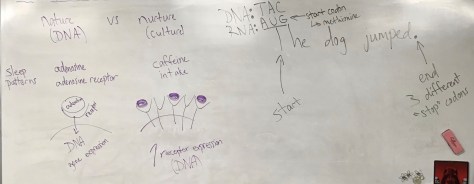
After responding to the entry task, students worked with their table teams and together they debated whether a list of traits provided on a worksheet are inherited via nature, nurture, or both. We came back together as a class so students could share their thinking and hear each others ideas.
Class concluded with the following assignment, due tomorrow:
Using your list of traits from the entry task, write an explanation about which of your traits are nature, which are nurture, and which are both. Explain your thinking!
Notes from class:
Selected traits with student ideas captured during concluding class discussion
Wednesday, January 29, 2020: Yesterday, we debated whether a variety of traits are obtained through nature (DNA) or nurture (culture). During our class discussion at the end of class, we determined the trait of sleep pattern was likely caused by both nature and nurture. We will begin class with the TedEd video below to provide evidence to support the claim that sleep pattern is indeed a product of both DNA and culture:
In today’s lesson, we used a case study about cystic fibrosis as the mechanism to:
review Central Dogma (from way back in Week 5!) and introduce the stop codon;
connect the concepts of protein structure and function;
bring a human face to a genetic disease;
and help students recall the mechanism of genetic inheritance.
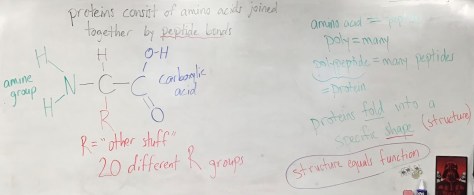
For the entry task, students were challenged to consider how genes begin and end. We discussed how mRNA sequences always begin with AUG (which codes for methionine, and amino acid which may also occur elsewhere in a protein). Students were then reminded of the three “stop codons” and we reviewed how those work to release a protein from the ribosome. We reviewed the structure of amino acids, focusing on the 20 different R groups and how those R groups each have different properties. The interactions between R groups determine protein shape, and shape determines protein function. When the sequence changes, the shape changes, thus changing the function of a protein. We then moved into the cystic fibrosis case study, first watching the video below and then working through the lesson PowerPoint.
Class notes:
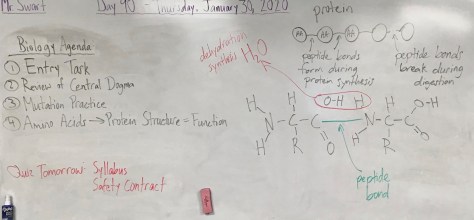
Thursday, January 30, 2020 (HS-LS3-2): For day one of our two-day lesson on the structure and function of genes, we reviewed Central Dogma via the first two slides of today’s PowerPoint. Next, we dug into the vocabulary of proteins, revisiting words like amino acid, peptide, polypeptide, protein, and peptide bonds. Students learned that proteins fold into specific structures (shapes) and that a protein’s structure determines its function. Next, we reviewed the structure of amino acids, and students received a handout with the names and structures of all 20 amino acids. We drew a model of two amino acids bonding via dehydration synthesis and forming a peptide bond. We then defined the R group for an amino acid and discussed how each amino acid contributes to the overall shape of a protein. Finally, we connected this review of Central Dogma back to the idea of traits by considering how DNA mutations can affect proteins, sometimes with drastic consequences.
Class Notes:
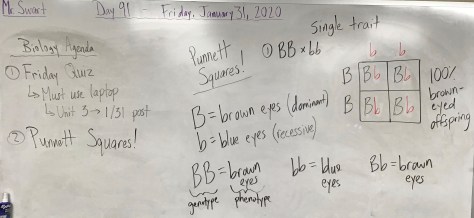
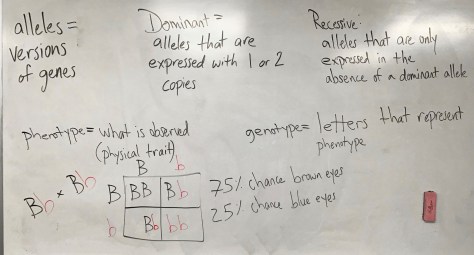
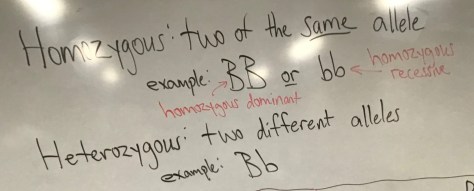
Friday, January 31, 2020 (HS-LS3-3): For our entry task today, students worked through the Friday Quiz (click here!) using the class Chromebooks. After the quiz, we previewed single-trait Punnett Squares to prime students for next week. Class notes are provided below:
Monday, January 20, 2020: Martin Luther King, Jr. Day (No School)
Tuesday, January 21, 2020:
For our final week of the semester and this unit, we refocus the Biome Project through the lens of “rewilding” – restoring an area of land to its natural uncultivated state (used especially with reference to the reintroduction of species of wild animal that have been driven out or exterminated).
After a class discussion focused on gathering student reactions to the concept of rewilding, students were tasked with selecting one or more articles about the topic to read and summarize for their Biome Project team on the team’s Google Doc in the Rewilding, Part 1 section.
Wednesday, January 22, 2020:To conclude this project, it is time to think big. REALLY BIG. In the Ted Talk yesterday by George Monbiot, he proposes the reintroduction of mega flora and fauna (really big plants and animals) that have gone extinct. Focusing specifically on your biome on your continent, research really big plants and animals that once lived in your area but have gone extinct some time in the past 10,000 years. Complete this section in the Team Google Doc in the Rewilding, Part 2 section.
As a group, select one mega flora (huge plant) and one mega fauna (huge animal) to reintroduce into your biome. Explain how reintroduction of each will impact the ecosystem of your biome. Complete this section in the Team Google Doc in the Rewilding, Part 2 section.
Next, predict how humans living on your continent in your biome might respond to reintroduction of the mega flora and mega fauna you reintroduced. How will culture be impacted? Complete this section in the Team Google Doc in the Rewilding, Part 2 section.
Finally, work together as a team to create a poster describing one aspect of culture as it exists today (before) and as it might exist in the future after rewilding. The poster should be colorful, creative, and able to be shared with the class on Friday, January 24.
Thursday, January 23, 2020: Work day! Complete all unfinished work on the Team Google Doc and work together to to create the team poster (see yesterday’s instructions and the Team Google Doc).
Friday, January 24, 2020: For the final day of the semester, and the final day of Unit 2, student groups must turn in a complete poster to display in class next week. Work together as a team to create a poster describing one aspect of culture as it exists today (before) and as it might exist in the future after rewilding. The poster should be colorful, creative, and able to be shared with the class on Friday, January 24. Posters and Team Google Docs will be evaluated over weekend and credit will be assigned as the last grades of first semester.






 Science with Swart
You must be logged in to post a comment.