Category Archives: Biology

Mutation and Selection Gizmo

After an abbreviated end to last week during which a late-start (snow) and two all-school activities conspired to limit our classroom time, we decided to start the class period with Jack Horner’s entertaining TED Talk in which he describes his research connecting dinosaurs and chickens.

After the video, we briefly discussed how scientists study embryology, the fossil record, atavisms, and behavior to add to our understanding of evolution.  Students were then released to work with a partner on the Mutation and Selection Gizmo.  Students were instructed to work at least through Activity A of the handout today in preparation for our work tomorrow.
Writing to Explain

What a week!  With 12 minute class periods yesterday and only 35 minutes today, we made the most of our time by completing and discussing the Cosmos video and then students were tasked with a “writing to explain” assignment where they compared and contrasted artificial and natural selection.  Most importantly, the assignment asked students to explain using evidence from the video.  The assignment is due Monday.

As we continue in our study of biology this school year, students will continue to practice the skill of explaining using evidence, with the expectation that students will draw on a variety of sources and learn to differentiate between credible and less-than-credible scientific resources.

Introduction to Evolution / Cosmos Video

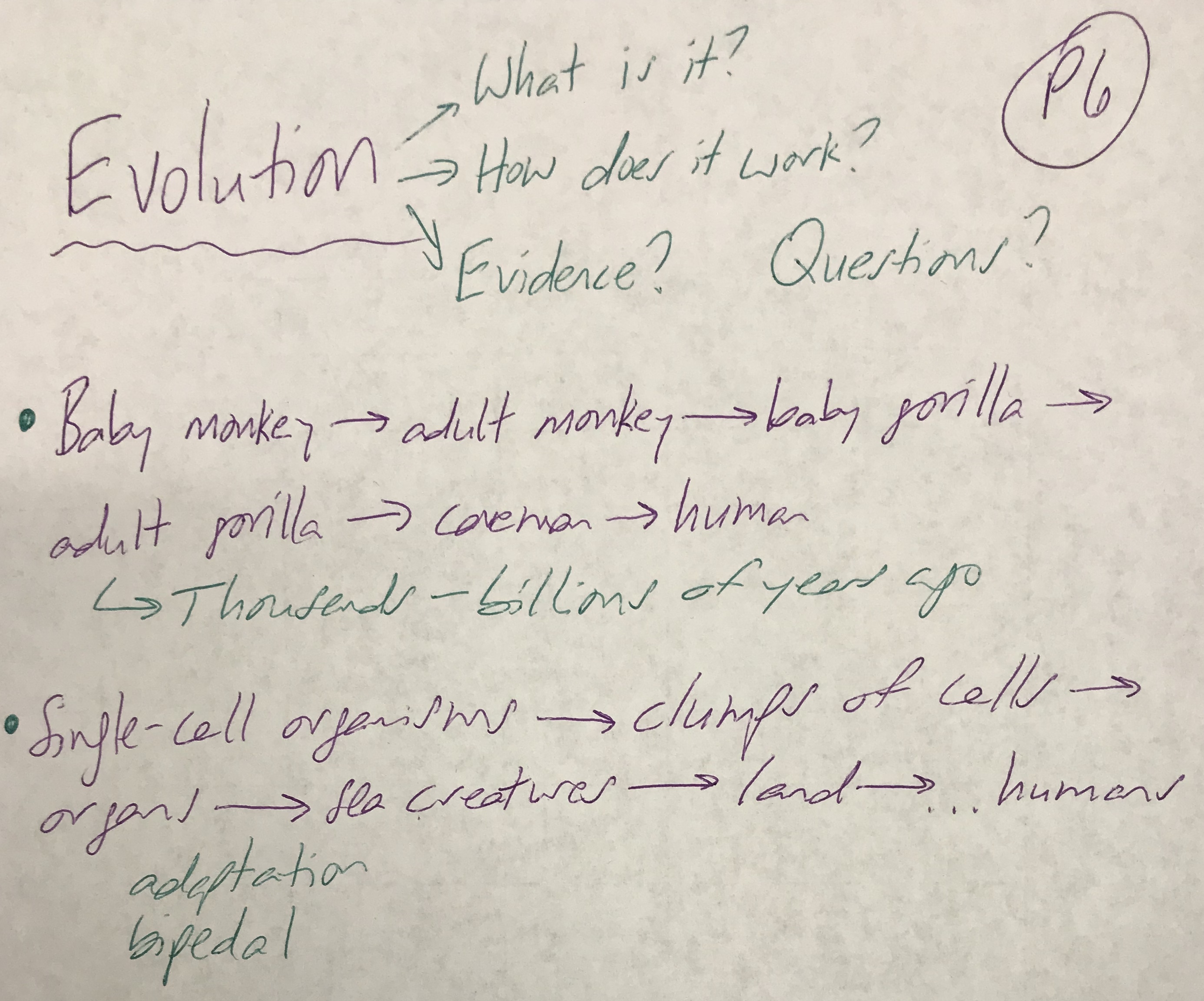
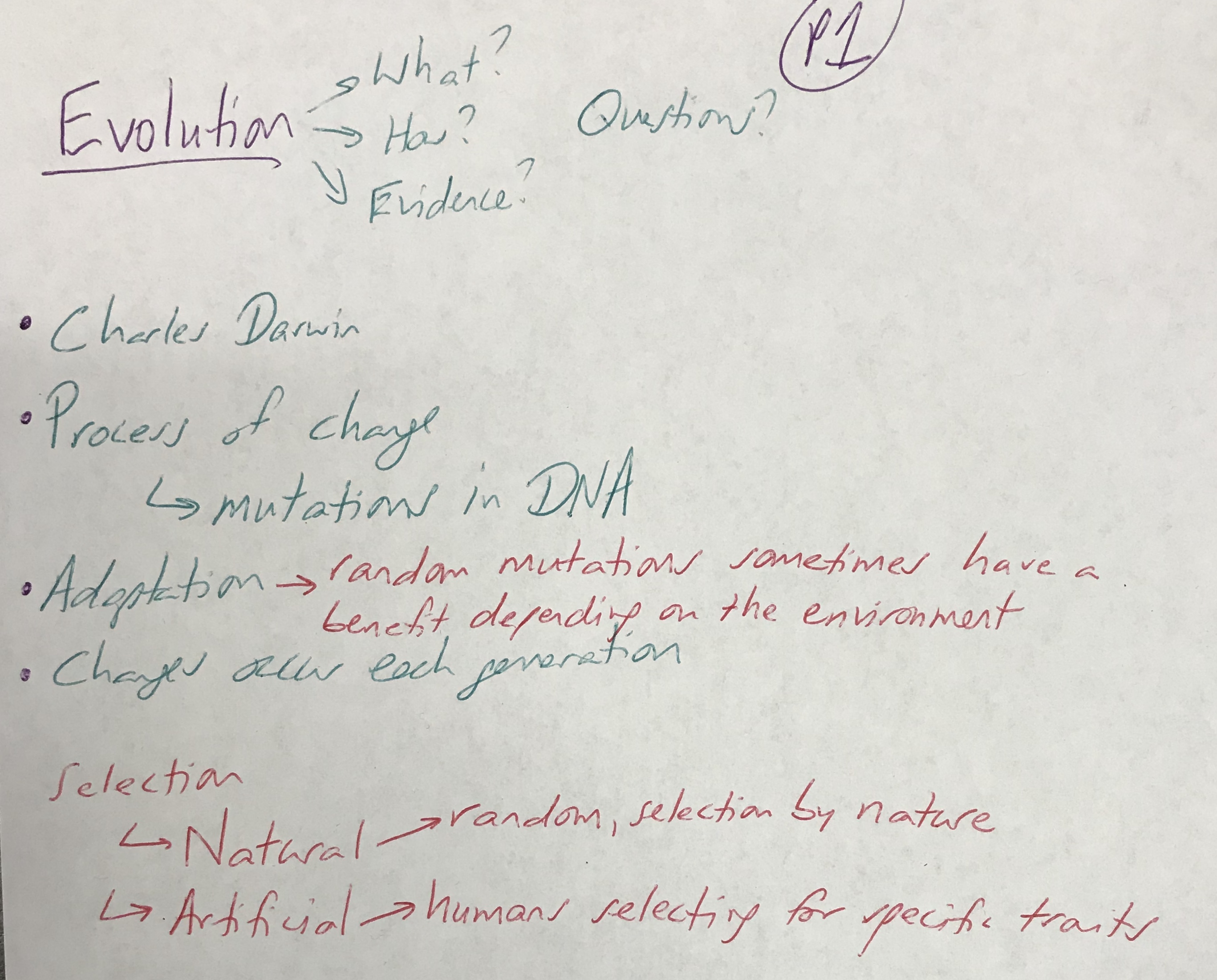
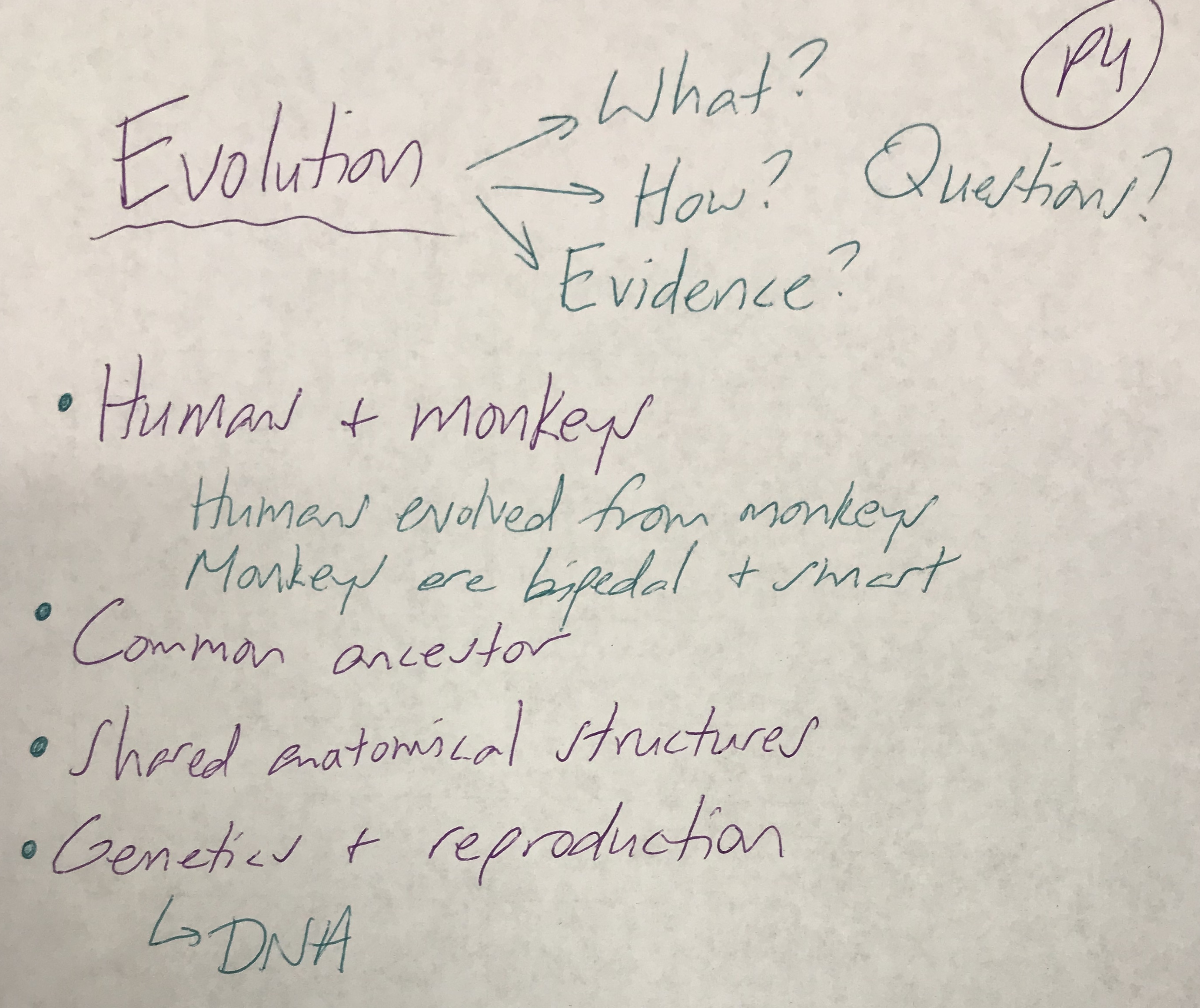
We began Unit 6 with a brief class discussion about what students know (or think they know) about evolution.  All student ideas were recorded and served as an entry point into the second episode of Cosmos from the 2014 series hosted by Dr. Neil deGrasse Tyson.  Student initial ideas are shared below.  We watched the first 30 minutes of the video today, pausing periodically to answer questions on the handout students received and which will be turned in after we complete the video tomorrow.  Students learned today during the episode (titled “Some of the Things That Molecules Do”):

  • dogs and wolves share a common ancestor (artificial selection);
  • polar bears and brown bears share a common ancestor (natural selection);
  • how random DNA mutations can occasionally produce desirable traits depending on the environment in which the organism with the mutation lives;
  • how all life on Earth is connected via DNA to a common ancestor (using the Tree of Life analogy);
  • how the evolution of sight can be traced all the way back to bacteria
1st period initial ideas
4th period initial ideas
6th period initial ideas

Reproductive Strategies Project

Class began with all students receiving a printed copy of the  Reproductive Strategies Project assignment.  We reviewed the assignment in class to ensure students understand the project deliverables.

Students may work alone or with one partner.

Presentations will take place on Thursday, February 15.  There will not be any time to work on presentations that day, so all work must be completed before class begins on the 15th.

For the presentation, you and your partner will make either a PowerPoint (Google Slides) or a poster.  For Google Slides presentations, you are welcome to include short videos (must be school appropriate!!!) depicting the reproductive strategies of one or both of the organisms you selected.  Remember, presentation time is limited to three minutes, so the videos must be brief, or you must identify a segment of the video to show in advance.

Need more challenge?  Add an organism – but select one from a different biological kingdom than the organisms you have already researched.  Remember, you must have two organisms in your presentation to earn full credit.  However, for each additional organism you include, you will earn 5 bonus points!  The six different kingdoms are pictured below:

Human Reproduction

As we enter the final week of Unit 5: Inheritance and Meiosis, we turn our attention toward the process of reproduction.  Class begins with a video which explains the process of human fertilization.  After a brief class discussion about what was learned and what questions remain, students were assigned a reading from the textbook along with the questions below:

In the BSCS textbook, read “Making More People” (p.477-481)

  1. How many ova are found in the ovaries of a newborn baby?
  2. How many ova mature into healthy ova?
  3. Where and when do ova begin maturing?
  4. Where are mature ova fertilized by sperm?
  5. Where are sperm formed?
  6. How long does it take an individual sperm to develop?
  7. How do sperm obtain the energy to swim through the female reproductive tract?
  8. How and why does the male body regulate testicle temperature?
  9. Explain the difference between a zygote, an embryo, and a fetus.
  10. What determines when a woman is ready to begin labor?

Turn in your response for credit and review the Reproductive Strategies Project assignment that we will formally begin as a class tomorrow.

Chromosome Project Poster Walk

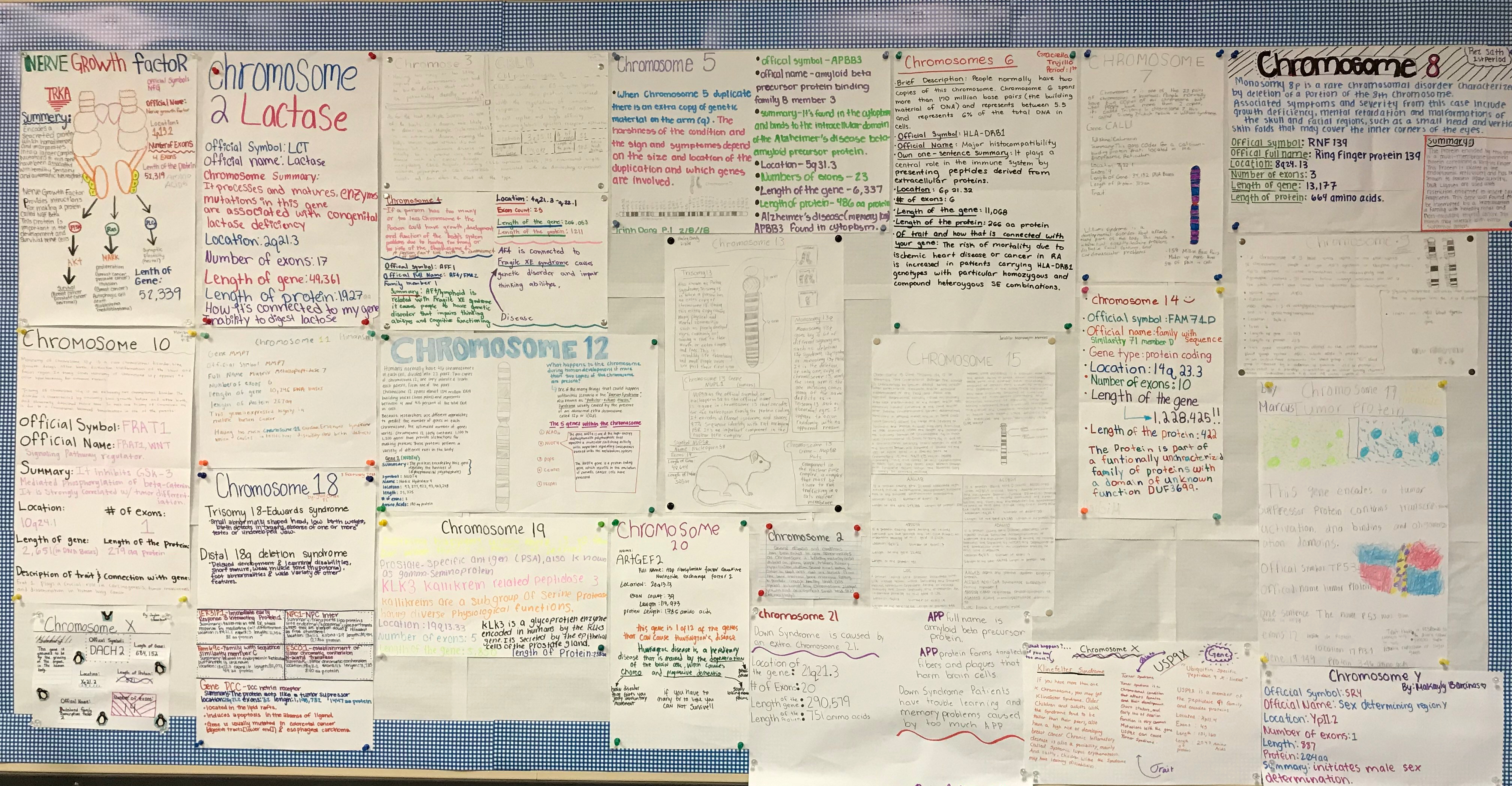
The chromosome project culminated today with a poster walk.  Students placed their posters on their desks and then looked over each other’s posters while completing the poster walk handout.  After the poster walk, students turned in the handout (15 points), their completed posters (10 points), and their research notes (25 points).

Selected Chromosome Project Posters

Chromosome Project

Welcome to the Chromosome Project!  Today you have the opportunity to select a chromosome for further research.  The goal of this project is to help you make a clear connection between DNA, genes, chromosomes, traits, and inheritance.

Your goals for Days 1 and 2 are as follows:

  1. Select one of the human chromosomes to research (autosomal chromosomes = 1-22 and the sex chromosomes are X and Y).
  2. Research and write down what happens during human development if more than two copies of the chromosome are present.  What happens if only one copy of the chromosome is present?  Be sure to document your sources!  One resource is the Wikipedia entry on aneuploidy.
  3. Conduct a search for “genes on chromosome____” and insert your selected chromosome.
  4. Research at least 5 genes on your chromosome.  Research = write it down!  You must document your work to receive credit.  For each gene, write down the key information about each gene.  How?  Read below:

To research your gene, visit the NCBI Human Genome Resources page and enter your gene name into the “Search For Human Genes” box.  When the search completes, click on your gene name (typically the first gene on the list) and browse through the entry.  There is a ton of information provided!  For each gene, write down the following:

  • Official Symbol
  • Official Name
  • Your own one-sentence summary of about the protein the gene codes for
  • Location of the gene on the chromosome
  • Number of exons in the gene
  • Length of the gene (in DNA bases) – hover your mouse over the top green line under the “genomic regions, transcripts, and products” and looking for the number after the word “length”)  
  • Length of the protein (in amino acids) the gene codes for – the length of the amino acid sequence can be found by clicking on the word “protein” on the right hand side of the page under Related Information.  Browse the entries for the full-length protein and note the number of amino acids in the protein.  The full-length protein can be challenging to find: look for an entry that does not include words like truncated, isoform, predicted, synthetic construct, or unnamed protein product.

Day 3: Select one of the genes from your list.  Research one trait associated with that gene and explain the connection between the gene and the trait.  For your final work, create a poster with the following information:

  • Chromosome
  • Brief description of what happens with too many or too few copies of the chromosome
  • For the gene you researched the most (and have trait information for):
    • Official Symbol
    • Official Name
    • Your own one-sentence summary of about the protein the gene codes for
    • Location of the gene on the chromosome
    • Number of exons in the gene
    • Length of the gene (in DNA bases)
    • Length of the protein (in amino acids)
    • Description of trait and how that is connected with your gene


Down Syndrome Case Study

Next, we transitioned in to the lesson about Down Syndrome.  We discussed the first three slides of the Down Syndrome Case Study slide deck and then detoured to the Wikipedia entry on aneuploidy.  We focused on the Types section of the entry, examining how, of the autosomal chromosomes, only Trisomy 21 will result in a viable fetus most of the time.  Students learned that when trisomy occurs in most of the other autosomal chromosomes, the result is an embryo that is non-viable, often resulting in miscarriage.

Back to the Case Study!  To learn how Trisomy 21 occurs, students watched a short video illustrating non-disjunction.  To put a human face on Trisomy 21, or Down Syndrome, students watched another short video about two young twins with Down Sydrome.  Both videos are shown below:

The second video naturally leads to questions about twins, so slide 5 explains the difference between identical and fraternal (non-identical) twins.  After slide 5, students received an article to read and annotate with questions about the connection between Down Syndrome and Alzheimer’s Disease.

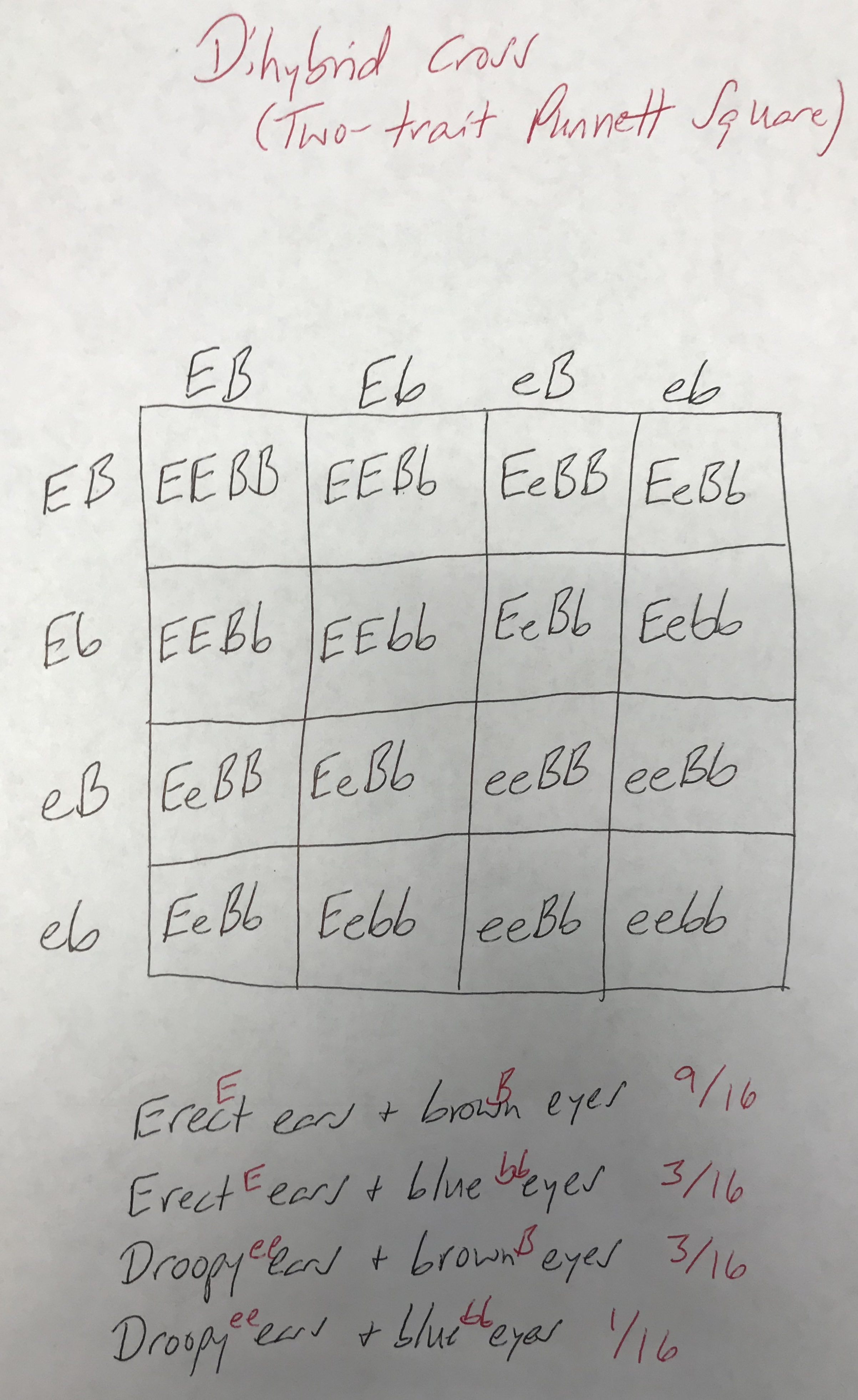
Diybrid Crosses (two-trait Punnett Squares)

As a review from last week’s  work on monohybrid crosses (single-trait Punnett Squares) and to extend student learning of Punnett Squares to dihybrid crosses (two- traits Punnett Squares), we began class with the following video by Mr. Anderson of Bozeman Science:

We then applied these concepts to a Two-Trait Punnett Square Gizmo in which students worked together in pairs to complete a work packet which included an additional review and application of the vocabulary learned thus far.

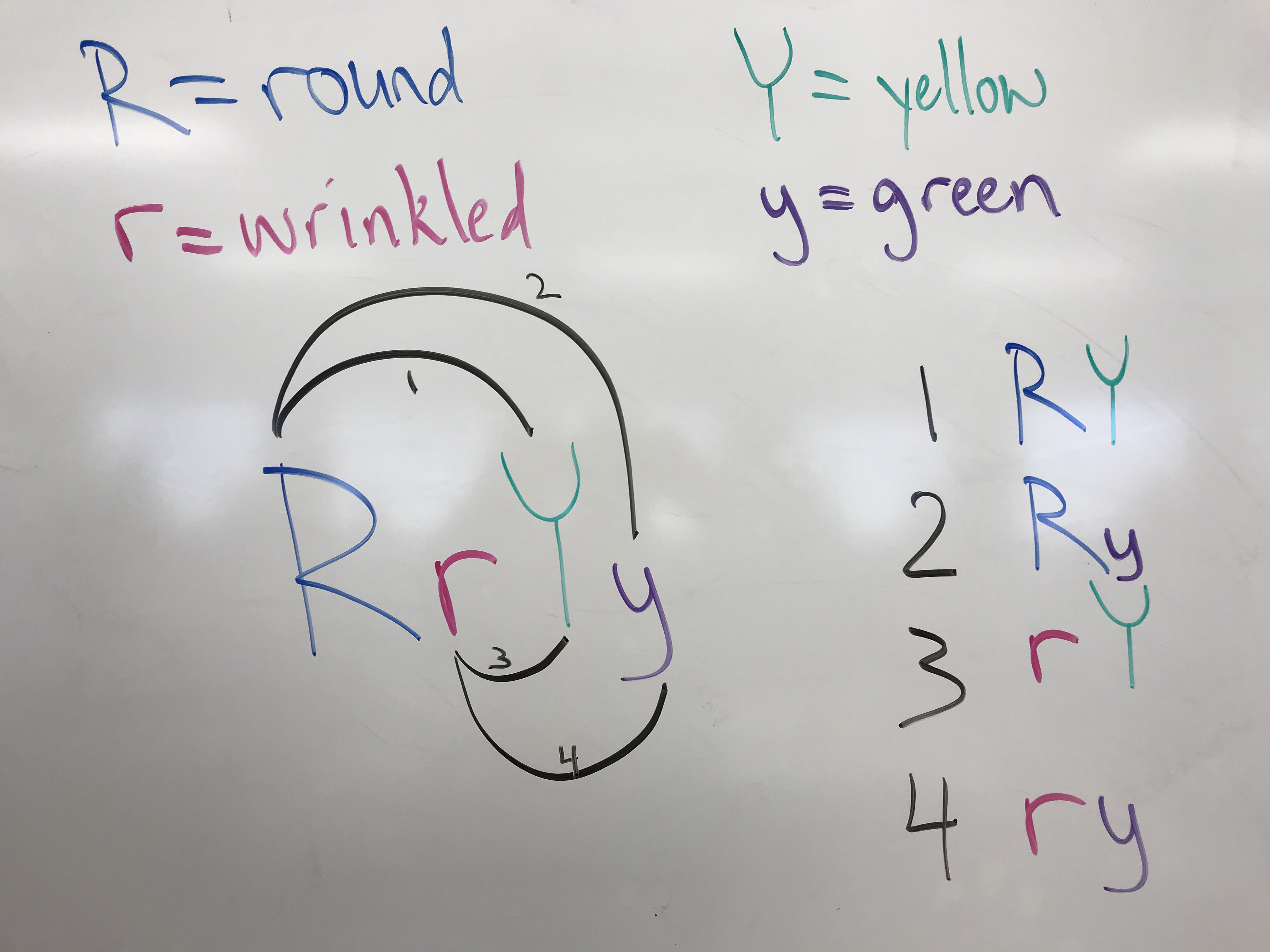
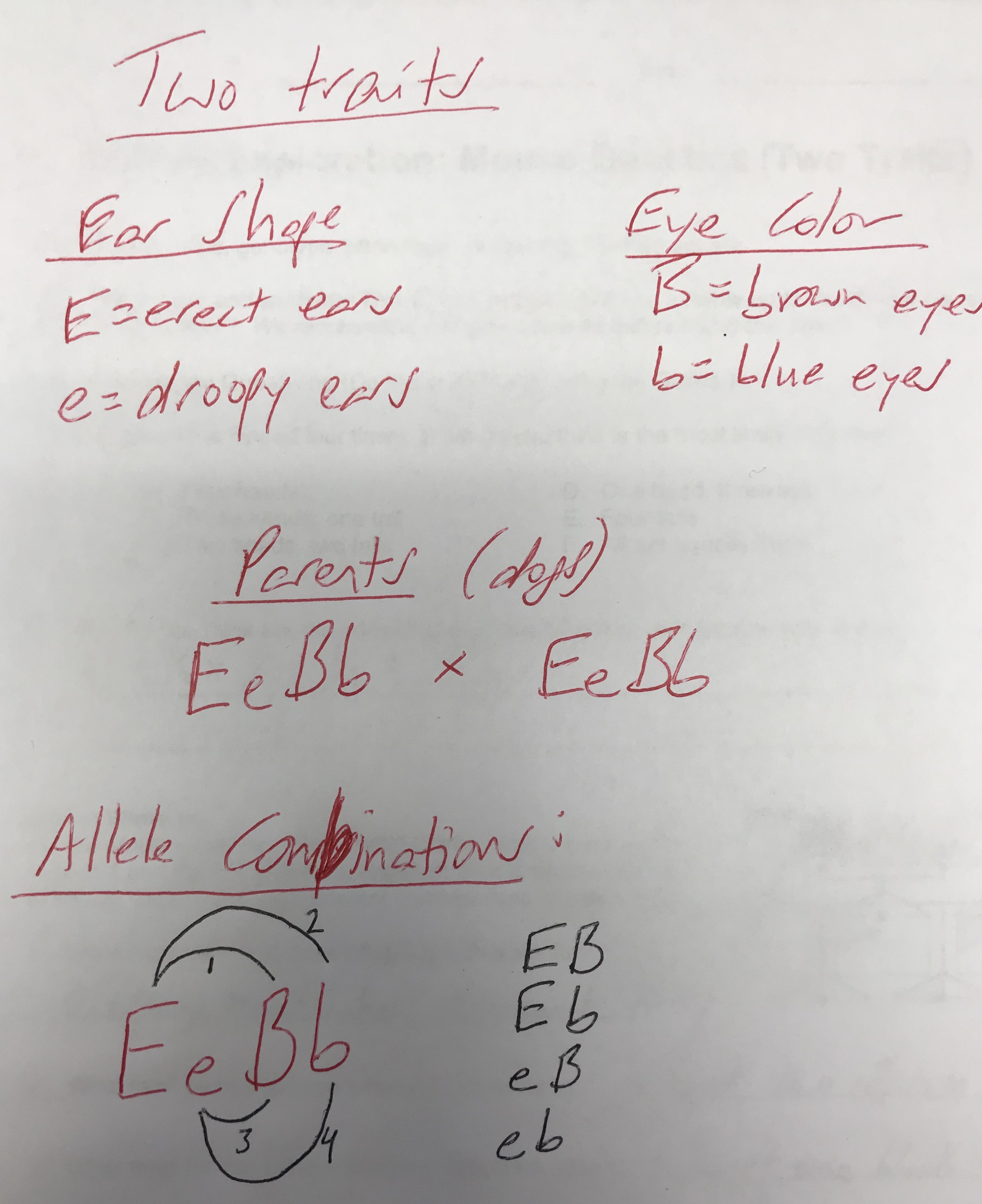
Notes from the white board for determining the alleles in a diybrid cross:

Modeling Meiosis

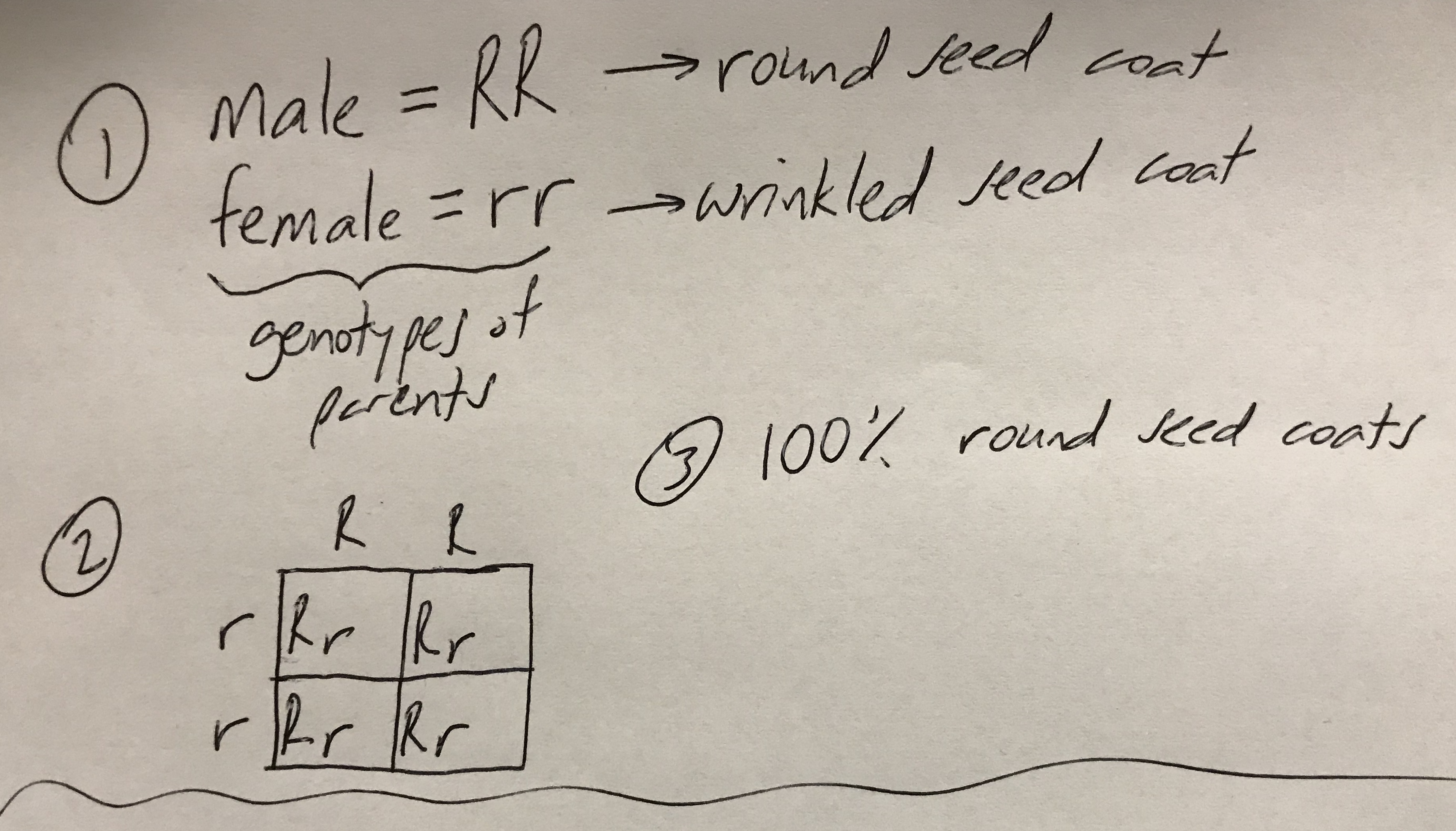
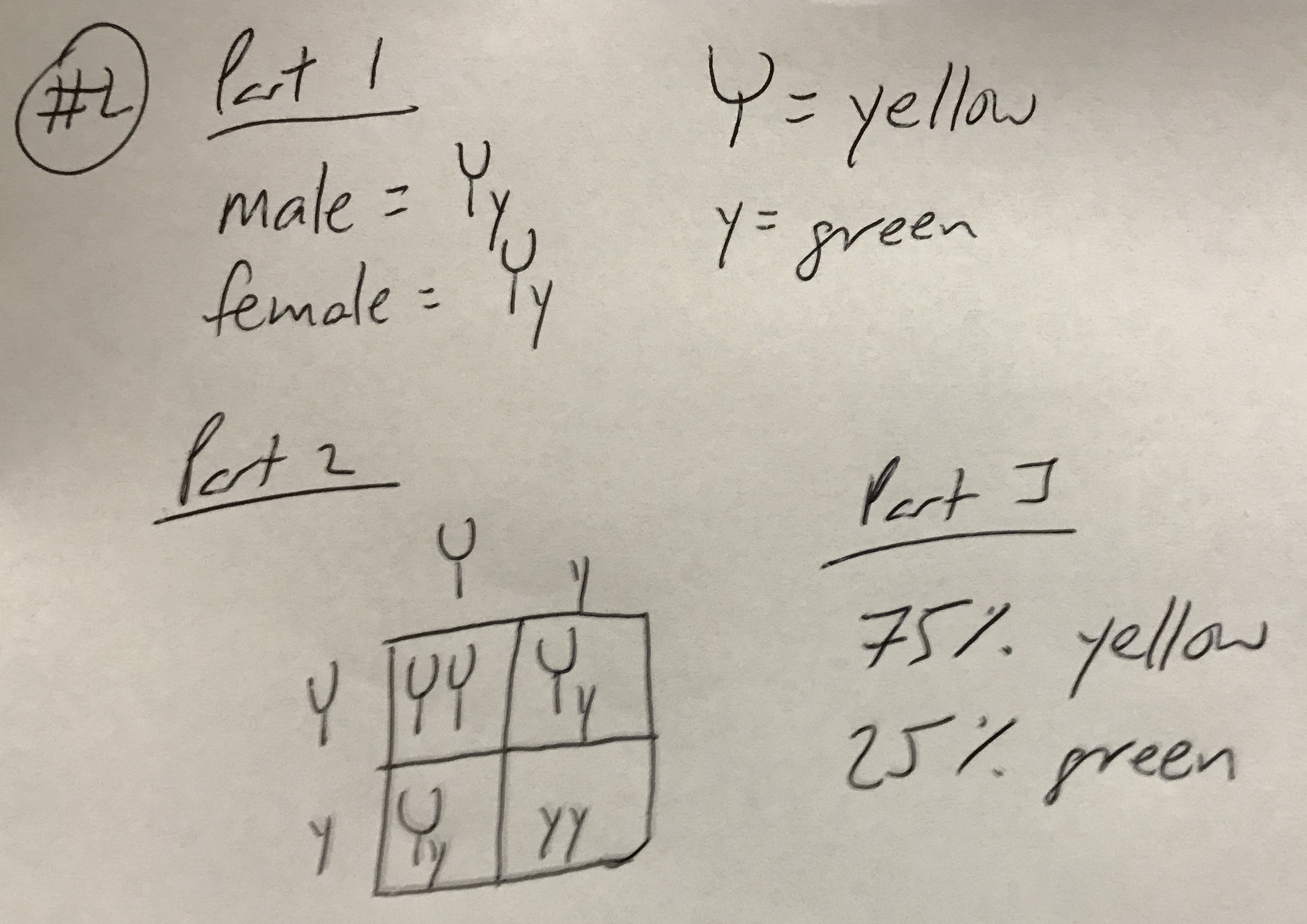
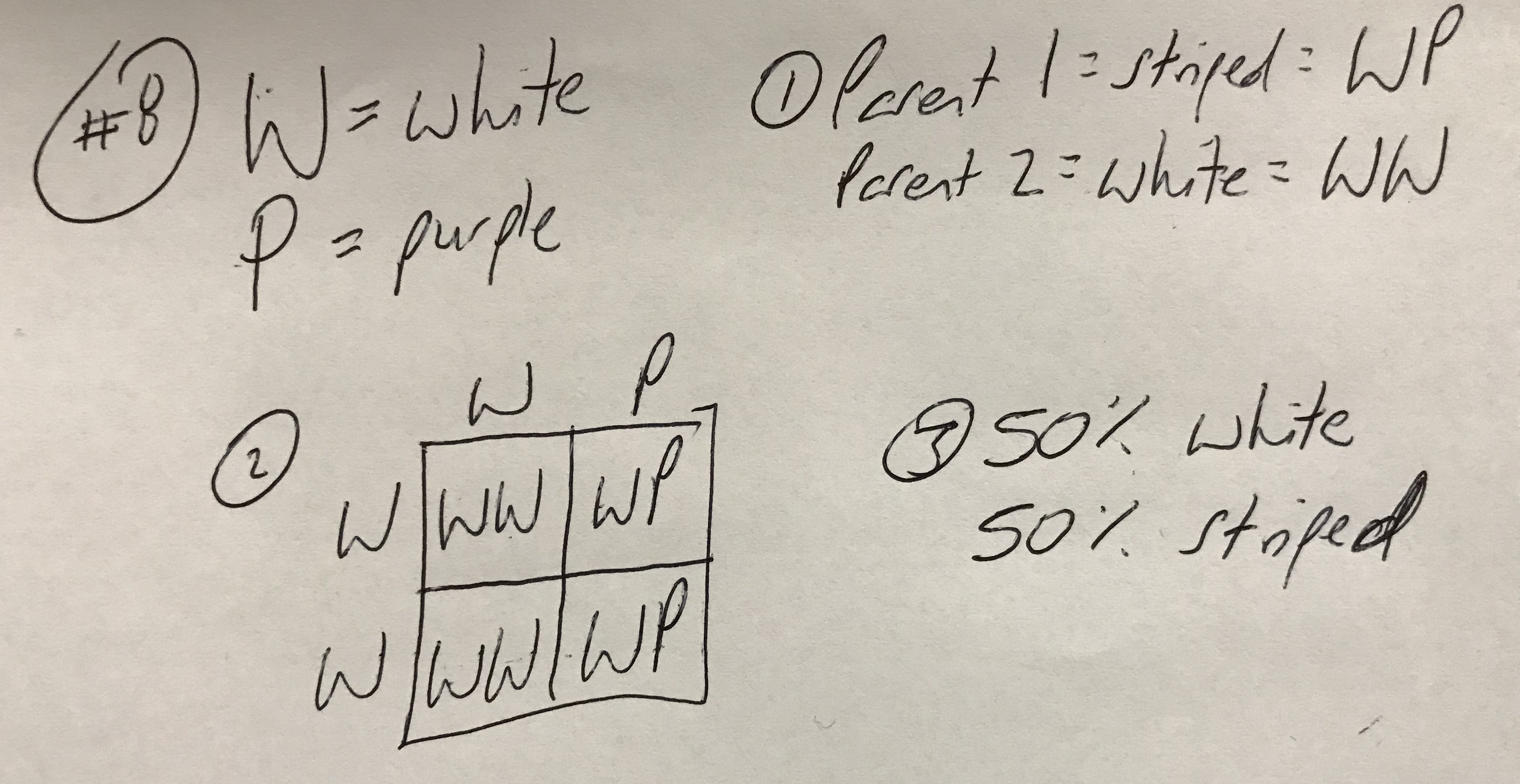
We reviewed problems 1, 2, 8, and 9 from yesterday’s Punnett Square worksheet at the start of class (work shown at the bottom of the post).  Next, we watched the Amoeba Sisters video about meiosis (below) and students worked through a guided worksheet.  After the video, students had the remainder of class to use the Inside the Cell books to help them complete the worksheet and to investigate the processes of independent assortment and crossing over.

Students then had the remainder of class to complete the worksheet, complete the meosis reading assignment from last Thursday, and to get both assignments checked off in Illuminate.