Welcome to the Evidence for Change across Time activity! As part of our Evolution Project, you were tasked with identifying careers associated with the study of evolution. We will expand on what you learned about those careers in this activity. You will be assigned to one of four careers. Your job: complete the assigned tasks for your career. Some parts of the activity should be completed as a team. Other parts are to be completed individually, with the understanding that the members of your group are available for consultation. You are expected to actively engage in your own learning and to share your learning with others.
For this project, you will be assigned to a team of 3 or 4 students. Each team will receive a folder. Please keep the materials in the folder organized as they will be used by students in multiple classes. You are expected to sit with your team this week and use class time efficiently. Please do not ask to change groups. You will present your work Friday, so your research and presentations must be completed and assembled before class begins Friday.
This work will count as your Evolution Unit Final Exam. To receive credit, you must complete all individual and group work, document all of your research, and turn in all of your documentation in addition to preparing and sharing your findings during the presentation. This will be your final grade for third quarter. Late work will not be accepted.
Once you receive your assignment, it’s time to go to work!
Notes from essay, “Evidence for Evolution: Vestigial structures” Not the one in the book
Answer to question 3a (pg 45)
Answer to question 4 a-b (pg 45)
Team: Create a poster that you can use to explain to your classmates of how fossils form and how they can be dated. Use the half-slip in your packet that explains exactly what needs to be in your final presentation.
Description of their career
How each of the following is evidence for evolution
Comparison of chicken dissection wing with bat wing and human hand diagrams
Description of vestigial structures (what, why & how)
Description of homologous structures (what, why & how)
Now that students better understand how scientists use radiometric dating to determine the age of physical items and structures, it is time to look into the deep history of Earth. Students should research the following events, determine when they occurred, and construct a timeline of the events:
First dinosaurs
Formation of Mount Rainier
First hominids
Break up of Pangea
First vertebrates
First life (bacteria)
First modern humans
First oxygen in the atmosphere
First land plants
First animals
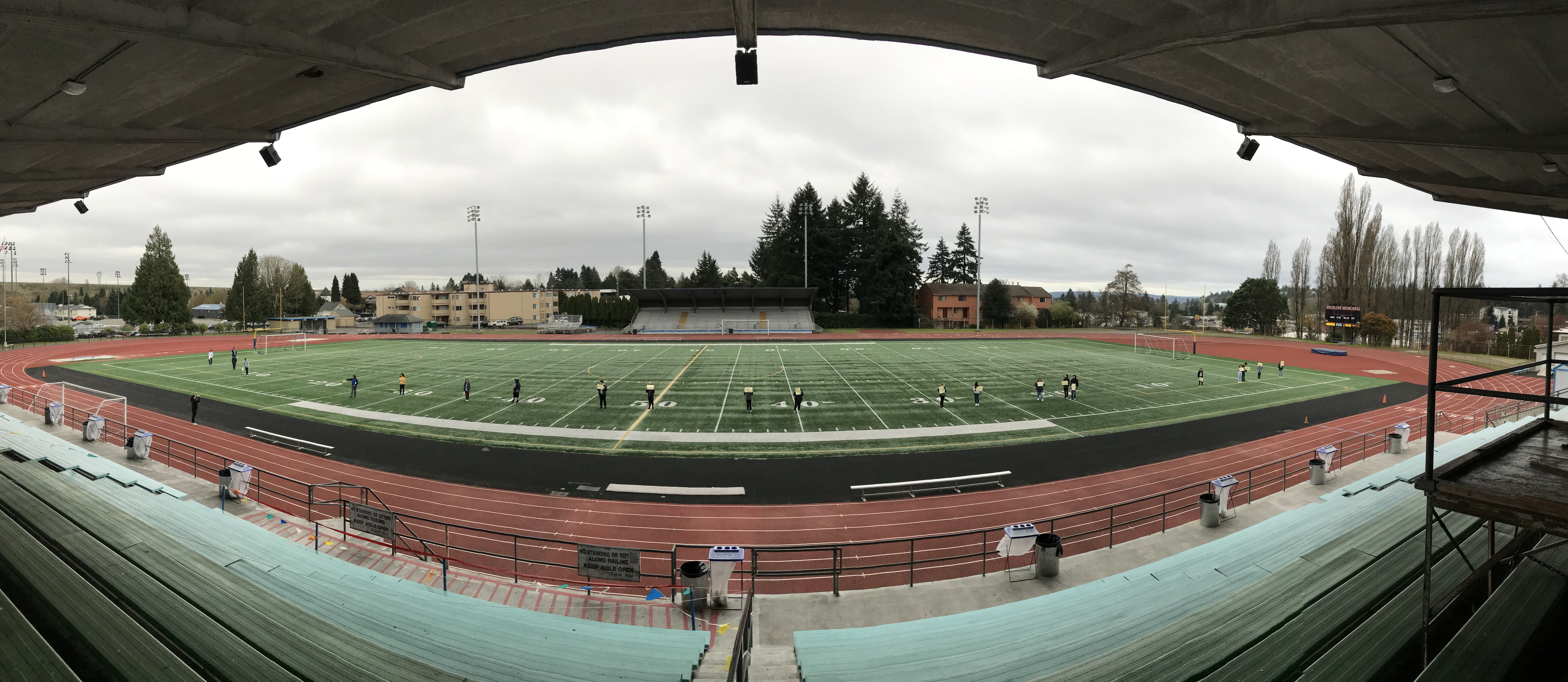
On Friday, we made a timeline of the last billion years of Earth history on the football field:
1st Period Timeline4th Period Timeline6th Period Timeline
After we debriefed the timeline exercise back in the classroom, if time permitted, students watched one of the two videos below:
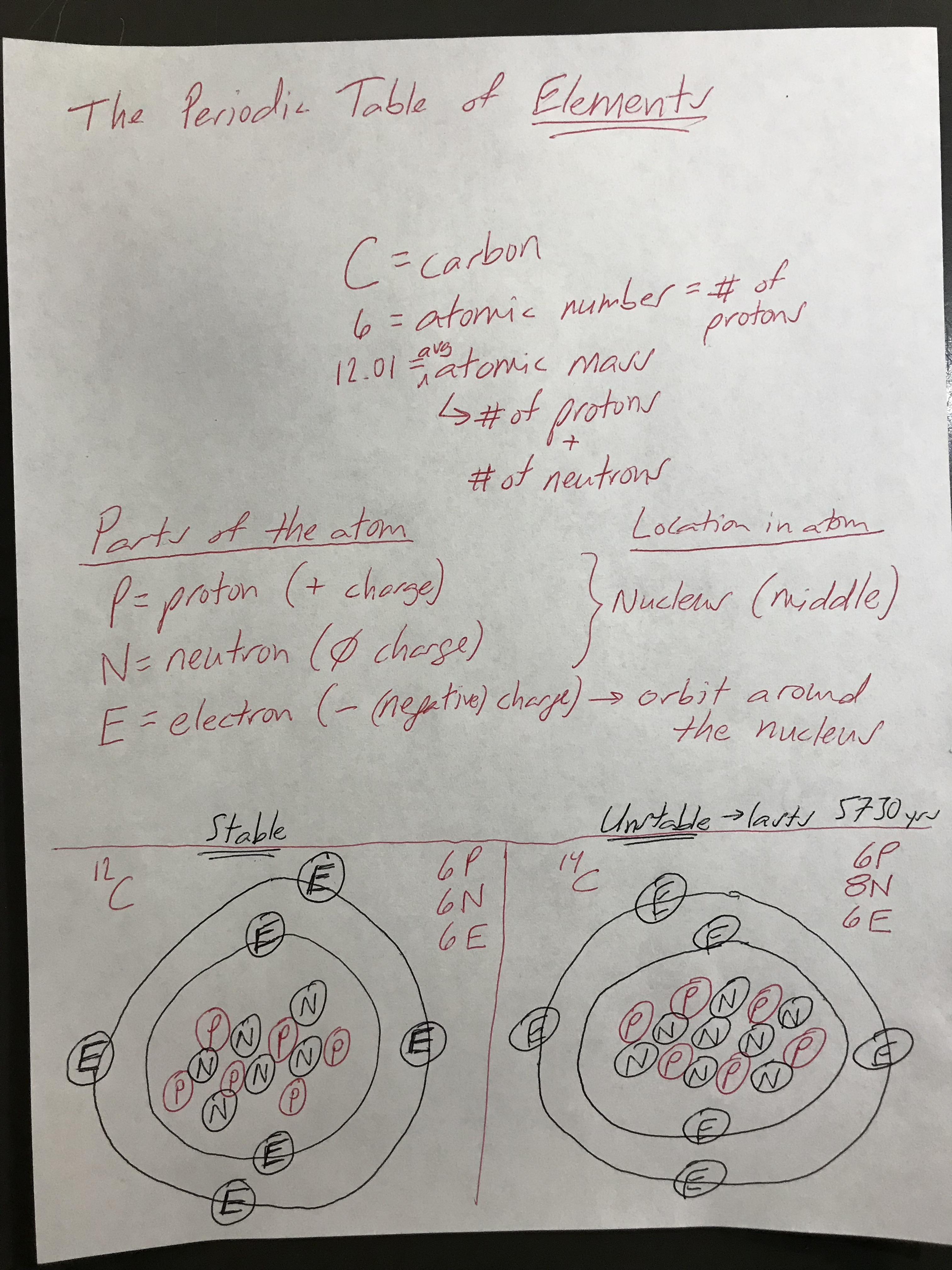
Last week, we learned about Darwin’s voyage and how he collected data to formulate his theory of evolution. We went on to study biological classification, using the system devised by Linneaus way back in 1735. Previously, we learned that scientists collecting were able to date common ancestors of humans to over 3 million years ago. Our work over the next few days will be to learn how scientists use radiometric dating to estimate the age of really old samples. We will begin an introduction to chemistry, focusing our efforts on understanding the difference between carbon-12 and carbon-14 atoms. Class notes are pictured below:
Next, we will watch a video introducing radiocarbon dating:
After the video, we will begin the Radioisotopes Activity. We will read through the first few pages, and then tomorrow students will work with a partner to complete the activity which is anticipated to wrap up by Wednesday.
We continued our investigation into the history of biological research by moving past Charles Darwin and learning about the work of Carolus Linneaus, the father of modern taxonomy. To help place the concept of taxonomy into historical perspective, we took a few notes connecting the discovery of the structure of DNA, the publication of Darwin’s work on evolution, and the publication of Linneaus’ work on taxonomy. Class notes are shown below:
Structure of DNA discovered in 1953
James Watson (1928- )
Francis Crick (1916-2004)
Rosalind Franklin (1920-1958)
Theory of Evolution, The Origin of Species (published 1859)
Charles Darwin (1809-1882)
Biological Classification / Taxonomy (Systema Naturae, published 1735)
Carolus Linneaus (1707-1778)
After the notes, students each received a copy of the Biological Classification POGIL and we worked through the first two pages together as a class. Students who would like additional learning about taxonomy are encouraged to watch the Crash Course video below:
Students who complete the POGIL activity early are encouraged to assemble and share with me a Google Slides consisting of organisms from as many different diverse species as possible. Each slide should include a picture of the organism, it’s common name, and the complete taxonomic naming (from Kingdom through Species).
On Friday, we will review the POGIL and work through the final problem of the (question 23) as a class. For the last few minutes of class, we will review slides 5-8 of a PowerPoint describing complex relationships between organisms.
Students are encouraged to watch a National Geographic video about zombie parasites this weekend. The presenter, Anand Varma, applies his expertise in photography to the study of parasites. Mr. Varma travels the world collecting specimen for study, and his ability to apply biological concepts to his work, think creatively, and drive to overcome failure make him and his work truly remarkable.
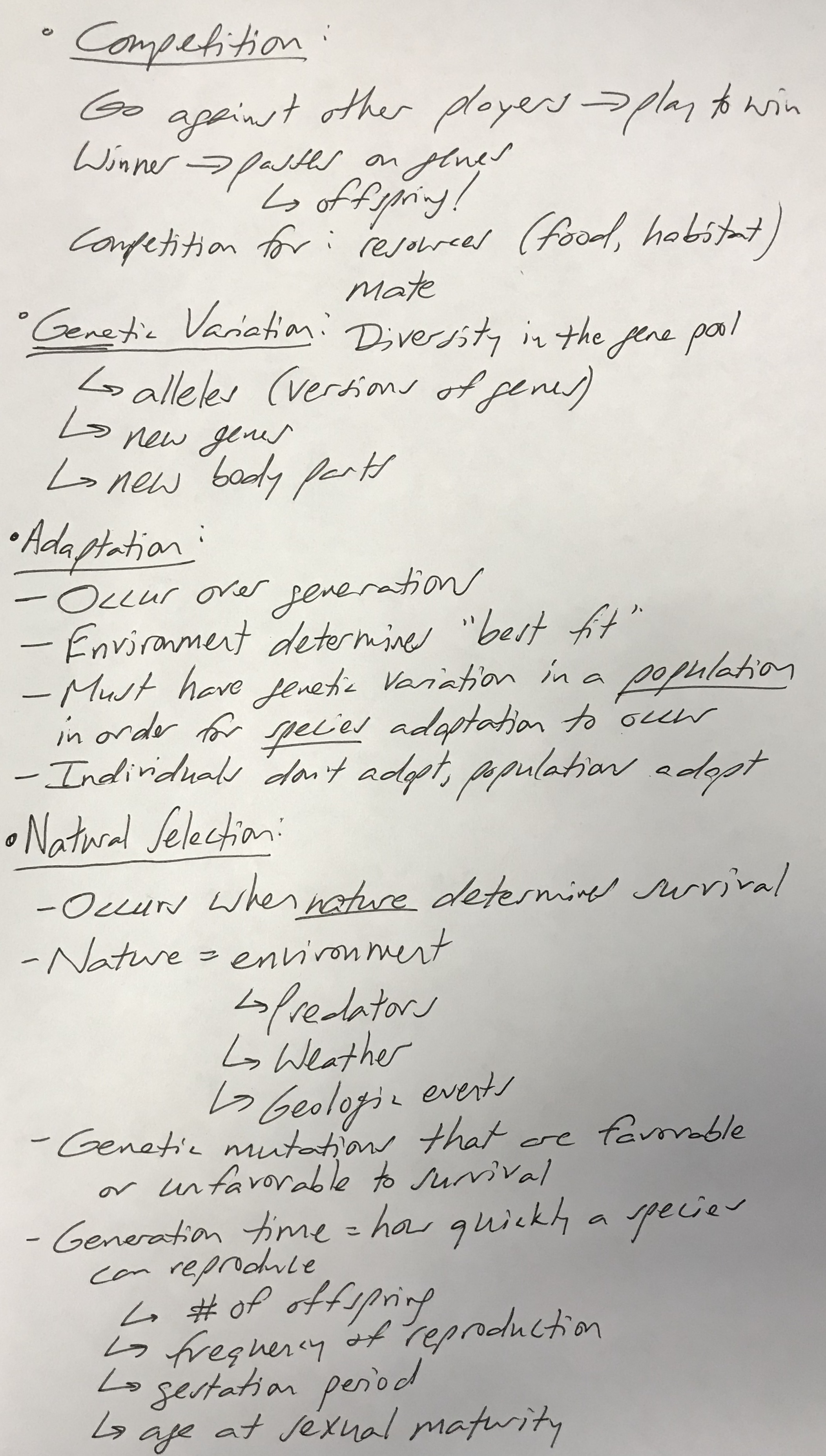
Despite the disruption of multiple fires started by students in the restrooms, we managed to take class notes on the four key facets of evolution studied thus far (pictured below). A few classes were able to begin the activity below the picture.
A part of Darwin’s journey to developing the idea of evolution was in the Galapagos Islands. You will start by taking a tour of where he went and what he observed. Go to Explore the Galapagos on the PBS NOVA website and go through the interactive tour. Answer the following questions in full sentences below in your lab notebook and turn in for credit:
Where are the Galapagos Islands?
First click on “Explore the Islands” and read about three of the islands. Summarize one observation for each of the three islands you read about.
Look at “Darwin’s Finches”. What do you think it means by unique niche, based on what the rest of the paragraph says?
How are the beaks different and why was that important?
Now click on “What Darwin Saw”. You will be going through his various stages and reading about what Darwin said (if you have headphones you can listen to the interviews as well). Summarize Darwin’s first impressions (just writing the opening sentence will get you zero credit, click for the full story).
What surprised Darwin on the islands?
What did the tortoises offer the local people? How did it benefit Darwin?
At first Darwin thought the birds were unrelated, but what ideas eventually came from his observations of the finches?
What was the fallout (or result) of Darwin’s journey?
Go back to the “Explore the Islands”. Look at some of the interpretative panoramics and the animals. Pick one (or two for a bonus point) animals and summarize their unique characteristics.
As a reward for a job well done on the Evolution Project and also because many students were on a field trip, we watched “Your Inner Monkey” in class today. Students who missed class are encouraged to watch the first 35 minutes this evening and we will finish the rest in class tomorrow. The video can be accessed for free on the HHMI website. Students have the option of completing a guided video worksheet for one bonus point.
Our study of evolution turns to an investigation of the enzyme lactase, which converts lactose (a sugar found in milk) into the sugars glucose and galactose. While lactase is found in the digestive system of infants, many adults no longer express the enzyme and thus suffer from lactose intolerance. However, there are populations of people in the world who continue to express lactase as adults. Such people are called lactase persistent. People who no longer produce lactase are called lactase nonpersistent (or more commonly, lactose intolerant). Today and tomorrow, students will investigate which populations of people around the world have developed lactase persistence, and they will analyze data and use their analysis to write a conclusion based on the Cultural-Historical Hypothesis. We will make use of a set of materials collected from a much larger body of work published by BSCS. We will also use the Complete Map of Test Results to complement the mapping work students will do using data from 70 different test subjects.
Note: the conclusion writing assignment is due Monday, March 5.
We will begin the lesson by watching the HHMI video Got Lactase? The Co-Evolution of Genes and Culture provided below:

 Science with Swart
You must be logged in to post a comment.