
All posts by David Swart

High school science teacher

Matter, Atomic Structure, and Bonding: Stable and Radioactive Isotopes

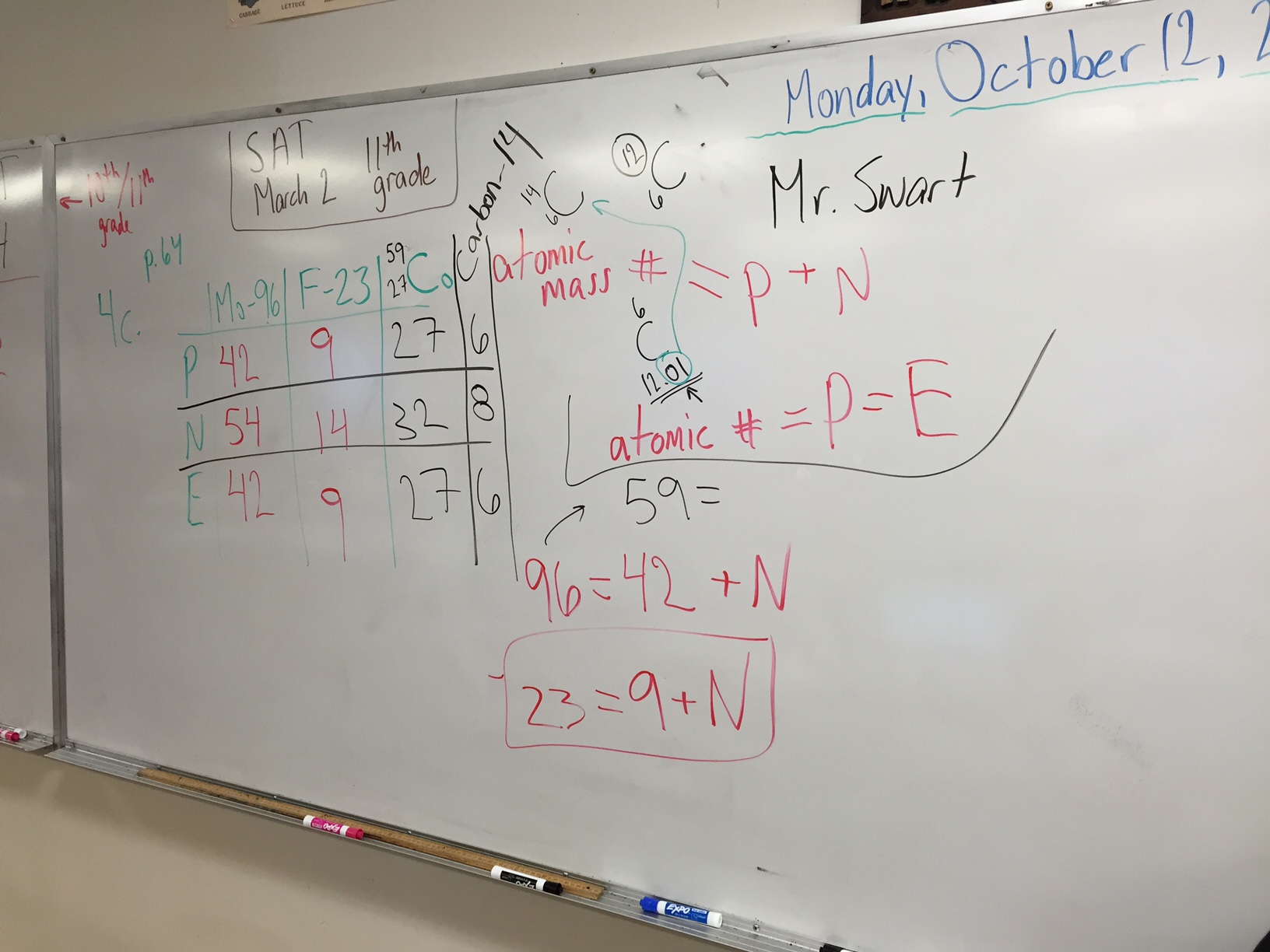
After the long weekend, we spent a majority of the class period reviewing Lesson 13.  Students had a lot of great questions focusing on how to calculate the number of protons and neutrons in a given atom, how to wrote isotopes, and how to calculate the average atomic mass of an element given the frequency of naturally occurring isotopes.  Pictures from the white board are shown below.  At the end of class, students received copies of the Lesson 14 Worksheet and the Chart of Naturally Occurring Isotopes.  Tomorrow, students will review the Lesson 14 PowerPoint, taking careful notes on slides 7-9 before working together to complete the worksheet and textbook questions 1-14.  Email me with any questions.
IMG_0011

IMG_0018

Updates: Students had a substitute on Tuesday (10/13) and then took the PSAT yesterday (10/14).  Today, we watched the final segments of Hunting the Elements (from 1:26:00 to the finish) to refresh student learning about neutrons and isotopes.  After the video, we worked through a few questions from the Lesson 14 worksheet and from the textbook.  Tomorrow (Friday) students will participate in a “write to explain” baseline assessment to support the science department’s goal of assessing how well our science students are able to clearly write scientific explanations so that we can work to improve their writing in that area.
Matter, Atomic Structure, and Bonding: Isotopes

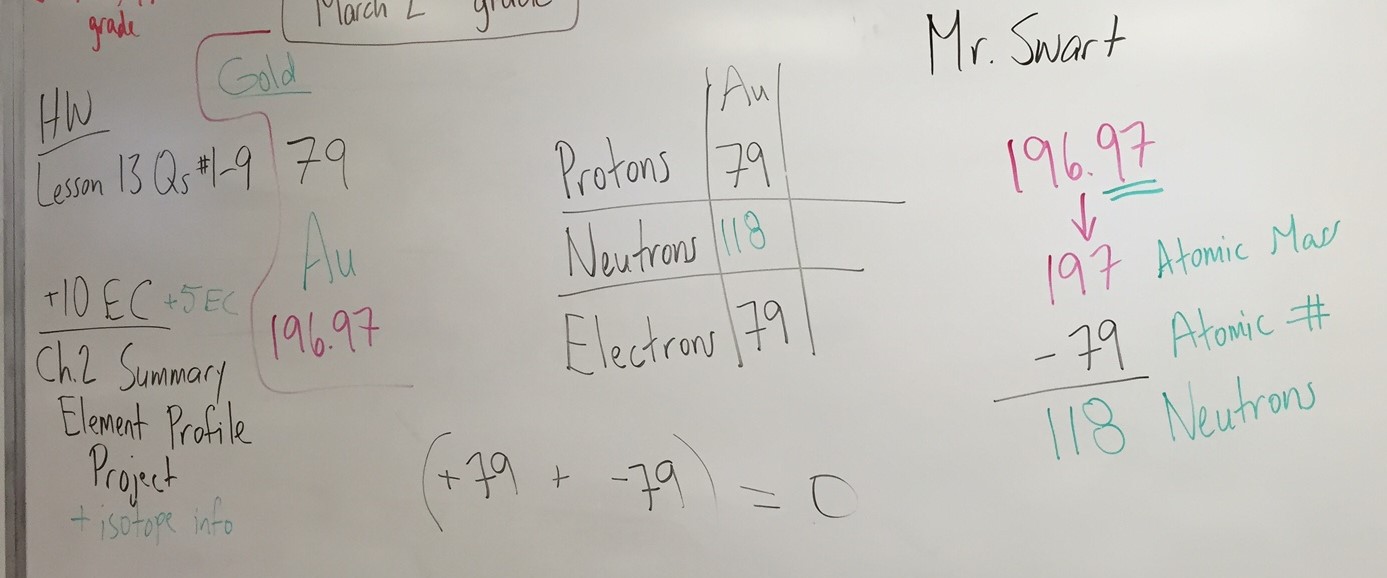
We extended our learning about neutrons yesterday with an lesson about isotopes.  The Lesson 13 PowerPoint explains how certain elements like carbon always contain the same number of protons, but may contain different numbers of neutrons.  Students then practiced calculating the number of protons, neutrons, and electrons on the Lesson 13 Worksheet.  For homework, students should complete questions 1-9 at the end of Lesson 13 in the textbook.  For extra credit, students may earn 10 extra points by researching about one of the elements and compiling their research into an  Element Profile Project (see Chapter 2 Summary page in the textbook for instructions).  An additional 5 points may be earned by adding on a section explaining which isotopes of the selected element are naturally occurring, the proportion of each isotope, and the atomic structure of each isotope (the number of protons, neutrons, and electrons in each isotope).  If an isotope has a particular scientific use, that should also be included.  Remember, no school tomorrow.

IMG_0008

Cells & Homeostasis: Extreme Environments

Today’s lesson focused on bridging student learning about extremophiles and our field trip set for this coming Monday.  We set our sights on defining “extreme environments”, learning about what makes an environment extreme and also about how some organisms are specially adapted to live in such environments.  The PowerPoint introduced students to the concept of a Bell-Shaped Curve, challenged them to articulate their own ideas about what constitutes extreme, and then provided an opportunity for discussion around how statisticians define “normal” and whether our own perspective about whether something is extreme necessarily involves judging an individual who looks or acts extreme.  We concluded the lesson after slide 26 and will complete the slide deck tomorrow.

Matter, Atomic Structure, and Bonding: Atomic Number and Atomic Mass

We continued our study of the atom by learning about the relationship between atomic number and atomic mass.  Before launching into the Lesson 12 PowerPoint, we paused and reviewed student questions about the Lesson 11 Worksheet.  We focused primarily on questions 3 and 5 from the worksheet, with responses drawn on the white board (pictured below, with the answer for question 3 on the left side of the board and question 5 on the right).

IMG_0006

The questions nicely led into the Lesson 12 PowerPoint, after which students had the remainder of the class period to complete the Lesson 12 Worksheet.  Aside from reviewing Lesson 12 in the textbook and reading Lesson 13 in preparation for class tomorrow, there was no additional homework assigned for this evening.

Matter, Atomic Structure, and Bonding: Models of the Atom

Chapter 3 began with a historical study of models of the atom.  The Lesson 11 PowerPoint provides key vocabulary around the components of the atom (proton, electron, neutron, and nucleus).  To go along with the Lesson 11 Worksheet, students also received a handout explaining the five models of the atom.  Students also received a copy of the Periodic Table for reference.  For homework, students should complete questions 1-5 from the end of Lesson 11 in the textbook.

Cells & Homeostasis: Types of Cells

Today we learned about the three major cell types: prokaryotes, eukaryotes, and archaea.  The PowerPoint included detailed notes on the similarities and differences of the cell types, and concluded with a SciShow video about the tardigrade.  Students then had time to read through the extremophiles reading packet which is due Wednesday.

As a reminder, we will meet in our classroom at the beginning of the class period, after which we will head down to the library for a meeting with Christine Froschl, Outreach and Volunteer Coordinator at the Environmental Science Center at Seahurst Park.  Ms. Froschl will be speaking to us about the ESC and will prepare us for our upcoming field trip to Seahurst Park.

Cells & Homeostasis: Cell Membrane Function Quiz

As promised, students were quizzed on their understanding of the content we covered on Monday’s lesson on Membrane Function.  Specifically, students needed to apply their learning of several key vocabulary terms to an example of a plant in a solution analogous to an egg in corn syrup.  Because the quiz was content-rich, students were allowed to use their written notes, as well as their phones to access the PowerPoint from Monday’s lesson.  As we progress into the year, supports like using notes on quizzes will be removed, with students having to improve study habits in order to commit content to memory.

Matter, Atomic Structure, and Bonding: The Periodic Table

We continued our exploration of the Periodic Table by working through the first 13 slides of the Lesson 10 PowerPoint.  Students then worked through most of the Lesson 10 worksheet with their groups from yesterday.  We will complete both the slide deck and the worksheet activity tomorrow.

Update 10/2 – Students completed the Lesson 10 worksheet in class and were also assigned the Lesson 10 questions from the textbook.  In advance of Monday’s Chapter 2 quiz, students received practice copies of the Chapter 2 Multiple Choice and Short Answer quizzes.  Students were also encouraged to work through the Chapter 2 review questions on page 49 of the textbook.  The review questions and practice quizzes are not assigned and do not need to be turned in for credit.