All posts by David Swart

High school science teacher

EOC Review: Unit 4 Review / Research and Explore

With several students in each of my classes absent because of the Algebra EOC, we used the class period to review a variety of concepts up through Unit 4.  Students reviewed the water, carbon, and nitrogen cycles by reviewing posters they had made earlier in the school year.  For students who were absent, an example of one poster is provided below:

IMG_0821.JPG

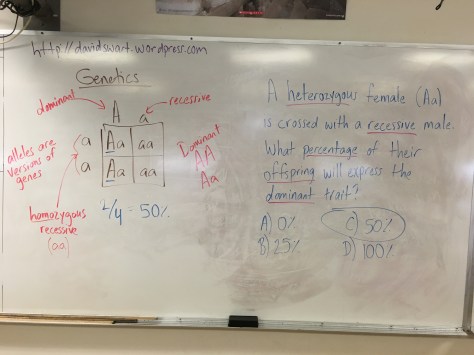
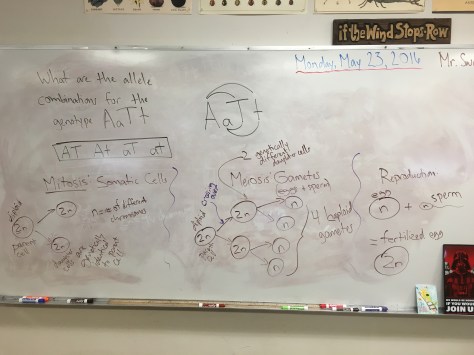
We also reviewed genetics (vocabulary, single-trait Punnett Squares, and dihybrid crosses) along with mitosis, meiosis, and fertilization.

IMG_0819IMG_0820

Students in attendance also received a copy of the EOC-style writing prompt called Research and Explore.  We spent a few minutes discussing the prompt and looking at the rubric, and students are welcome to practice working through the prompt as homework.  The prompt will not be collected as homework.

EOC Review: Jeopardy

With multiple students scheduled to take both the Algebra and Geometry EOC exams tomorrow and Wednesday, followed by the Biology EOC on Thursday, today was the final day available for a whole-class content review.  We used the class period to play a special biology edition of Jeopardy! Students partnered with one or two other students and they worked together as a group to answer questions using white boards.  With only 45 seconds to answer each question, students had to draw primarily from content they have already mastered.  Several of the questions came directly from previous Biology EOC practice exams, with the intent to prepare students as well as possible for what they will experience on Thursday (although they will not have notes available to consult during the exam).

Ecology: Ecology

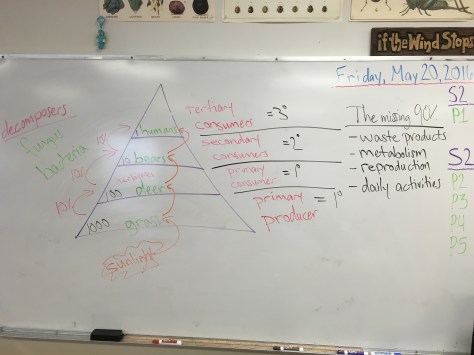
With an extended advisory scheduled to support the Pirate Pride work party, we used our 30 minutes of class time to sprint through the key learning about ecology.  Some of the content originated previously during the Harmful Algal Bloom portion of Unit 1 as well as during the energy and metabolism unit (Unit 2).  The notes below highlight the key learning about ecology that students should commit to memory prior to the Biology EOC Exam.

IMG_0809IMG_0808

EOC Review: Unit 3 Review / Test Solution

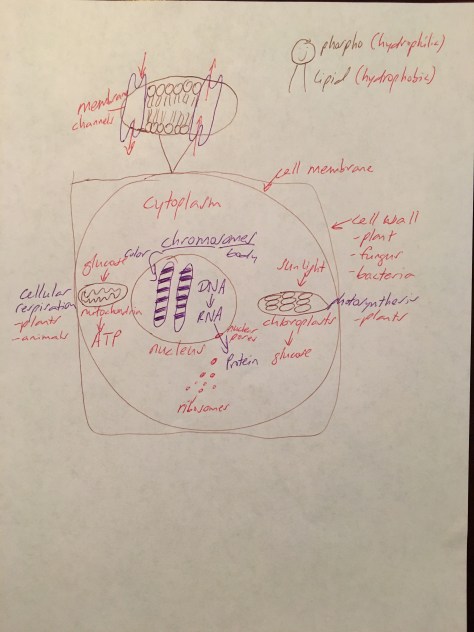
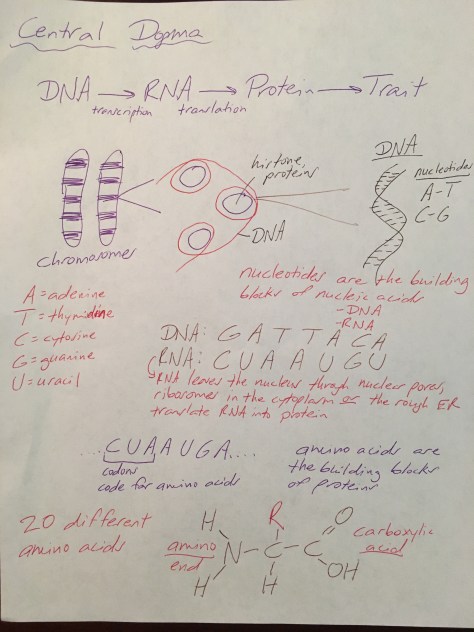
Class today was divided into two parts: a review of Unit 3 followed by practice with an EOC writing prompt called a Test Solution.  Our review began with students drawing a cell and labeling the organelles, weaving in key vocabulary terms.  The review ended with students drawing out the process of Central Dogma, with an emphasis on vocabulary and a refresher on the connection between DNA, RNA, proteins, and the subunits that comprise them.  Pictures of notes from today are shown below.

IMG_0804IMG_0805

EOC Review: Criteria and Constraints

Our focus today was to become familiar with and practice responding to the Criteria and Constraints biology EOC writing prompt.  The practice prompt asked students to consider the scenario of 3D-printed coral reefs, so to help students better understand the prompt and formulate some ideas, we watched short segments of three different videos:

Students then had at least 15 minutes to respond to the Criteria and Constraints example prompt. After that, we came together as a class and shared out ideas. A selection of student ideas are listed below:

  • Materials could dissolve / erode / cause pollution
  • Algae may not grow on the materials
  • Ocean acidification is dissolving the shells of marine organisms, and the artificial reef will not prevent that process
  • Intentional placement / size/ shape of reefs
  • Access to skilled workforce and heavy machinery / power requirements
  • Could affect the life cycles of coral reef organisms
  • 3D printing process may not produce detailed enough coral

After the share-out, the remaining few minutes of class time were spent addressing some of the student-provided constraints by watching a video detailing one sculptor’s efforts to create an enormous coral reef habitat in the Bahamas.

EOC Review: Review of Units 1 and 2

To help prepare students for the Biology End of Course exam, students received two different practice worksheets.  By treating the cell organelle matching worksheet (page 1) as a quiz (no talking, no cell phones, no collaboration), students were able to self-assess their preparedness for that section of the EOC.  After about 15 minutes of private think time, we reviewed the answers as a class.  Students were then tasked with answering the cellular respiration and photosynthesis questions on the back of page 3 of the worksheets.  Again, we reviewed the answers as a class after some quiet work time (pictured below).  Finally, we concluded with 15 EOC-style questions (13 multiple choice and 2 short answer) that reinforced the organelle practice.  Students were then encouraged to review the organelles at home, and blank note cards were offered to students who want to make flash cards as a review tool.

Office Lens 20160516-141553.jpg

Chapter 17: Toxic Cleanup

For Chapter 17, students will each participate in a project designed to meet the learning targets of the chapter while de-emphasizing the focus on daily worksheets.  Students are still responsible for reading the individual lessons in the chapter and applying their learning to the project.  While the project is an individual assignment, students are encouraged to collaborate and time will be allocated for students assigned the same topic to share and compare their work.


Part 1: Locate your assigned reactant pair below.  Each reactant in the pair is hyperlinked, and the link will take you to the Material Safety Data Sheet (MSDS) for the chemical.  The MSDS contains 16 different sections.  Read through the sections, locate the following information for both reactants, and summarize in a Google Doc:

  • Chemical Name
  • Chemical Formula
  • CAS #
  • Oral LD50 for Rat

Next, read through MSDS Sections 4-16.  Summarize the most important information relating to safety, exposure, handling, and disposal.  If the information for proper disposal is not specific, refer to the schools chemical database on the King County Rehab the Lab website.

After locating and summarizing the information above, use the rat LD50 (oral exposure) to calculate the LD50 for a human with a mass of 80 kg (176 pounds).  Repeat for humans with a mass of 50 kg and 20 kg.  Graph the results in Google Sheets and then copy the graph into your Google Doc.  For step-by-step instructions, watch the video below:


Reactant Pairs:

  1. NaCl + KNO3
  2. NaClMg(NO3)2
  3. NaClCu(NO3)2
  4. NaClAgNO3
  5. Na2CO3 + KNO3
  6. Na2CO3Mg(NO3)2
  7. Na2CO3Cu(NO3)2
  8. Na2CO3AgNO3
  9. NaOH + KNO3
  10. NaOHMg(NO3)2
  11. NaOHCu(NO3)2
  12. NaOHAgNO3

For specific information on NaOH toxicity, view page B2 of the BASF Chemical Emergency Medical Guidelines document.


Part 2: Next, determine the missing product of your assigned reaction.  To assist in your efforts, one of the two products is provided:

  1. NaCl and KNO3 → NaNO3 + ?
  2. NaCl and Mg(NO3)2 → NaNO3 + ?
  3. NaCl and Cu(NO3)2 → NaNO3 + ?
  4. NaCl and AgNO3 → NaNO3 + ?
  5. Na2CO3 and KNO3 → NaNO3 + ?
  6. Na2CO3 and Mg(NO3)2 → NaNO3 + ?
  7. Na2CO3 and Cu(NO3)2 → NaNO3 + ?
  8. Na2CO3 and AgNO3 → NaNO3 + ?
  9. NaOH and KNO3 → NaNO3 + ?
  10. NaOH and Mg(NO3)2 → NaNO3 + ?
  11. NaOH and Cu(NO3)2 → NaNO3 + ?
  12. NaOH and AgNO3 → NaNO3 + ?

As with the reactants, repeat the review process with the NaNO3 MSDS.  In addition, after correctly solving the equation for the missing product (confirm your answer with Mr. Swart), search for the MSDS for the confirmed second product and again work through both the MSDS summary process and the LD50 calculations with graphing.  A simple Google search for the chemical formula and MSDS will help you locate the MSDS.

Now that you know all of the reactants and products in your assigned equation, balance the chemical equation.  Practice balancing the remaining equations by first solving for the unknown product and then balancing them out.  Record all of your work in your Google Doc.  We worked through multiple examples on the white board and the work is pictured below:


Part 3: Focusing once again on your assigned chemical reaction, calculate the number of grams per mole of each reactant and product.  Does the total reactant mass equal the total product mass?  Why or why not?  Show how you can use the mole ratios (the numbers written in front of your balanced equation) to demonstrate the Law of Conservation of Mass.  Again, record your work in your Google Doc.  Compare your work with the other students who were assigned the same reactants as you were.  You will be working together as a small group to complete the lab portion of this project.


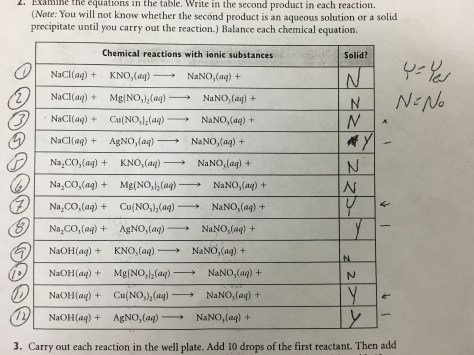
Part 4: Lesson 90 lab!  Students combined the reactants from their assigned chemical reaction and created a class data set by reporting whether or not the products formed in their reaction produced a solid.  The Lesson 90 Worksheet provides details of the lab.  Our class results are shown below.  Note: according to the textbook, reactions 6 and 10 also should have produced a solid product.
FullSizeRender (2)


Part 5: For the final part of the research report, students should update their data to include which chemical reactions from the Lesson 90 lab produced solids and which did not.  The research report should include a discussion of questions 5 and 6 from the Lesson 90 Worksheet.  Explain why you think mixing certain compounds produces a solid while other mixed compounds remain in solution.  Research reports are due Wednesday, June 1.


Research Report Checklist

□ For both of your assigned reactants and the products formed after the reaction:

  • Chemical Name
  • Chemical Formula
  • CAS #
  • Oral LD50 for Rat

□ Summary of MSDS sections 4 through 16.  Note: summarize each section in one sentence, focusing on the theme of the section rather than specific information.

□ Calculate the lethal dose for a human with a mass of 20 kg, 50 kg, and 80 kg using the oral rat LD50 for all 4 of your compounds.  Graph the results with mass on the X axis and lethal dose on the Y axis.  Copy the graph into your Research Report.

□ Balance all 12 of the reactions, solving for the missing product in each reaction.  Remember to first balance the individual compounds based on charge, and then balance the overall equation using molar ratios.

□ For your assigned reaction, calculate the molar mass of each compound in your reaction.  If the reaction is properly balanced, the reactant mass will equal the product mass.

□ Include the results of the Lesson 90 lab, specifically including which products formed solids and which did not.

□ Discuss what generalizations you can make about the results of mixing aqueous salt solutions.

□ Apply your learning by predicting what solutions you could mix together to form Ca(OH)2.  Repeat for ZnCO3.  There are many possible solutions.  Identify one solution for each product.

□ Share your Research Report with Mr. Swart.

□ Explore the Recology CleanScapes website and the King County Household Hazardous Waste Collection Options website for information about how to properly dispose of (and identify what is and is not hazardous) different household waste products.

□ Should you be concerned about lead and arsenic contamination from the Tacoma Smelter Plume?  Visit the Washington State Department of Ecology website to learn more about this important public health issue.

□ Locate your address on the map to find out how your environment has been impacted.

□  Given that much of the soil in south King County has been contaminated by the smelter, visit the learn more about cleanup options by reading through the Dirt Alert Soil Sampling Brochures available on the Dept of Ecology website.

□ How will you use information like this when considering where to live in the future?

EOC Review: Unintended Consequences

With the Biology End of Course Exam less than two weeks away, we used the short Friday class period to work through one of the types of writing prompts that students will need to prepare for.  Students received a writing prompt asking them to brainstorm and then explain two unintended consequences of mosquito eradication to help prevent the spread of malaria.  During the final 10 minutes of class, students shared out their ideas, and their most thoughtful responses are summarized below:

  • Food web disruption – organisms that rely on mosquitoes for food will have less to eat, causing populations of organisms to decline
  • Pollution – soil and local waterways will accumulate large concentrations of insecticides, causing dead zones that affect current and future populations of organisms
  • Off-target effects – the use of an insecticide that kills insects in addition to mosquitoes may negatively affect the food web.  For example, if the insecticide kills insects that pollinate flowers, birds that rely on nectar for food will have less to eat and their populations may decline.
  • Bioaccumulation – the insecticide may be ingested by organisms eating insects killed by the insecticide, causing it to build up to toxic levels in the larger organisms.  Toxicity may prevent reproduction or result in birth defects.
  • Selection for resistant mosquitoes – mosquitoes not killed by the insecticide may carry genetic mutations causing them to be resistant.  Overuse of the insecticide may select for insecticide-resistant mosquitoes which are more efficient at transmitting malaria.
  • Loss of sickle cell allele – humans have co-evolved with malaria, resulting in the preservation of the sickle cell allele in the human population.  Without malaria, the frequency of sickle cell allele may decline, leaving the population at risk should malaria once again return to the area.
  • Over-population – diseases like malaria maintain human populations at a level that may greatly increase in the absence of malaria.  The increased consumption of natural resources by growing populations can have negative effects on the ecosystem.
  • Bad precedent for future generations – the idea that mass killing of an unwanted organism may be short-sighted.  For example, wolves are predators of livestock, and yet most humans value the human-dog relationship.  Given that dogs and wolves share a common ancestor, imagine if mosquitoes represent the common ancestor of a future organism that may be viewed as more favorable to humans.

Evolution: Infectious Organisms Project Comic Work

For the final phase of the Infectious Organisms project, it is time to put together what you have learned into something easily shared with others.  A comic strip is one way to share information both with words and images.  Using the information contained in your organism-specific article summary worksheets, and carefully reviewing the project rubric to be sure you have the necessary information, it is time to create your comic strip.  Your work must be original – you may refer to existing comic strips for inspiration only.  We have different sized paper available: large poster paper, 8.5″ x 14″ long printer paper, and 8.5″ x 11″ standard printer paper.  Use the paper that works best for you and your project.  Include as many panels as you need to tell your story.  Be creative!

Students have been quite successful using comic creator websites like  MakeBeliefsComix.com, Pixton.com, and StoryBoardThat.com so if the thought of drawing your own comic is overwhelming, try using an online resource to help you with the artwork so you can focus on the content.  There are several other comic creator websites on the Internet, so find one that works best for you.

Comics are due at the beginning of class on Wednesday.  All comics must be ready to share in paper form, so if you create a comic online, be sure to print it!  On Wednesday, you will get to see everyone else’s work and they will see yours, so use your class time well to make a comic strip you are proud of.