All posts by David Swart

High school science teacher

Unit 1 Wrap-up

To conclude Unit 1, students received back Day 2 of the exam and we graded it together as a class.  Students then received Day 1 of the exam (already teacher-graded) and a Unit 1 Exam Reflection worksheet.

Next, students conducted a peer review of another student’s Egg Lab report and provided feedback using the Egg Lab Report Peer Review Form.  Students used the remainder of the class period to revise their own lab reports using the feedback received.  All Egg Lab reports are due no later than Wednesday, November 1.  Students may submit a paper copy, email a copy, or ideally share a copy using the “Share” button in Google Docs.

Quiz Corrections / Catch-up Day

We concluded the week with students receiving back their graded Chapter 4 quizzes.  Students have the opportunity to earn back 1/2 the value of each question they got wrong by completing the following instructions:

  1. Write the correct answer and cite a credible scientific source (i.e. textbook page number)
  2. Explain what you were thinking when you selected the incorrect answer.

Credit will not be given for incomplete revisions.  

Students also had the opportunity to catch up on any missing assignments and begin studying for the Unit 1 Exam coming up next Thursday and Friday.

Notes:

  1. Homework for Lessons 25-27 is now optional.  Students are encouraged to work the problems listed in the Unit 1 Homework list but it does not need to be turned in and will not be scored for credit.
  2. All missing Unit 1 work must be turned in by next Friday, November 3.

Lesson 26

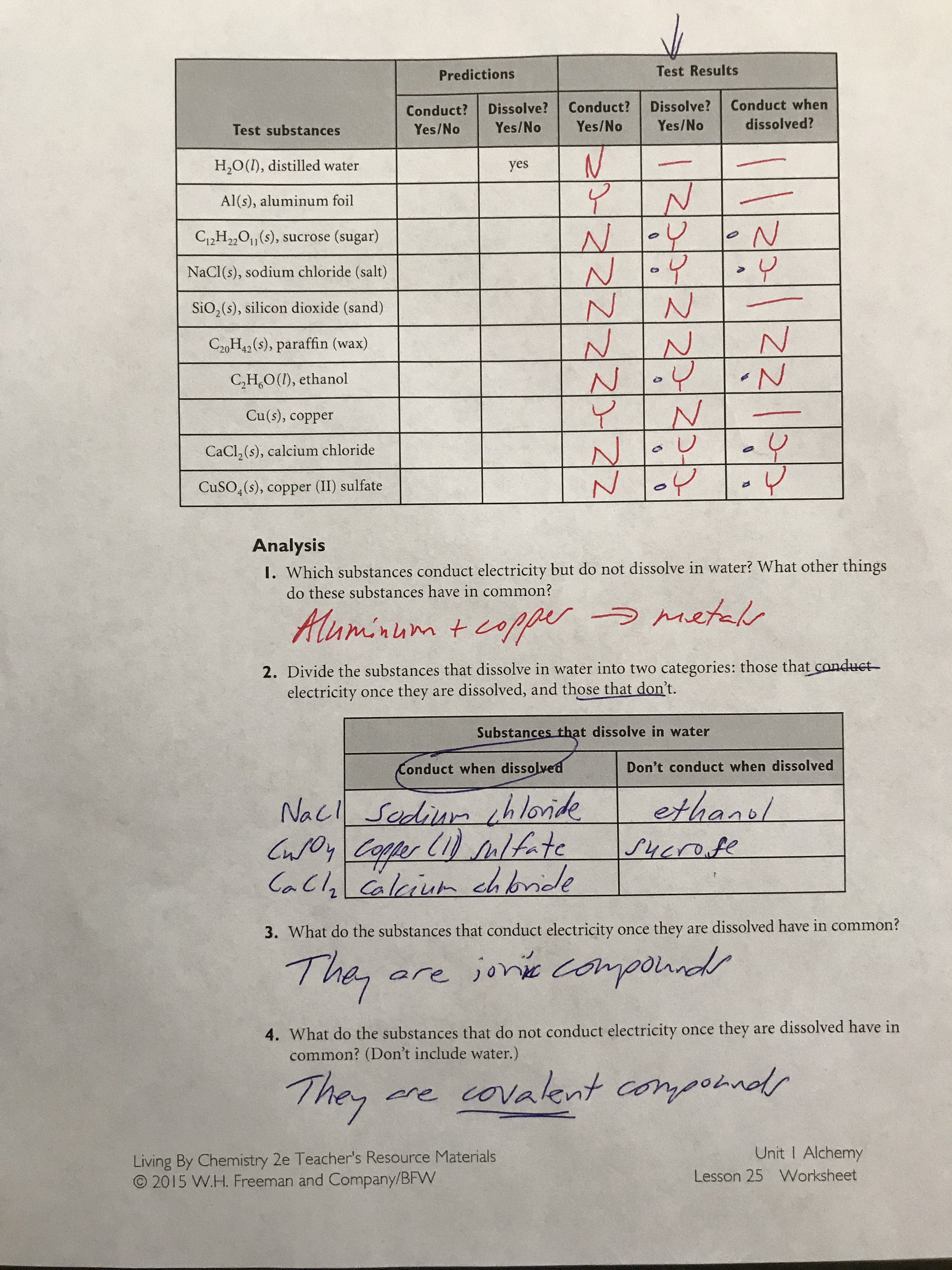
We began class by revisiting the Lesson 25 worksheet from yesterday, focusing on Analysis questions 1-4 and compiling our thoughts as shown:

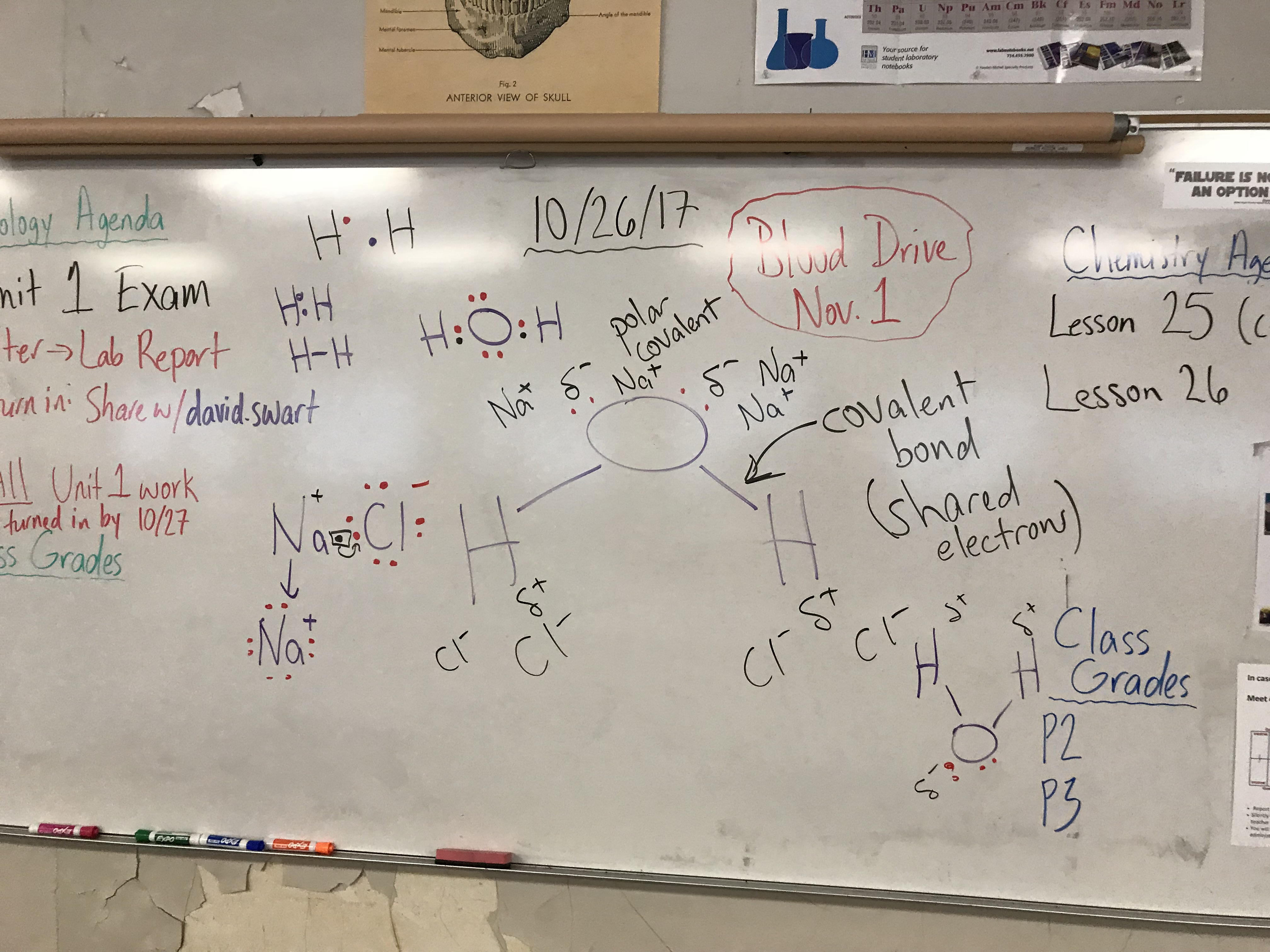
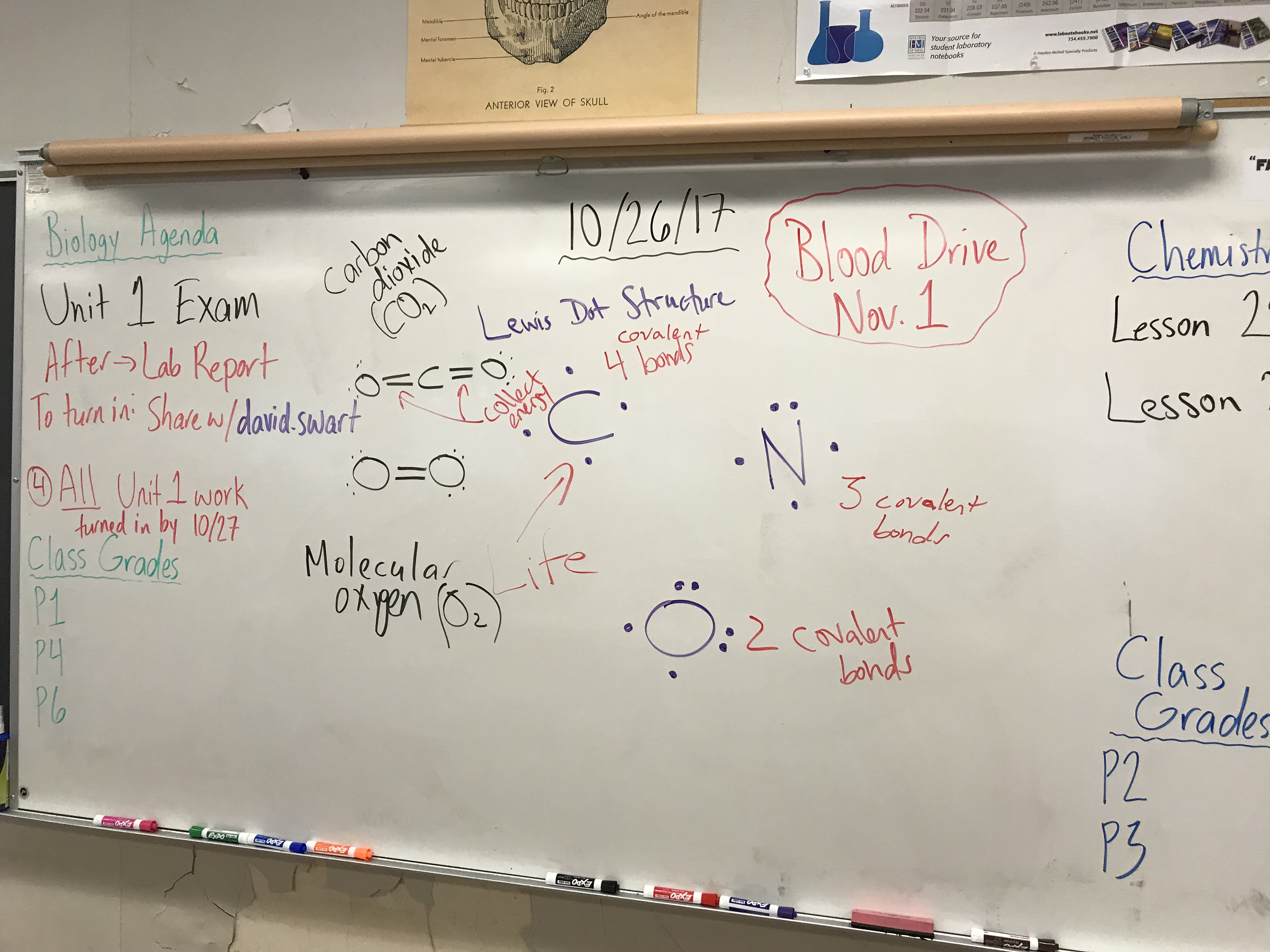
That work led to a broader discussion of bonding, the theme of Lesson 26.  I introduced the concepts of Lewis Dot Structures, covalent bonds, and polar molecules.  I used those concepts to explain why ionic compounds dissolve in water, thus enabling them to conduct electricity.  The intent was for students to develop an understanding for where our study of chemistry is headed and to challenge them to stay actively engaged in their learning.  Notes from that portion of the lesson are shown below:

For the final portion of the class period, students received a handout depicting the four models of chemical bonding.  They then worked in groups of four to categorize the Substance Cards and record their learning on the Lesson 26 worksheet (one per student group).

Lesson 25 / demo lab

Because of the earthquake drill disrupting the quiz yesterday, students in both chemistry classes received the first 10 minutes of class to complete their quiz.  As a result of the shortened class period, the Lesson 25 PowerPoint was abbreviated to include key vocabulary and the Lesson 25 lab was conducted as a teacher demo with student assistance.  All students received the Lesson 25 Worksheet and those who finished their quiz had time to make predictions about whether the test substances would conduct electricity and/or dissolve in water.  Students shared out their predictions with the class and then we proceeded to test those predictions during the demonstration.  After collecting the results, students were tasked with completing the front of the worksheet as homework.

Unit 1 Review

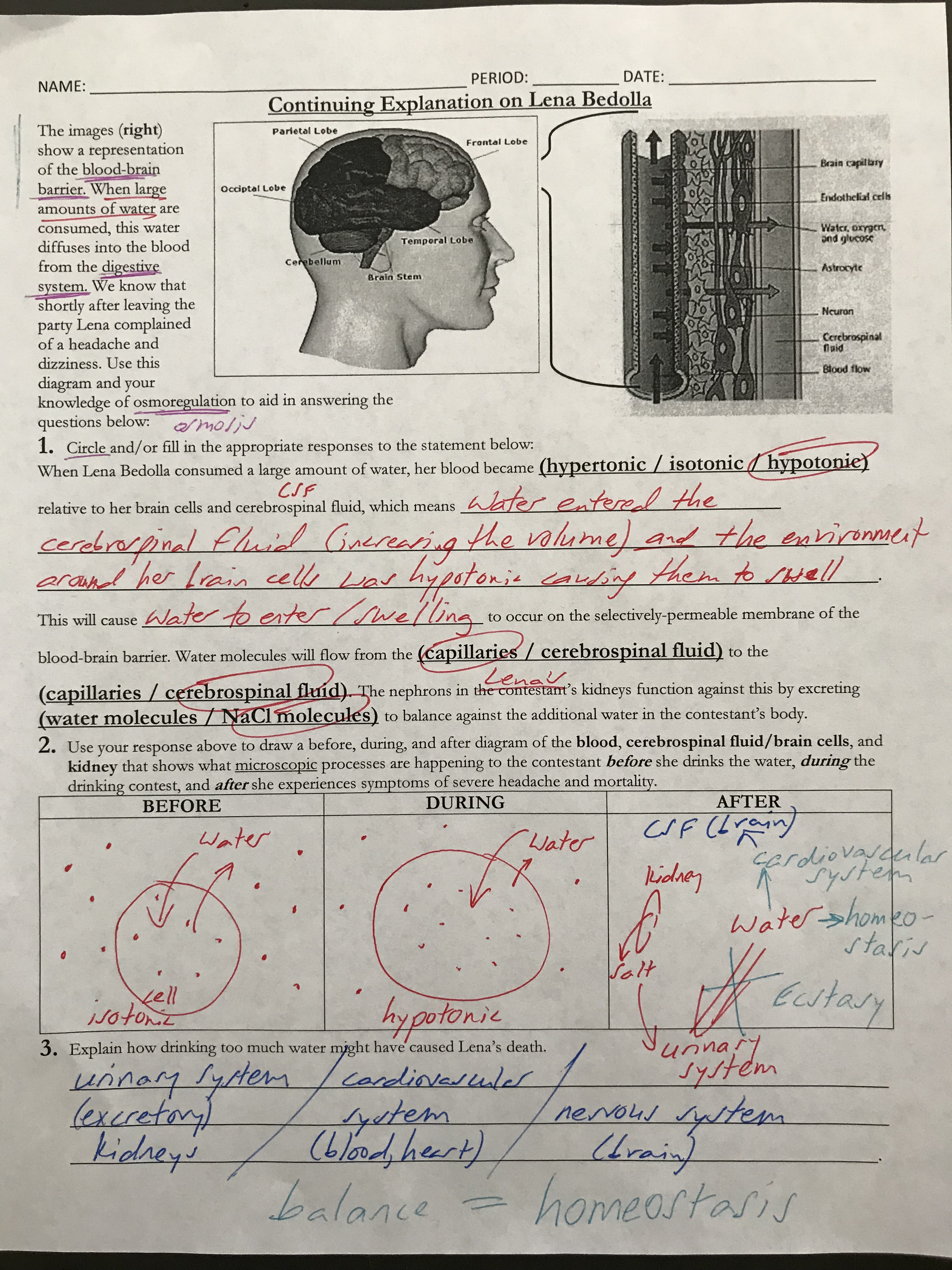
Our work in Unit 1 came to a close today with students working as a class to explain why Lena Bedolla died after taking Ecstasy.  We filled out the Blood-Brain Barrier worksheet to help explain what happened to Lena as a result of her consuming Ecstasy and drinking a lot of water.  A copy of our work is shown below:

Students had the remainder of the class period to complete their Egg Lab reports (due by midnight Friday) and to prepare one page of notes that can be used on the Unit 1 Exam tomorrow and Friday.

Chapter 4 Review

In preparation for the Chapter 4 quiz tomorrow, students worked through the Review Exercises on page 122 of the textbook.  They had the remainder of the class period to prepare one page of notes to use on the quiz and access to computers for further review of electron configurations via the Gizmo from last Friday.

For the quiz tomorrow, students should be prepared to:

  • Determine the products of two reacting ionic compounds
  • Name compounds
  • Write and interpret formulas involving transition metals
  • Write the electron configuration for a given element
  • Locate elements on the periodic table from a given electron configuration
  • Explain the connection between electron configuration and the structure of the periodic table

Egg Lab Report – Day 2

Step 1: Read this post all the way to the end!

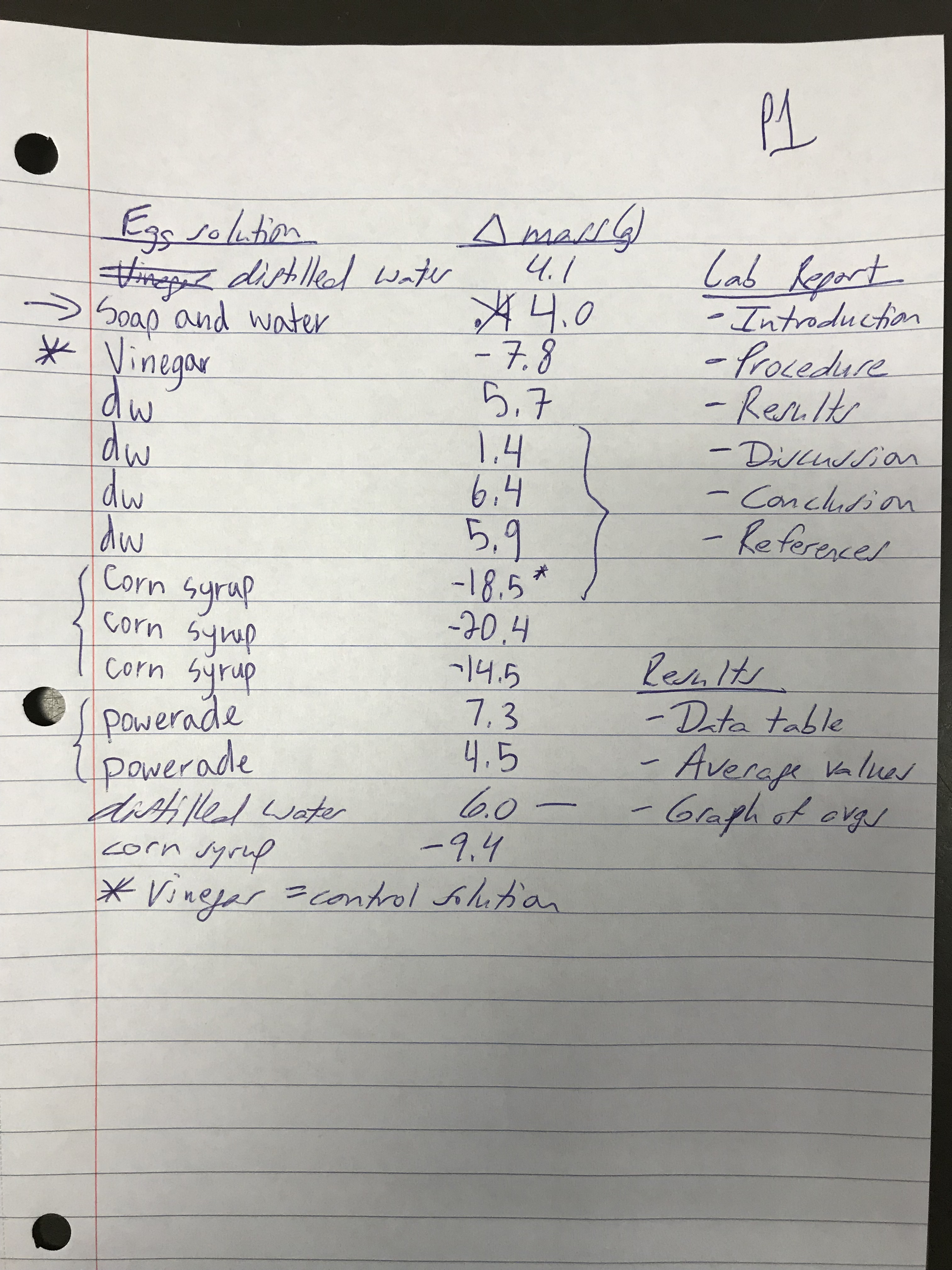
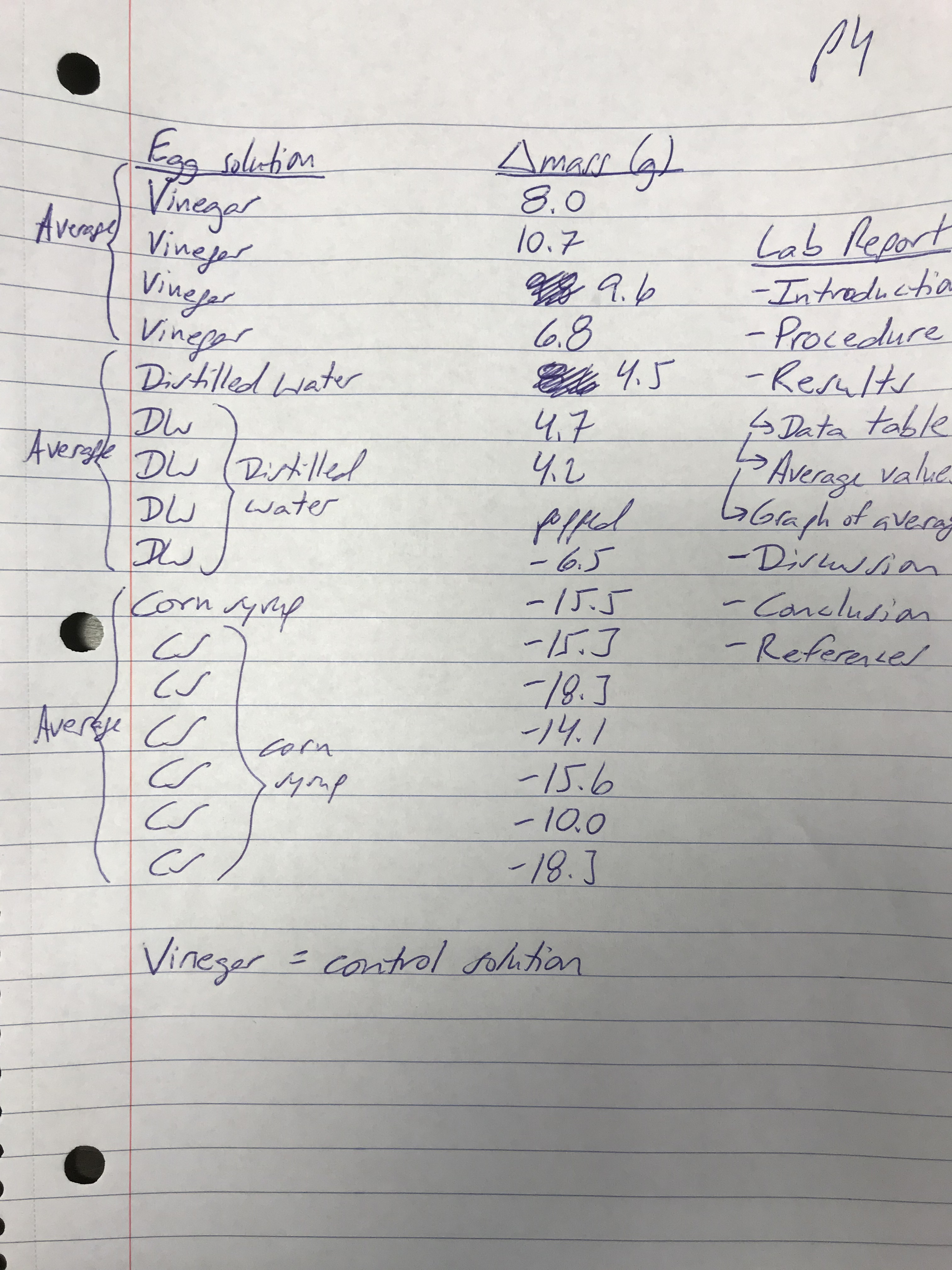
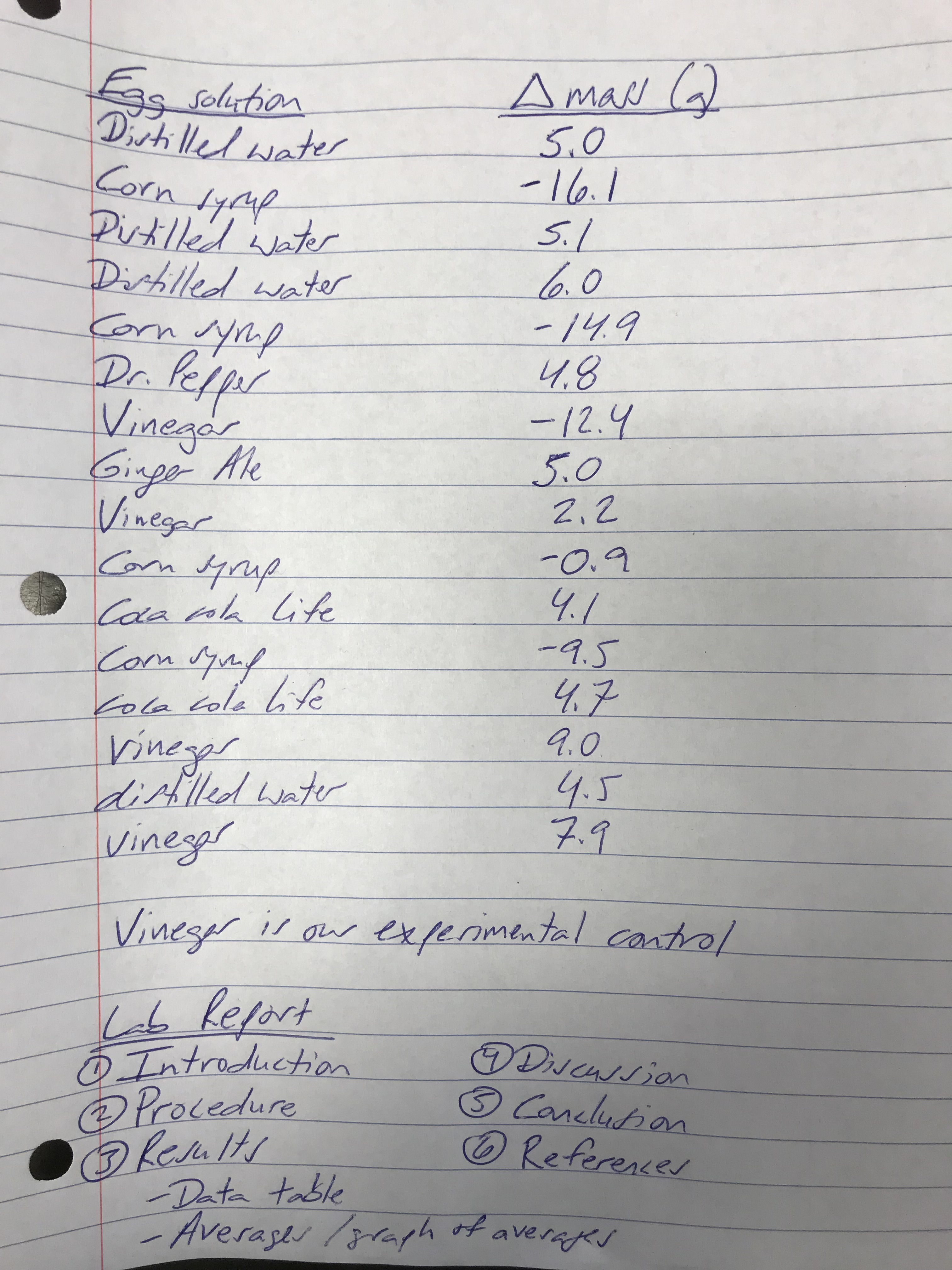
Instructions for the Introduction, Procedure, and some of the Results section (creating a data table) are included in last Friday’s post (October 20).  For today, students should complete the Results section by calculating the average of each egg solution group.  For example, add up all of the change in mass values for the eggs that were in corn syrup, then divide by the number of eggs that were in corn syrup.  Repeat for all of the solutions.  Remember, the more data you include, the more “real” your results will be.  Please consider adding data from one or more additional class periods!  All of the data from my three biology classes can be found on last Thursday’s post (October 19).

Next, write the Discussion section.  In the Discussion paragraph, discuss what you think your results mean.  Do they make sense given what you know about osmosis (think about a cell – the egg – in isotonic, hypotonic, and hypertonic solutions).  Explain your thinking!  Explain why you think the egg changed mass in the different solutions.  What evidence do you have for the movement of water across the cell membrane?  Why do you think some of the eggs gained or lost more or less mass (why were the results variable)?  How can we use the word “homeostasis” to describe how the egg changed mass when placed in a different environment?  What are three possible sources of error that could have affected the results?  What would you change to improve the experiment next time?  All of these questions should be addressed in the Discussion section.  You may need to write more than one paragraph to clearly explain your thinking.

In the Conclusion section, write a paragraph explaining both what happened in the experiment and how it connects with the research you have done into Lena Bedolla and her death from Ecstasy.  How can you use the evidence to help explain what happened to Lena?  You should be able to explain how Ecstasy changed the way Lena’s urinary (excretory) system worked, affecting her cardiovascular system and her nervous system, and ultimately leading to her death.  Your Conclusion section should clearly explain how the Egg Lab provides evidence to support your understanding of why Lena died.

Finally, if you used any outside resources (other websites) to help you with this lab report, list them in the References section.  If you didn’t use any, you do not have to include a References section.

This lab report is due tomorrow at the end of the class period.  If you think you will need additional time, work on it tonight as homework.

Electron Configuration Gizmo

For today’s Electron Configuration Gizmo activity, complete the following steps:

  1. Go to the Explore Learning website.
  2. Click the Login/Enroll button (upper right).
  3. Select Chemistry from your list of classes.
  4. Launch the Electron Configuration Gizmo.
  5. Complete the “Electron Configuration Gizmo” worksheet with a partner.

For students who have not yet created an account:

  1. Enter the class code (written on the white board).
  2. Click the Enroll in Class button.
  3. Choose “I need to create…” option.
  4. Enter your First and Last name (not email!)
  5. Use your student numer (s-#######) as your username.
  6. Enter birthdate as password (MMDDYYYY)
  7. Click “Submit”
  8. Launch the Electron Configuration Gizmo.
  9. Complete the “Electron Configuration Gizmo” worksheet.

Egg Lab Report – Day 1

Introduction

  • What did we do?
  • Why did we do it?  
  • What were we observing?  
  • What were we learning about?

Procedure – should be in your lab notebook and on class website

  1. Step 1
  2. Step 2
  3. Continue until finished

Results

Data table of class data (Table > Insert table > select number of columns and rows

Calculate average values for solution groups

Graph the averages (use Google Sheets)

Discussion

Conclusion

References

Egg Lab Day 4 / Class Results

The egg lab concluded with students receiving the following instructions:

  1. Gently rinse and dry egg
  2. Measure and record the final mass
  3. Discard the egg and cup
  4. Calculate the change in mass of the egg

To calculate the change in mass, students were instructed to subtract the initial mass (measured yesterday) from the final mass (measured today).  A positive change means the egg gained mass.  A negative change means the egg lost mass.  Students reported out their data (shown below), and then we discussed the movement of water across the membrane of eggs placed in various solutions (final picture below).

Period 1 Class Data
Period 4 Class Data
Period 6 Class Data
Membrane Movement