



Our goal for this week is for students to work together in their groups to conduct a deep-dive into their assigned biome and human-caused environmental disaster. Students must share the work load equally, documenting their efforts in a shared team Google Doc. Groups are expected to work together to identify scientifically credible resources and to document those resources in their Google Doc. By Friday, everyone in the group should be able to:
Your project team will be assigned a biome. Your team may choose from the options provided, or propose a different topic (must be discussed with Mr. Swart before moving on). If multiple groups in the same class period are assigned the same biome, teams must select different project options. Teams are expected to identify additional resources beyond those provided below and incorporate those resources into their research.
Selected Project Team Resources:
Rainforest (including Jungle) Biome
Wetland (including Swamp) Biome
For Lesson 61, students were introduced to the Combined Gas Law, k=PV/T. We worked through the Lesson 61 PowerPoint and then students received the Lesson 61 Worksheet. During class, we also watched a portion of a video showing the effect of atmospheric pressure on balloon volume.
For homework, students were encouraged to work through textbook problems 1-7 and check work against the posted answer key. This homework will not be entered into the grade book.
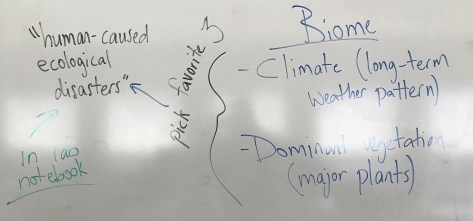
Students presented their work from yesterday, with each student limited to a single minute of time to present their slide to the class describing the biome they researched and a man-made ecological disaster that occurred in that biome. The audience was tasked with making a list in their notebooks that included the name of the presenter, the biome, and the disaster. At the end of the presentations, students selected the top three biomes they want to continue researching. Students will be strategically placed into groups designed to honor their interests and group identities will be revealed Monday.
Our biome work continues today with students investigating the “human caused ecological disasters” they identified yesterday for the three biomes they selected. Student groups will present preliminary findings to the class tomorrow. Students should create one Google Slide for each of the biomes (one disaster per biome) and the slide should include as much of the following information as possible:
Example of slide layout:
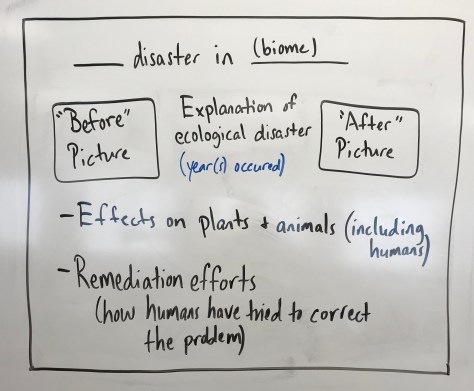
A selection of resources are provided below:
For our final section of the year, we end our study of Ecology first by studying the biomes of Earth, and then constructing models of the biomes complete with students solving a human-made problem found within each biome.
For our first day of work, students will assemble into groups of three students each. Requirement: team members cannot have worked on a project together yet this year!
Notes from the white board:
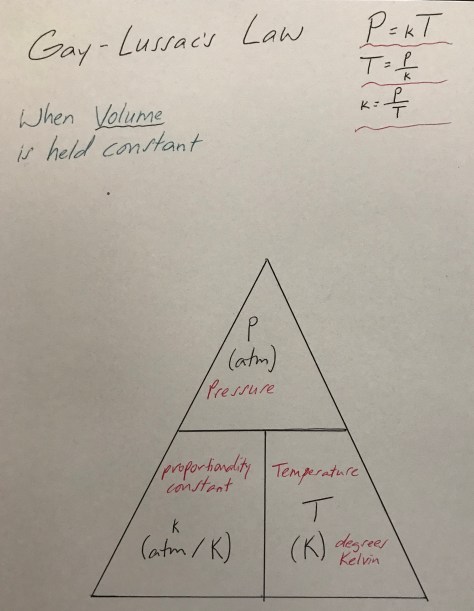
For lesson 59, we learned about Gay-Lussac’s Law (P=kT), the third gas law needed to connect pressure, volume, and temperature. Gay-Lussac’s Law helps explain the egg-in-a-bottle trick, where boiled water displaces the air inside a bottle, and as the water condenses, an egg placed over the bottle will be pulled inside because of the change in pressure inside the bottle.
For students who missed the demonstration in class today, see the video below:
The Lesson 59 worksheet and Lesson 59 PowerPoint are available for download. By the end of class tomorrow, students should be able to explain the outcome of the experiment below using Gay-Lussac’s Law:
Below are notes from the white board where we modeled the candle experiment (demonstrated in class) and a discussion of Gay-Lussac’s Law where we used algebra to replace the proportionality constant in the P=kT equation to the create the ratio of P1/T1=P2/T2. Using the ratio, as long as we have three of the four parts of the ratio, we can solve for the missing piece without having to solve for k first.

Time-lapse of images from the candle experiment demonstrated in class:
Update: We continued our study of Gay-Lussac’s Law for a second day as yesterday the class period was abbreviated and our seniors were absent from class due to an assembly. Our work for today includes:
Reminder: Lab reports (one Google Doc per team shared with Mr. Swart), and the Plants Notes organizer (one per person) are both due Friday (May 25).
Having acquired a deeper understanding of plant biology, we set our sights on the final piece of the Baggie Garden lab report: the Discussion / Conclusion section. Remember, lab reports are organized into at least four parts in the following order:
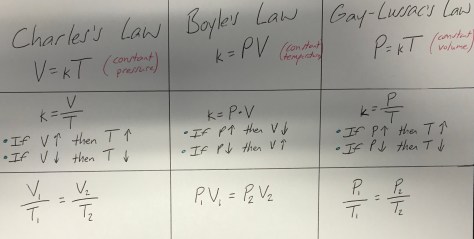
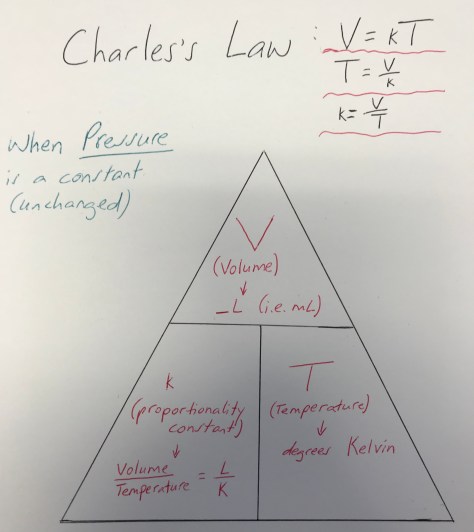
Before we began our study of Boyle’s Law, we reviewed Charles’s Law of Ideal Gases:
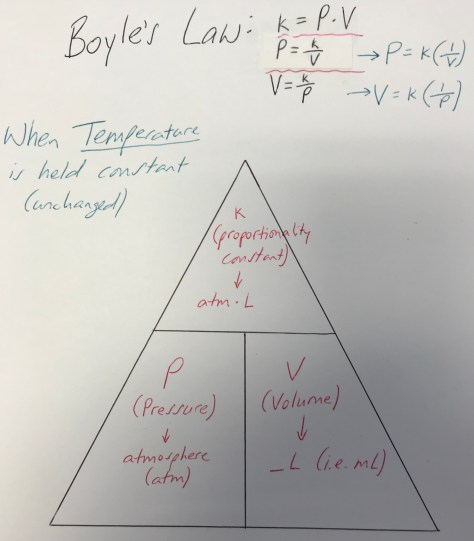
Continuing with our study of pressure and volume, students learned about Boyle’s Law in Lesson 58. Class began with a Sci Guys video about Boyle’s Law:
After the video, students took down a few notes from the whiteboard (below) and then worked through the Lesson 58 Worksheet. For reference, students are also encouraged to review the Lesson 58 PowerPoint.

With our seed germination experiment coming to a close yesterday, students are taking a break from writing the lab report in order to add to their knowledge about plants. We began with a Crash Course video about vascular plants:
Next, each student was assigned to read pages 758-763 from the textbook Biology (Raven & Johnson, 4th Edition, 1996). Students recorded definitions to vocabulary words and summarized sections using the Plants Notes organizer. The organizer is due Friday, along with the Lab Report, and should help students improve Introduction sections and help support their writing of the Conclusion section later this week.
 Science with Swart
You must be logged in to post a comment.