
As we head toward Winter Break, students watched episode 6 of Neil deGrasse Tyson’s version of Cosmos as a primer for Lesson 41 tomorrow. The episode captures many of the themes from our work thus far, integrating them into a student-accessible narrative focused in part on molecular shape and smell.
All posts by David Swart
Covalent Bonds PhET Simulations
Entry Task – December Graphing Practice #3
After completing the Entry Task, complete the Covalent Bonds Gizmo from yesterday. When finished, try out the PhET simulations below (listed in order of increasing difficulty):
Molecule Polarity
https://phet.colorado.edu/sims/html/molecule-polarity/latest/molecule-polarity_en.html
To help explain polarity (a concept we will arrive at in a few more lessons), check out the video below:
Need a breather from chemistry simulations? Investigate hybrid orbitals! Begin by watching the video below:
Learn more about d2sp3 hybridized orbitals – ever heard of sulfur hexafluoride (SF6)? Breathing in SF6 is like the opposite of breathing in helium:
Learn about why d2sp3 hybridized orbitals exist by watching the video below:
Covalent Bonds Gizmo
Entry Task – December Graphing Practice #2
After completing the Entry Task, students re-assembled into work groups from yesterday to complete Lesson 40. Students used the remainder of the class period to work through the Covalent Bonds Gizmo with a partner.
At the end of class, we reviewed the key learning from Lesson 40 with whiteboard notes pictured below:
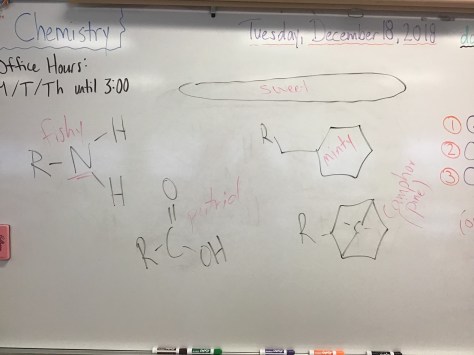
Shape and Smell
Entry Task – December Graphing Practice #1
For Lesson 40, students worked in small groups to organize a set of 24 cards containing compounds with different shapes and functional groups. The Lesson 40 PowerPoint includes a nice graphic organizer for studying the relationship between molecule name and functional group. The Lesson 40 Worksheet and Card Sort are available for download.
Homework:
- Read Lesson 40 in the textbook. Login via hs.saplinglearning.com and enter your username and password:
- Username: wahps****s-####### (**** = first 4 letters of your last name and ####### = student number). Remember to include the dash between s and #.
- Password: S-####### (the S must be capitalized)
- Write notes for Lesson 40 on the Chapter 7 Notes handout.
- Work through the practice problems at the end of Lesson 40.
- Please ask questions about anything from Lesson 40 you do not yet fully understand.
Space-Filling Models
Pop Mini-Quiz!
After completing the quiz, read and follow the steps below:
- Read Lesson 39 in the textbook (pages 200-202). Use a paper copy of the text or try logging in to the digital textbook (instructions at the bottom of this post).
- Write the definition for Space-Filling Model in your Chapter 7 Notes. The definition is in the glossary (page G-20).
- Write a short summary of what you think are the most important things to remember from what you read in Lesson 39.
- Use MolView, a free molecular modeling software program available online, to search for the molecules shown in Lesson 39. To begin, type methyl octanoate into the search bar to see the structure.
- Rotate the ball-and-stick model around by clicking and dragging the molecule.
- Use the Models > Representations menu and select the van der Waals Spheres option. How does the ball-and-stick model compare with the van der Waals Spheres model?
- Repeat the process with the other molecules shown in Lesson 39.
- Research the name of the molecule responsible for your own favorite smell. Can you find it in MolView?
Homework:
- Read Lesson 39 in the textbook. Login via hs.saplinglearning.com and enter your username and password:
- Username: wahps****s-####### (**** = first 4 letters of your last name and ####### = student number). Remember to include the dash between s and #.
- Password: S-####### (the S must be capitalized)
- Write notes for Lesson 39 on the Chapter 7 Notes handout.
- Work through the practice problems at the end of Lesson 39.
- Please ask questions about anything from Lesson 39 you do not yet fully understand.
Molecular Shape
We returned to the molecular modeling kits in Lesson 38, this time using the kits to learn about the shape of molecules. We worked through the Lesson 38 PowerPoint, learning vocabulary terms to describe molecular shape. Students then worked in small groups to complete the Lesson 38 Worksheet.
Notes from class:

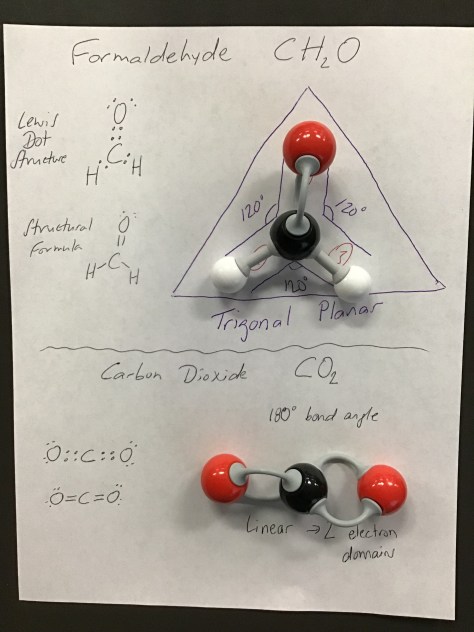
Homework:
- Read Lesson 38 in the textbook. Login via hs.saplinglearning.com and enter your username and password:
- Username: wahps****s-####### (**** = first 4 letters of your last name and ####### = student number). Remember to include the dash between s and #.
- Password: S-####### (the S must be capitalized)
- Write notes for Lesson 38 on the Chapter 7 Notes handout.
- Work through the practice problems at the end of Lesson 38.
- Please ask questions about anything from Lesson 38 you do not yet fully understand.
Electron Domains
We began the day with the Lesson 37 PowerPoint. Students learned about electron domains and how they affect the shape of a molecule. They then worked in pairs on the Lesson 37 Worksheet.
Key ideas:
- noble gases (single atoms) are visualized as points
- molecules consisting of two atoms (i.e. hydrogen fluoride) are linear
- molecules consisting of three atoms can be bent (H2O) or linear (CO2)
- molecules consisting of four atoms, like ammonia (NH3) are called pyramidal
- molecules consisting of five atoms, like methane (CH4) are called tetrahedral
Homework:
- Read Lesson 37 in the textbook. Login via hs.saplinglearning.com and enter your username and password:
- Username: wahps****s-####### (**** = first 4 letters of your last name and ####### = student number). Remember to include the dash between s and #.
- Password: S-####### (the S must be capitalized)
- Write notes for Lesson 37 on the Chapter 7 Notes handout.
- Work through the practice problems at the end of Lesson 37.
- Please ask questions about anything from Lesson 37 you do not yet fully understand.
Ball-and-Stick Models
For the first lesson of Chapter 7, students applied the 3-dimensional ball-and-stick model to bridge the concepts of molecular shape, functional groups, and smell. The Lesson 36 PowerPoint introduced students to the model, during which time they passed around actual models constructed with molecular modeling kits. Next, students transitioned to the activity portion of the lesson, experiencing the scents of five different compounds, connecting the smells to molecular structure, and recording observations and analysis responses in the Lesson 36 Worksheet.
Homework:
- Read Lesson 36 in the textbook. Login via hs.saplinglearning.com and enter your username and password:
- Username: wahps****s-####### (**** = first 4 letters of your last name and ####### = student number). Remember to include the dash between s and #.
- Password: S-####### (the S must be capitalized)
- Write notes for Lesson 36 on the Chapter 7 Notes handout.
- Work through the practice problems at the end of Lesson 36.
- Please ask questions about anything from Lesson 36 you do not yet fully understand.
Chapter 6 Review
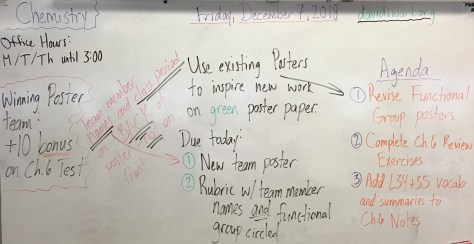
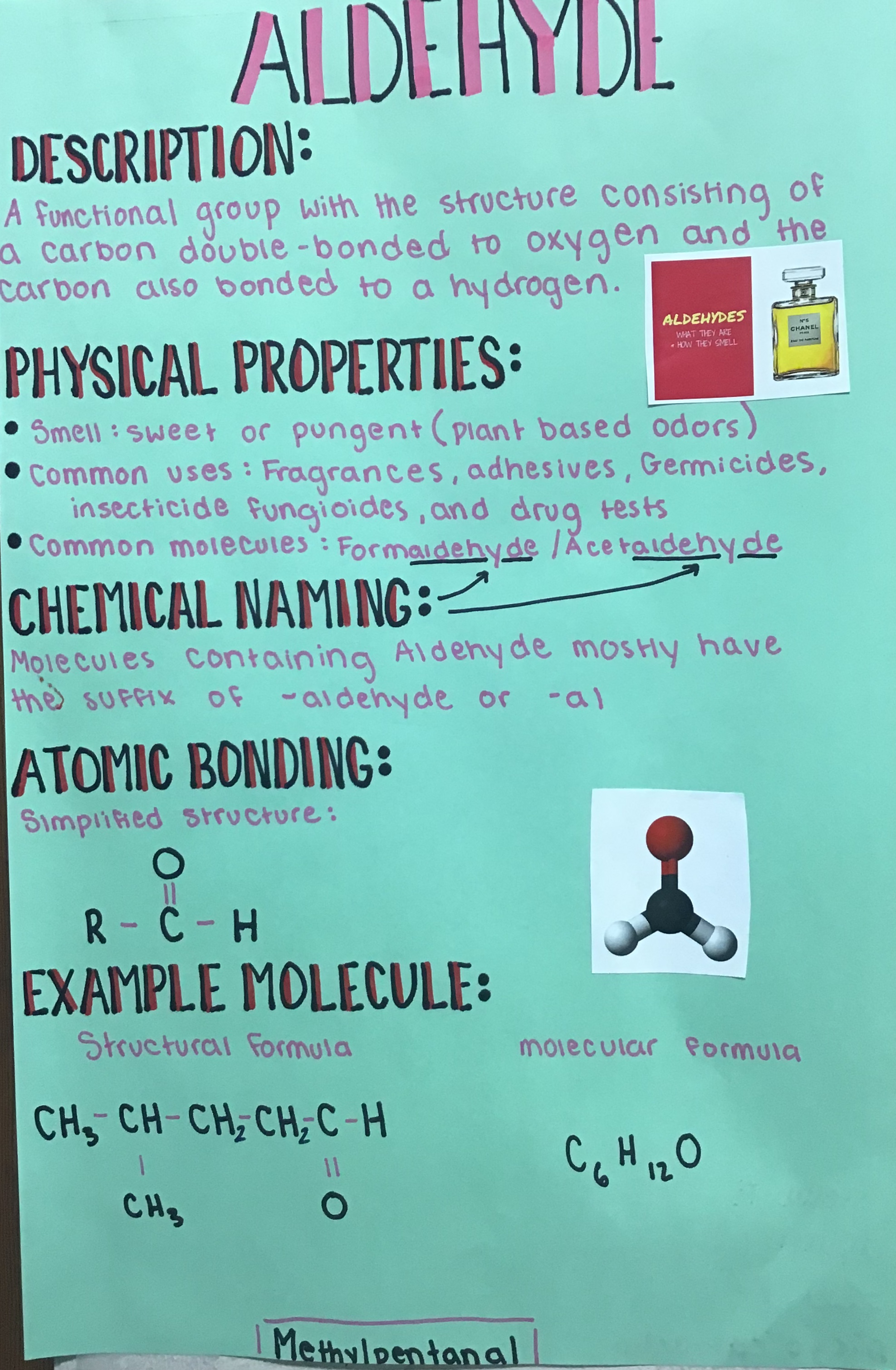
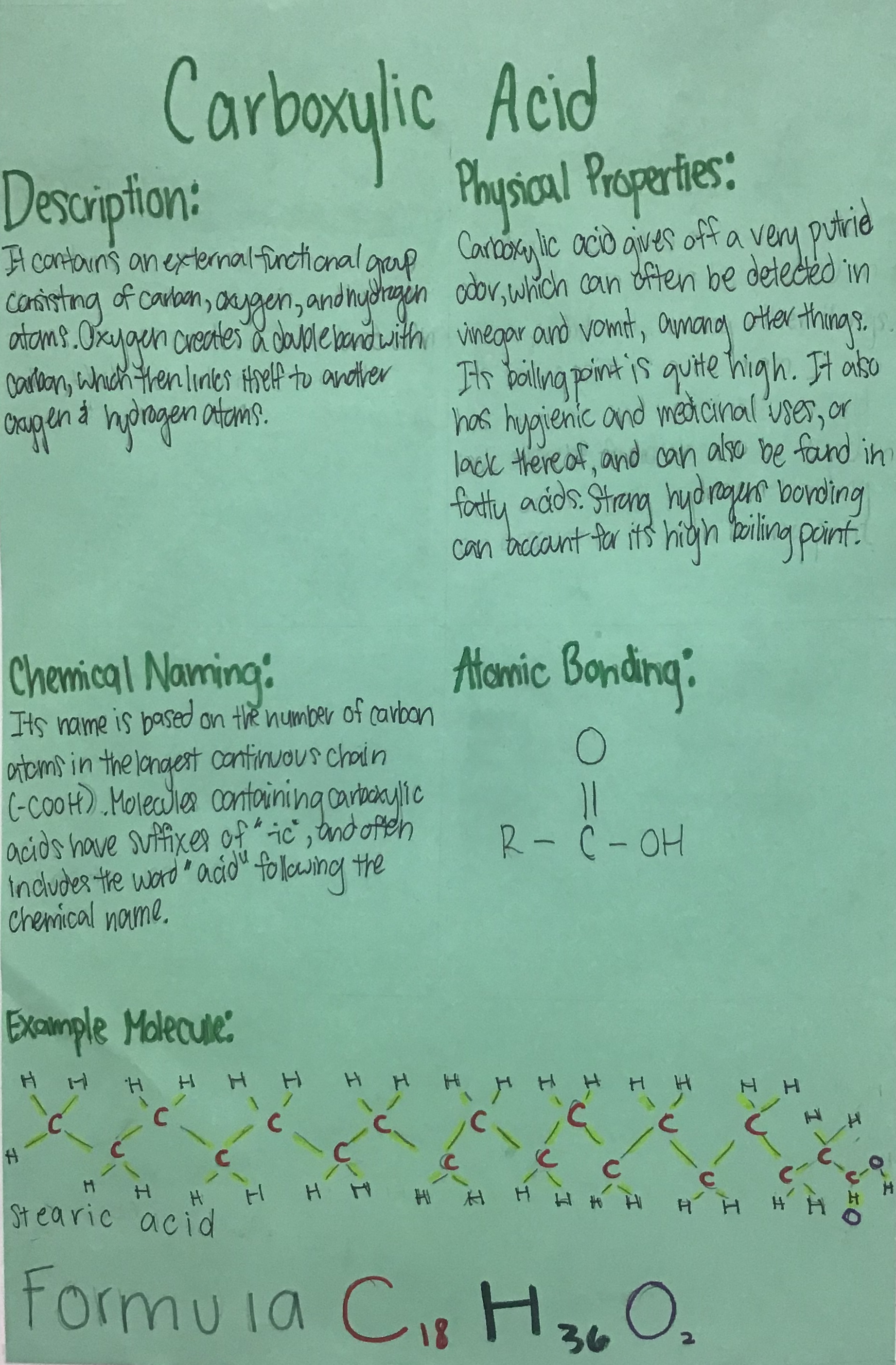
Instructions for the review today were written on the white board (pictured below). Students had the class period to create the best possible functional group poster using posters from all five of my chemistry classes as resources. Remaining time was to be used working through the Chapter 6 Review Exercises from the textbook, and adding vocabulary and summaries from lessons 34 and 35 from the book. Note: the Chapter 6 test on Monday will only include questions covering Lessons 28-33.
Functional Groups
We began class with an entry task in which students read Lesson 33 in the textbook and then recorded the definition of functional group and wrote a brief summary of the lesson in their Chapter 6 Notes. Students then copied the functional groups pictured below into their lab notebooks. Although we did not use it today, the Lesson 33 PowerPoint is provided here as a learning resource.
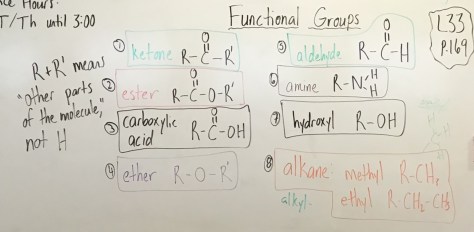
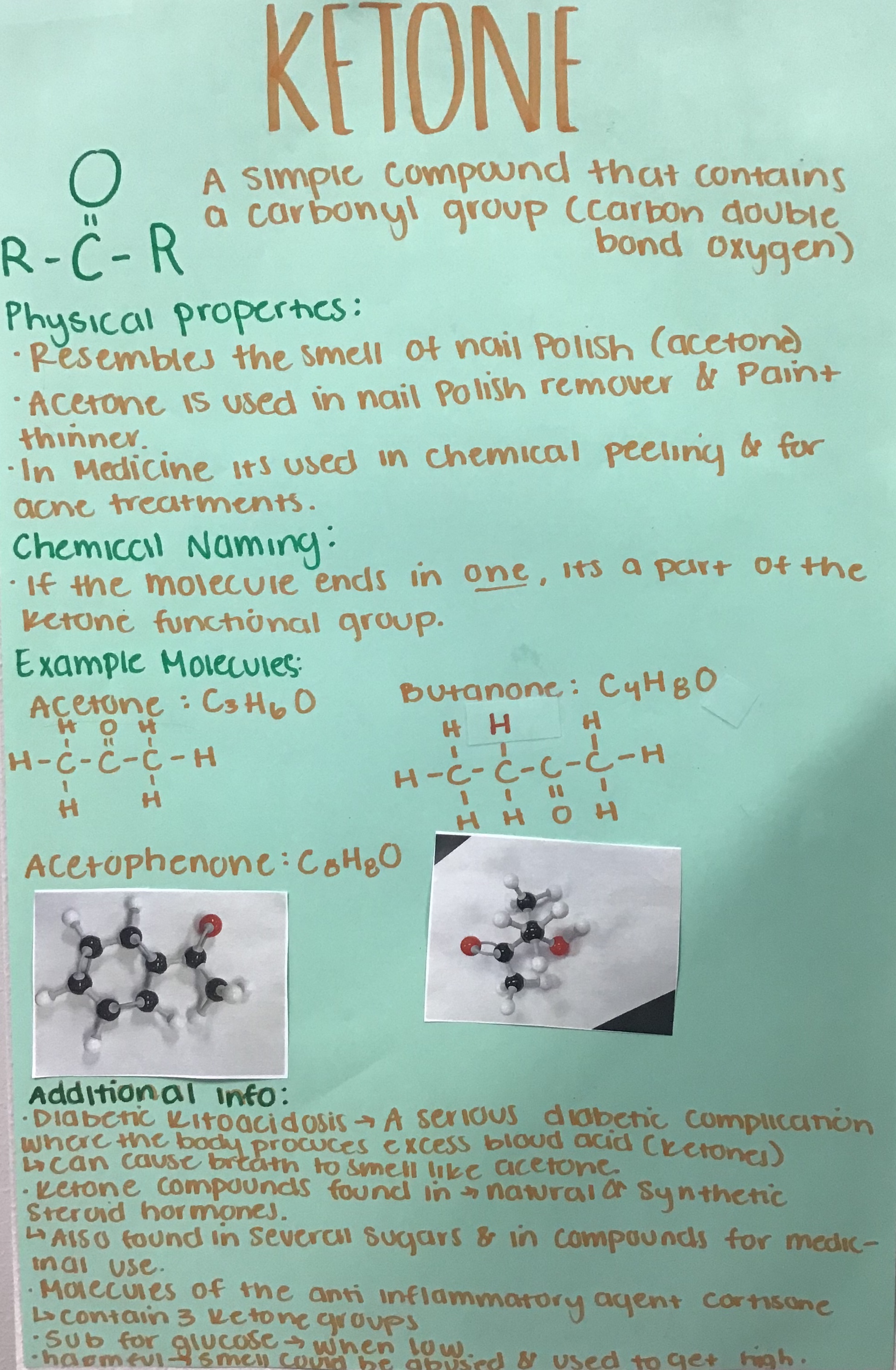
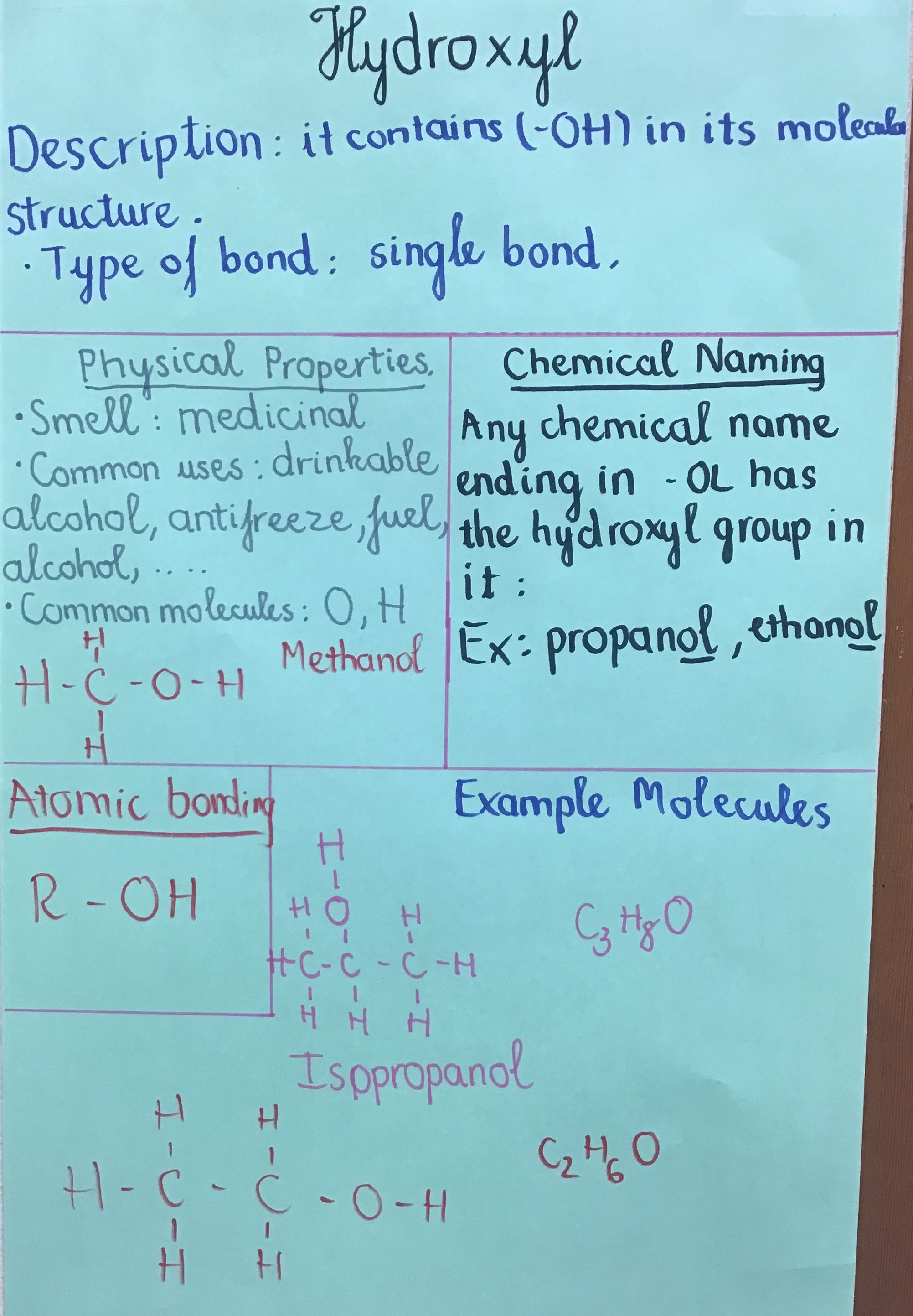
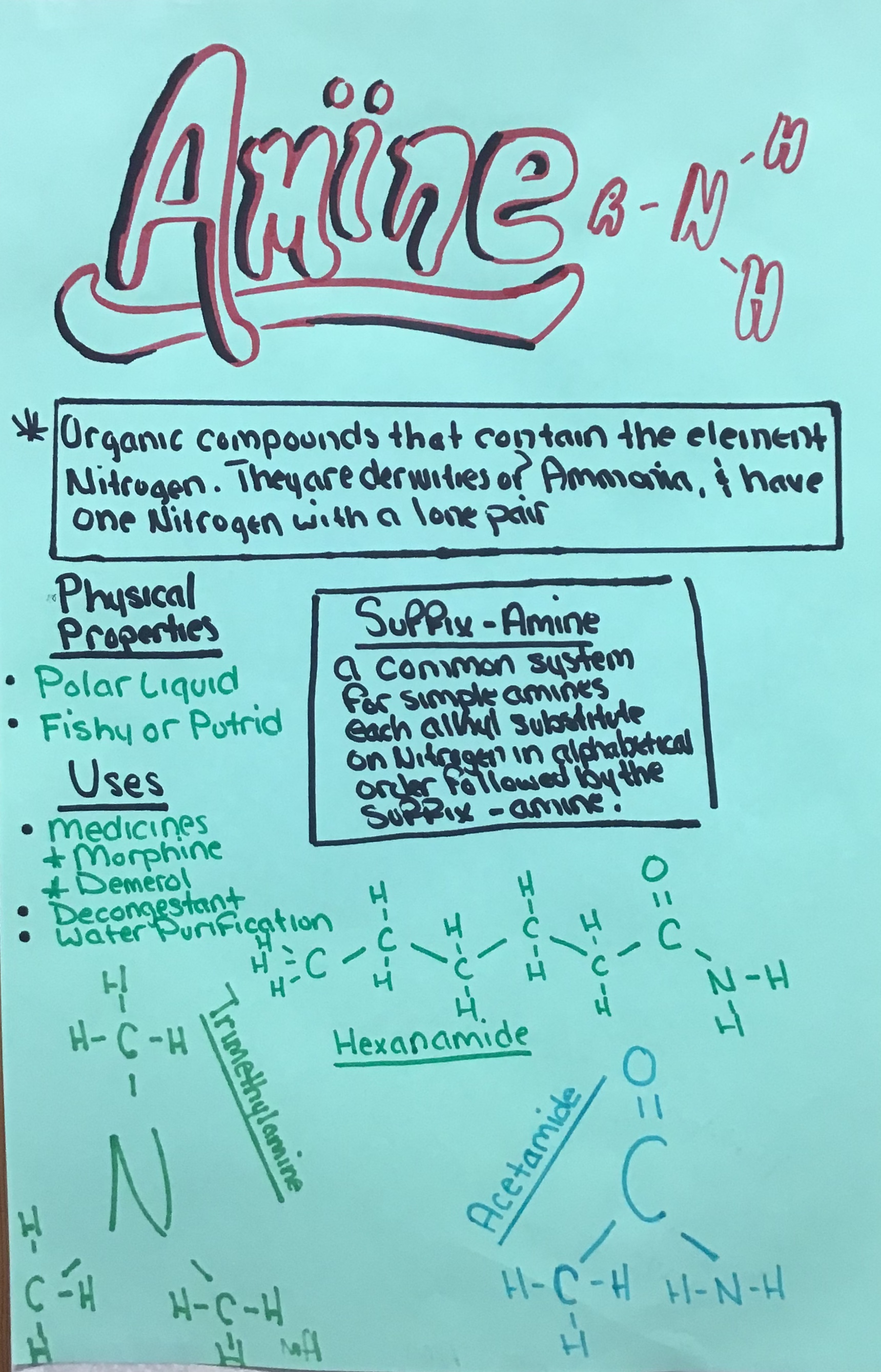
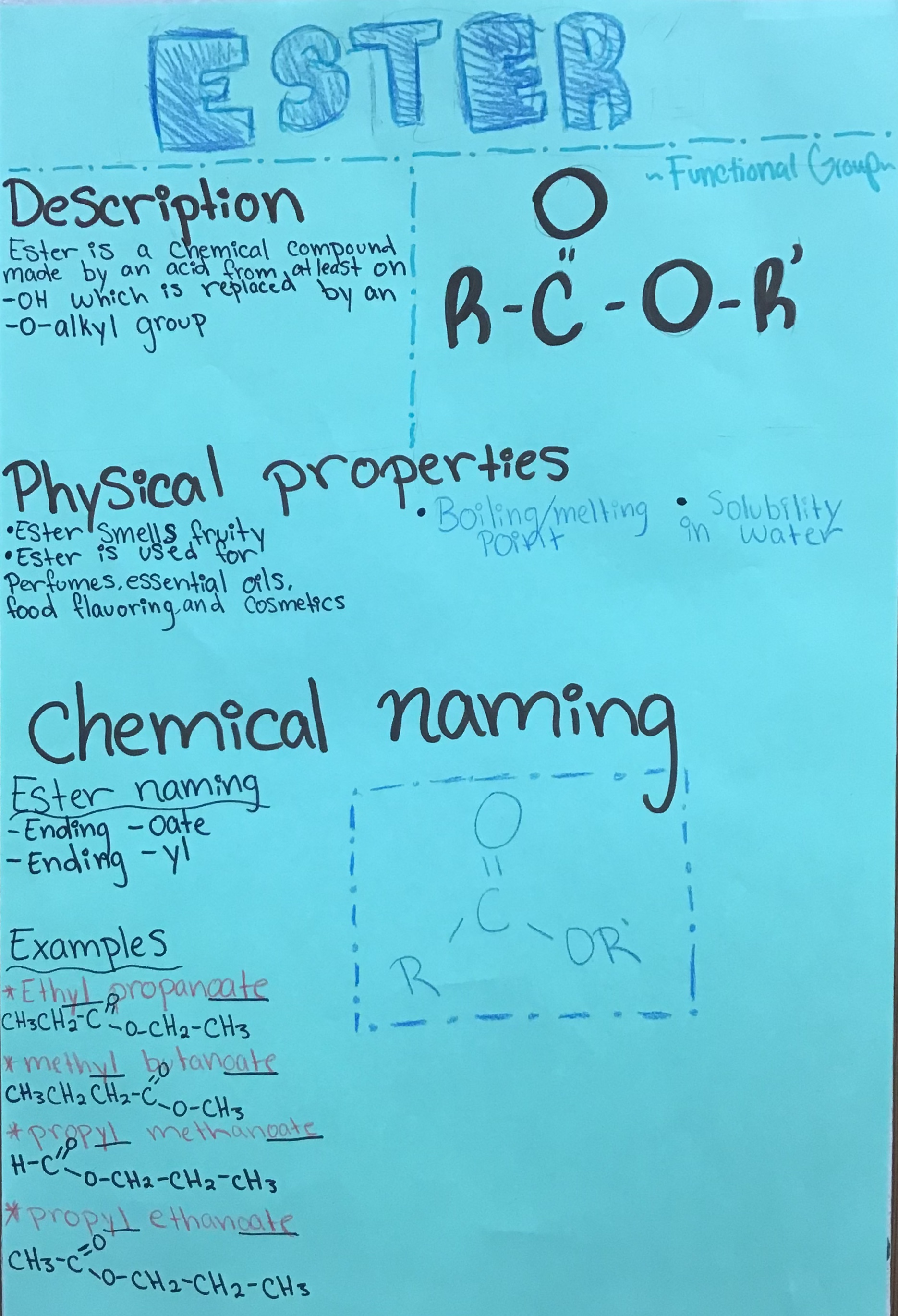
Students were then assigned to a Functional Group project team and began working on the Functional Group Project. Students have through the end of the class period tomorrow to research the various aspects of the functional group and create a poster which will be utilized by the class next Monday during the Chapter 6 test.
12/6 Update: After reviewing the initial set of posters, it was determined an additional round of revision was required to produce the best quality posters to be used on the test. Poster teams were provided with functional group posters from across my five chemistry classes and then used those posters and all other available resources to produce the best possible poster for their functional group. The winning poster from each functional group is shown below, with each member of the winning team receiving 10 bonus points on the test.


Keep Learning!
Students are encouraged to watch the video below and practice drawing structures:
Homework:
- Read Lesson 33 in the textbook. Login via hs.saplinglearning.com and enter your username and password:
- Username: wahps****s-####### (**** = first 4 letters of your last name and ####### = student number). Remember to include the dash between s and #.
- Password: S-####### (the S must be capitalized)
- Write notes for Lesson 33 on the Chapter 6 Notes handout.
- Work through the practice problems at the end of Lesson 33.
- Please ask questions about anything from Lesson 33 you do not yet fully understand.
 Science with Swart
You must be logged in to post a comment.