Immunology is the study of the immune system. To help build out this page, visit the links below and begin exploring immunological networks. Pick a network, write it up, and contribute your findings.
For the final lesson of chapter 13, students learned to classify the types of reactions as combination, decomposition, single exchange, or double exchange reactions.
Combination: A + B -> C
Decomposition: A -> B + C
Single Exchange: AB + C -> A + BC
Double Exchange: AB + CD -> AD + CD
We focused primarily slide 8 of the Lesson 73 PowerPoint. Students are encouraged to review the full slide deck, including the vocabulary defined on slides 9-12. Students then received the Lesson 73 Worksheet and Toxic Reaction Cards to work on for the remainder of class. As an alternative, students who self-assessed as needing additional practice balancing equations were offered the opportunity to work through the Balancing Equations Gizmo.
Homework:
Read Lesson 73 in the textbook. Log in and enter your username and password:
Username: full student gmail address.
Password: HighlineMM/DD (student birthday, use leading zero if needed, i.e. March 7 = 03/07)
Class began with the ChemCatalyst from the Lesson 72 PowerPoint. With the lesson focusing on balancing chemical equations, we worked through the ChemCatalyst equation with a focus on differentiating coefficients and subscripts (slides 11 and 12). We used the remainder of the class period to practice balancing equations.
For students who would like additional instruction around balancing equations and enjoy learning by watching videos, I recommend Tyler DeWitt’s videos Introduction to Balancing Equations (above) and Balancing Chemical Equation Practice Problems (below):
Homework:
Read Lesson 72 in the textbook. Log in and enter your username and password:
Username: full student gmail address.
Password: HighlineMM/DD (student birthday, use leading zero if needed, i.e. March 7 = 03/07)
We briefly reviewed the Lesson 71 PowerPoint and then students had the remainder of the class period to work in groups to complete the lab described on the Lesson 71 Worksheet.
Homework:
Read Lesson 71 in the textbook. Log in and enter your username and password:
Username: full student gmail address.
Password: HighlineMM/DD (student birthday, use leading zero if needed, i.e. March 7 = 03/07)
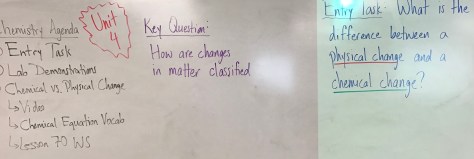
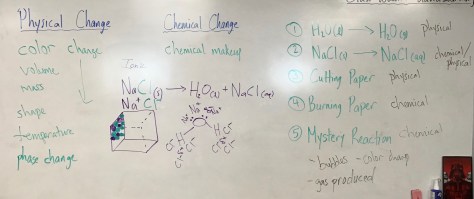
For our introductory lesson of Unit 4, we revisited the concepts of physical and chemical change in the context of chemical reactions. The lesson began with a series of demonstrations. Students were tasked with recording observations and then determining whether a chemical or physical change had taken place.
Notes from class:
Next, students watched the following video from Mr. Anderson of Bozeman Science, with the expectation that they can clearly articulate the difference between a chemical and physical change by the end of the video.
After the video, we reviewed the vocabulary of chemical reactions (inputs/reactants and outputs/products) and then students had the remainder of the class period to complete the Lesson 70 Worksheet.
Homework:
Read Lesson 70 in the textbook. Log in and enter your username and password:
Username: full student gmail address.
Password: HighlineMM/DD (student birthday, use leading zero if needed, i.e. March 7 = 03/07)
Ever wonder why humans spend 1/3 of our lives sleeping? Watch the PBS NOVA episode Mysteries of Sleep and learn the answer to that question and more!
Learn more about the connection between adenosine, caffeine, and sleep by watching the TedEd video below:
Turn it up to 11!
Create a sleep journal. Think about the factors that might impact your sleep each day, then track those along with how much sleep you get each night. Which factors seem to affect your sleep? Which factors don’t seem affect your sleep? Add and remove factors to help you dial in on how to get the best possible sleep each night.
Create a dream diary. Record your dreams upon waking. Write them down, draw them out, or narrate them into your phone. Notice any trends or patterns? How often are you able to recall your dreams? Does your ability to remember your dreams correlate with how long or how well you sleep? Does the content of your dreams correlate with your past, present, or future experiences? Do you have recurring dreams?
Learning to remember. Feeling tired after a long day of learning at school? Try a Power Nap and see whether it helps you remember what you learned during the day. Are you more efficient at completing homework before or after a Power Nap?
For the Day 2 of the Unit 3 Exam, students are tasked with using the Ideal Gas Law to explain how methane bubbles originating on the ocean floor change as they travel to the surface. Methane gas is explosive, and might be one reason ship are lost in the Bermuda Triangle.
The temperature at the ocean floor is 0°C. The pressure at the ocean floor is 35 atm. The size of methane gas bubbles has been determined using sound. Read the article Audio Reveals Sizes of Methane Bubbles Rising from the Seafloor and locate the information about the size distribution of bubbles. The team reports that bubbles range in size from a few millimeters (mm) to a few centimeters (cm). Once you find the actual numbers reported, enter them into the Google Form corresponding to your class period.
The Great CDC Scavenger Hunt (Centers for Disease Control)
For Advisory today, students are instructed to work with a partner to complete a scavenger hunt lesson prepared by Highline Public Schools central office staff.
Students must find the following 10 items on the CDC website, then add html links to the Google Form. The first team to successfully complete the Google Form wins!
Here are the ten Scavenger Hunt items:
When are the times that are most important to wash hands?
What is the proper way you should wash your hands?
Do sanitizers work for all people as tools to kill viruses?
Do disinfecting wipes work effectively?
Is sneezing and coughing on clothes better than using a tissue paper?
How do viruses change?
What is the most effective soap for young kids?
What is the impact of toilet seats on the spread of communicable disease?
What are places that are high risk for contamination?
What are places in school that are high risk for contamination?
With our 11th grade students out of class today for the SAT, students had the opportunity to explore what it might be like to work as a researcher tasked with understanding and ultimately stopping the spread of infectious diseases like COVID-19. Students worked in pairs as Disease Detectives using the CDC “Solve the Outbreak” simulation.

 Science with Swart
You must be logged in to post a comment.