Introduction Writing

In addition to efficiently observing seed germination, making measurements of roots and shoots, and recording all the data in Google Sheets, students should browse through the following resources:

Students should note whether the seeds used in their own experiment are dicots or monocots, and be prepared to explain the difference between the two.  Students should take careful notes about the optimal conditions for seed germination, focusing on the biology of the seed and especially the sources of energy the seed uses to germinate.

Next, students should work together to write the Introduction paragraph of their lab report.  The Introduction should include the following:

  • State (in a sentence or two) the scientific concept the lab is about.  Hint: germination!
  • Describe what you know about germination and how the lab is investigating the process of germination.  Include a discussion about how the energy used for germination is different from the energy used for plant growth.
  • State the hypothesis in if/then/because format for the experiment and then explain:
    • why this particular hypothesis was selected
    • how the experiment will add to your understanding of germination
Observations and Data Table

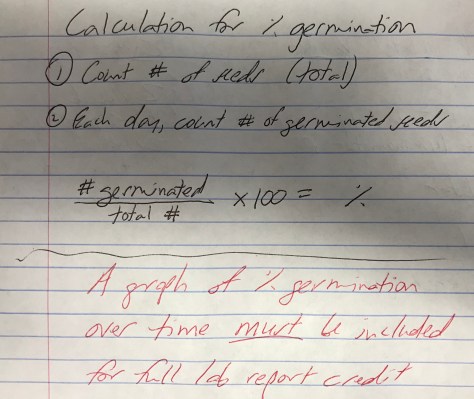
Today, we focused on identifying the experimental data to include in the Results section of the Baggie Garden Experiment lab report.  We compared the pros and cons of collecting lots of data with collecting a focused amount of data.  Students identified, discussed, and justified which experimental endpoints they wanted to collect for their experiment, and then created data tables in their lab notebooks to collect the data.  Finally, students made their first careful observations of their baggie gardens and recorded their observations.  We discussed how to calculate percentages so students can track the percent of their seeds that have germinated (notes below):

IMG_1839

Finally, students were shown an example spreadsheet created in Google Sheets.  The table below can be copied into Sheets and modified as needed:

Day 0 Day 1 Day 2 Day 3 Day 6
Control
Experimental Condition 1
Experimental Condition 2
Experimental Condition 3

The slide deck includes lesson content, including a link to the Chia Pet video which is also available below.

Density, Temperature, and Fronts

In the final lesson of Chapter 10, students focused their learning of temperature and volume back on the concept of weather as it relates to warm and cold fronts and the formation of clouds.  We worked through the ChemCatalyst in the Lesson 55 PowerPoint and then watched a clip of Kenvin Delaney, Jimmy Fallon, and Lucy Liu experiment with matter of different densities:

Students then worked through the Lesson 55 Worksheet which calls for them to reference the Weather Variables worksheet from Lesson 49.  For homework, students were assigned textbook questions 1-6.

Setting up the Garden

Students established their Baggie Garden experiments today, setting up their experiment bags and one or more experimental control bags.  We began class with a brief overview of the day, and then students worked in groups to write a detailed experimental procedure.  Once their procedure was reviewed and teacher-approved, the students assembled their baggie gardens, using the resources available to test their hypotheses.

For groups testing temperature as their manipulated variable:

  • Freezer -10C
  • Refrigerator 9C
  • Room 23C
  • Warm box 30C

Tomorrow we will make our first experimental observations and then discuss how to organize how to collect and organize data relevant to each group’s research question.

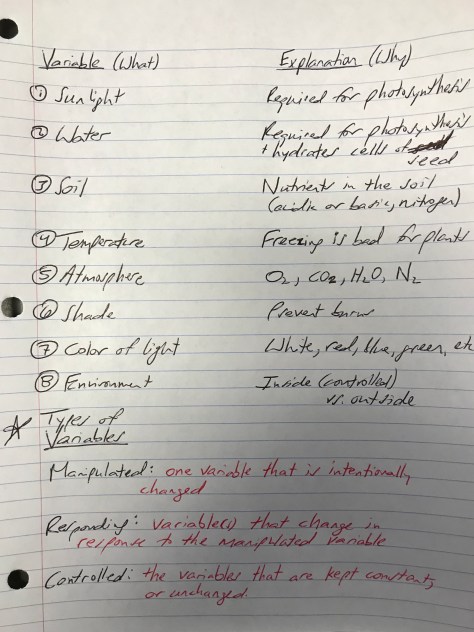
Testable Experimental Variables

To extend our study of ecology, we will invest the next two weeks reviewing the scientific process through the lens of plant biology.  Our work today will involve identifying testable experimental variables associated with plant seed germination. Tomorrow, students will establish baggie gardens in order to test whether their selected variable impacts seed germination and/or seedling growth.  Our collective data will enable us to make detailed scientific observations and conclusions about factors affecting seed germination, seedling growth, and photosynthesis.  Along the way, students will practice the art of inquiry by:

  • identifying variables (manipulated, responding, and controlled)
  • writing hypothesis statements (using the if…then…because… format)
  • writing a detailed experimental procedure (incorporating the concepts of validity, reliability, repeated trials, and experimental control conditions)
  • recording, organizing, and analyzing detailed observations
  • writing a conclusion statement

Students will be expected to produce a typed lab report which includes a data table and a graph of the data.

Notes from class today:

IMG_1835

Charles’s Law

We formally connected observations about the relationship between temperature and volume by introducing Charles’s Law.  The Lesson 54 PowerPoint includes the definition of Charles’s Law (V=kT), extending the concept of the proportionality constant, k, to gases.  The constant is unique to each gas, and serves to connect temperature and volume.  We worked through the ChemCatalyst and watched a few minutes of a YouTube video showing a lava lamp in action:

We sketched out a before/during/after model of how a lava lamp works and the white board notes are shown below.

Students then practiced working through Charles’s Law by completing the Lesson 54 Worksheet.  For homework, students were assigned textbook questions 1-7.


Thermometers

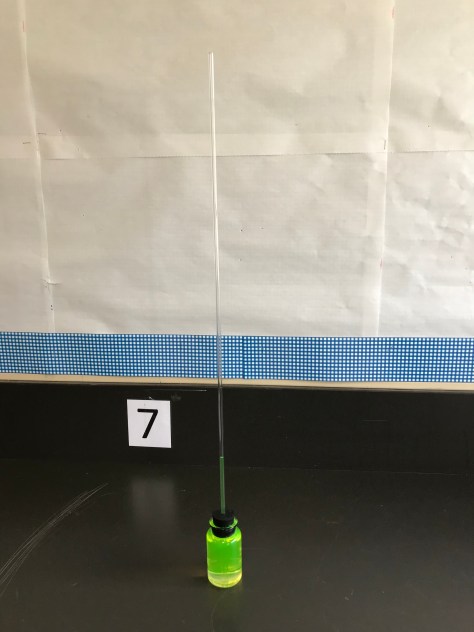
For Lesson 52, students conducted the DIY Thermometers Lab.  For homework, students were assigned textbook problems #1-9.  A picture of the liquid (antifreeze) thermometer setup is shown below:

Note: Tomorrow over half of each chemistry class will be attending the Shakespeare play, so students attending class will have time to complete homework.

Kelvin Scale

With so many students out of class on a field trip on Friday, we switched the order of Lesson 52 and moved ahead to Lesson 53.  We will return to Lesson 52 tomorrow after students have the opportunity to read through the lab and complete the pre-lab. Today, class began with a short SciShow video about the Kelvin Scale:

After the video, students worked through the Lesson 53 Worksheet.  The worksheet refers to a simulation which can be accessed here: Gas Properties (PhET simulation which requires Java).  The Lesson 53 PowerPoint is available for review by clicking here.  For homework, students should complete textbook questions 1-7.  Notes from class are provided below:

Biogeochemical Poster Project

We began the week with a brief review of what to expect on the quiz scheduled for this Friday.  Class notes are shown below:

IMG_1781

This week, students will work in groups of three students each to create a poster representing biogeochemical cycling.  For the project, students will create a poster to model the water, carbon, nitrogen, phosphorus, and sulfur cycles on a poster with an emphasis on including the ecosystem of Yellowstone National Park where possible.  Students will have access to the class textbook and the class set of laptops to conduct their research.  Students will also receive the Nutrient Cycling POGIL worksheet packet that will provide them with additional information about the process of carbon (C), water (H and O), nitrogen (N), and phosphorus (P) cycling.  Sulfur is often included as a component of the biogeochemical cycle, frequently appreviated as the CHNOPS cycle.  To help keep student projects moving forward, a variety of resources will be posted here for review.

Crash Course: Carbon and Water Cycles

Crash Course: Nitrogen and Phosphorus Cycles

Bozeman Science: Biogeochemical Cycles (includes the Sulfur Cycle)

The Global Carbon Cycle – a website with data about global carbon cycling with actual numbers that need to be added to the student posters.

Water Cycle – USGS website providing a robust review of hydrologic (water) cycle vocabulary, a presentation of the cycle itself, and data students will need to add the actual amount of water stored in various locations on Earth.

Texas A&M University has a website with pages devoted to explaining the Nitrogen Cycle.  Additional in-depth information about the Nitrogen Cycle is available on the Nature Education Knowledge Project website.

Phosphorus Cycle – information about the cycle and a nice graphic from the Shmoop University website.

Sulfur Cycle – a presentation provided by The Environmental Literacy Council

Example poster

Growing, growing, grown

For our abbreviated Friday class period, students were assigned to read pages 656-661 from the BSCS biology textbook and to complete the following:

  • Summarize the main ideas
  • Define the vocabulary words (in bold) and provide context for each word (an example of what the word means in relation to what the reading is about)
  • Answer Part B, questions 3a-c, on page 647