As a reward for a job well done on the Evolution Project and also because many students were on a field trip, we watched “Your Inner Monkey” in class today. Students who missed class are encouraged to watch the first 35 minutes this evening and we will finish the rest in class tomorrow. The video can be accessed for free on the HHMI website. Students have the option of completing a guided video worksheet for one bonus point.
With many students participating in the walkout, we used the last part of class to continue watching Hunting the Elements. We will resume our regularly scheduled programming tomorrow. Enjoy!
We took advantage of the gap in AP testing to work through Lesson 82. The Lesson 82 Worksheet called for students to work in groups to prepare salt solutions and then we measured the specific gravity of each solution using a hydrometer. Our class results are provided below:
Additionally, students are encouraged to practice observing the relationship between moles, volume, and molarity using the University of Colorado Molarity PhET simulation below:
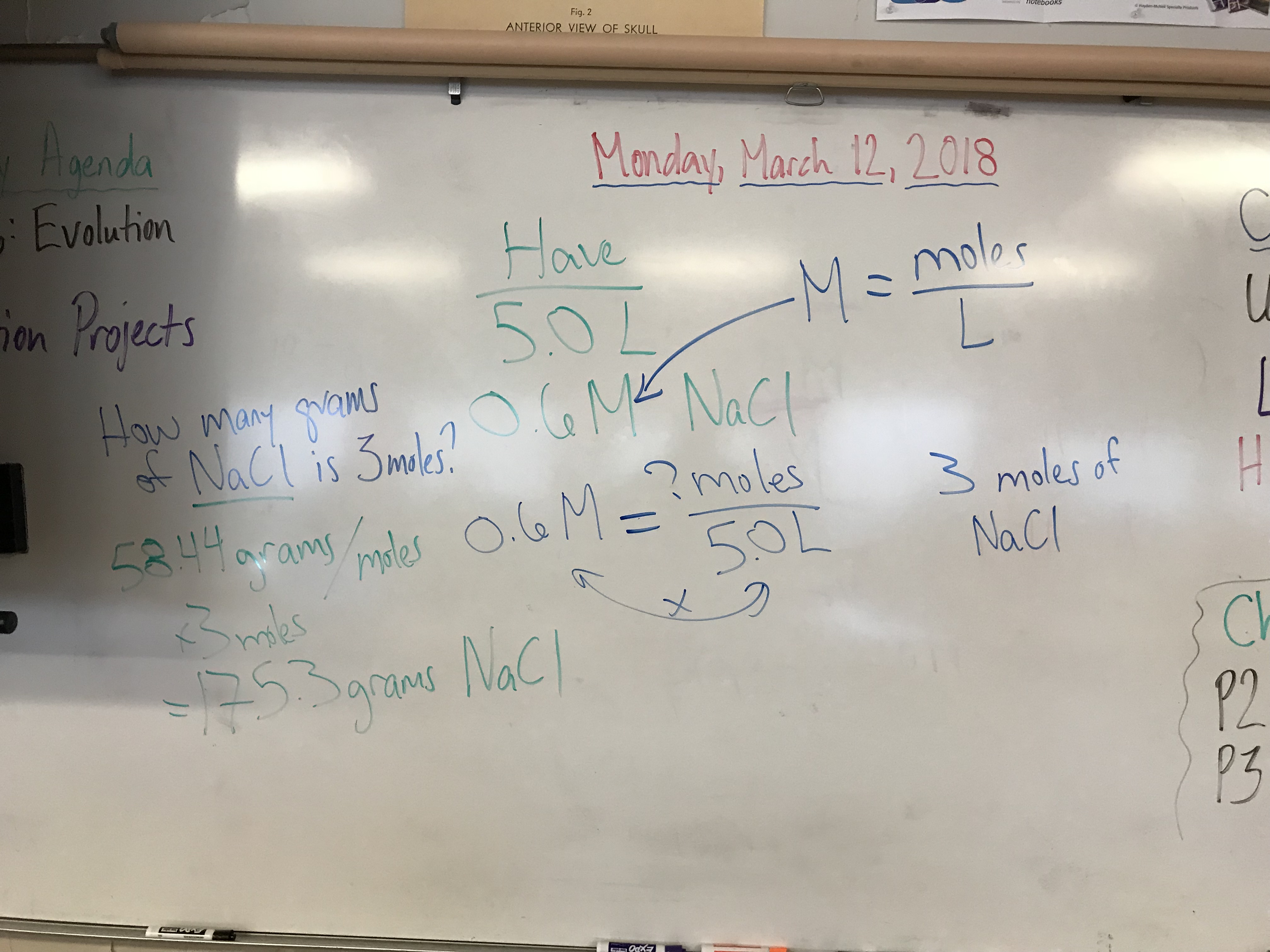
Our work today involved thinking about solutions from a molecular perspective. Students briefly reviewed yesterday’s Gummy Bear portion of the lab via the ChemCatalyst on slide 3 of the Lesson 81 PowerPoint. Students then received the Lesson 81 Worksheet and the Particle Views Handout. The handout was used in Part 1 of the worksheet. For Part 2, students did the mental work of thinking through how to prepare solutions with different volumes and molarities. They then observed the outcome of preparing those solutions. The lesson helped illustrate the connection between molarity (M), particle density, and the number of moles (particle number) in a solution. Pictures from the white board are shown below.
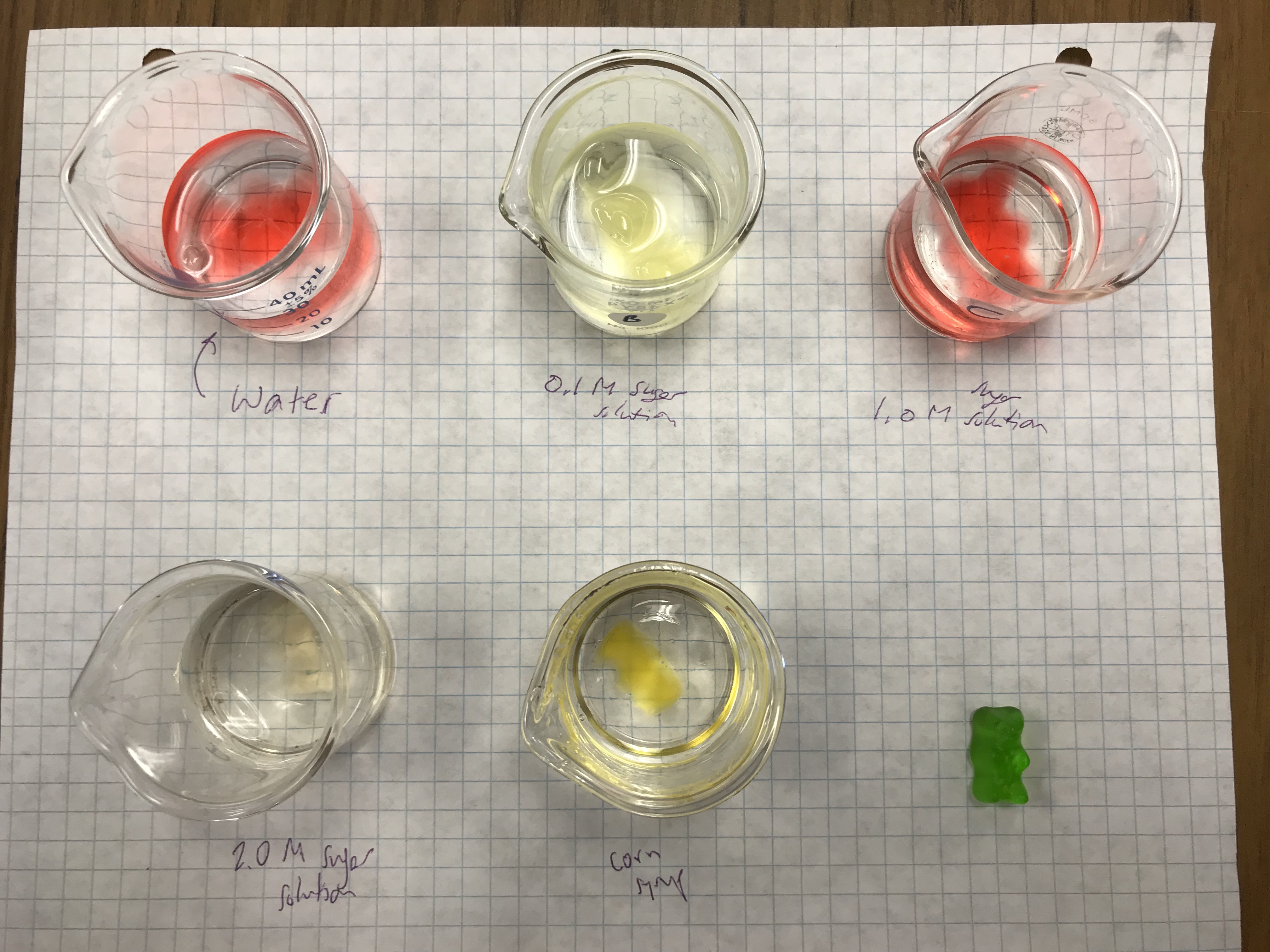
We began Lesson 80 with an entry task (included in the Lesson 80 PowerPoint) in which students were asked to consider the fate of gummy bears placed into solutions containing increasing amounts of sugar. The resulting discussion allowed us to revisit the concept of osmosis and to model what might be happening in the gummy bears (shown after soaking in solution overnight).
After recording some additional lesson-related vocabulary (solute, solvent, concentration, and molarity), students received the Lesson 80 worksheet and used the remainder of class time to acquire the data and begin filling in the table on the bottom of the front page. With SAT tomorrow for juniors, we will complete the Lesson 80 Worksheet on Thursday. Students in class tomorrow will have time to work through the assigned problems from the textbook, problems 1-10.
As a reward for a job well done on the Chapter 13/14 quiz, students were treated to the first half of Hunting the Elements. We will resume our regularly scheduled programming tomorrow. Enjoy!
Our study of evolution turns to an investigation of the enzyme lactase, which converts lactose (a sugar found in milk) into the sugars glucose and galactose. While lactase is found in the digestive system of infants, many adults no longer express the enzyme and thus suffer from lactose intolerance. However, there are populations of people in the world who continue to express lactase as adults. Such people are called lactase persistent. People who no longer produce lactase are called lactase nonpersistent (or more commonly, lactose intolerant). Today and tomorrow, students will investigate which populations of people around the world have developed lactase persistence, and they will analyze data and use their analysis to write a conclusion based on the Cultural-Historical Hypothesis. We will make use of a set of materials collected from a much larger body of work published by BSCS. We will also use the Complete Map of Test Results to complement the mapping work students will do using data from 70 different test subjects.
Note: the conclusion writing assignment is due Monday, March 5.
We will begin the lesson by watching the HHMI video Got Lactase? The Co-Evolution of Genes and Culture provided below:



 Science with Swart
You must be logged in to post a comment.