Electron Configuration Gizmo

For today’s Electron Configuration Gizmo activity, complete the following steps:

  1. Go to the Explore Learning website.
  2. Click the Login/Enroll button (upper right).
  3. Select Chemistry from your list of classes.
  4. Launch the Electron Configuration Gizmo.
  5. Complete the “Electron Configuration Gizmo” worksheet with a partner.

For students who have not yet created an account:

  1. Enter the class code (written on the white board).
  2. Click the Enroll in Class button.
  3. Choose “I need to create…” option.
  4. Enter your First and Last name (not email!)
  5. Use your student numer (s-#######) as your username.
  6. Enter birthdate as password (MMDDYYYY)
  7. Click “Submit”
  8. Launch the Electron Configuration Gizmo.
  9. Complete the “Electron Configuration Gizmo” worksheet.
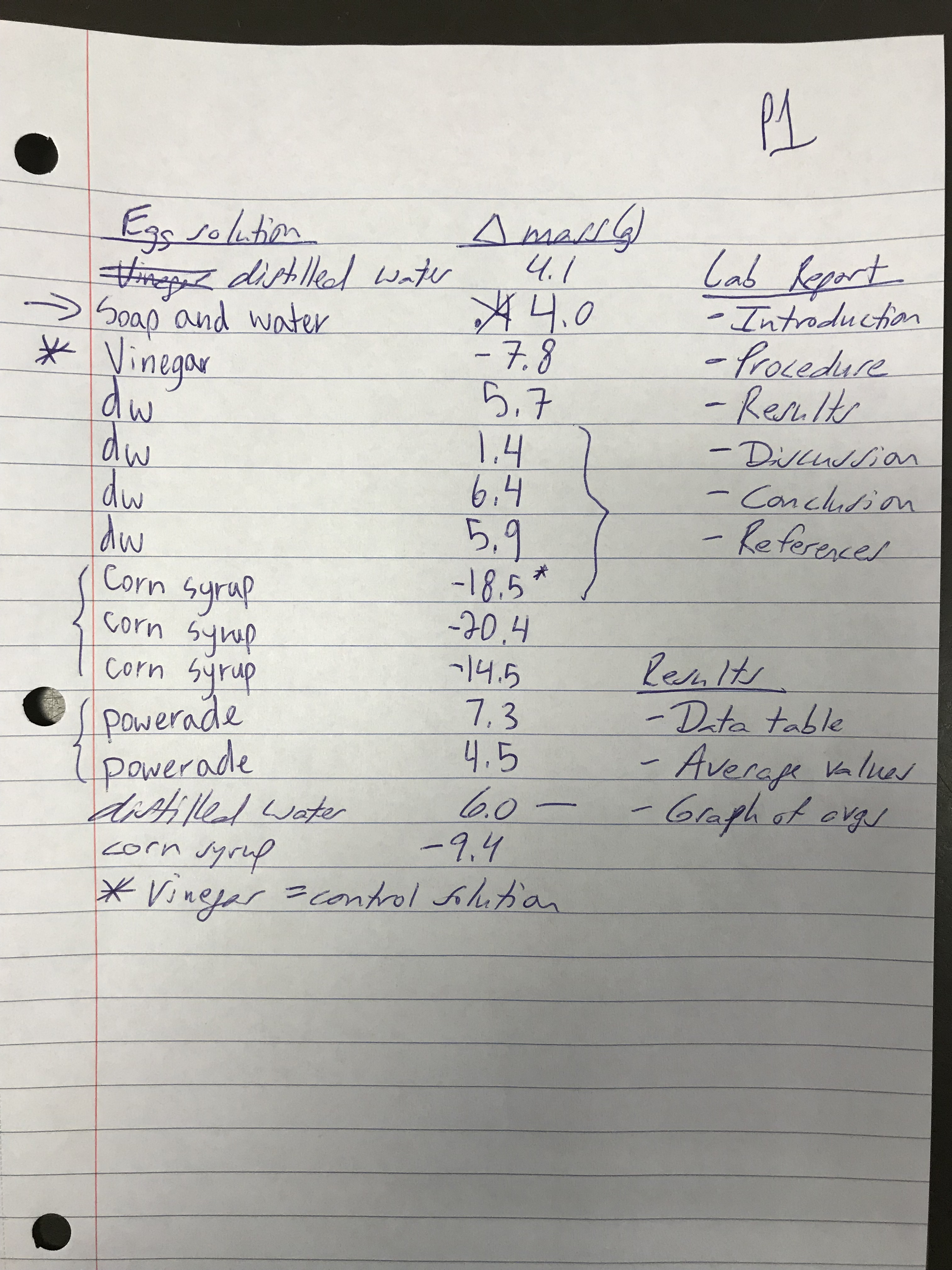
Egg Lab Report – Day 1

Introduction

  • What did we do?
  • Why did we do it?  
  • What were we observing?  
  • What were we learning about?

Procedure – should be in your lab notebook and on class website

  1. Step 1
  2. Step 2
  3. Continue until finished

Results

Data table of class data (Table > Insert table > select number of columns and rows

Calculate average values for solution groups

Graph the averages (use Google Sheets)

Discussion

Conclusion

References

Egg Lab Day 4 / Class Results

The egg lab concluded with students receiving the following instructions:

  1. Gently rinse and dry egg
  2. Measure and record the final mass
  3. Discard the egg and cup
  4. Calculate the change in mass of the egg

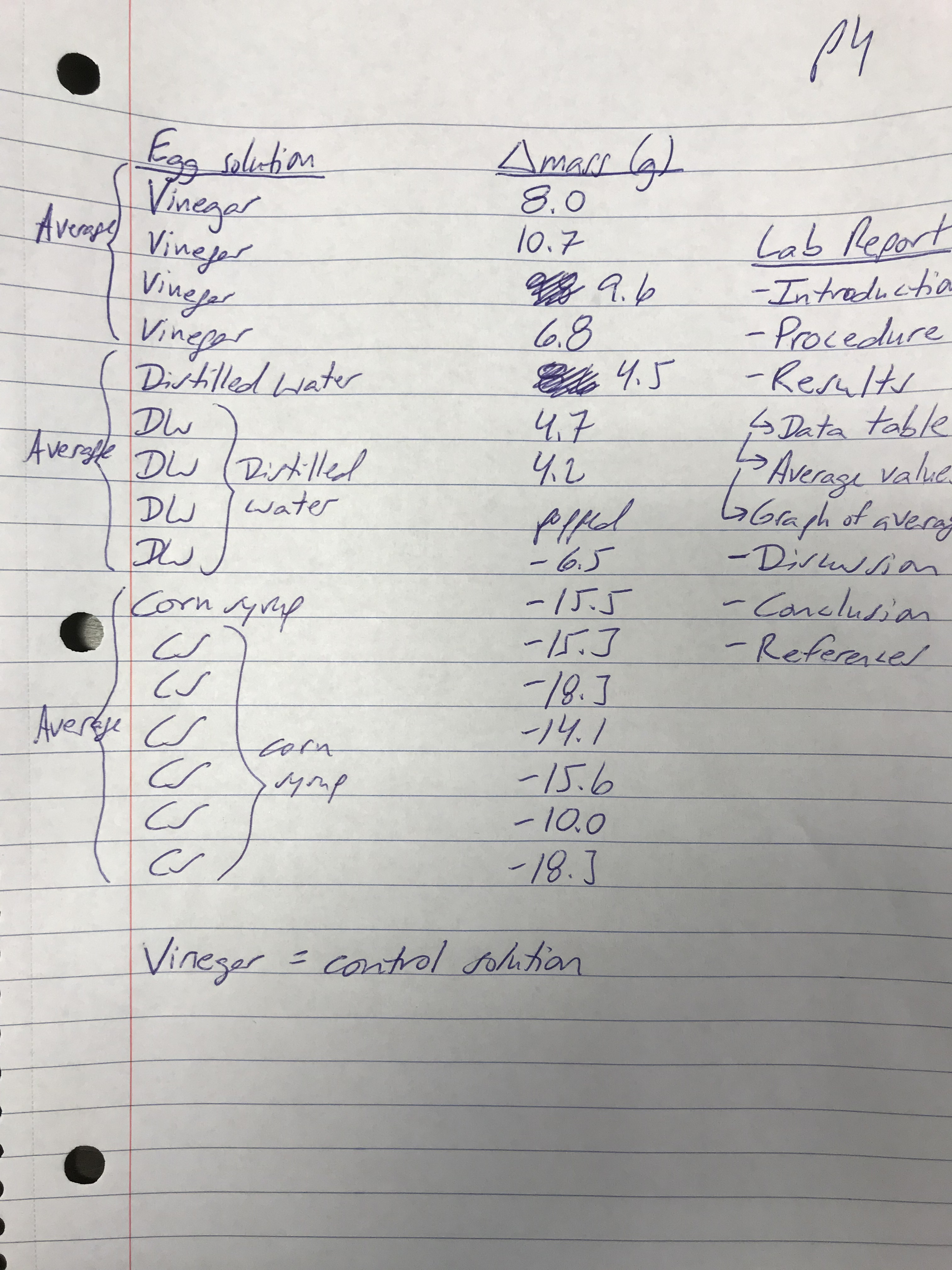
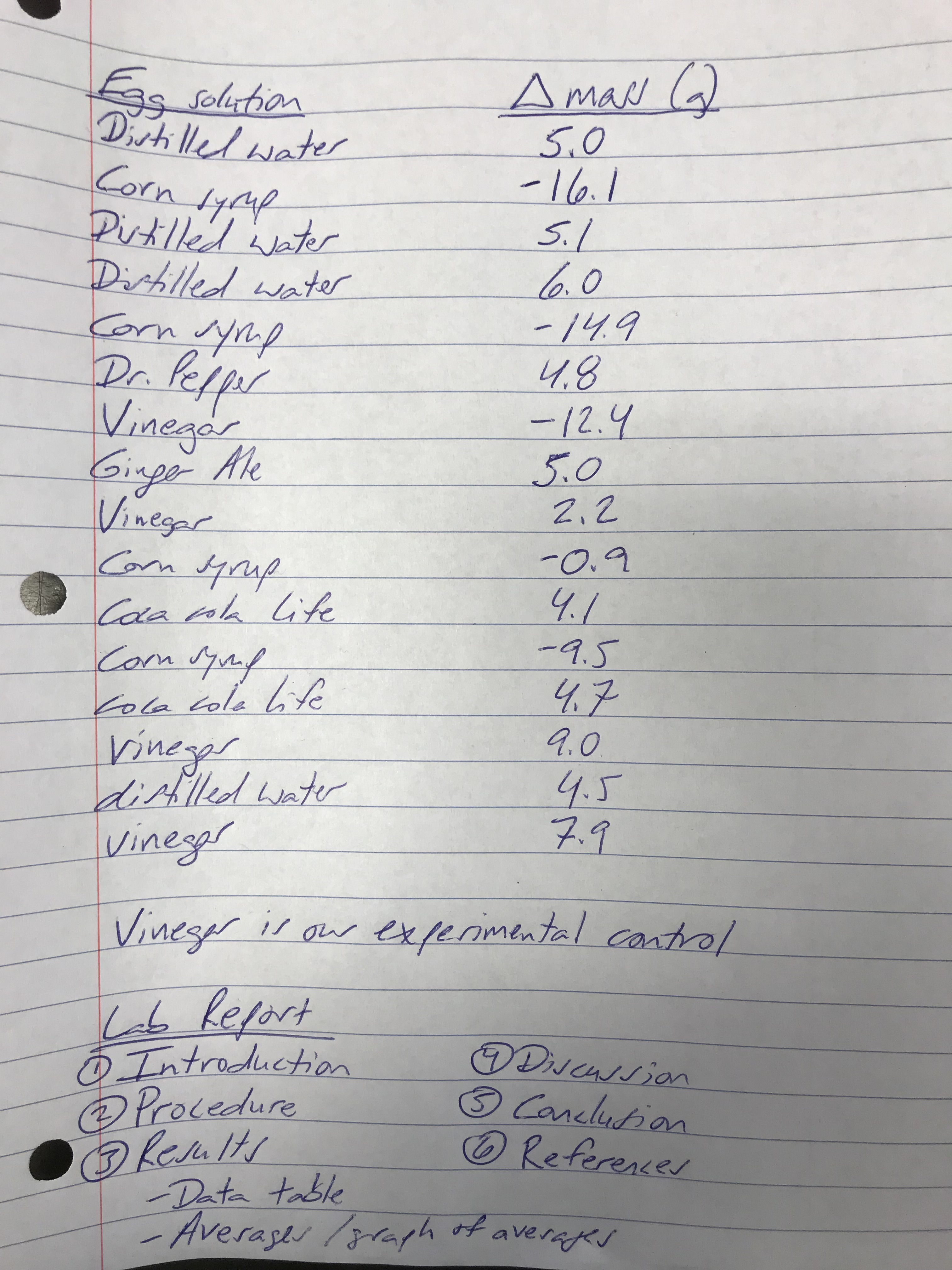
To calculate the change in mass, students were instructed to subtract the initial mass (measured yesterday) from the final mass (measured today).  A positive change means the egg gained mass.  A negative change means the egg lost mass.  Students reported out their data (shown below), and then we discussed the movement of water across the membrane of eggs placed in various solutions (final picture below).

Period 1 Class Data
Period 4 Class Data
Period 6 Class Data
Membrane Movement

Egg Lab Day 3 / Catch-up Day

For day 3 of the Egg Lab, students worked with their lab groups to complete the following:

  1. Gently rinse each egg to remove any last parts of the shell.
  2. Gently dry each egg.
  3. Measure the mass of each egg separately (in grams) using the balance.
  4. Each student in the group should record the mass of each egg in their lab notebook.  A group of four students will each have four egg mass recordings in each lab notebook.
  5. Rinse out the cup and carefully dry it, being careful to make sure note which egg went with which cup.  This matters!  The cups are labeled with student names, and we need to keep track of the mass of each egg, so we need to know which egg belongs to which student.
  6. Return the egg to the correct cup.
  7. Carefully cover the egg with one of the following:
    • Vinegar (egg #1)
    • Corn syrup (egg #2)
    • Distilled water (egg #3)
    • Bonus liquid (egg #4)
  8. Cover the cup with plastic.
  9. Record any additional observations about the egg during the class period.
  10. Return the cup to the counter for further observation tomorrow.

For the remainder of the class period, students should work hard to complete missing biology assignments.  We have an exam next Thursday, so students who are caught up on work, including last night’s homework, should begin assembling a page of notes to use on the exam.

For tonight’s homework, watch the video below and take notes!  The video will reinforce the learning from October 12 (Membrane Movement lesson).

Electron Configurations

Our learning about electrons culminated today with Lesson 24, in which students understanding of electron shells was expanded to include the concept of subshells.

To launch the lesson, we began with the Crash Course chemistry video below:

Next, we worked through the Lesson 24 PowerPoint, and students also received a copy of the Lesson 24 Worksheet.  For homework, students should complete textbook questions 1-13 at the end of Lesson 24 (page 121).

Want more?  There is a follow-up Crash Course video (#25) that picks up where this one left off and takes the content to a whole new shell (sorry, chemistry humor):


For Thursday, October 19, we began class with a refresher from yesterday and extension (ionization energy) via Mr. Anderson of Bozeman Science:

We reviewed at length the connection between the periodic table and electron configuration, working through parts of the Lesson 24 worksheet handed out yesterday as a class.

Transition Metal Chemistry

After taking yesterday to review our learning of ions through the first six lessons of chapter 4 (in the form of a quiz), today we learned about how to name compounds that involve transition metals.  To help launch the lesson, students watched a video by Tyler DeWitt titled Writing Ionic Formulas with Transition Metals:

Students are encouraged to watch the follow-up video titled “Naming Ionic Compounds with Transition Metals Introduction” as review:

After watching the first video, students worked through the Lesson 23.1 worksheet.  For homework, students should complete Lesson 23 problems 1-5 on page 115 of the textbook.  Students should also read Lesson 24 in the textbook in preparation for class tomorrow.

Egg Lab Day 2 / Body Systems

After carefully pouring out the vinegar from yesterday and replacing it with fresh vinegar, students returned their eggs to safe storage while the last of the egg shell dissolved overnight.

For the remainder of the class period, students investigated the body systems known to be impacted by the drug Ecstasy as introduced in the case study yesterday.  Students were directed to the website InnerBody.com to learn about both body systems and specific organs.  Working in teams of four, students filled out the associated worksheet, describing the location and function of the systems and organs, and also providing specific pieces of evidence from the case study that those systems or organs were not functioning properly.

For homework, students must watch and take detailed notes about the Crash Course video below (the excretory system):

Egg Lab Day 1 / Initial Model

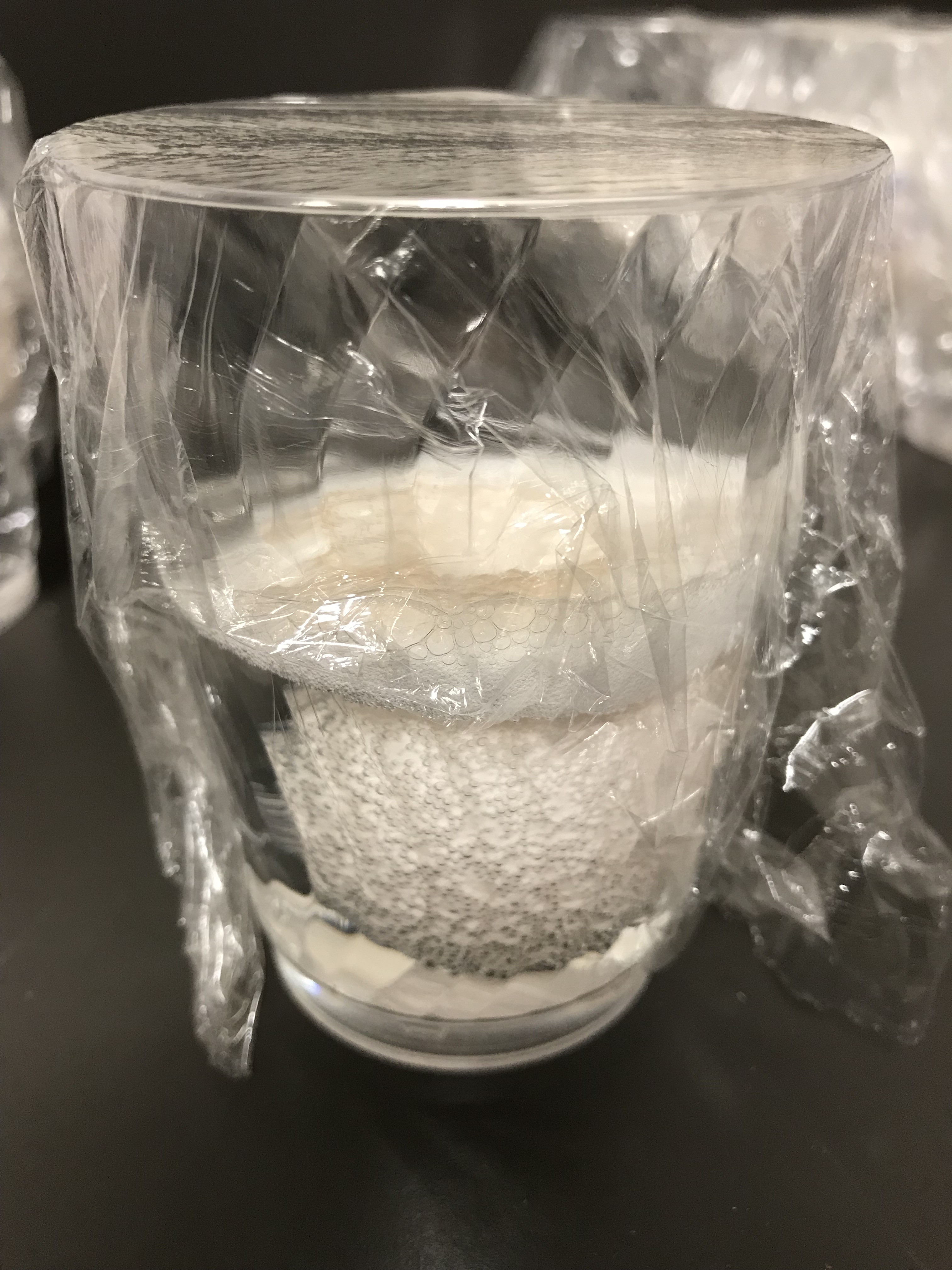
Using the procedure written last Thursday, students initiated the Egg Lab by beginning the process of dissolving egg shells with vinegar.  Each student received an egg, a cup, and enough vinegar to cover their egg.  We will replace the vinegar tomorrow and begin our experiment on Wednesday.

The remainder of class was used to explore a real case study in which a young woman took Ecstasy at a party and ended up in the hospital.  Students took on the role of the doctor who was able to learn a bit about the woman and who also ordered blood work.  After reviewing the results of the blood work, students were tasked with sharing their thinking in the form of an initial model.  Working alone or with a partner, students drew and wrote about what they thought was happening in the woman’s body before she took the drug, when she became sick, and how her body ultimately was unable to handle the toxic side effects of the drug.  We will learn more about body systems tomorrow and apply that learning to construct a stronger explanation of why the woman died in our work later this week.

Egg Lab Prelab / Membrane Movement

Looking ahead to Monday (when we begin the egg lab), students were tasked with writing a procedure for the following objective: Remove the shell from an egg using only vinegar.  Sitting with their new table partners (new seating chart today!), students wrote out a list of steps to dissolve the egg shell.  We then compiled a class procedure (pictured below):

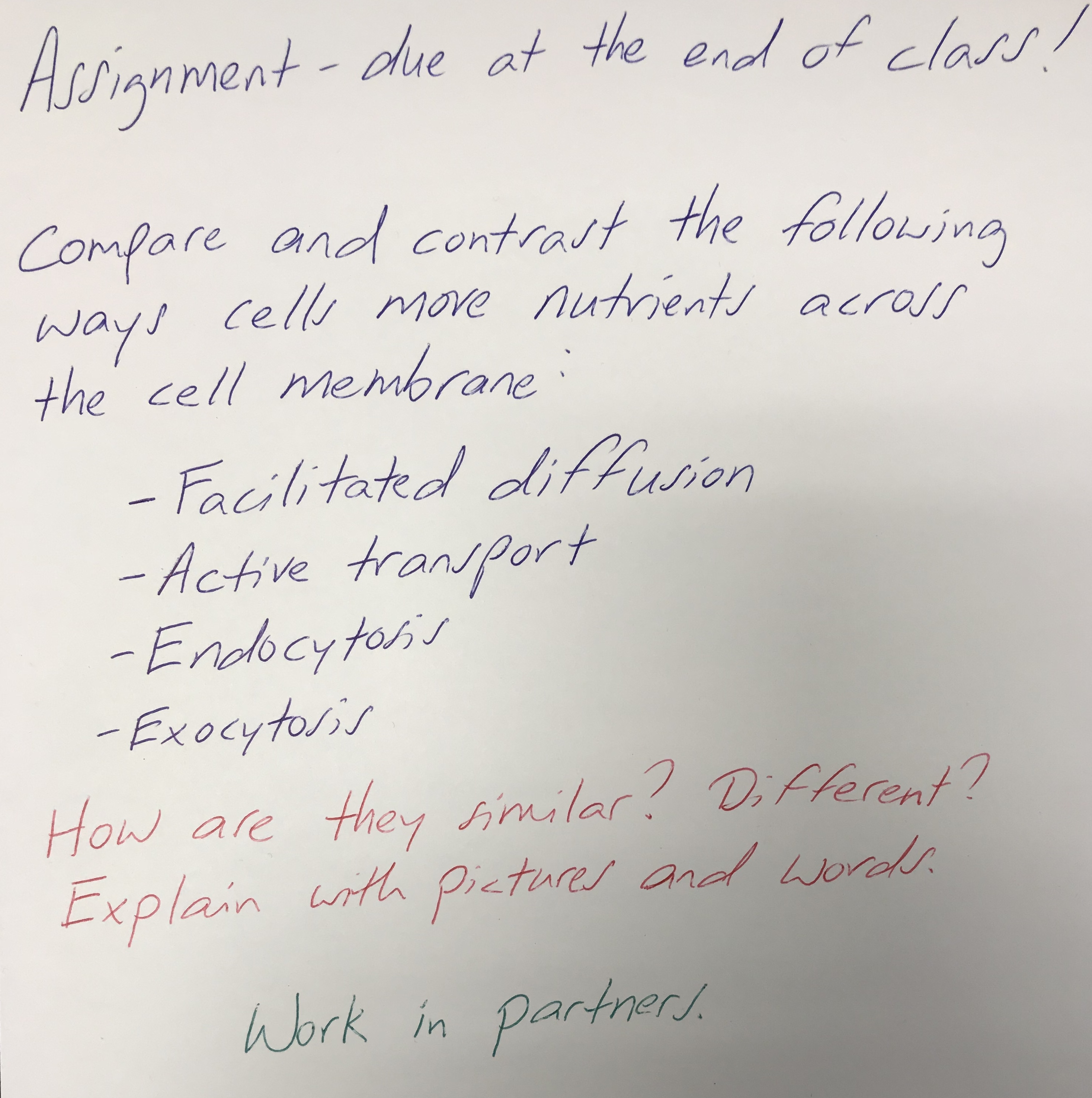
After the procedure writing, students worked with their new partner to complete the assignment below using the knowledge gained from yesterday’s lesson on how to identify credible scientific sources.