Mitosis: Introduction to Mitosis – Part 2

Class began with an example of why mitosis is important: a video showing how salamanders can regenerate lost limbs:

After the video, we worked through a PowerPoint providing students with important vocabulary related to mitosis, with images related to the vocabulary to help reinforce student learning.  Students were encouraged to memorize “PMAT” – an acronym for Prophase, Metaphase, Anaphase, and Telophase which may prove useful on the Biology EOC.  We also discussed the difference between the Washington State Science Standards and the Next Generation Science Standards governing mitosis.  Although Washington State has adopted the NGSS, students are still tested on the WSSS and therefore must navigate between both worlds.  The WSSS (9-11 LS1H) expects students to describe and model the process of mitosis, in which one cell divides, producing two cells, each with copies of both chromosomes from each pair in the original cell.  The NGSS mitosis standard (HS-LS1-4) requires that students use a model to illustrate the role of cellular division (mitosis) and differentiation in producing and maintaining complex organisms.  To help students achieve mastery of the content standards, students were introduced to the Mitosis Project.  The final slide of the project includes a list of 12 different projects for students (working alone or in pairs) to chose from.  Students learned a bit about each project and then had time to decide which project they would like to pursue.  We will formally launch the project tomorrow.

Weather: Molecular View of Pressure

We began class with the Meters, Liters, and Grams video:

After the video, we briefly reviewed the Metric System:

We worked through a few practice problems from Appendix A in the textbook (page A-0) which integrate the metric system and dimensional analysis.  After the

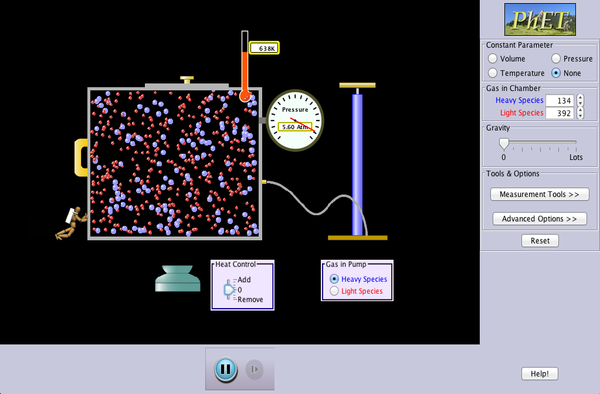
We then transitioned to Lesson 60, providing students the opportunity to make connections between Charles’s Law, Boyle’s Law, and Gay-Lussac’s Law.  Although we did not review it in class, the Lesson 60 PowerPoint is available for students to review.  The Lesson 60 Worksheet called for students to use a University of Colorado PhET simulation.  Because our Chromebooks are unable to run Java, students instead observed a teacher-led demonstration of the simulation software.  For homework, students were assigned textbook problems 3-9 (odds).  Students with access to a Windows-based computer are encouraged to try the simulation (embedded below):

Gas Properties

Click to Run

Mitosis: Modeling Mitosis

After assembling into project groups of 3-4 students, groups were tasked with modeling the process of mitosis using modeling clay.  Students documented their work by taking pictures (extra credit for stop-motion video) and emailing them to the teacher.  The modeling activity served to reinforce the steps of mitosis and provided students with a creative way to share their learning.

Weather: Gay-Lussac’s Law

For lesson 59, we learned about Gay-Lussac’s Law (P=kT), the third gas law needed to connect pressure, volume, and temperature.  Gay-Lussac’s Law helps explain the egg-in-a-bottle trick, where boiled water displaces the air inside a bottle, and as the water condenses, an egg placed over the bottle will be pulled inside because of the change in pressure inside the bottle.  The Lesson 59 worksheet and Lesson 59 PowerPoint are available for download.

Central Dogma: Introduction to Mitosis

After wrapping up our work for now on the Chromosome Project, we transitioned to studying how cells divide.  Mitosis, or somatic cell division, involves the division of one cell into two after all of the components of the original cell (including the DNA!) divide into two sets.  We began by watching a Crash Course video about mitosis:

After the video, students were assigned to read pages 46-51 of chapter 4 (Cellular Reproduction: Multiplication By Division) of Inside the Cell.   Students then answered the following questions in their lab notebooks:

  1. Explain the purpose of mitosis.
  2. Which cells undergo mitosis?
  3. Describe the phases of mitosis in detail (words and/or drawings).
  4. Explain what happens when cells divide uncontrollably.  List the known causes of uncontrolled cell division.

This unit is focused specifically on NGSS Standard HS-LS1-4Use a model to illustrate the role of cellular division (mitosis) and differentiation in producing and maintaining complex organisms. Students have previously been assessed on their understanding of how cellular expression of specific gene products (proteins) can result in unique cell types, and groups of unique cell types can form tissues.  Students learned about body structure and organization during Unit 3, including the organization of cells into tissues and organs.  In this mini-unit, students will be able to clearly connect the process of mitosis (cell division) with tissue organization and organism development.

Weather: Air Pressure

Lots of demonstrations today!  We will conduct as many demonstrations as time and resources permit.  Students are encouraged to watch the videos below to make additional observations and to help explain what is happening in each of the demonstrations.  Students will write observations and draw pictures of air molecules to visualize pressure using the space provided on the Lesson 57 Worksheet.  The Lesson 57 PowerPoint includes the definition of pressure.

Balloon in a bottle:

Soft drink can:

Submerged cup:

Air pressure mat:

Cup and card:

Balloon in a vacuum:

Marshmallows:

Egg in a bottle: