Variation and Inheritance: Punnett Squares

We packed a lot into the short class period today.  To reinforce concepts introduced in the video yesterday but not covered in the reading assignment, we spent today learning and applying the vocabulary of inheritance.  We dusted off the cobwebs from student memories from middle school, reviewing the vocabulary words of genotype, phenotype, alleles, dominant, recessive, homozygous, and heterozygous.  We then applied the vocabulary to an example Punnett Square about eye color inheritance patterns.  Notes from the white board are pictured below:

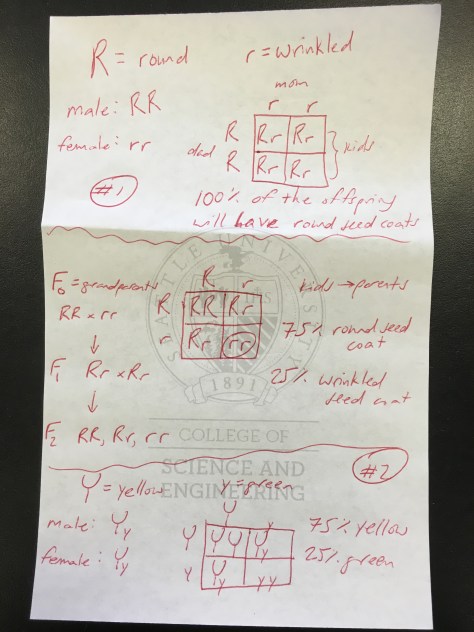
We then applied these concepts to a Punnett Square worksheet.  We worked through the first two problems together (pictured below), and then students used the remainder of the class period to work through the remaining problems.
IMG_0639

Students in 4th period were very interested in learning more about the genetics of eye color.  The NIH Genetics Home Reference website explains the genetics of eye color, complete with references to relevant scientific journal articles.  The Tech Museum of Innovation website has a lengthy article written in more student-friendly language (with graphics!) on the topic.  The article includes a calculator to predict the eye color of your offspring, and even provides evidence about how two blue-eyed parents can have a brown-eyed child (Surprise!  High school genetics is over-simplified!).  The question of traits “skipping a generation” also came up during 4th and 5th periods.  We used problem 1 from the worksheet to explain how a grandparent and a grandchild can both share a trait that “skips” the generation in between.

Weather: Humidity, Condensation

For Lesson 66, students learned the definition of humidity on slide 5 of the Lesson 66 PowerPoint.  Students then broke into groups and conducted the lab outlined in the Lesson 66 Worksheet.  The worksheet packet also included a copy of the Relative Humidity Handout to use for calculations.  For homework, students may work through any 4 problems from the textbook (or take notes on the reading – always an option!).  Students were also reminded that we will have the Chapter 12 quiz next Tuesday and the Unit 3 exam next Thursday.

Weather: Ideal Gas Law

After several lessons learning about the component parts and relationships mathematically connecting pressure, volume, temperature, and number of particles, the Ideal Gas Law was revealed.  We worked through the Lesson 64 worksheet and then watched a Crash Course video on the Ideal Gas Law:

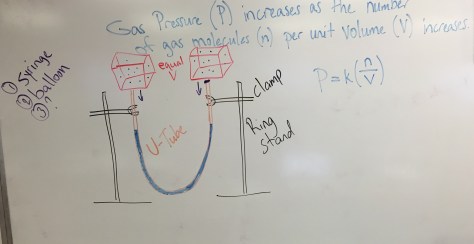
After the video, we worked through Lesson 65 textbook problems 3 and 5.  The notes from the white board are shown below.  The Lesson 65 PowerPoint and Lesson 65 Worksheet are available for students who would like to see them.  We did not use either today in class, and the Lesson 65 Worksheet was not assigned.

Central Dogma: Mitosis Project Presentations

Today marked the first of two days allocated to student presentations of their Mitosis Projects.  Audience members were instructed to engage both by actively listening and also by taking the following notes in their lab notebooks:

  1. For each presentation, write down the most important thing learned;
  2. One question you still have about the topic;
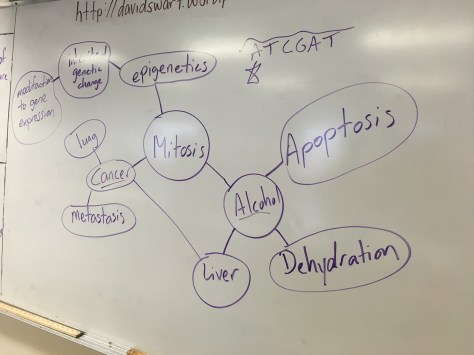
  3. Add the main ideas to a network diagram to illustrate connections both with mitosis and between project topics.

A picture of one of the network diagrams constructed by one class period is shown below as an example of our work today:

IMG_0627.JPG

Weather: Pressure and Number Density

Happy Pi Day!  We began class with a SciShow video about Pi (below) and students received an additional 20 minutes to finish the Chapter 11 quiz from Friday.  We then moved into Lesson 63, the first lesson of Chapter 12.  Students received copies of the Lesson 63 Worksheet, a companion handout with information connecting air pressure and temperature, and a calendar detailing lessons, assignments, and tests through the end of March.  Students are also welcome to review the Lesson 63 PowerPoint.  A picture of the white board with notes about the lab are also provided below.

FullSizeRender (11)

Weather: High and Low Air Pressure

For the final lesson of Chapter 11, students conducted the”cloud in a bottle” lab.  They added warm water to two-liter bottles and then filled the bottles with smoke.  By squeezing and releasing the bottles, students observed cloud formation.  They repeated the experiment with bottles filled with cold water and without water and made observations on the Lesson 62 Worksheet.  The Lesson 62 PowerPoint is available here as a resource.  In place of homework, students were encouraged to prepare a page of notes to use for the Chapter 11 Quiz tomorrow.  Pictures of the whiteboard, including a list of key notes to take for the quiz tomorrow and some thinking about warm and cold front interactions.

Mitosis: Mitosis Project

Today students launched in to the Mitosis Project.  The project outline can be viewed here.  Below are some resources for groups as they begin conducting research on their topic:

  1. Mitochondrial replication
  2. Chloroplast replication
  3. Binary fission in bacteria
  4. Muscle growth and repair
  5. Epigenetics and regulation of gene expression
  6. Homeobox genes in embryogenesis
  7. Limb regeneration in newts and salamanders
  8. C. elegans cell fate mapping
  9. Cancer and metastasis
  10. The effect of smoking on lung cells
  11. The effect of alcohol on liver cells
  12. Retrovirus infection

Additional information for each project topic can be found on the Mitosis Project Resources page.  Remember to cite sources using APA format – Citation Machine can help simplify the process.