Central Dogma: Central Dogma

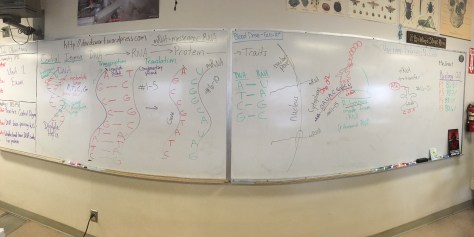
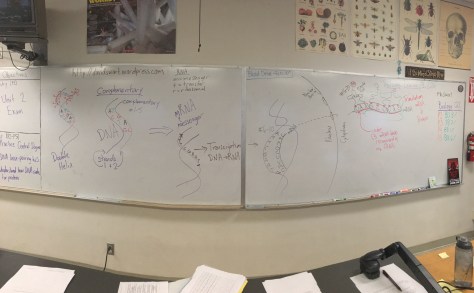
After wrapping up the discussion from the previous day’s lesson, we launched into an investigation of the process of Central Dogma.  Students learned how DNA codes for RNA which codes for protein.  We drew out the processes of transcription and translation, using a guided worksheet approach to help students understand what happens at each step of the process.  Whiteboard notes from two different classes are shown below:
IMG_0517
Notes from 2nd period
IMG_0518
Notes from 5th period

Updated: February 5, 2016

We completed the DNA base-pairing worksheet that we began yesterday.  We reviewed how DNA codes for RNA and RNA codes for protein.  We learned how RNA is read by ribosomes, with 3-base RNA sequences (codons) coding for specific amino acids.  Students were surprised to learn that that for many amino acids, there are more than one codons.  This was emphasized in questions 22 and 23 of the worksheet, where students learned to work backwards from a sequence of amino acids to figuring out one possible RNA sequence encoding that amino acid sequence, and finally figuring out the DNA sequence coding for the chosen RNA sequence.

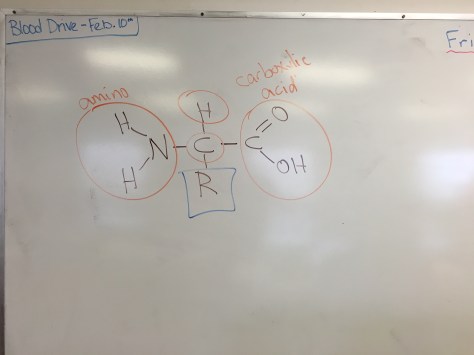
Question 26 of the worksheet asked students to notice how amino acids with multiple codons often “wobble” at the third position (click here for a brief summary, or here for a not-so-brief summary).  The picture below attempts to add some context to the discussion.
IMG_0520
Parts of an amino acid, the basic unit of proteins
IMG_0521
Some amino acids are encoded in multiple codons because of what is known is the wobble position, or more formally as “degeneracy” of the genetic code.

Central Dogma: Content Pre-assessment

We began class with an assessment of what students know and need to know about the content we will cover in Unit 3 (Central Dogma).  Students received a worksheet with a list of science standards (both Washington State and Next Generation Science Standards) as well as a list of vocabulary words.

The majority of the class period was used to guide students through the process of writing a full-credit EOC-style conclusion using the writing prompt from the Unit 2 Exam.  We thoroughly reviewed how to use the exam as a resource, how to carefully dissect the scenario and data table that are provided as part of the prompt, and how to use the provided list of bullet points to write the conclusion.  An example of the prompt (after markup) and a writing sample are provided below:

My 5th period class finished early and was treated to the following classic video of the 1971 hit video Protein Synthesis: an epic on the cellular level:

Molecular Structure and Properties: Amino Acids and Proteins

The final lesson of Unit 2 explores how amino acids connect to make proteins.  The Lesson 48 PowerPoint includes the vocabulary terms of amino acid and protein.  Lesson 48 connects with Lesson 47, as amino acids are chiral molecules.  Notably, all of the 20 different amino acids in human proteins are “left-handed” (as opposed to the mirror-image “right-handed” isomers), meaning they all have the L conformation (L for laevus, Latin for “left”) rather than the D conformation (D for dexter, Latin for “right”).  Students will work in pairs to complete the Lesson 48 Worksheet, learning about the properties of amino acids and how they bind together to form proteins.  For more on the D and L convention, click on the picture below.

As noted previously, there are 20 different amino acids.  All amino acids share the same base structure of a central carbon atom bound to a carboxylic acid (-COOH), an amino group (-NH2), and a hydrogen (H).  The central carbon is also bound to an R group, with R indicating any one of the 20 different amino acid structures.  The structures each have different physical properties.  When individual amino acids link together, a polypeptide chain is formed (and a molecule of water is removed as each new amino acid is linked to the chain).  The polypeptide chain, composed of a string of amino acids, folds into a particular shape determined by the interactions of all of the amino acids.  The shape of a protein determines its function in the body.  Mr. Anderson of Bozeman Science has a fantastic video explaining the nature of proteins:

For students looking for a good review of Central Dogma (DNA > RNA > Protein > Trait), the Crash Course Biology video DNA, Hot Pockets, & The Longest Word Ever is a good resource:

Finally, for students with access to a home computer, the Fold.It website will have you folding proteins in no time!

Central Dogma: Initial Ideas

We began the new semester with a review of the Unit 2 Exam from last Thursday.  Students received their graded exams and we went over how the exam was scored and how the final scores were curved.  We went over the procedure writing question in detail, with students revising their procedures to better meet the criteria for writing a successful EOC-style procedure.  The procedure for the experiment was outlined on the white board, variables were identified, and students then were instructed to add the important missing details to make the procedure reproducible.

We pivoted to a brief acknowledgement of the Iowa caucuses this evening, with students voting on whether to keep the original grading system (second semester grades = the average of third and fourth quarters) or transition to a semester-long grade book.  After the final votes were tallied, students decided bya 48-40 margin to transition to the semester-long grade book.  Finally, we concluded class with an exit task where students were instructed to write down everything they know (or think they know) about DNA, genetics, inheritance, and related concepts.  After some private think time, student ideas were captured on a class poster, where each student was asked to contribute a unique idea.  The posters will be displayed and periodically updated to reflect new student learning as we progress through the new unit.

Molecular Structure and Properties: Mirror-Image Isomers

Welcome to second semester!  We have a few new students joining our class, so we will briefly review the syllabus (with minor revisions), talk about class mechanics, and consider opportunities for fine-tuning how we use our new textbook this semester.  Next, we will dive into Lesson 47 and investigate the concept of mirror-image isomers, also known as chiral compounds.  We will begin with the Lesson 47 PowerPoint ChemCatalyst to help get students thinking about mirror images.  We will then watch a short video about chirality (below):

Students will then receive the Lesson 47 Worksheet, working in pairs to model the compounds using the class set of molecular modeling kits.  The worksheet concludes with students hypothesizing whether L-carvone will smell like D-carvone, and then testing their hypothesis.  For homework, students were assigned textbook questions 2, 7, 8, and 9.

Want more?  Check out the blog post Perhaps looking-glass milk isn’t good to drink for an overview of Lewis Carroll, looking-glass milk, and L- and D-carvone.  Want more?  Joanna Shawn Brigid O’Leary from Rice University published an even more extensive investigation of how Lewis Carroll (author of Alice in Wonderland and Through the Looking Glass) weaved biochemistry into his fiction.  Her paper (available as a PDF), WHERE ‘THINGS GO THE OTHER WAY’: THE STEREOCHEMISTRY OF LEWIS CARROLL’S LOOKING-GLASS WORLD is well worth the read.  Perhaps it will even inspire students to read the book before the movie is released in theaters on May 27!