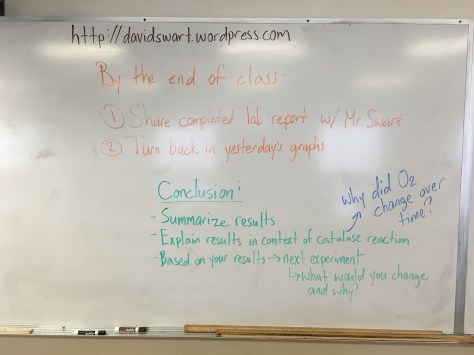
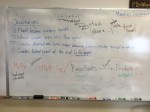
We wrapped up the calendar year with students working with their groups to write the conclusion section of the potato catalase lab report. The picture below provides guidance for writing the conclusion. When finished, students shared their lab report with the teacher and turned in their individually completed paper graphs.
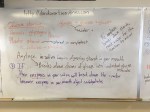
We continued our work from yesterday, with students re-grouping to share the data from the lab (and creating T-charts of the data) and using it to create graphs using graph paper. Students then analyzed the graphs to answer questions about what the data demonstrated. The analysis questions were intended to help prepare students for the types of questions they might see on the Biology End Of Course Exam in May, as well as deeper questions that better reflect the thinking of highly capable high school students. For example, students were pushed to describe the enzyme’s rate of activity (the rate of change in their graph). Students have learned how to calculate the slope of a line in algebra, but it is not necessarily a concept students readily apply to biology. Students who finished continued working on their lab reports using the Chromebook, creating digital versions of their data tables and a few even created graphs in Google Sheets and copied them over to their Google Doc lab report. Students will finish the lab reports tomorrow.
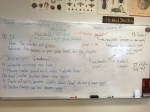
We began the lesson with students reflecting back on the vocabulary words they learned on Monday (enzyme, reactant, and product). Students used the vocabulary to describe the chemical equation written on the board. The equation showed the enzyme catalase converting the reactant hydrogen peroxide (H2O2) into the products water (H2O) and oxygen (O2). Students then learned that catalase is an enzyme found in animals and potatoes. The enzyme has one of the fastest known reaction rates, converting 5 million H2O2 molecules into H2O and O2 every second! Students learned that we would be conducting an experiment with potatos to measure the rate of oxygen gas produced from the reaction of potato catalase with hydrogen peroxide. After writing down the procedure and watching a demonstration of the steps, students were assigned to groups and worked through the experiment, collecting initial and final temperature readings, as well as the change in oxygen percentage released over 10 minutes. Once the experiment was underway, students who were not actively timing or recording the results were assigned the job of typing up the procedure using the Chromebooks. We will analyze the results tomorrow.
After grading the writing assessment from last Friday, it became apparent that the assessment did not accurately reflect student understanding of the content. We briefly discussed the reason for this, with students explaining the scenario was confusing and they did not have enough time with the short Friday class period to formulate a solid explanation. With the need remaining for students to “show what they know,” students received a new assessment organized more like an assignment and focused on drawing out student content knowledge. The new assessment helped students build a framework upon which they could then “write to explain” the process of digestion and biomolecule metabolism. This assessment, along with work from the student’s Unit 2 portfolio and
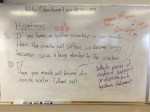
We opened class with a brainstorming session about what would happen if a person placed a Saltine cracker in their mouth and left it there. Students in each class came up with two or three hypothesis statements, after which, they conducted the experiment. Students were offered regular or whole wheat crackers. We recorded observations, determined whether the observations supported or disproved the hypothesis statements, and then launched into a discussion of enzymes. Students recorded the definitions of reactants, products, and enzymes taken from today’s Chemistry class Lesson 35 PowerPoint slide deck (on slide 11, the word “catalyst” was replaced with “enzyme” and “substance” was replaced with “protein”). We reviewed the way that animals and plants created polymers of glucose to create glycogen (energy stored in animals), starch (energy stored in the plant organelle called the amyloplast), and cellulose (structural molecule in plants). We then applied that learning to the discussion of how the salivary amylase enzyme digests the starch in the Saltine crackers, releasing glucose molecules. A few students in each class who let the crackers sit in their mouths for a long time even reported the crackers tasted slightly sweet. The discussion of enzymes set the stage for tomorrow’s potato catalase lab.
Pictures from the white boards for today’s classes:
Students used the class period to complete a writing assessment in which they were asked to explain how your body can take in the materials from a “beef burger” and make it a part of you. The assessment was taken by all biology students and will be used both to assess individual student learning and to help the science department determine student growth in the area of writing. At the end of class, students turned in the writing assessment along with their Unit 2 portfolio work for grading.
Class was divided into two parts today: organizing student portfolios and using the work to revise the initial model from the second day of the unit. For the first part, students received a worksheet with a list of all of the Unit 2 assignments to date. They located the work and checked off completed items. The process gave students a clear idea of their progress toward work completion in the class. To gauge comprehension, students used their work to revise their initial models of how someone can survive an extreme scenario (like running from a fire or swimming the English Channel). By thinking through the process of how the body systems interact and obtain and use energy, students are primed for the writing assessment for tomorrow. After the assessment, students will turn in their portfolios for grading over the weekend, with the portfolio grade, revised initial model, and writing assessment comprising the majority of their mid-quarter grade.
Having watched a video about biomolecules and read about biomolecules, it is time to build biomolecules! Thanks to a DonorsChoose grant last school year, we have a class set of molecular modeling kits and students used those to work through the first half of the What is the Chemical Nature of Biomolecules packet. Students learned how to use the molecular modeling kits and then used the components to model molecular oxygen, carbon dioxide, water, and ultimately glucose. We will complete the packet tomorrow, with students modeling how two glucose molecules combine to form a disaccharide, and then they will extend their learning about fatty acids and amino acids.
With most students needing some additional class time to complete one or more assignments, we used today as a catch-up day where students could use the Chromebooks, work in small groups, and receive focused help from the teacher. Tomorrow we will begin learning how to build biomolecules using our molecular modeling kits. Students have until Wednesday to complete and turn in unfinished work, and the classroom will be open after school tomorrow for students who would like additional help outside of normal class time.
With the hugely successful Career Fair extending Advisory today, we used the 25 minute class period for a quiz covering cellular respiration, body systems, biomolecules, and feedback.



 Science with Swart
You must be logged in to post a comment.