Category Archives: Chemistry

Structural Formulas

We continued our work from yesterday, adding three additional scents for students to smell and connect with molecular formulas.  Students learned that two molecules can have the same molecular formula but smell very differently.  One compound smelled like rum extract, the other smelled like stinky cheese.  This created a powerful and memorable moment for students to remember the concept of isomers.  Key definitions for the day:

Structural Formula – A drawing or diagram that a chemist uses to show how the atoms in a molecule are connected. Each line represents a covalent bond.

Isomers – Molecules with the same molecular formula but different structural formulas

For the class period, students worked through the Lesson 29 worksheet and then were assigned Lesson 29 problems 5-7 from the textbook as homework.
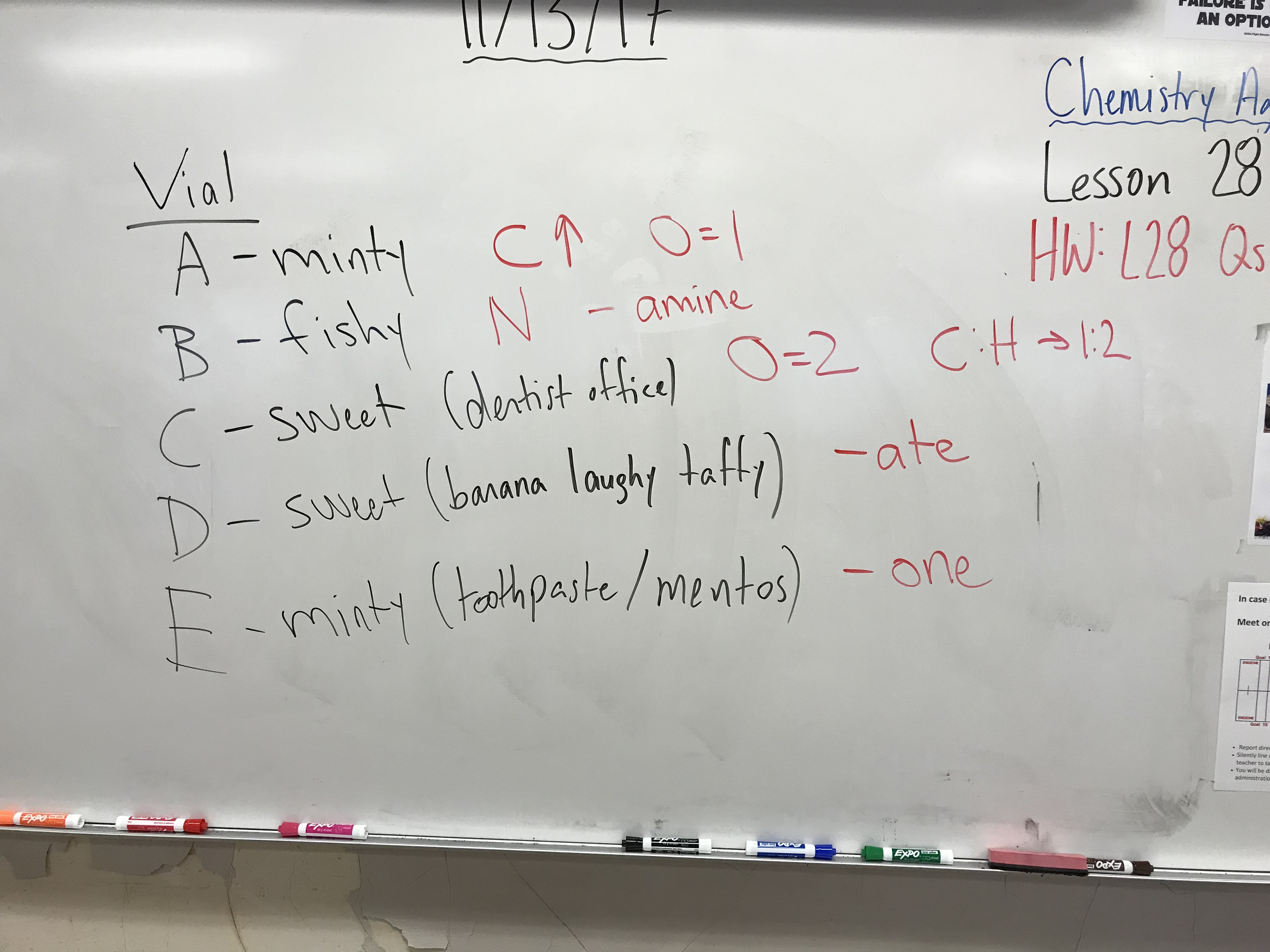
Molecular Formulas

For our first lesson of Unit 2, students were asked to respond to the following entry task:

  • What do you think is happening when you smell something?
  • Why do you think we have a sense of smell?

After a class share-out, students all participated in an activity where they smelled five different scents and then compared their observations as a class.  Based on the class results, students made connections between molecular formulas, chemical names, and scents (fishy, minty, or sweet).  After completing the Lesson 28 Worksheet, students were assigned problems 7-9 from Lesson 28 of the textbook as homework.

Notes from the whiteboard are shown below:

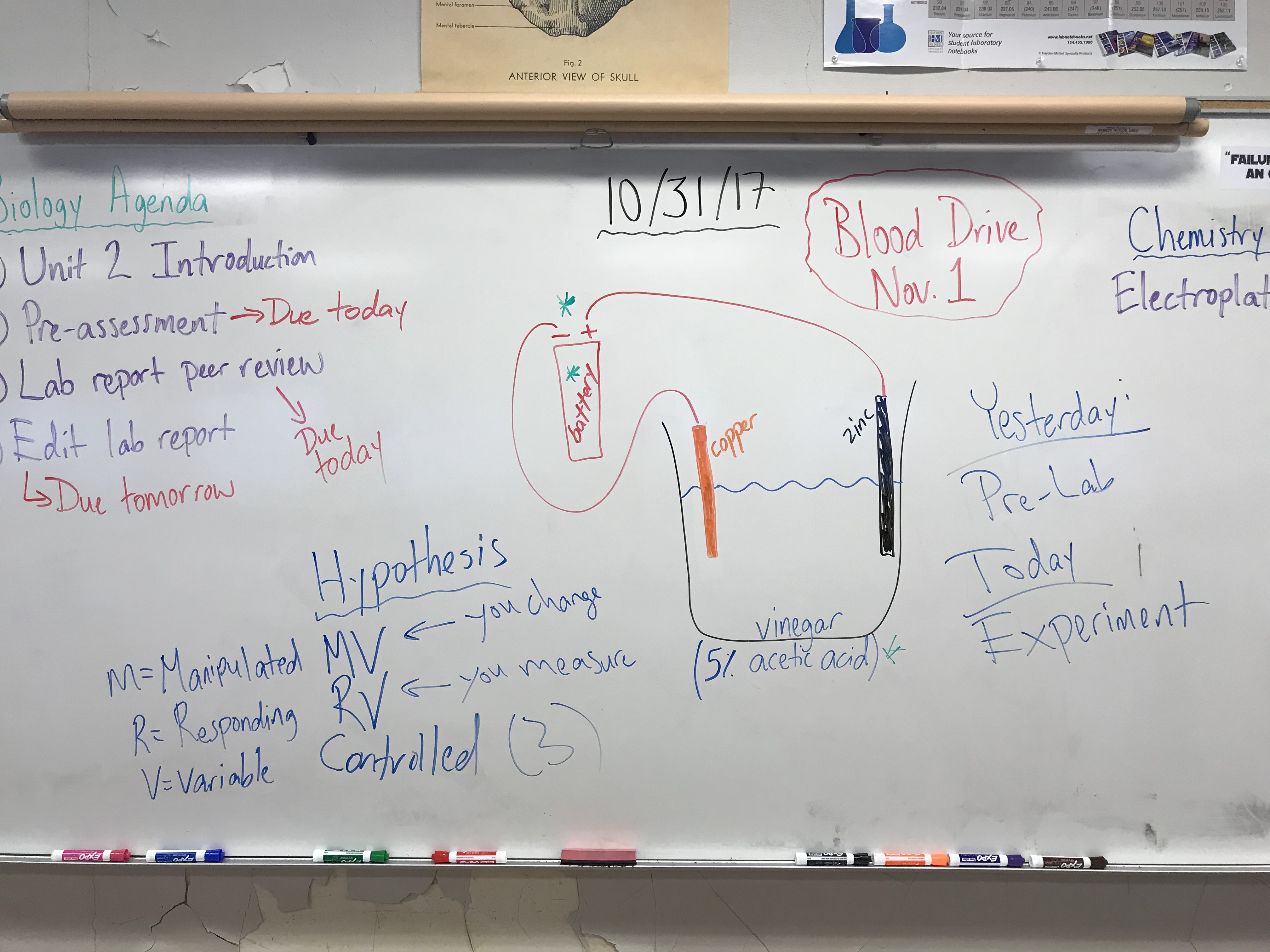
Lesson 27 lab

Following up on the Lesson 27 pre-lab from yesterday, students were tasked with thinking through their setup and identifying one variable to manipulate in the lab today that would yield observable results (the responding variable).  Such manipulated variables included battery type, direction of current flow, choice of metals, and concentration of acetic acid.  Students had the remainder of the class period to set up their experiments, record observations, refine if necessary, and repeat yesterday’s experiment if insufficient data was recorded yesterday.  This work will be written into a lab report next week.

Lesson 27 with pre-lab

For our final lesson of Unit 1, we learned about electroplating by watching two short videos.  The first shows a garage-style setup with a guy who uses a spork and pickle juice to electroplate a part of his cart project:

The second video was a bit more typical of what we are doing today in class:

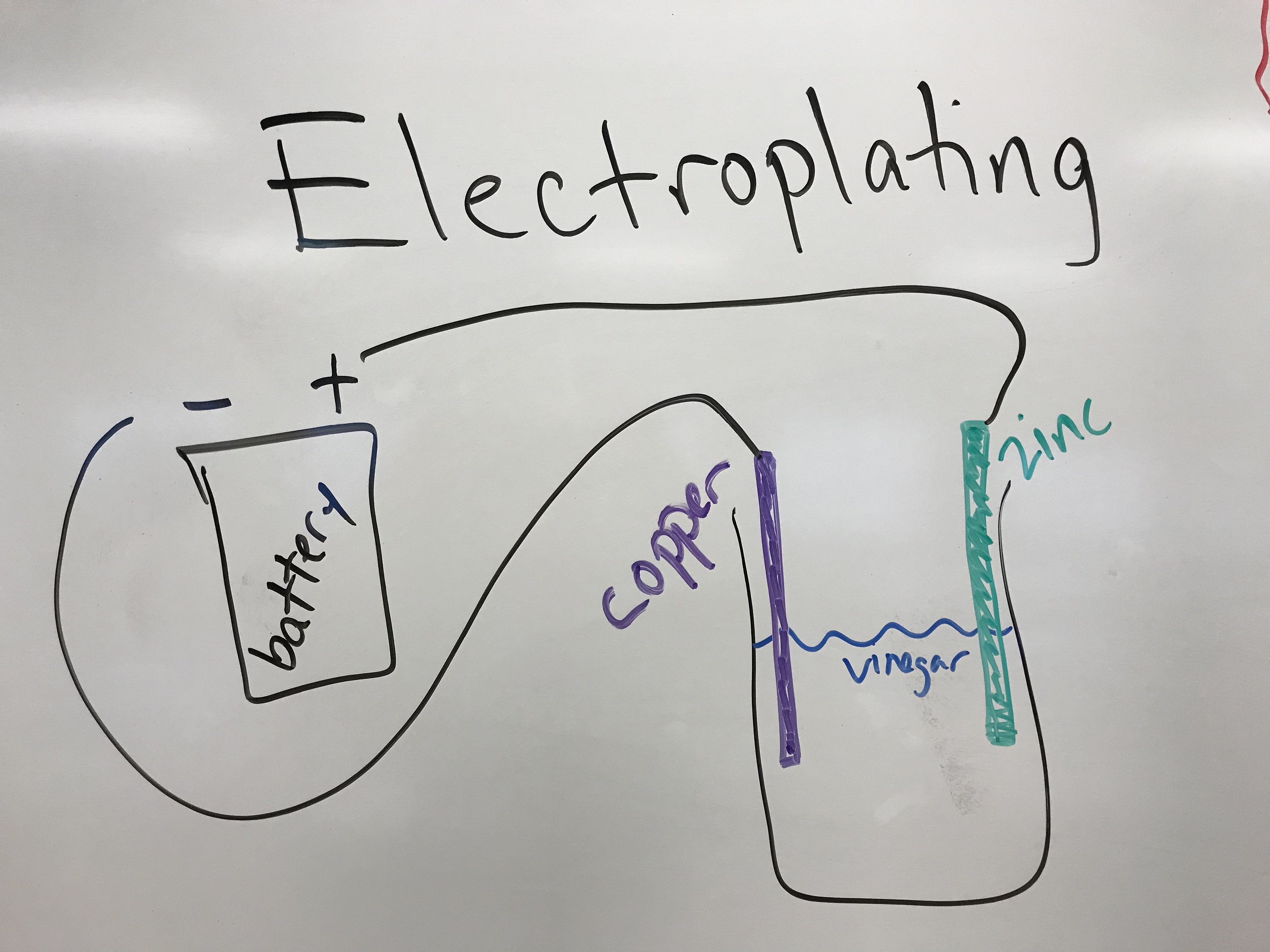
For class today, students conducted a live pre-lab, using batteries, alligator clips, zinc strips, copper strips, beakers, and acetic acid (5% vinegar).  The purpose was to create an electroplating circuit to visualize the movement of metal from one strip to the other through the acetic acid.  Some students integrated a holiday light into their setup to measure current flow between the metal plates.  After documenting their experimental design and observing the formation of bubbles (hydrogen gas) and discoloration of one of the metal strips, students reversed the flow of current and made further observations.  We will continue our study of electroplating tomorrow.

Quiz Corrections / Catch-up Day

We concluded the week with students receiving back their graded Chapter 4 quizzes.  Students have the opportunity to earn back 1/2 the value of each question they got wrong by completing the following instructions:

  1. Write the correct answer and cite a credible scientific source (i.e. textbook page number)
  2. Explain what you were thinking when you selected the incorrect answer.

Credit will not be given for incomplete revisions.  

Students also had the opportunity to catch up on any missing assignments and begin studying for the Unit 1 Exam coming up next Thursday and Friday.

Notes:

  1. Homework for Lessons 25-27 is now optional.  Students are encouraged to work the problems listed in the Unit 1 Homework list but it does not need to be turned in and will not be scored for credit.
  2. All missing Unit 1 work must be turned in by next Friday, November 3.

Lesson 26

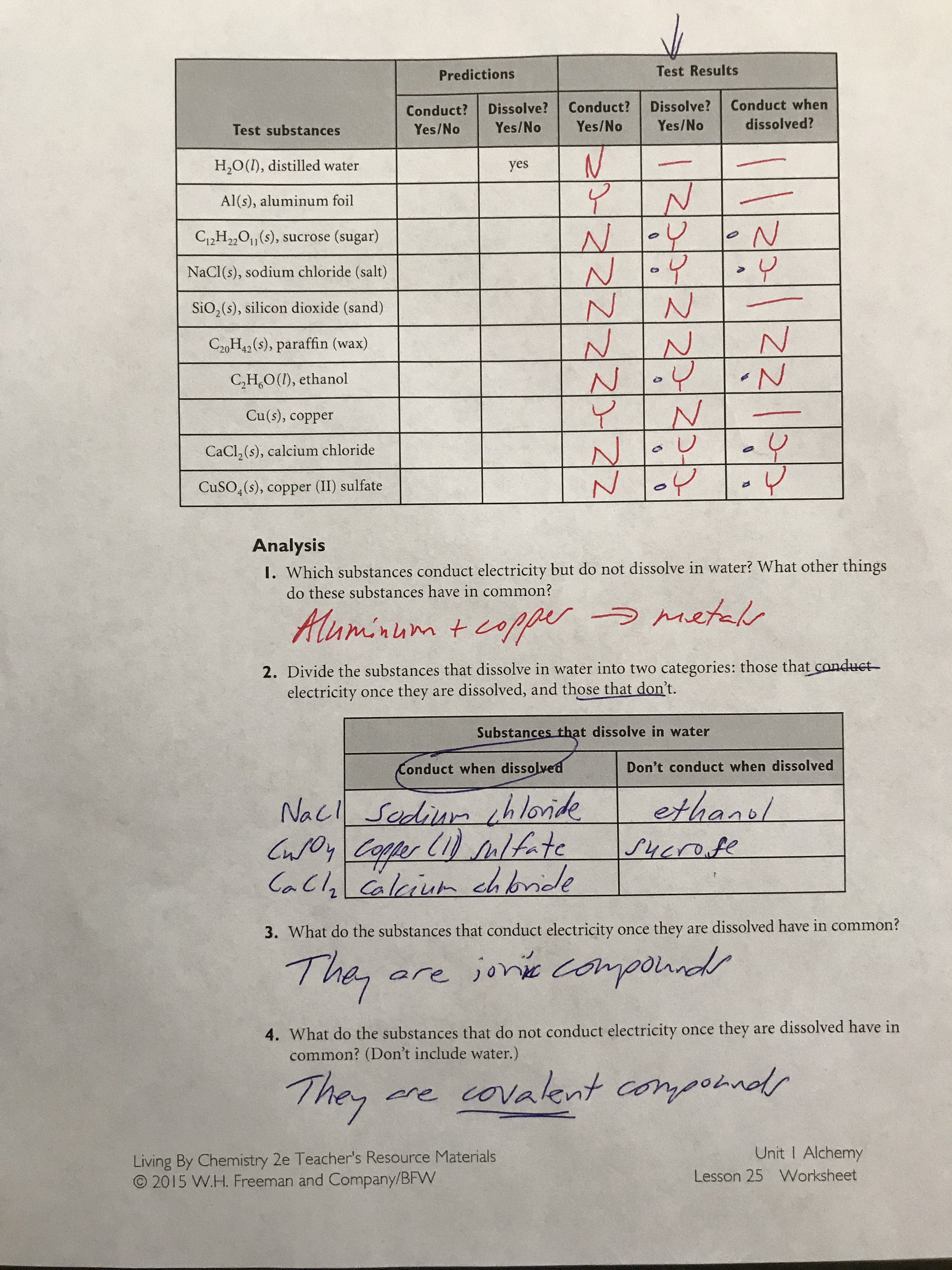
We began class by revisiting the Lesson 25 worksheet from yesterday, focusing on Analysis questions 1-4 and compiling our thoughts as shown:

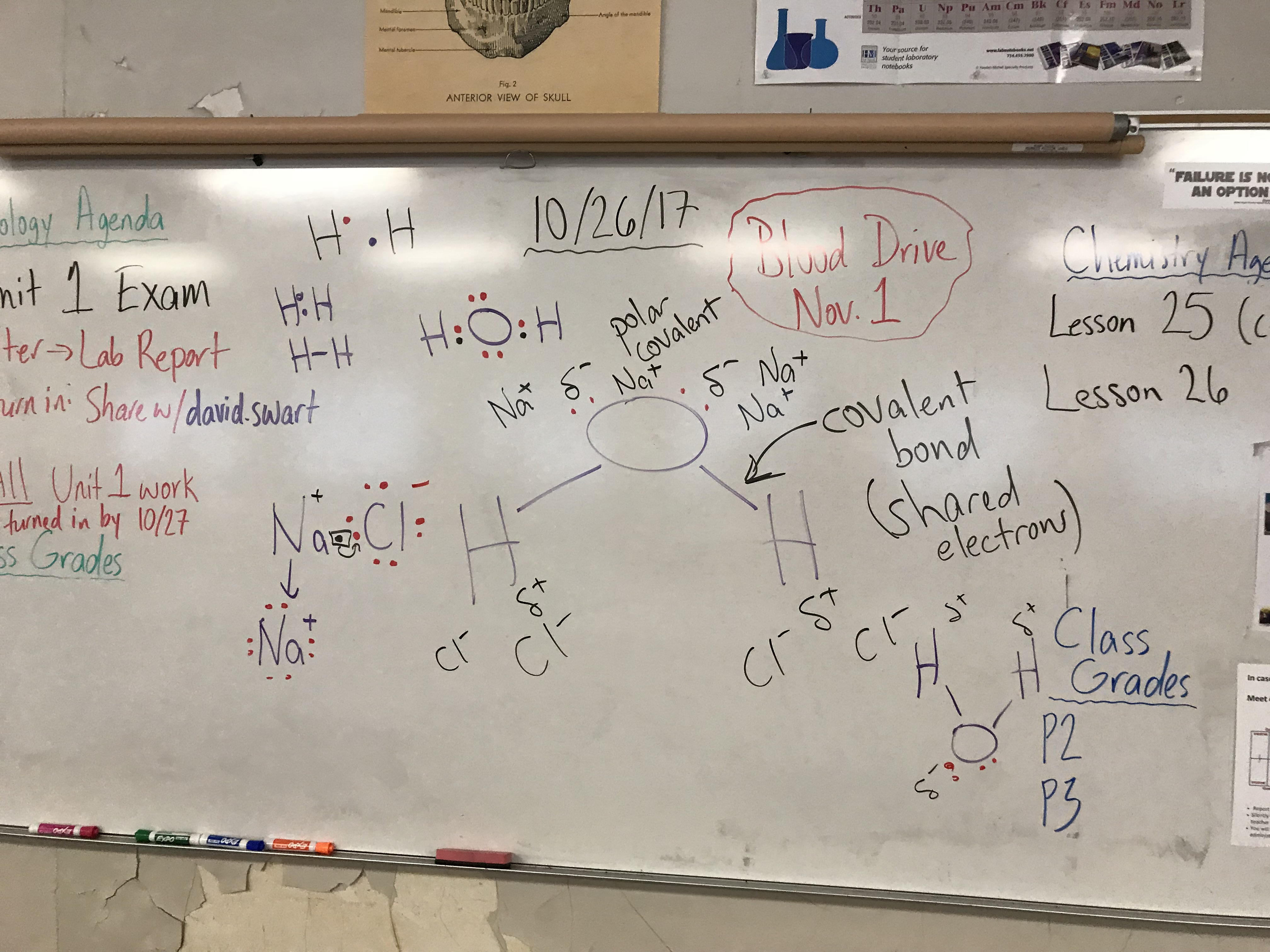
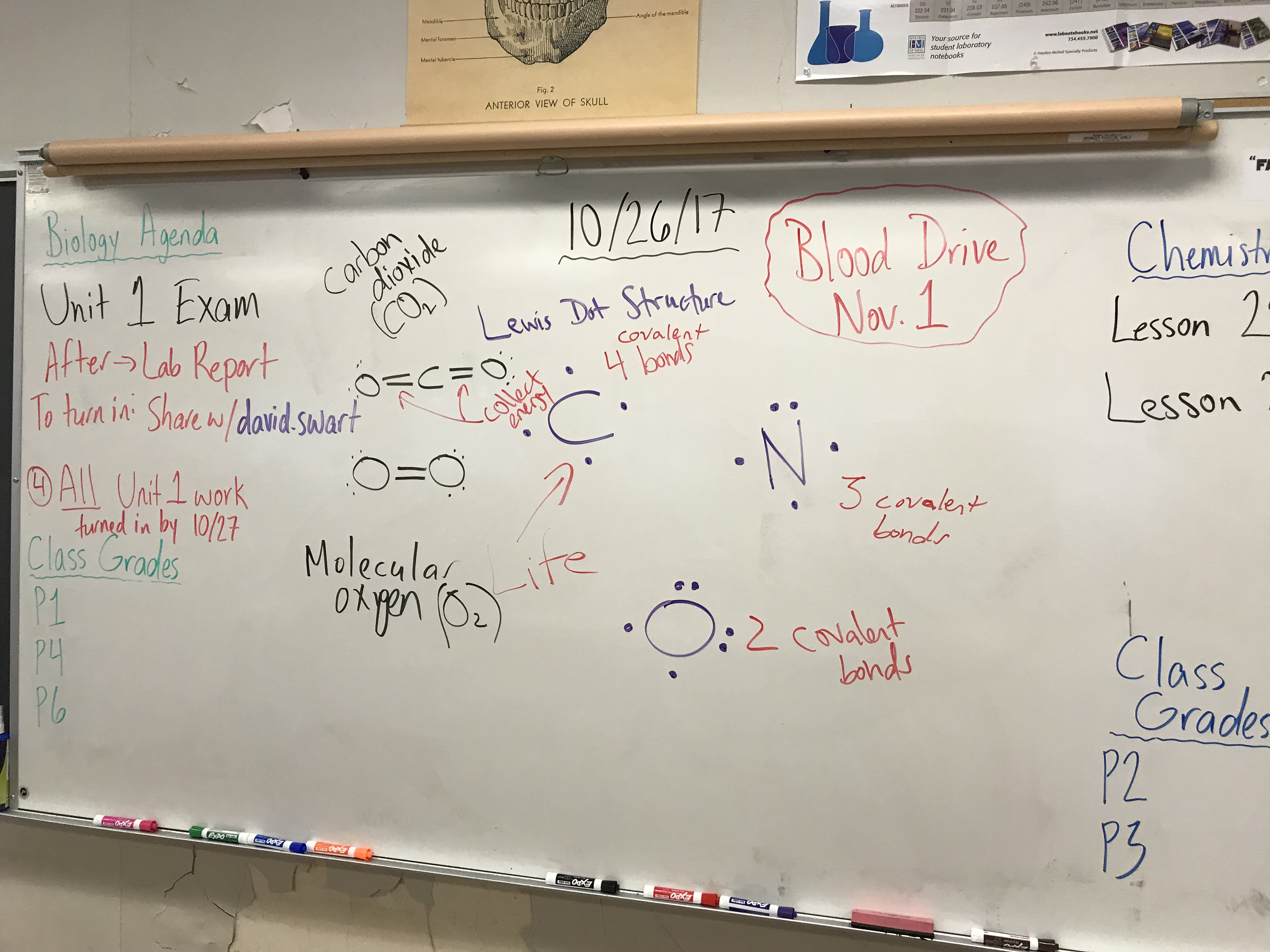
That work led to a broader discussion of bonding, the theme of Lesson 26.  I introduced the concepts of Lewis Dot Structures, covalent bonds, and polar molecules.  I used those concepts to explain why ionic compounds dissolve in water, thus enabling them to conduct electricity.  The intent was for students to develop an understanding for where our study of chemistry is headed and to challenge them to stay actively engaged in their learning.  Notes from that portion of the lesson are shown below:

For the final portion of the class period, students received a handout depicting the four models of chemical bonding.  They then worked in groups of four to categorize the Substance Cards and record their learning on the Lesson 26 worksheet (one per student group).

Electron Configuration Gizmo

For today’s Electron Configuration Gizmo activity, complete the following steps:

  1. Go to the Explore Learning website.
  2. Click the Login/Enroll button (upper right).
  3. Select Chemistry from your list of classes.
  4. Launch the Electron Configuration Gizmo.
  5. Complete the “Electron Configuration Gizmo” worksheet with a partner.

For students who have not yet created an account:

  1. Enter the class code (written on the white board).
  2. Click the Enroll in Class button.
  3. Choose “I need to create…” option.
  4. Enter your First and Last name (not email!)
  5. Use your student numer (s-#######) as your username.
  6. Enter birthdate as password (MMDDYYYY)
  7. Click “Submit”
  8. Launch the Electron Configuration Gizmo.
  9. Complete the “Electron Configuration Gizmo” worksheet.

Electron Configurations

Our learning about electrons culminated today with Lesson 24, in which students understanding of electron shells was expanded to include the concept of subshells.

To launch the lesson, we began with the Crash Course chemistry video below:

Next, we worked through the Lesson 24 PowerPoint, and students also received a copy of the Lesson 24 Worksheet.  For homework, students should complete textbook questions 1-13 at the end of Lesson 24 (page 121).

Want more?  There is a follow-up Crash Course video (#25) that picks up where this one left off and takes the content to a whole new shell (sorry, chemistry humor):


For Thursday, October 19, we began class with a refresher from yesterday and extension (ionization energy) via Mr. Anderson of Bozeman Science:

We reviewed at length the connection between the periodic table and electron configuration, working through parts of the Lesson 24 worksheet handed out yesterday as a class.

Transition Metal Chemistry

After taking yesterday to review our learning of ions through the first six lessons of chapter 4 (in the form of a quiz), today we learned about how to name compounds that involve transition metals.  To help launch the lesson, students watched a video by Tyler DeWitt titled Writing Ionic Formulas with Transition Metals:

Students are encouraged to watch the follow-up video titled “Naming Ionic Compounds with Transition Metals Introduction” as review:

After watching the first video, students worked through the Lesson 23.1 worksheet.  For homework, students should complete Lesson 23 problems 1-5 on page 115 of the textbook.  Students should also read Lesson 24 in the textbook in preparation for class tomorrow.