Category Archives: Biology

Egg Lab Day 1 / Initial Model

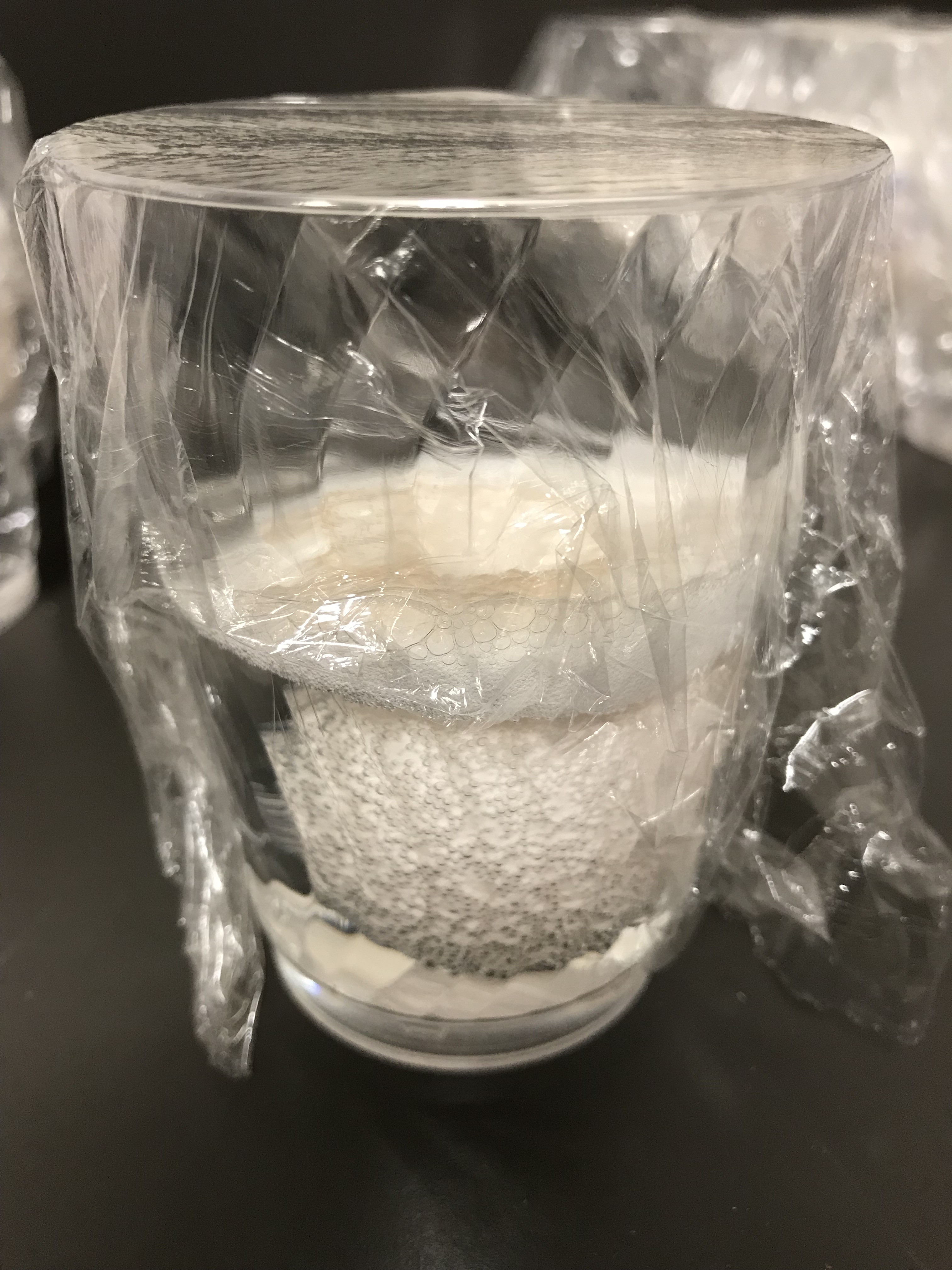
Using the procedure written last Thursday, students initiated the Egg Lab by beginning the process of dissolving egg shells with vinegar.  Each student received an egg, a cup, and enough vinegar to cover their egg.  We will replace the vinegar tomorrow and begin our experiment on Wednesday.
The remainder of class was used to explore a real case study in which a young woman took Ecstasy at a party and ended up in the hospital.  Students took on the role of the doctor who was able to learn a bit about the woman and who also ordered blood work.  After reviewing the results of the blood work, students were tasked with sharing their thinking in the form of an initial model.  Working alone or with a partner, students drew and wrote about what they thought was happening in the woman’s body before she took the drug, when she became sick, and how her body ultimately was unable to handle the toxic side effects of the drug.  We will learn more about body systems tomorrow and apply that learning to construct a stronger explanation of why the woman died in our work later this week.

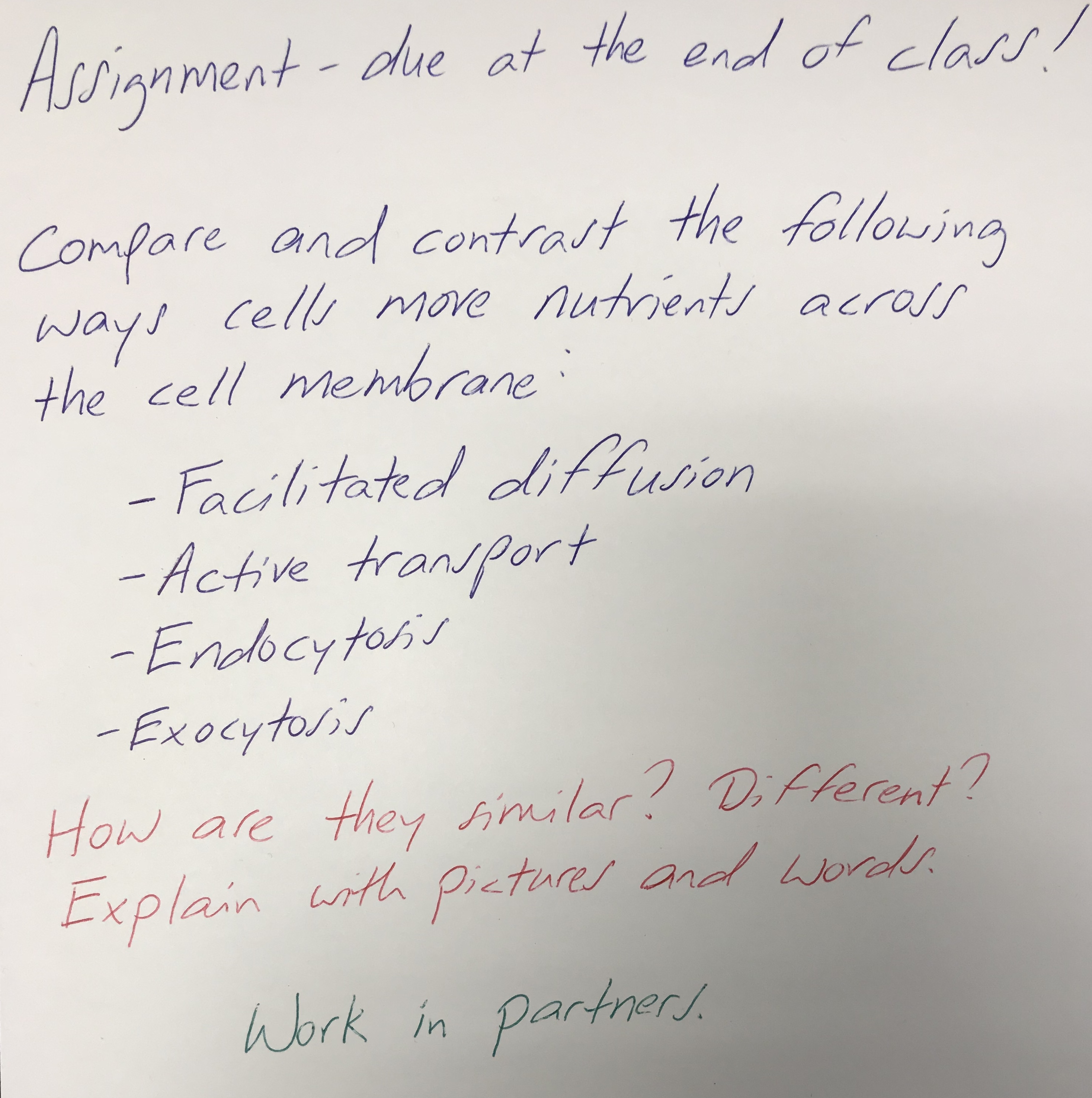
Egg Lab Prelab / Membrane Movement

Looking ahead to Monday (when we begin the egg lab), students were tasked with writing a procedure for the following objective: Remove the shell from an egg using only vinegar.  Sitting with their new table partners (new seating chart today!), students wrote out a list of steps to dissolve the egg shell.  We then compiled a class procedure (pictured below):

After the procedure writing, students worked with their new partner to complete the assignment below using the knowledge gained from yesterday’s lesson on how to identify credible scientific sources.

Website Credibility

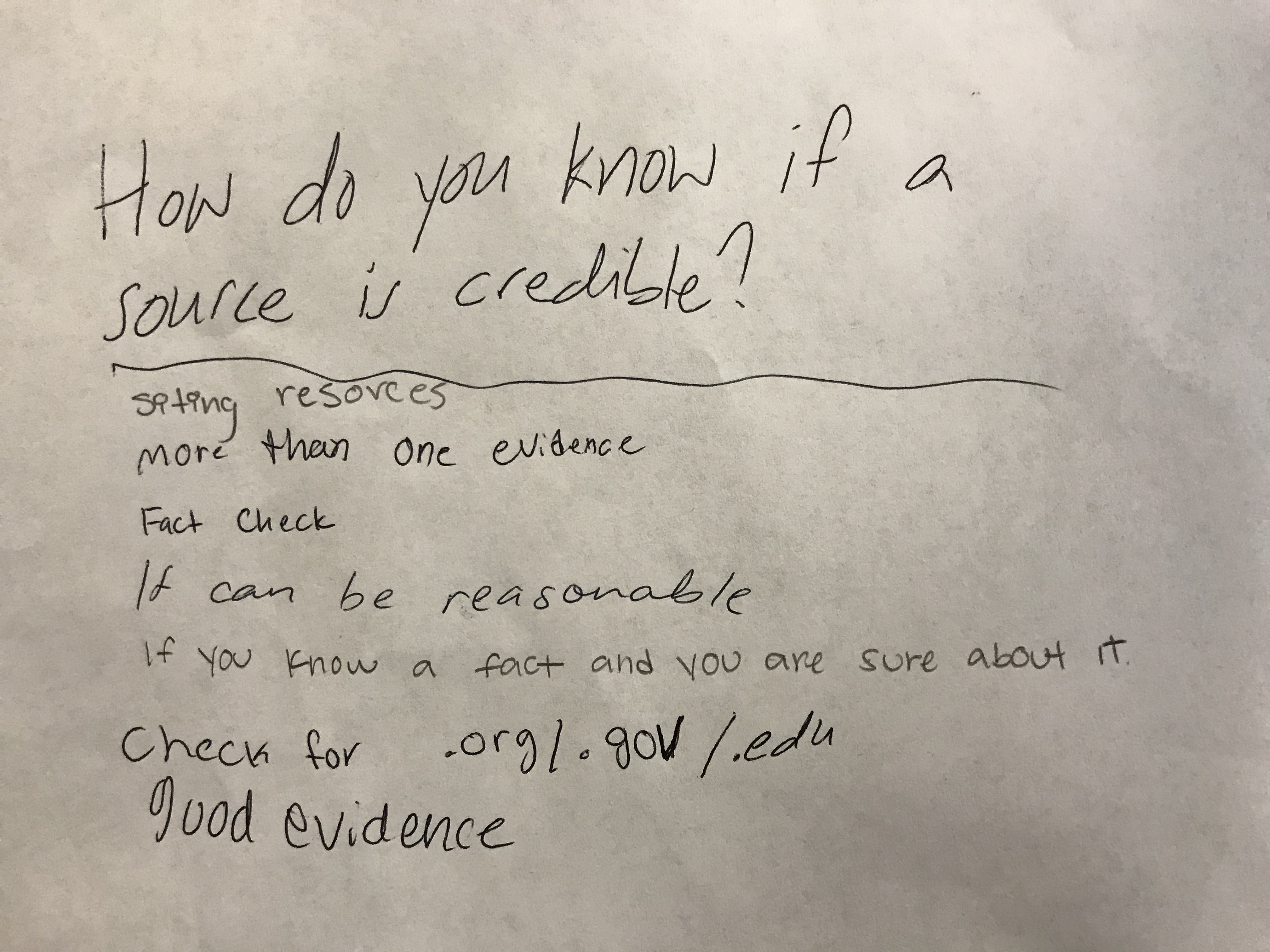
Using resources provided by our amazing librarian, students learned techniques to determine whether an online resource is credible.  We began with a discussion of how students determine whether or not a resource is credible:

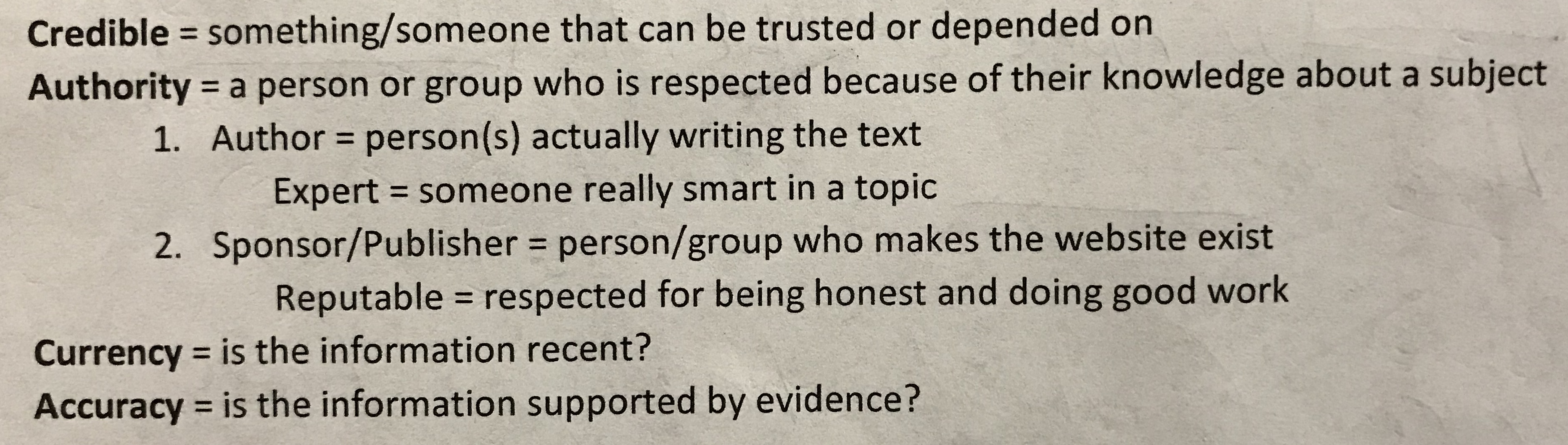
After a brief discussion, we discussed the concepts of credibility, authority, currency, and accuracy.  Students recorded the following notes in their notebooks:

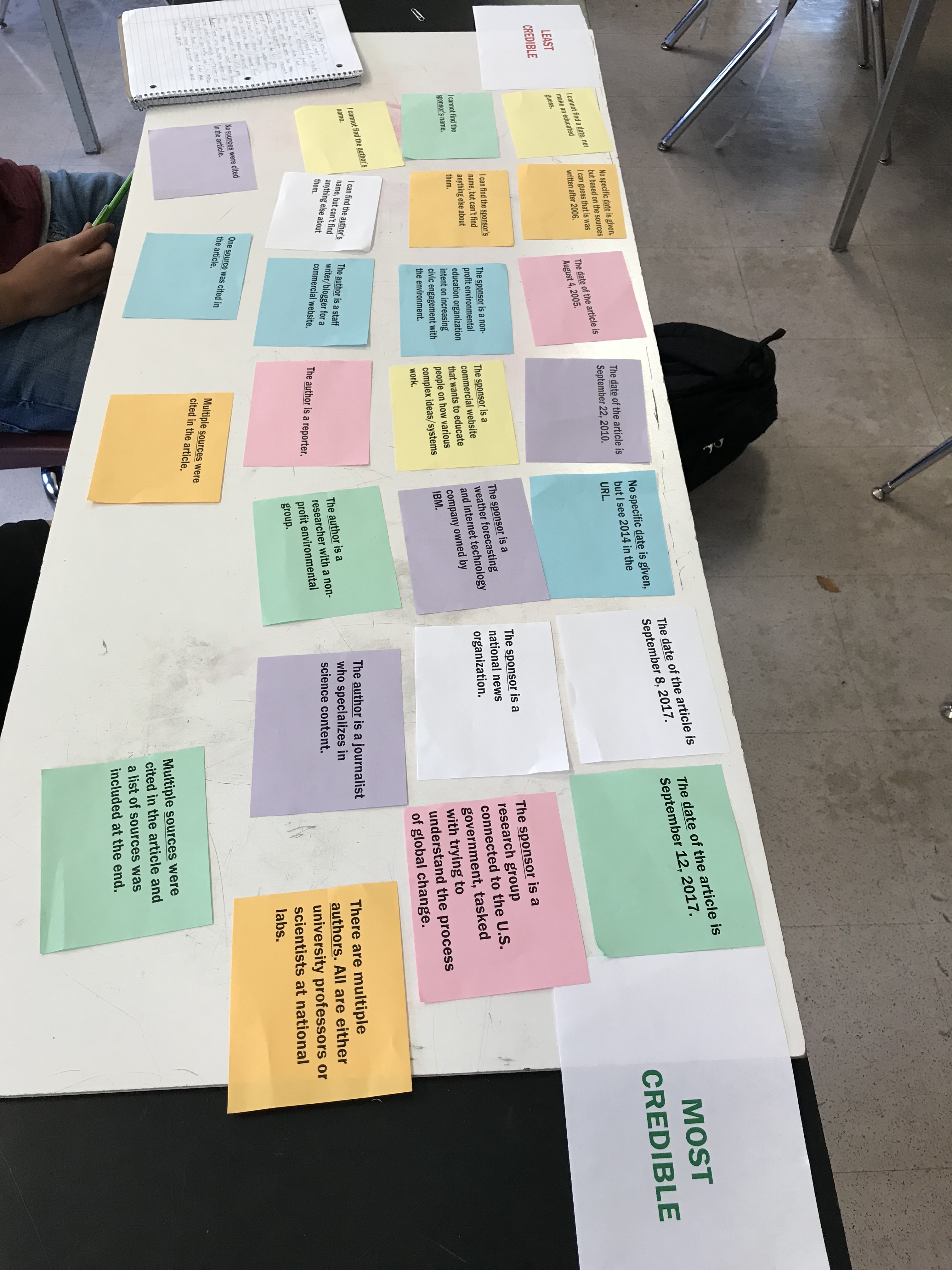
Students then received four sets of cards to order from most to least credible.  The cards included information from a web search about increasing hurricane intensity.  Our librarian collected information from each website (author, sponsor, date, and sources) and prepared cards for students to use in the activity.  An example of student work is shown below:

To complete the assignment, students were tasked with selecting two cards from each set (author, sponsor, date, and sources) and explaining why one card is more credible than the other using the following sentence frame, “Card A is more credible than Card B because…” and inserting the written contents from cards A and B into the sentence.  Students completing all four sentences received credit for the assignment.

Osmosis Gizmo

For today’s Osmosis Gizmo activity, complete the following steps:

  1. Go to the Explore Learning website.
  2. Click the Login/Enroll button (upper right).
  3. Select Biology from your list of classes.
  4. Launch the Osmosis Gizmo.
  5. Complete the “Observing osmosis” worksheet with a partner.
  6. If time permits, work through the “Effect of cell volume” worksheet.

For students who have not yet created an account:

  1. Enter the class code (written on the white board).
  2. Click the Enroll in Class button.
  3. Choose “I need to create…” option.
  4. Enter your First and Last name (not email!)
  5. Use your student numer (s-#######) as your username.
  6. Enter birthdate as password (MMDDYYYY)
  7. Click “Submit”
  8. Launch the Osmosis Gizmo.
  9. Complete the “Observing osmosis” worksheet with a partner.
  10. If time permits, work through the “Effect of cell volume” worksheet.

Cell Organelle Network

Our study of cell organelles intersected with our previous unit’s work with drawing systems when students were tasked with constructing a network diagram with cell organelles as nodes.  For edges, students had to explain how two organelles interacted with each other.  For full credit, pairs of students had to include all of the nodes in the network, with each organelle (node) connected to another organelle via at least one edge.  The list of organelles came from the organelle flash cards students made on September 27.  Students were able to use their flash cards, the Inside the Cell book (available via the computer), the Cell Structures Gizmo (from September 28), or they could research online as long as the resources they were using to construct their network were scientifically credible.

The picture below represents how the activity was set up, with three edges provided to all students at the launch of the activity.

Microscope Observations

Class began with a brief entry task asking students to recall the parts of the microscope.  Students learned (or re-learned from 8th grade) the parts of the microscope in the Gizmo from yesterday.

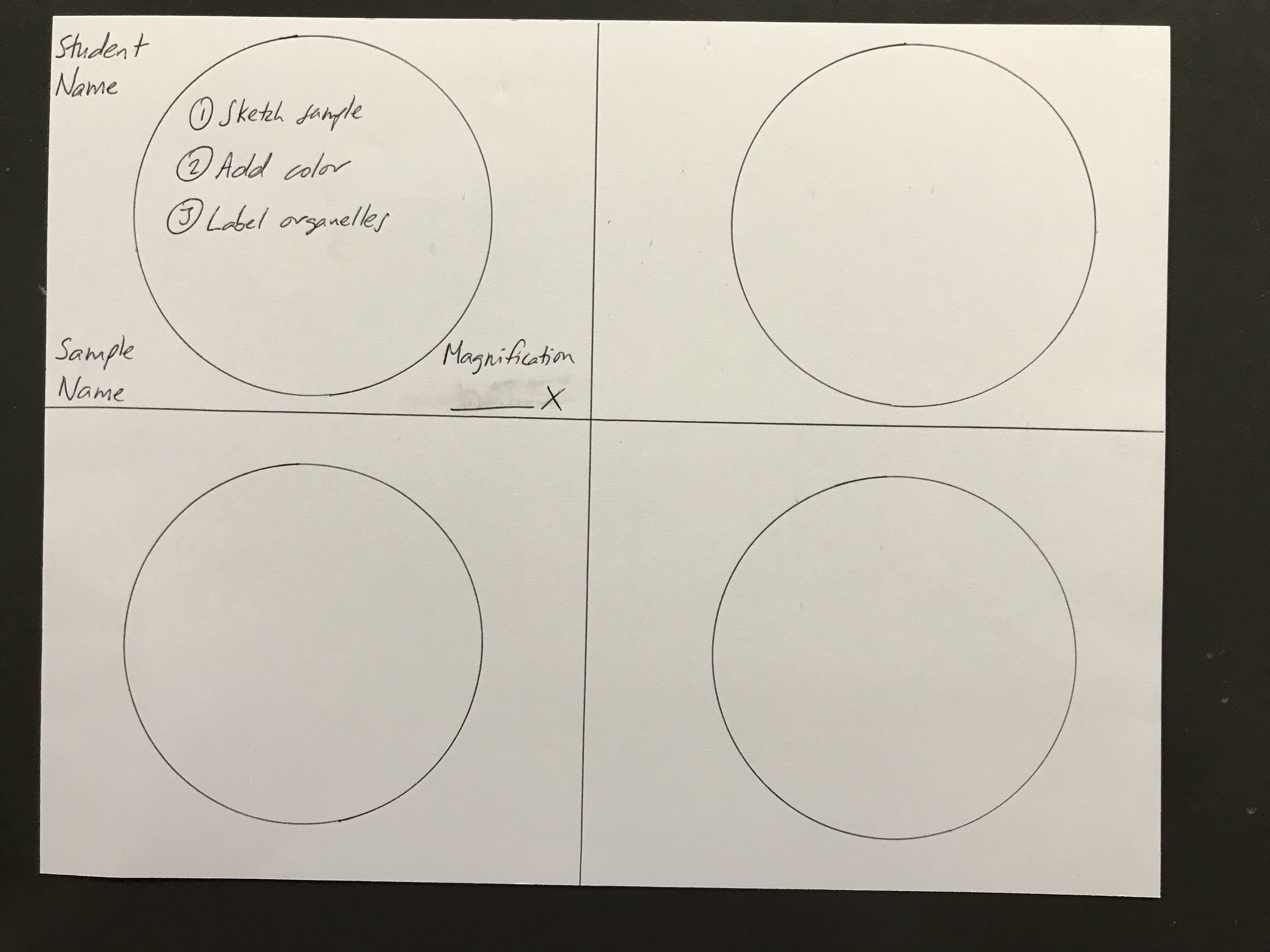
Next, for our first lab of Unit 1, students observed and made observations about various sections of plant and animal tissues under the microscope.  Participation credit was received for students who sketched a sample, added color to the section drawn, and who labeled the visible organelles contained in a representative cell within the section.  Students also needed to write down the name of the sample they observed and the magnification at which the observation was made.

Students were provided with the template below to organize the work of the members in their group.  Each team member was responsible for filling in at least one quadrant of the paper.  The work was due at the end of class and credit was received by students who completed the assignment as described above.

Cell Structures Gizmo

For today’s Gizmo activity, complete the following steps:

  1. Go to the Explore Learning website.
  2. Click the Login/Enroll button (upper right).
  3. Enter the class code (written on the white board).
  4. Click the Enroll in Class button.
  5. Choose “I need to create…” option.
  6. Enter your First and Last name (not email!)
  7. Use your student numer (s-#######) as your username.
  8. Enter birthdate as password (MMDDYYYY)
  9. Click “Submit”
  10. Launch the Cell Structure Gizmo
  11. Complete the Student Exploration worksheet

Inside the Cell / Organelle Flash Cards

Students were tasked with completing the reading from Chapter 1 of Inside the Cell (assigned yesterday) and turning in answers to the Got It questions on page 19.  Next, students received eight index cards on which to create flash cards of the following cell organelles:

  • cell membrane
  • cytoplasm
  • nucleus
  • ribosome
  • mitochondria
  • endoplasmic reticulum
  • Golgi apparatus
  • lysosome

On the front of the card, students wrote the name of the organelle.  On the back of the card, students explained the function of the organelle and were encouraged to draw a picture that would help them remember the function of the organelle.  The flash cards are due tomorrow and must be completed before the student can participate in the Gizmo simulations of cell structure and function.

Initial Model of the Cell

For our first lesson of our new unit, students were tasked with drawing an initial model of a cell.  They used the white boards on their desks to draw cells as they understand them, including the parts of cells (organelles).  Students shared out what types of cells they had drawn and what parts they could remember.  An example of student work is pictured below.

Next, we watched the Harvard BioVisions video Inner Life of a Cell, which presents a realistic animation of how cells move.

http://www.youtube.com/watch?v=B_zD3NxSsD8

We concluded the lesson with students reading Chapter 1 of Inside the Cell.  The “Got It” questions on page 19 are due tomorrow by the end of class.  For homework, students are encouraged to read as much of Chapter 1 as necessary to be able to complete the reading in class tomorrow.

Unit Wrap-up

We concluded our Bioethics and the Nature of Science unit with the following activities:

  • Student feedback from Friday’s Guest Speakers
  • Student thank you “cards” for Guest Speakers
  • Return of all Unit 0 student work
  • Revise and resubmit justification paragraph (if needed)
  • Review Limits of Science worksheet packet