
For today’s lesson, students were tasked with their first reading assignment from our official Biology textbook. The assignment called for students to read The Breath of Life essay on pages 236-239 in the textbook. After reading each paragraph, students were instructed to write a short summary sentence about the main idea of the paragraph. Students needing additional time will be able to complete the assignment after the quiz tomorrow. Students who finished early were instructed to continue reading the next essay in the textbook. Credit will be given to students who complete the notes by the end of class tomorrow.
Category Archives: Biology
Exercise Lab
For the second day of our new unit, students began class by answering the following entry task:
In your lab notebook, explain why you can’t hold your breath forever.
A class share-out of the entry task enabled students to reason through the processes of photosynthesis and cellular respiration, learning new vocabulary to apply to the processes. Class notes are shown below:
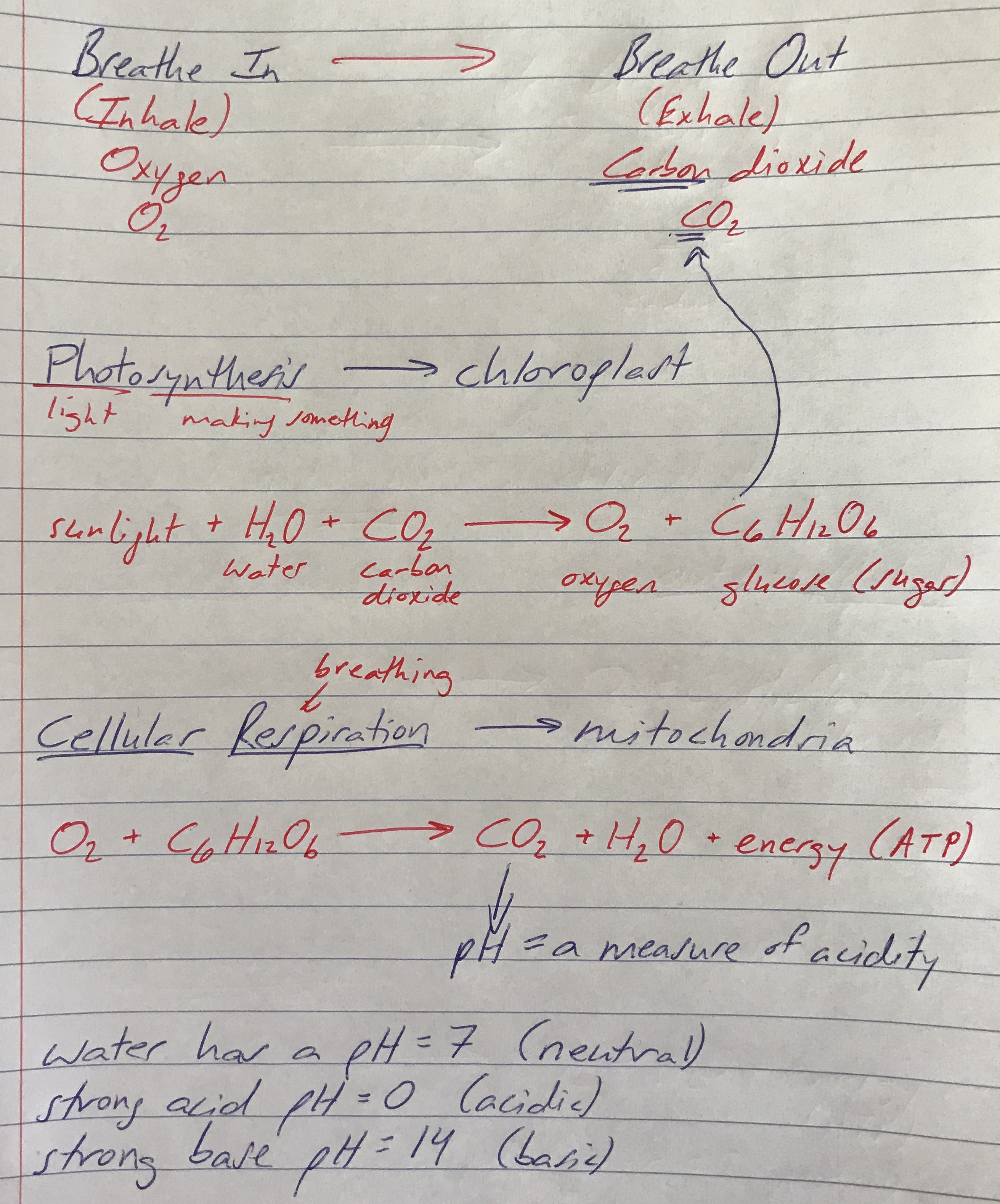
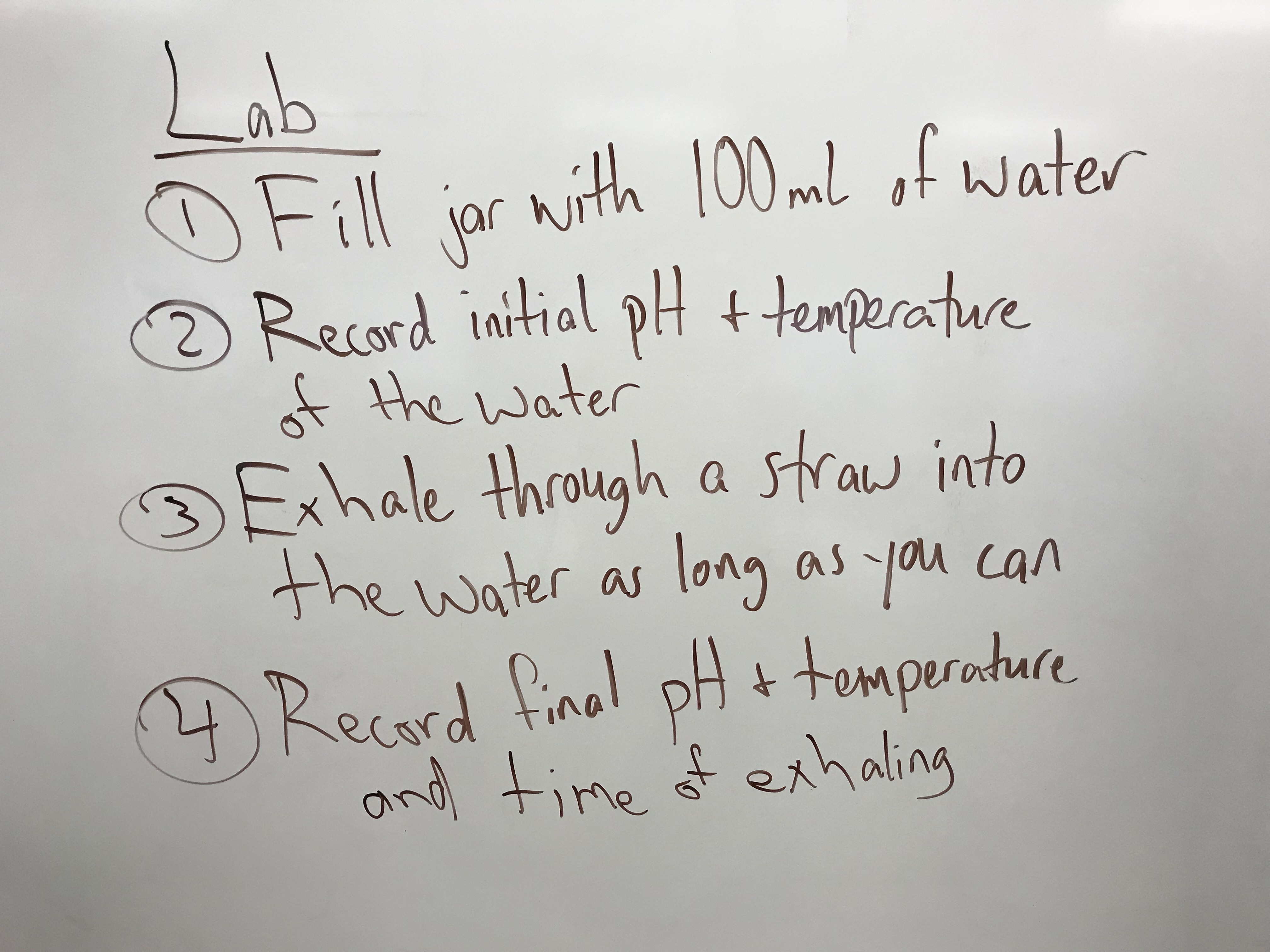
Next, we discussed the connection between carbon dioxide and pH, and then students observed a demonstration for how to use probeware to measure pH and temperature. Students wrote down the following procedure in their lab notebooks:
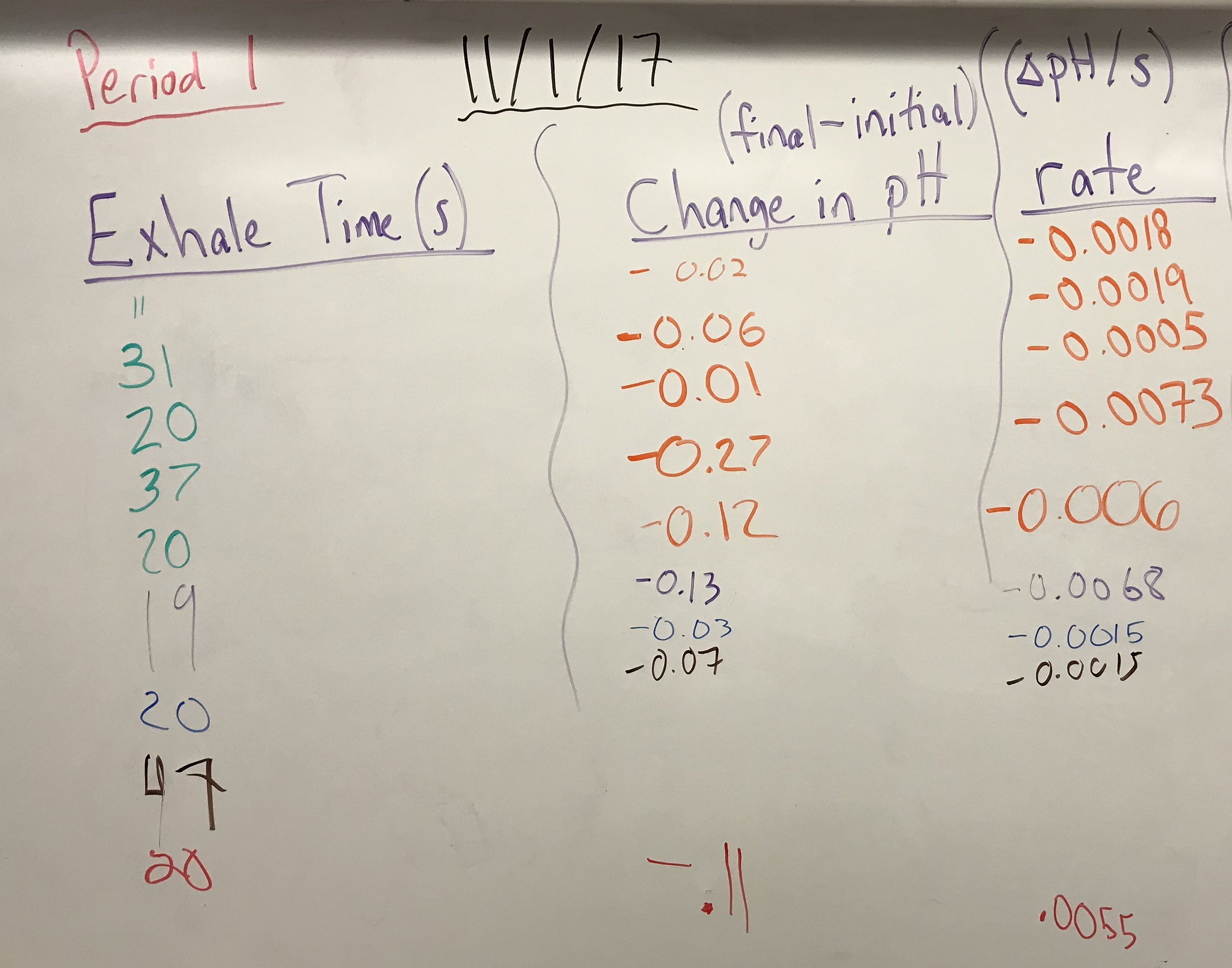
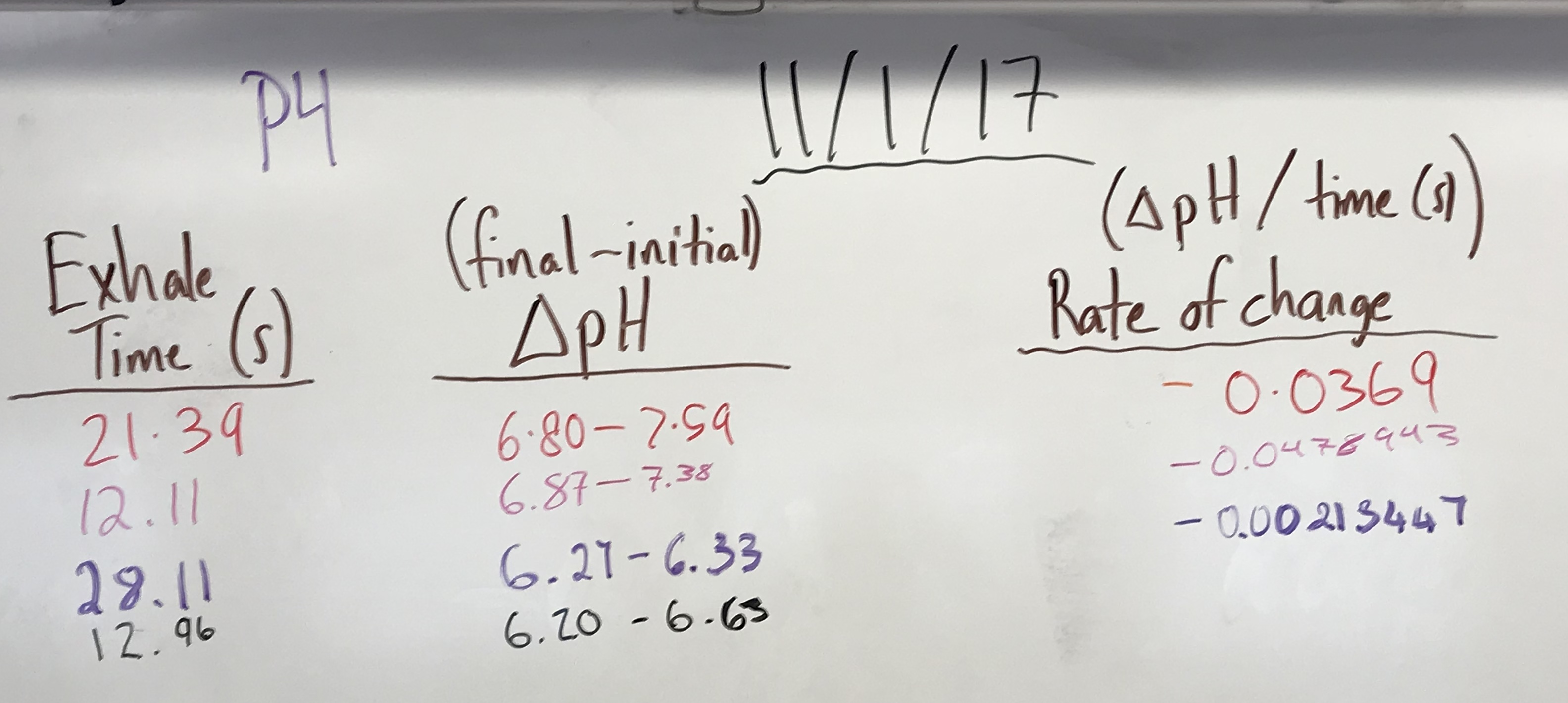
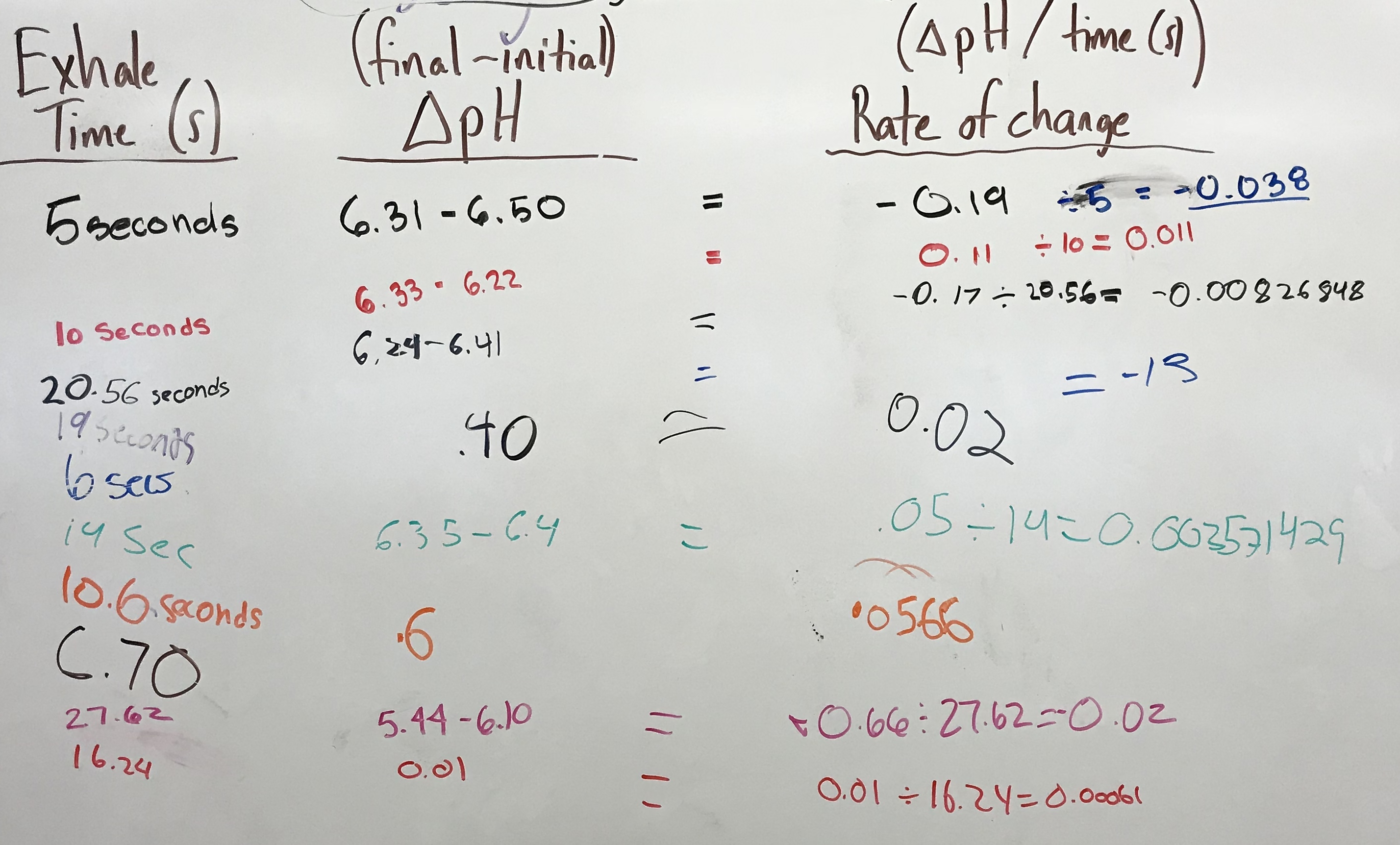
After completing the lab, students processed their data and recorded it on the white board for everyone to see. Not everyone had time to record their data, so the class data sets pictured below will be revisited soon:
Introduction
We kicked off Unit 2 with the following entry task:
In your notebook, make three columns with the following titles:
Carbohydrate Lipid Protein
List as many foods as you can in the appropriate columns.
Next, students were shown an image of a traditional Thanksgiving meal and we discussed the components of the meal, placing each food item in the appropriate food category. Students then used this thinking as they took the Unit 2 Pre-Assessment which called on them to label the parts of a cheeseburger and place those food parts into the food categories from the entry task. The remainder of the Pre-Assessment asked students to explain the processes of digestion, absorption, and biosynthesis.
Students who completed the Pre-Assessment early were able to spend the remainder of the class period finalizing their Egg Lab reports (due tomorrow by midnight).
Unit 1 Wrap-up
To conclude Unit 1, students received back Day 2 of the exam and we graded it together as a class. Students then received Day 1 of the exam (already teacher-graded) and a Unit 1 Exam Reflection worksheet.
Next, students conducted a peer review of another student’s Egg Lab report and provided feedback using the Egg Lab Report Peer Review Form. Students used the remainder of the class period to revise their own lab reports using the feedback received. All Egg Lab reports are due no later than Wednesday, November 1. Students may submit a paper copy, email a copy, or ideally share a copy using the “Share” button in Google Docs.
Unit 1 Review
Our work in Unit 1 came to a close today with students working as a class to explain why Lena Bedolla died after taking Ecstasy. We filled out the Blood-Brain Barrier worksheet to help explain what happened to Lena as a result of her consuming Ecstasy and drinking a lot of water. A copy of our work is shown below:
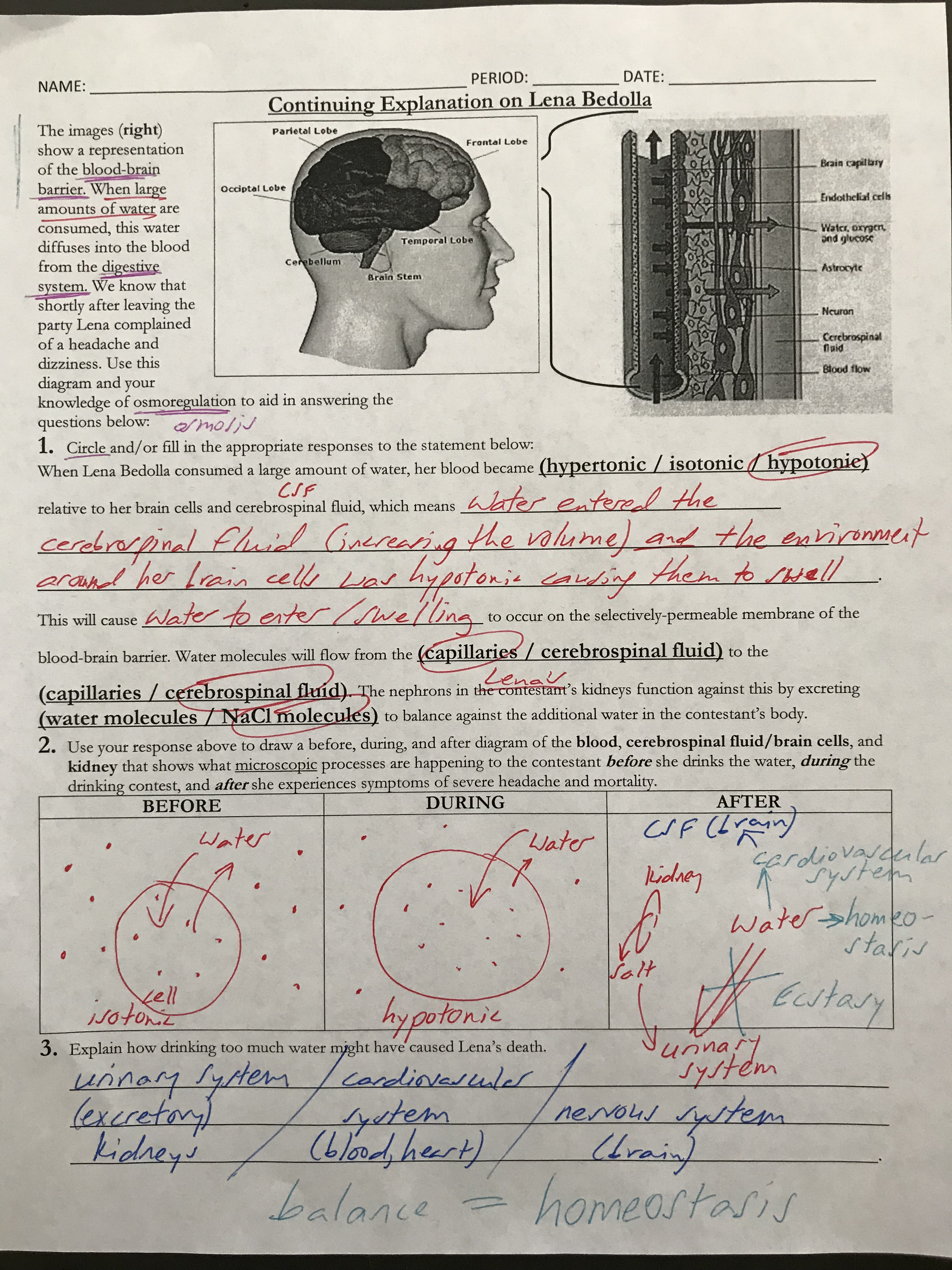
Students had the remainder of the class period to complete their Egg Lab reports (due by midnight Friday) and to prepare one page of notes that can be used on the Unit 1 Exam tomorrow and Friday.
Egg Lab Report – Day 2
Step 1: Read this post all the way to the end!
Instructions for the Introduction, Procedure, and some of the Results section (creating a data table) are included in last Friday’s post (October 20). For today, students should complete the Results section by calculating the average of each egg solution group. For example, add up all of the change in mass values for the eggs that were in corn syrup, then divide by the number of eggs that were in corn syrup. Repeat for all of the solutions. Remember, the more data you include, the more “real” your results will be. Please consider adding data from one or more additional class periods! All of the data from my three biology classes can be found on last Thursday’s post (October 19).
Next, write the Discussion section. In the Discussion paragraph, discuss what you think your results mean. Do they make sense given what you know about osmosis (think about a cell – the egg – in isotonic, hypotonic, and hypertonic solutions). Explain your thinking! Explain why you think the egg changed mass in the different solutions. What evidence do you have for the movement of water across the cell membrane? Why do you think some of the eggs gained or lost more or less mass (why were the results variable)? How can we use the word “homeostasis” to describe how the egg changed mass when placed in a different environment? What are three possible sources of error that could have affected the results? What would you change to improve the experiment next time? All of these questions should be addressed in the Discussion section. You may need to write more than one paragraph to clearly explain your thinking.
In the Conclusion section, write a paragraph explaining both what happened in the experiment and how it connects with the research you have done into Lena Bedolla and her death from Ecstasy. How can you use the evidence to help explain what happened to Lena? You should be able to explain how Ecstasy changed the way Lena’s urinary (excretory) system worked, affecting her cardiovascular system and her nervous system, and ultimately leading to her death. Your Conclusion section should clearly explain how the Egg Lab provides evidence to support your understanding of why Lena died.
Finally, if you used any outside resources (other websites) to help you with this lab report, list them in the References section. If you didn’t use any, you do not have to include a References section.
This lab report is due tomorrow at the end of the class period. If you think you will need additional time, work on it tonight as homework.
Egg Lab Report – Day 1
Introduction
- What did we do?
- Why did we do it?
- What were we observing?
- What were we learning about?
Procedure – should be in your lab notebook and on class website
- Step 1
- Step 2
- Continue until finished
Results
Data table of class data (Table > Insert table > select number of columns and rows
Calculate average values for solution groups
Graph the averages (use Google Sheets)
Discussion
Conclusion
References
Egg Lab Day 4 / Class Results
The egg lab concluded with students receiving the following instructions:
- Gently rinse and dry egg
- Measure and record the final mass
- Discard the egg and cup
- Calculate the change in mass of the egg
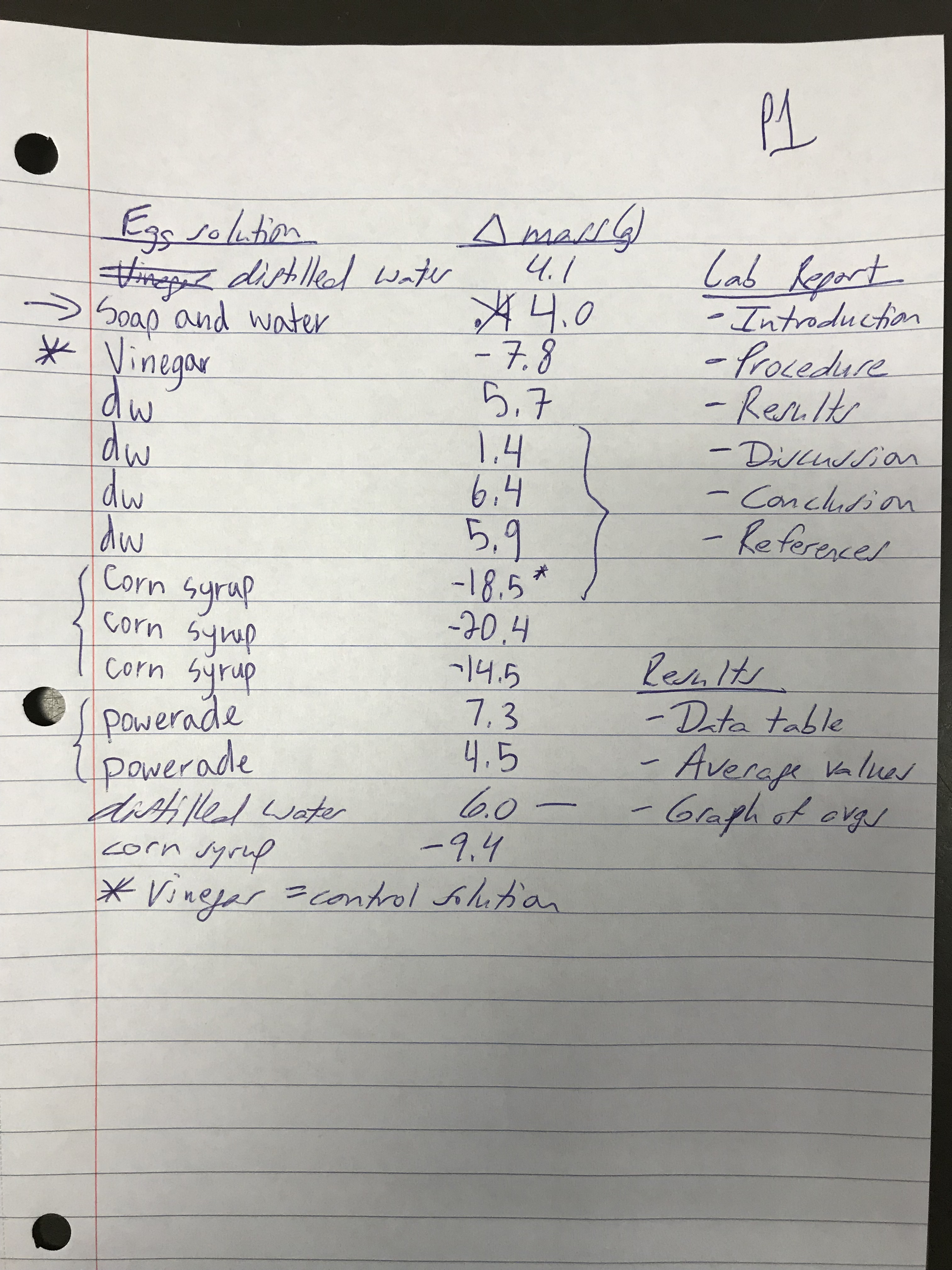
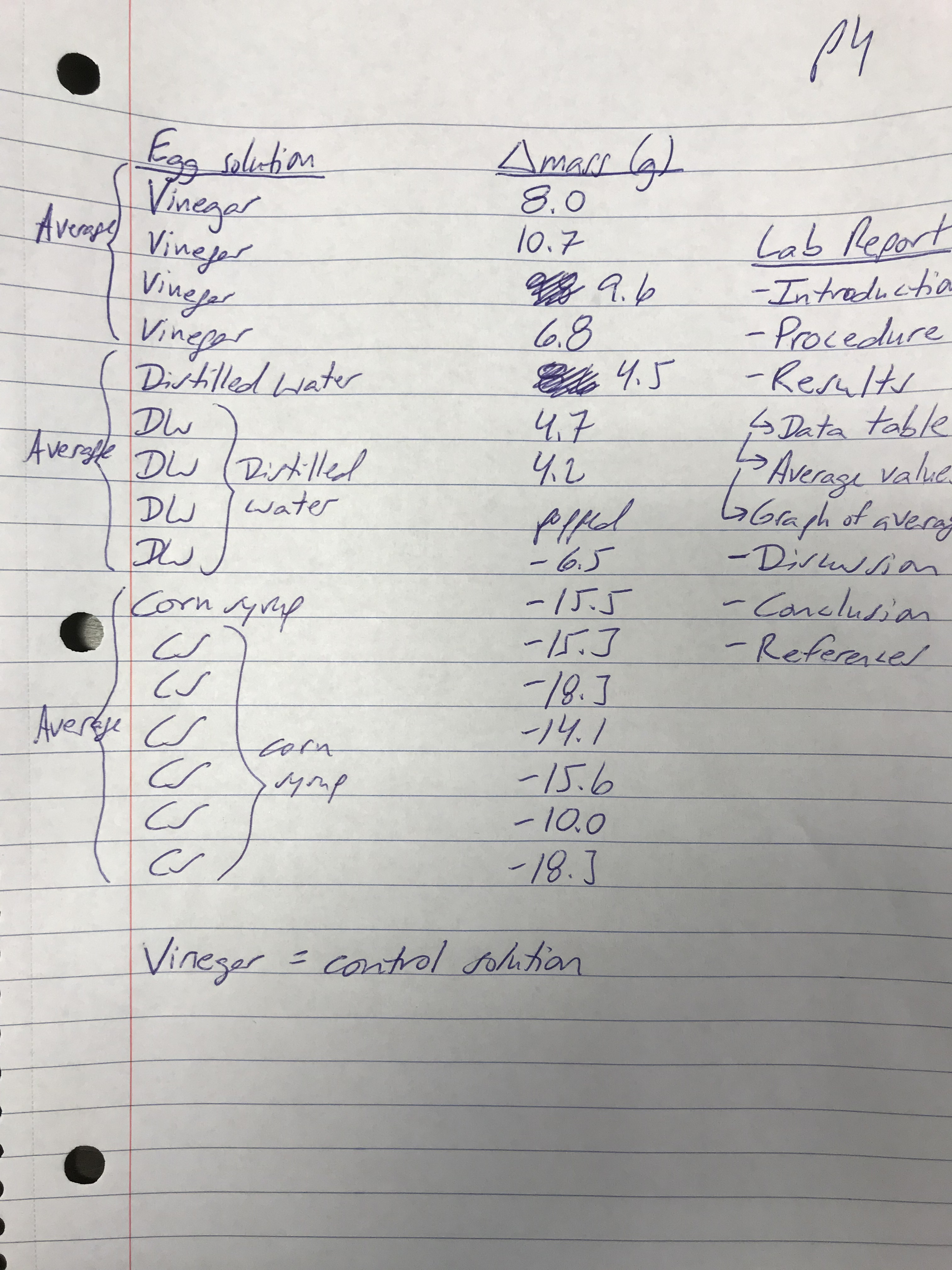
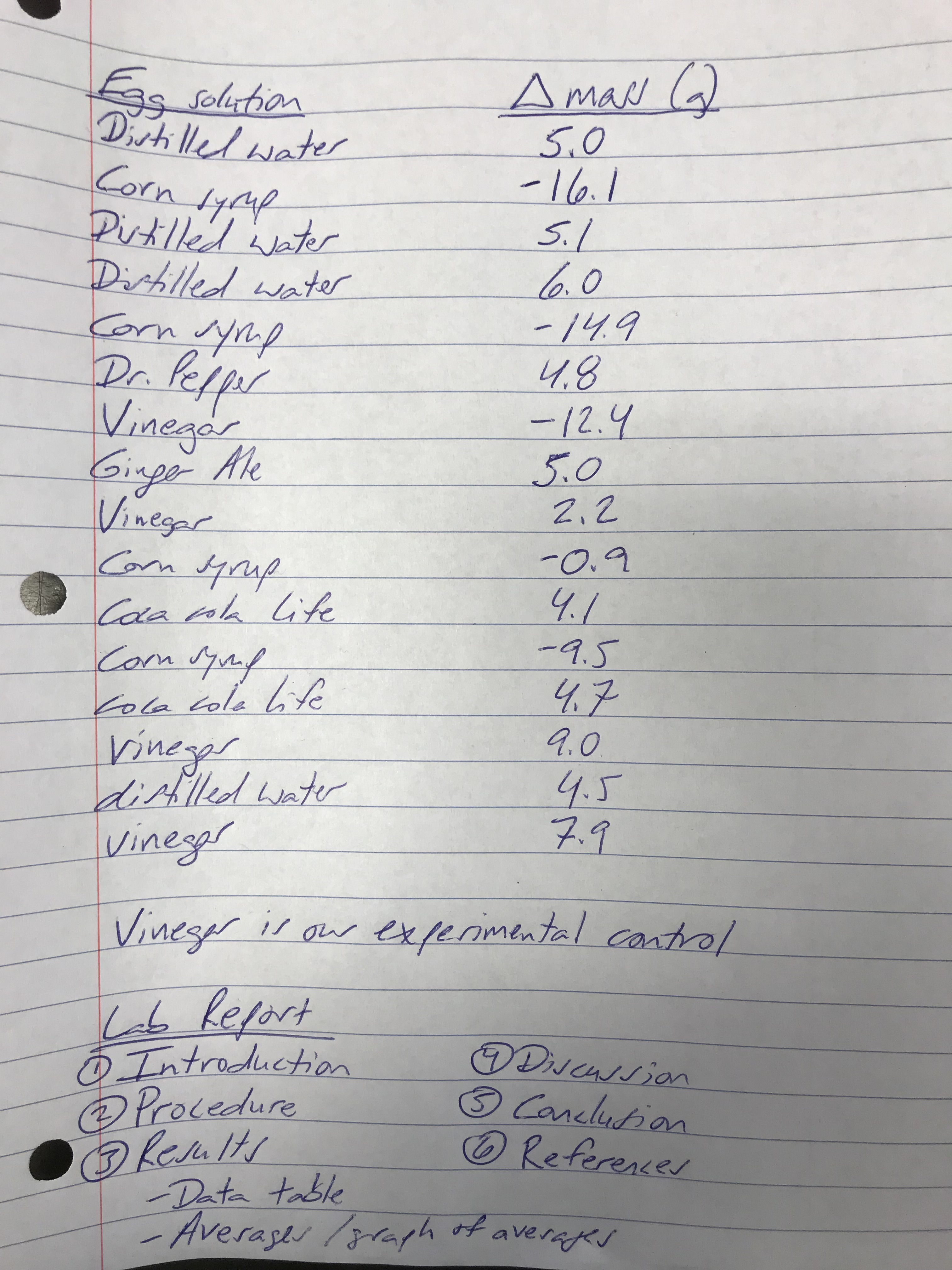
To calculate the change in mass, students were instructed to subtract the initial mass (measured yesterday) from the final mass (measured today). A positive change means the egg gained mass. A negative change means the egg lost mass. Students reported out their data (shown below), and then we discussed the movement of water across the membrane of eggs placed in various solutions (final picture below).

Egg Lab Day 3 / Catch-up Day
For day 3 of the Egg Lab, students worked with their lab groups to complete the following:
- Gently rinse each egg to remove any last parts of the shell.
- Gently dry each egg.
- Measure the mass of each egg separately (in grams) using the balance.
- Each student in the group should record the mass of each egg in their lab notebook. A group of four students will each have four egg mass recordings in each lab notebook.
- Rinse out the cup and carefully dry it, being careful to make sure note which egg went with which cup. This matters! The cups are labeled with student names, and we need to keep track of the mass of each egg, so we need to know which egg belongs to which student.
- Return the egg to the correct cup.
- Carefully cover the egg with one of the following:
- Vinegar (egg #1)
- Corn syrup (egg #2)
- Distilled water (egg #3)
- Bonus liquid (egg #4)
- Cover the cup with plastic.
- Record any additional observations about the egg during the class period.
- Return the cup to the counter for further observation tomorrow.
For the remainder of the class period, students should work hard to complete missing biology assignments. We have an exam next Thursday, so students who are caught up on work, including last night’s homework, should begin assembling a page of notes to use on the exam.
For tonight’s homework, watch the video below and take notes! The video will reinforce the learning from October 12 (Membrane Movement lesson).
Egg Lab Day 2 / Body Systems
After carefully pouring out the vinegar from yesterday and replacing it with fresh vinegar, students returned their eggs to safe storage while the last of the egg shell dissolved overnight.
For the remainder of the class period, students investigated the body systems known to be impacted by the drug Ecstasy as introduced in the case study yesterday. Students were directed to the website InnerBody.com to learn about both body systems and specific organs. Working in teams of four, students filled out the associated worksheet, describing the location and function of the systems and organs, and also providing specific pieces of evidence from the case study that those systems or organs were not functioning properly.
For homework, students must watch and take detailed notes about the Crash Course video below (the excretory system):
 Science with Swart

You must be logged in to post a comment.