Category Archives: Biology

Initial Ideas / The Double Helix

Before transitioning to Unit 4: DNA, we launched class with a short movie starring Dr. Neil deGrasse Tyson which served to remind everyone why the study of science is so vital to our democracy:

Next, we followed up on the House A freshmen advisory meeting from last week in the gym (focusing on attendance, behavior, and grades) by reviewing specific sections of the syllabus .

Finally, we launched Unit 4 by reviewing the Unit 4 calendar and then holding a brief class discussion in which students shared out what they know (or think they know) already about DNA.  Students then received a worksheet with questions that were answered by watching The Double Helix video.  The completed worksheet will be turned in tomorrow.
Introduction to Mitosis

Mitosis, or somatic cell division, involves the division of one cell into two after all of the components of the original cell (including the DNA!) divide into two sets.  We began by watching a Crash Course video about mitosis:

After the video, students were assigned to read pages 46-51 of chapter 4 (Cellular Reproduction: Multiplication By Division) of Inside the Cell.   Students then answered the following questions in their lab notebooks:

  1. Explain the purpose of mitosis.
  2. Which cells undergo mitosis?
  3. Describe the phases of mitosis in detail (words and/or drawings).
  4. Explain what happens when cells divide uncontrollably.  List the known causes of uncontrolled cell division.

This unit is focused specifically on NGSS Standard HS-LS1-4Use a model to illustrate the role of cellular division (mitosis) and differentiation in producing and maintaining complex organisms. 


Updated: November 28

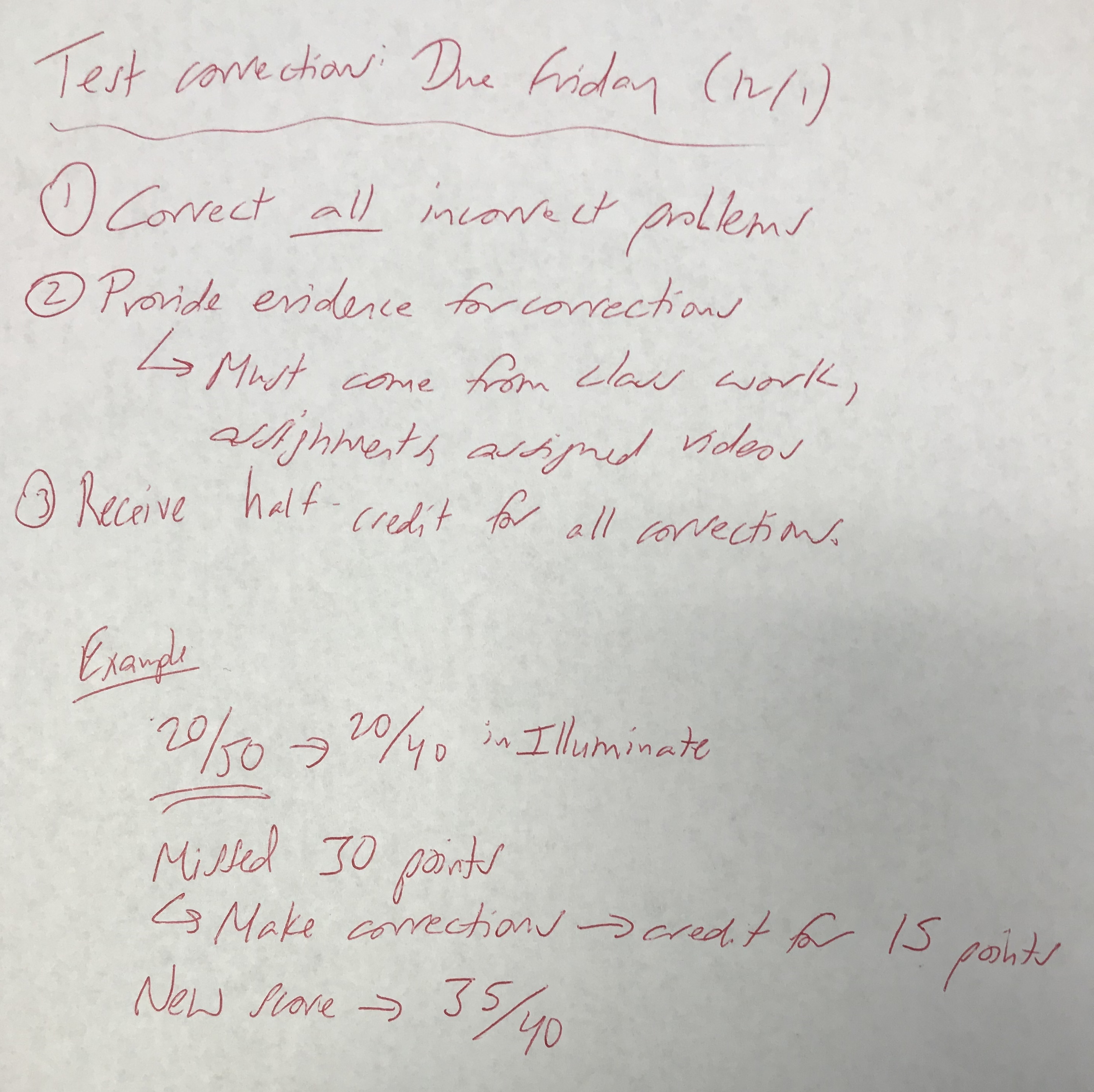
We continued our introductory lesson with a PowerPoint slide deck reviewing the key concepts from yesterday.  Students also received back their Unit 2 Exams with instructions on how to revise and resubmit the exam to recover partial credit (below):

Students had the remainder of the class period to work on lab reports or complete the reading assignment from yesterday.  As a reminder, the reading assignment is due on Thursday (11/30).

Potato Catalase Lab Report

  1. Read this document through to the end!!!
  2. The report is due on Friday, December 1, 2017.
  3. The Potato Catalase Lab Report Checklist contains all of the required items for your report.
  4. You may work (equally) with one partner.
  5. Create a Google Doc (shared with the teacher and your partner) for your lab report.
  6. Create a Google Sheet (shared with your partner) for your analysis.
  7. Use your potato catalase lab packet as your guide!  It contains nearly everything you need to write the Introduction.
  8. You should have written the Procedure in your lab notebook before conducting the experiment.
  9. The Results for Data Table 1 are provided here.  For Data Table 2, copy the results tables into Google Sheets and organize them so you can calculate the average change in oxygen for each experimental group.  Make a table of the average change in oxygen for each sample per group (i.e. average all of the “raw potato” data, repeat for the other groups) and then make a graph from that for your lab report.
  10. Use the data from Data Table 2 to discuss the results in your Discussion.  Also refer back to your potato catalase lab packet.
  11. Please ask Mr. Swart for help.  If you get stuck on one part, work on another part until you can get help.  This must be turned in by midnight on Friday, December 1 to receive credit.  No exceptions.

Unit 2 Review

We packed a lot into our short Friday class period today, starting off with a return to the potato catalase lab packet.  We worked through pages 4-6 and students were directed to find the results from all of the classes on yesterday’s lesson post.  Students also received a copy of the Potato Catalase Lab Report Checklist and learned that they may work with a partner to complete the report and the due date is December 1.  Students were told that they can turn the report early to receive feedback which can be used to revise and improve their report by the due date.

For the last part of class, we reviewed Unit 2 content, with students encouraged to review the process of a slice of pizza or a cheeseburger being digested.  Students should practice writing an explanation which breaks down the parts of the food into biomolecules, explaining how those molecules are digested (anatomy of the digestion system and enzymes involved), and then explaining how the biomolecules are absorbed into the body and reassembled (biosynthesis) to form new biomolecules the body needs to live.

Potato Catalase Lab

For the lab today, students were instructed to record the steps of the procedure in their lab notebooks.  Steps were provided orally to emphasize the absolute importance of active listening (and not talking) while instruction is being delivered.  Students conducted the lab working in groups and recorded data in a class data table on the white board.  Results from all three classes are provided below:

Period 1 Raw Boiled Frozen Vinegar Ammonia
% O2 start 17.06 17.81 17.58 17.65 18.21
% O2 final 16.10 17.80 18.96 18.49 18.14
Time (sec) 379 213 900 321 160
Mass of potato (g) 3.8 5.1 3.5 3.8 3.8
Period 4 Raw Boiled Frozen Vinegar Ammonia Raw
% O2 start 17.66 16.60 17.65 16.58 17.40 17.60
% O2 final 19.47 16.65 18.60 16.41 17.44 17.58
Time (sec) 600 226 417 247 285 300
Mass of potato (g) 5.5 6.5 5.9 5.6 6.9 8.1
Period 6 Raw Boiled Frozen Vinegar Ammonia
% O2 start 17.70 16.81 16.81 17.17 17.55
% O2 final 17.52 16.74 17.15 17.88 17.59
Time (sec) 300 300 300 300 300
Mass of potato (g) 8.1 3.1 6.3 7.9 4.9
Mr. Swart Raw Raw Raw
% O2 start 17.34 17.04 17.88
% O2 final 18.12 17.62 18.12
Time (sec) 300 300 300
Mass of potato (g) 6.6 6.9 7.9

Potato Catalase Pre-Lab

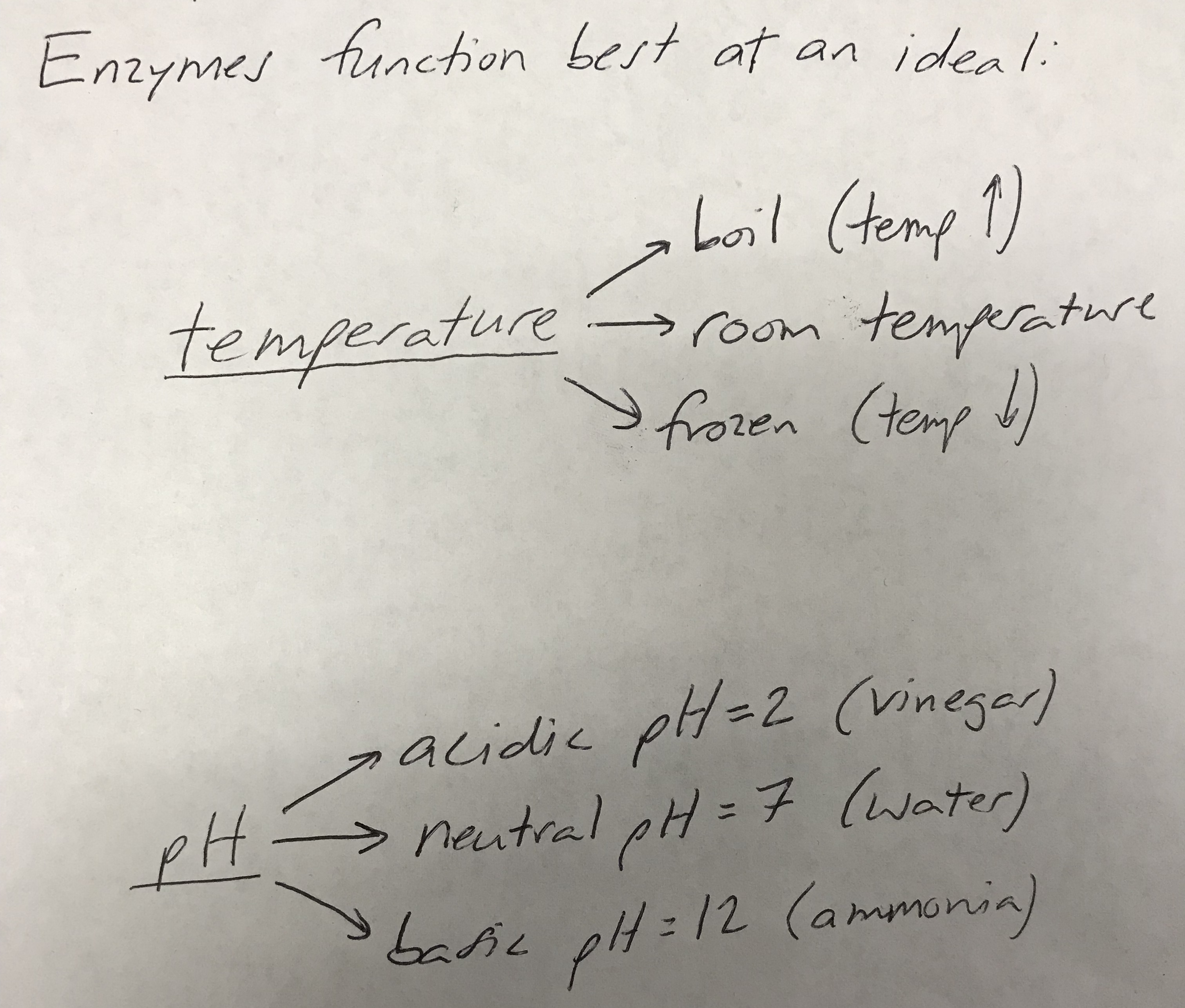
Class began with a brief review of the Amoeba Sisters enzyme worksheet from yesterday and then we transitioned to preparing for the potato catalase lab.  After turning in the enzyme worksheet, students picked up a catalase lab packet.  We discussed the function of catalase and then students had the remainder of class to complete the first three pages of the packet.  Students were told multiple times that the first three pages of the packet must be completed before they can participate in the lab tomorrow.  Students who did not finish the first three pages of the packet in class were instructed to complete the work as homework.  The following notes were shared to help students better understand how the lab would be conducted:

Enzymes

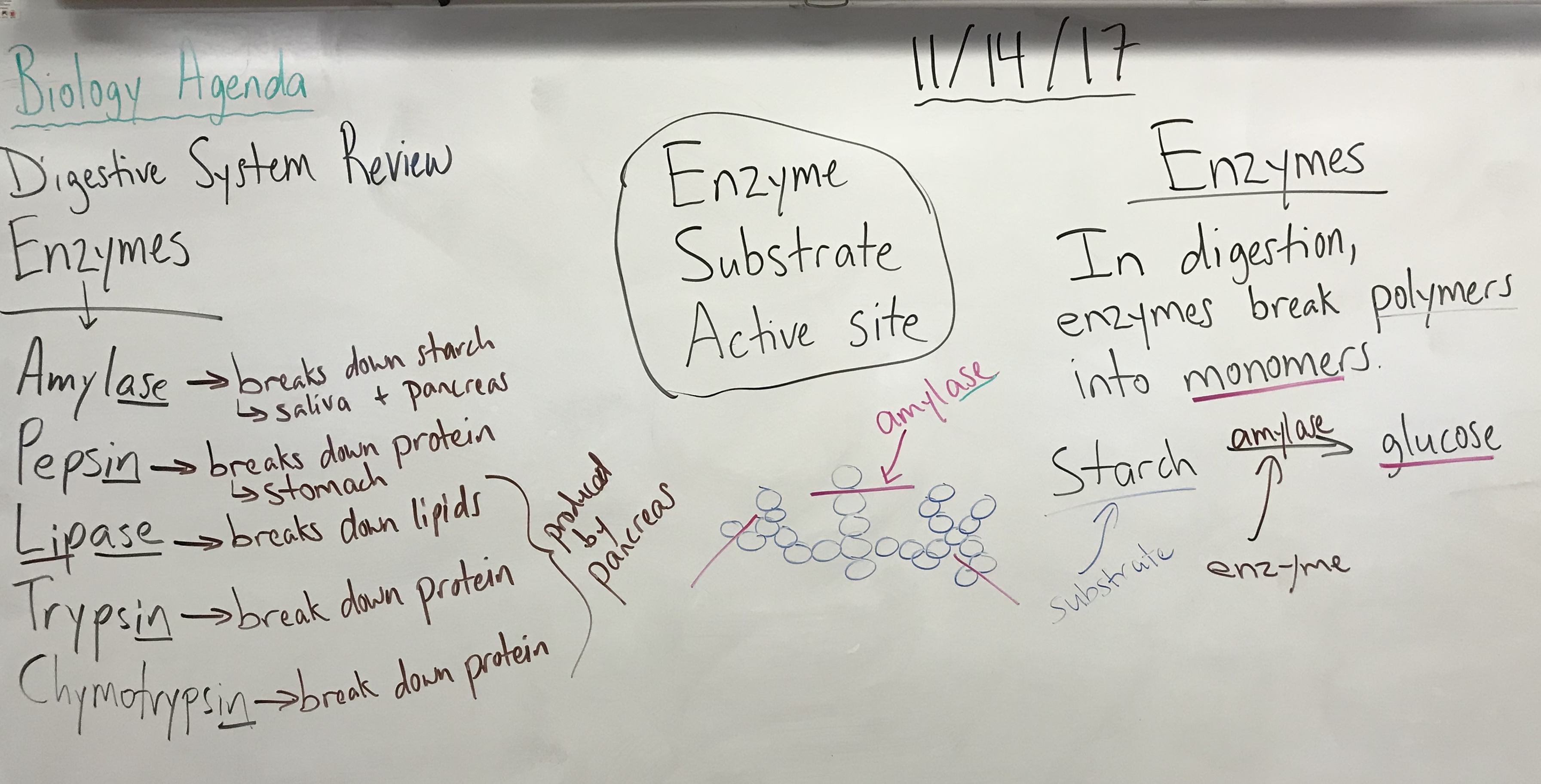
We began class with a vocabulary review from yesterday.  Students completed Activity D problem #3 where they matched 11 digestion related vocabulary words with the correct definitions.  Next, we reviewed the enzymes from yesterday’s lesson to reinforce vocabulary and to review where in the body the enzymes work and which biomolecules they act on.  Notes from the white board are shown below:

For today’s lesson, we furthered our study of enzymes by watching the Amoeba Sisters video below:

After the video, students had time to work on the video worksheet in class and were instructed to finish it as homework.

Digestion

We continued our study of enzymes and digestion by focusing specifically on the process of digestion today.  Students all received a handout with an image of the digestive system, and then we labeled the parts and took notes on the process of digestion while watching the video below:

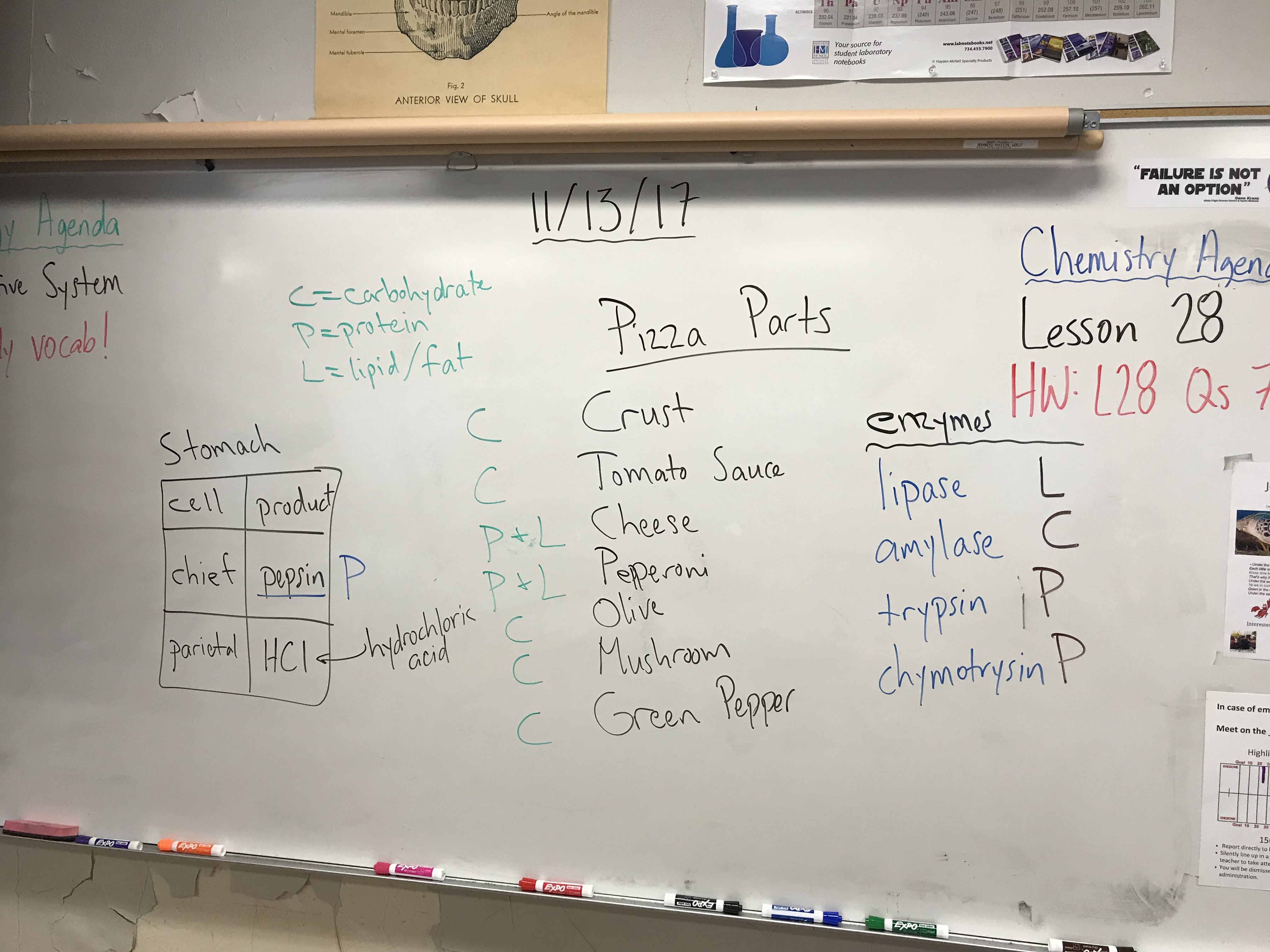
Additional notes from the whiteboard are shown below:

Biomolecules

Class began with the following entry task:

Use the Item Bank (H20, CO2, ATP, O2, C6H12O6):

  1. Which are inputs of cellular respiration?
  2. Which are outputs?
  3. Write the equation for cellular respiration

The entry task launched our brief review of cellular respiration, photosynthesis, and chemical potential energy stored in glucose and transferred to ATP.

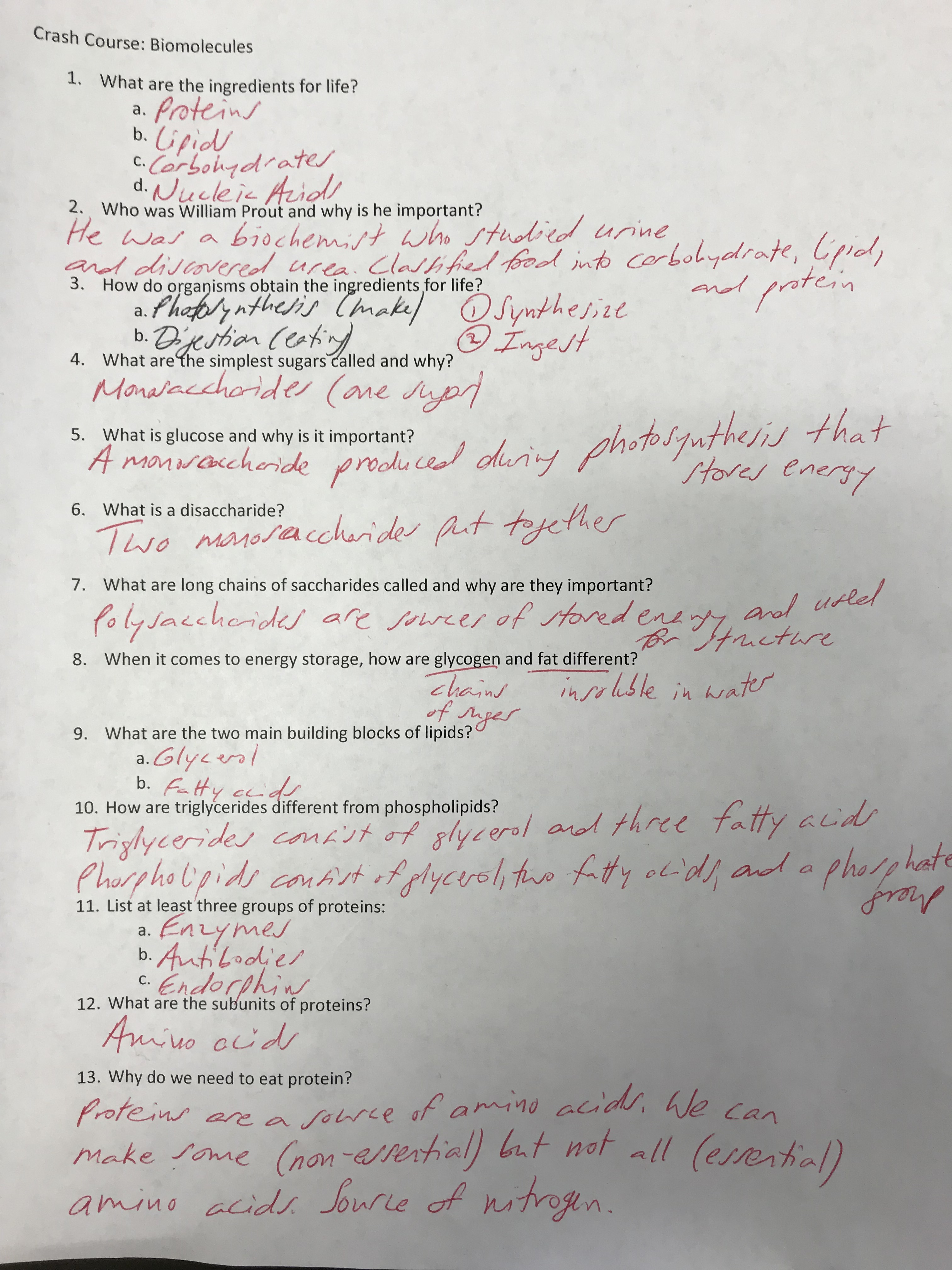
After taking notes, the discussion transitioned to a recognition that while humans can eat glucose directly by consuming plants, humans can also obtain energy by eating other animals that eat plants.  For example, when we eat beef, we are ingesting protein and fat (lipids) produced by a cow that ate grass.  That led us to the Biological Molecules Crash Course video (below) and the associated worksheet.  Each student was assigned one question from the handout to answer, and then students combined answers in a class share-out at the end of class.  A completed copy of the worksheet is also provided below.


November 8 – Updated

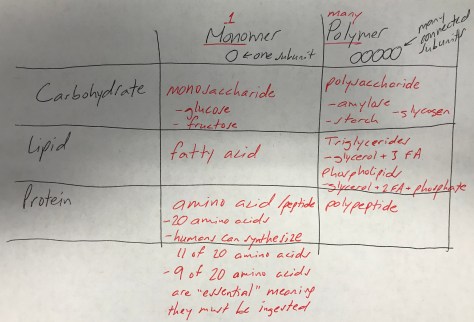
Our study of biomolecules continued with students working in groups of three to read about carbohydrates, lipids, and fats.  Each student read one section, and then all three shared what they learned with the other students in the group so that each student was able to complete one worksheet.  At the end of class, we re-grouped and created the summary table shown below:

IMG_0745

Food – Our Body’s Source of Energy

At this point in our study of enzymes and digestion, students have learned how plants capture the energy in sunlight and store it as chemical potential energy in glucose molecules.  Animals (and plants!) metabolize glucose using cellular respiration, transferring the chemical potential energy from glucose to ATP (adenosine triphosphate), the energy currency of cells.  Photosynthesis takes place in chloroplasts, while cellular respiration occurs in mitochondria.

In The Breath of Life reading, students learned how the respiratory system of humans enables gas exchange, with the lungs inhaling oxygen and exhaling carbon dioxide.  The gas exchange occurs within the alveoli, thin-walled sacs inside the lungs.  The reading introduced the concept of feedback systems, focusing on the special nerve cells in the cardiovascular and nervous systems that can sense changes in pH.  As carbon dioxide builds up, the blood becomes more acidic, and the lungs are forced to exhale to rid the body of carbon dioxide which then brings the pH back to normal levels.

For today’s lesson, we once again turned to our textbook and students were instructed to read pages 328-332 and complete the associated worksheet.  The assigned reading was titled Food: Our Body’s Source of Energy and Structural Materials.  Now that students understand the link between photosynthesis (chemical potential energy stored in glucose), cellular respiration (glucose metabolized to transfer the energy in glucose to ATP), and the larger connection with the respiratory and cardiovascular systems, it is time to learn more about how the digestive system makes use of the variety of foods available to us.  It is time to think beyond glucose.