With many students out of class because of three different field trips happening today, we had to reschedule our quiz for tomorrow. For a starter activity today, students received a worksheet instructing them to write a paragraph comparing mitosis and meiosis, using 10 different key vocabulary words in their paragraph. Students who finished early had time to complete missing assignments.
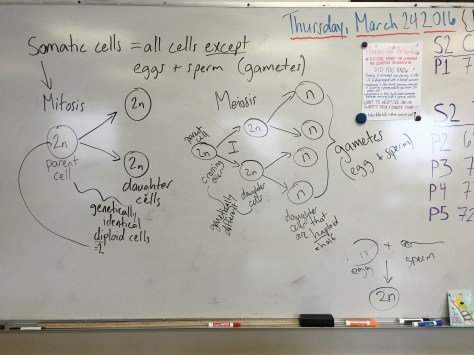
Notes from the white board after 5th period are shown below:
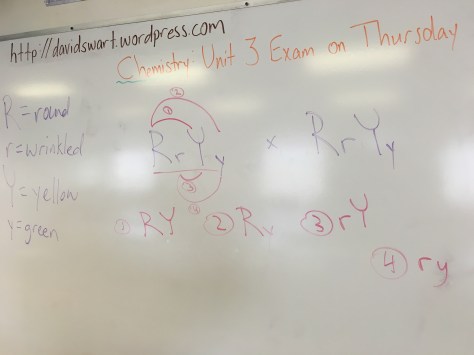
With the Unit 3 exam scheduled for tomorrow, we took class time today to review key concepts for the exam. We focused much of the review on the concept of moles, with students having access to a set of practice problems and the answer key. We worked through most of the problems in class and the work from the white board is pictured below:
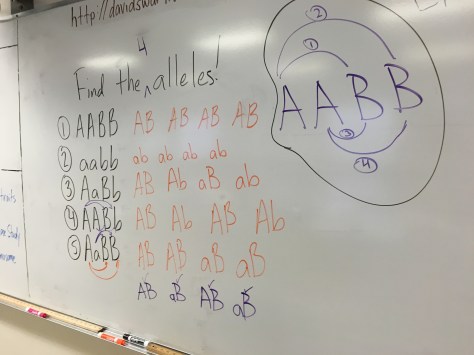
Class began with an entry task intended to provide students with practice identifying the four allele combinations possible from two different genes. A picture of the white board is shown below:
Next, we transitioned in to the lesson about Down Syndrome. We discussed the first three slides of the Down Syndrome Case Study slide deck and then detoured to the Wikipedia entry on aneuploidy. We focused on the Types section of the entry, examining how, of the autosomal chromosomes, only Trisomy 21 will result in a viable fetus most of the time. Students learned that when trisomy occurs in most of the other autosomal chromosomes, the result is an embryo that is non-viable, often resulting in miscarriage. There was a lot of student interest in learning more about polyploidy in the sex chromosomes, and students are encouraged to keep learning outside of class! There were also students curious about my use of Wikipedia. I explained that in my opinion, Wikipedia is a powerful research tool as long as the information included in an article is properly cited. Students can use a Wikipedia entry to locate primary source documents and then reference those documents directly once the information they contain has been verified. I referenced scientific publications that have determined Wikipedia to be as accurate as more traditionally accepted credible sources. Ironically, although Wikipedia is freely available, the publications determining the credibility of Wikipedia are not. Students interested in learning more without paying for the publications can read the Live Science article from 2011 titled “How Accurate is Wikipedia” as a starting point and come up with their own conclusions.
Back to the Case Study! To learn how Trisomy 21 occurs, students watched a short video illustrating non-disjunction. To put a human face on Trisomy 21, or Down Syndrome, students watched another short video about two young twins with Down Sydrome. Both videos are shown below:
The second video naturally leads to questions about twins, so slide 5 explains the difference between identical and fraternal (non-identical) twins. In slide 6, students are introduced to an adorable set of fraternal twins whose skin-color genetics will be revisited in our next unit. The embed feature of the video is deactivated, so here is the link to the ABC News video shown on YouTube.
Class concluded with a final look at the genetic phenomenon of X-inactivation. USing calico cats as the model, Mr. Anderson of Bozeman Science explains how in females, only one X chromosome is active in a given cell. We can visualize the result of this process in calico cats. At the end of the video, we explains how male calico cats, although extremely rare, can arise from the XXY phenotype (connecting back with our learning about aneuploidy).
As a review from yesterday and to extend student learning of Punnett Squares to dihybrid crosses, we began class with the following video by Mr. Anderson of Bozeman Science:
Students took notes throughout the video, with emphasis placed on understanding the connection between meiosis and fertilization (as represented by the Punnett Square), sex-linked traits, and how to determine the alleles in a dihybrid cross. After the video, we reviewed how to identify the alleles, with pictures from the white board shown below:
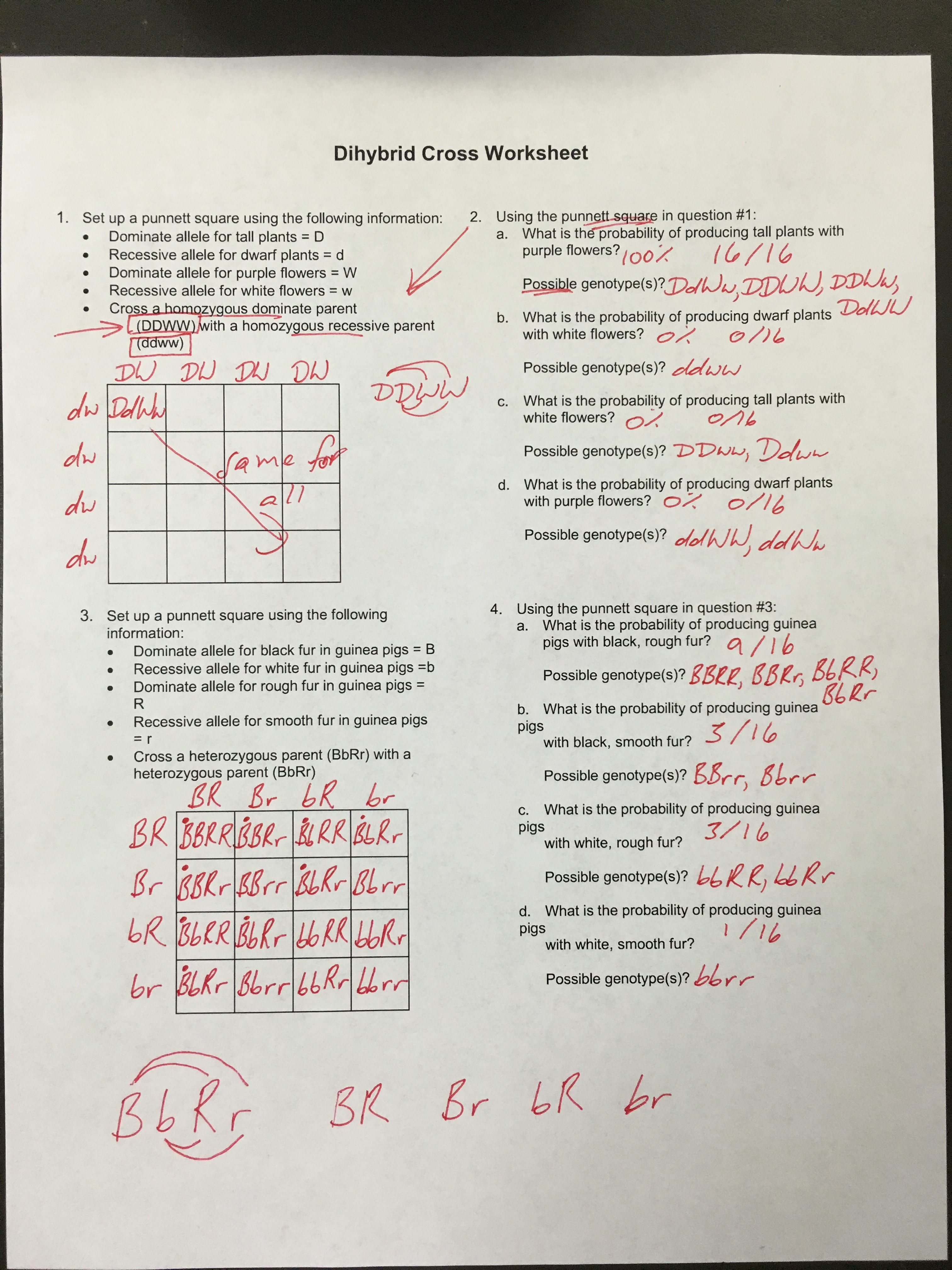
We then worked through questions 1 and 2 of the dihybrid cross worksheet (pictured below), as well as portions of questions 3 and 4.
We reviewed problems 6 and 7 from Friday’s Punnett Square worksheet at the start of class. Students then had the remainder of class to complete the worksheet, complete the meosis reading assignment from last Thursday, and to get both assignments checked off in Illuminate. When finished, students had the opportunity to model meiosis using clay as in the previous unit.
For the final lesson of Chapter 12 (and Unit 3!), students applied their understanding of temperature and pressure to the extreme weather example of hurricanes. We began class with a video describing how hurricanes form:
We packed a lot into the short class period today. To reinforce concepts introduced in the video yesterday but not covered in the reading assignment, we spent today learning and applying the vocabulary of inheritance. We dusted off the cobwebs from student memories from middle school, reviewing the vocabulary words of genotype, phenotype, alleles, dominant, recessive, homozygous, and heterozygous. We then applied the vocabulary to an example Punnett Square about eye color inheritance patterns. Notes from the white board are pictured below:
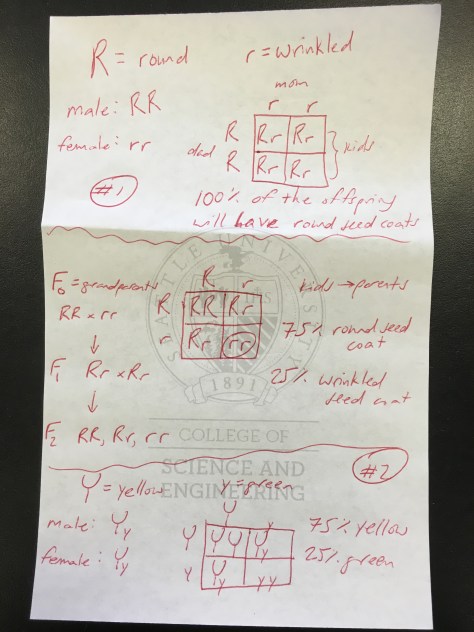
We then applied these concepts to a Punnett Square worksheet. We worked through the first two problems together (pictured below), and then students used the remainder of the class period to work through the remaining problems.
Students in 4th period were very interested in learning more about the genetics of eye color. The NIH Genetics Home Reference website explains the genetics of eye color, complete with references to relevant scientific journal articles. The Tech Museum of Innovation website has a lengthy article written in more student-friendly language (with graphics!) on the topic. The article includes a calculator to predict the eye color of your offspring, and even provides evidence about how two blue-eyed parents can have a brown-eyed child (Surprise! High school genetics is over-simplified!). The question of traits “skipping a generation” also came up during 4th and 5th periods. We used problem 1 from the worksheet to explain how a grandparent and a grandchild can both share a trait that “skips” the generation in between.
We launched Unit 4 with an introduction to the concept of meiosis. We began with a Crash Course video about heredity (below) and then followed that with a reading assignment. Students completed the reading from Chapter 4 of Inside the Cell (pages 52-59), answering the “Got It?” questions on page 59 in their lab notebooks.
For Lesson 66, students learned the definition of humidity on slide 5 of the Lesson 66 PowerPoint. Students then broke into groups and conducted the lab outlined in the Lesson 66 Worksheet. The worksheet packet also included a copy of the Relative Humidity Handout to use for calculations. For homework, students may work through any 4 problems from the textbook (or take notes on the reading – always an option!). Students were also reminded that we will have the Chapter 12 quiz next Tuesday and the Unit 3 exam next Thursday.
After several lessons learning about the component parts and relationships mathematically connecting pressure, volume, temperature, and number of particles, the Ideal Gas Law was revealed. We worked through the Lesson 64 worksheet and then watched a Crash Course video on the Ideal Gas Law:
After the video, we worked through Lesson 65 textbook problems 3 and 5. The notes from the white board are shown below. The Lesson 65 PowerPoint and Lesson 65 Worksheet are available for students who would like to see them. We did not use either today in class, and the Lesson 65 Worksheet was not assigned.







 Science with Swart
You must be logged in to post a comment.