
Electronegativity Scale

After learning about the concepts of electronegativity and polarity in yesterday’s lesson, students learned that scientist Linus Pauling assigned electronegativity values to individual atoms as a measure of how strongly an atom attracts electrons (click here for a deeper dive into how he calculated electronegativity).  Although not used in class, the Lesson 44 PowerPoint is provided here as a resource and includes a copy of the periodic table with electronegativity values for each element.  It also explains the difference in electronegativity between covalent bonds (0.5 and less), polar covalent bonds (between 0.5-2.1), and ionic bonds (greater than 2.1).

After practicing how to calculate bond differences as a class, students worked through the Lesson 44 Worksheet using the Electronegativity Scale and Bonding Continuum handout.

Students who finish the work early had time to complete yesterday’s Lesson 43 worksheet and Monday’s Polarity and Intermolecular Forces Gizmo.  Students who are fully caught up have the opportunity to investigate vectors and may earn bonus credit for completing one or both vector-related Gizmos.

Notes from class:
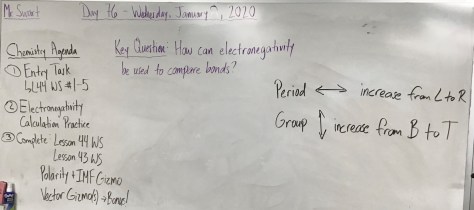
Lesson 44 Picture 1

Lesson 44 Picture 2

Keep Learning!

Want more information about dipoles from yesterday’s lesson?  Read about how dipole moments are calculated.

Wondering how scientists measure the electronegativity of atoms?  One new technique involves atomic force microscopy.  Read more:  Electronegativity of a single atom scrutinized under the microscope.

The Pauling scale of electronegativity was updated in a paper published a year ago (January 2019, Journal of the American Chemical Society).  Read a summary of the work: New scale for electronegativity rewrites the chemistry textbook.  Want more?  Take a look at the supporting data for the journal article.

Homework:

  • Read Lesson 44 in the textbook.  Login via the Sapling website and enter your username and password.
  • Write notes for Lesson 44 and work through the practice problems at the end of Lesson 44
  • Please ask questions about anything from Lesson 44 you do not yet fully understand.
Week 17

Monday, January 6, 2020 (HS-LS2-7, HS-ETS1-3): Welcome to the first week of school in 2020!  We have a lot to accomplish, so our work today is broken down into three steps:

Step 1: Take the Continent Survey – this will inform (but does not guarantee!) group placement for our work tomorrow.

Step 2: Join Mr. Swart’s Newsela classroom.  After joining the classroom, students are instructed to read the article titled, “Earth’s Systems: What is a biome?” and highlight key ideas in the article using the highlighting feature in Newsela.

Step 3: Open the HHMI BioInteractive BiomeViewer and work through the accompanying Student Worksheet.


Tuesday, January 7, 2020 (HS-LS2-7, HS-ETS1-3): We will extend our learning of biomes from yesterday with the Ted Ed video below (Why is biodiversity so important?):

After a brief discussion about the video, students will read the Newsela article titled, “What is biodiversity?” and and highlight key ideas in the article using the highlighting feature in Newsela..

After reading the article and completing the notes, students will learn of their continent team assignment by checking their student Gmail account.  Based on data from the continent survey yesterday, students were placed into one of five different continent teams:

The first team assignment is for each team member to read the articles about the Physical Geography and Human Geography of their continent through the Newsela classroom.

After reading the articles, team members will cross-reference the content from the article with the HHMI BiomeViewer and decide as a team which biome to move forward with the research project.


Wednesday, January 8, 2020 (HS-LS2-7, HS-ETS1-3): Student groups have the class period to work on yesterday’s work.


Thursday, January 9, 2020 (HS-LS2-7, HS-ETS1-3): With the Newsela website down during class today, students had two options: complete the BiomeViewer work from Monday (required) or, if finished with the BiomeViewer work, to watch the Popped Secret video below and complete the accompanying student handout.


Friday, January 10, 2020 (HS-LS2-7, HS-ETS1-3): Today is the final day of class time for students to complete the individual work for the Continent Biome project. Students have the class period to complete the work.  Any additional time should be used to complete the BiomeViewer Student Worksheet activity from Monday or the Popped Secret bonus handout from yesterday.

The BiomeViewer worksheet is due today for full credit.  Late work will receive 60% max credit.  The Popped Secret handout is due next Friday for bonus.

Electronegativity and Polarity

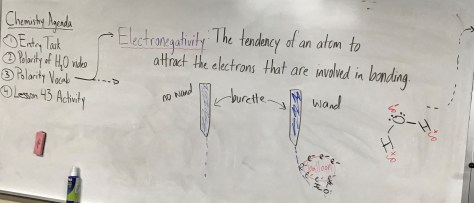
After completing the entry task on slide 3 of the Lesson 43 PowerPoint, we visualized the concept of a “charged wand” and it’s effect on polar molecules using a balloon, electrons gently extracted from the hair of a student volunteer, and a burette filled with water.  Students observed water flowing straight through the burette at the beginning of the demonstration, and then saw how water was attracted to the “charged wand” when the balloon was placed close to the stream of water.  Students were challenged to explain the observation using their understanding from our work yesterday (models drawn in the class notes below).  Next, we watched the Bozeman Science video below about the polarity of water molecules to review, extend, and apply the learning from yesterday to real-world scenarios:

We then talked through the definitions of electronegativity and dipole, relating both concepts back to molecules of water and carbon dioxide (see class notes below).  Finally, students received copies of the Lesson 43 Worksheet and accompanying cartoon to work through.

Notes from class:

Lesson 43 Picture 1

Lesson 43 Picture 2

Keep Learning!

Looking for more challenge?  When drawn as vectors, dipole arrows allow scientists to calculate the magnitude and direction of the overall dipole of a molecule.  Using vector addition, dipole arrows explain why water is polar while carbon dioxide is non-polar.  Brush up on vectors and vector addition using the Gizmo simulations.  Ask for one or both copies of the Gizmo handouts and grow your brain!

Homework:

  • Read Lesson 43 in the textbook.  Login via the Sapling website and enter your username and password.
  • Write notes for Lesson 43 and work through the practice problems at the end of Lesson 43
  • Please ask questions about anything from Lesson 43 you do not yet fully understand.