For weather forecast data, visit the University of Washington Atmospheric Sciences Virtual Map Room. Lesson 49 textbook questions 1-6 were assigned as homework.
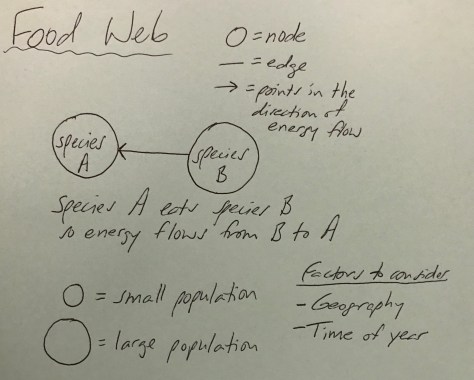
To conclude our work this week, we will assemble a food web of as many species as we can based on the research students did over the past few days into abiotic factors, biotic factors, and populations data. Important vocabulary we will use to build our food web includes node, edge, and energy flow. Class notes are pictured below:
For your assignment today, construct a food web using the biotic factors in your Google Doc. On the sticky note provided, write down population data for 2-3 species in Yellowstone and turn in to Mr. Swart. We will use the class population data along with the food webs from today to dig further into the concepts of trophic cascades and carrying capacity next week.
Combined student-researched data to be used for constructing food webs:
Species
Population
Mass (kg)/organism
Population mass (kg)
Peregrine Falcon
9
1
9
Bald Eagles
14
5
70
Wolverine
7
20
140
Canada Lynx
112
10
1120
Cougars
25
80
2000
Grey Wolves
104
34
3536
Beaver
500
23
11500
Mountain Goat
208
100
20800
Pronghorn Sheep
466
55
25630
Bighorn Sheep
328
100
32800
Black Bears
650
110
71500
Mule Deer
1850
45
83250
Grizzly Bears
610
300
183000
Moose
400
800
320000
Bison
4000
630
2520000
Elk
20000
275
5500000
Our work today is to find the mass (Google the mass of each species – look for grams (g) or kilograms (kg)). Copy and paste the table into Google Sheets. Fill in the mass of each organism (convert to kg) and then calculate the mass of each population using the formula in the population mass column.
Yesterday we learned about the connection between the biotic (living) and abiotic (not living) factors in the ecosystem of Yellowstone National Park. Wolves, deer, and trees are all biotic factors and connect together into a food web. Soil, rocks, and rivers are all abiotic factors that are influenced by the activity of the food web. Our work over the next two days is to research additional biotic and abiotic factors in the Yellowstone ecosystem, and to collect as much data as possible. We need numbers!
Browse through the sections of the Nature & Science page on the Yellowstone National Park website. Be warned – there is a ton of information! Your goal by the end of tomorrow is to come away with a deeper understanding of both the geology and the ecosystem of Yellowstone. Record as many facts as you can find about biotic and abiotic factors in your Google Doc.
Biotic Factors
Find specific population numbers for as many species of plants and animals as you can and record the data in your Google Doc. Cross-reference your list with the biotic factors you listed out yesterday. For example, there are an estimated 10,000-20,000 elk in the park. Be sure to read and take notes about the wildlife, plants, and life in extreme heat residing in Yellowstone.
Read about the Geology of Yellowstone Park, taking notes about key geologic features (example: Old Faithful geyser) and how they form, along with important historic geologic events and when they occurred. Be sure to read the following sections:
Now that we have a plan to virtually travel to Yellowstone, we set our sights on the ecosystem of the park. For today’s lesson, students will learn about how the reintroduction of wolves nearly 75 years after their extinction appears to have led to profound changes to both the biotic (living) and abiotic (not living) factors in the ecosystem of the park.
The video (below) features images about the wolves and other organisms in Yellowstone, with George Monbiot narrating. The narration is actually a segment from a longer TED talk by Mr. Monbiot.
During the video, make a list in your Google Doc (from yesterday) of the biotic and abiotic factors you see in Yellowstone. After watching the video, write down the claim being made by the narrator in their Google Doc, and then make of list of evidence used to support the claim. Next, students are must read an article titled Has The Reintroduction Of Wolves Really Saved Yellowstone? published on March 14, 2014 by Emily Gertz in Popular Science. After reading the article, write the counterclaim in your Google Doc and include evidence from the article to refute the original claim.
Finally, create a list of information you would need to determine whether or not wolves have impacted the ecosystem of Yellowstone National Park.
After completing the lesson, continue working on your virtual road trip plans from yesterday’s lesson. Be sure to share the Google Doc with Mr. Swart!
As we enter our final unit of the year, it’s time to have some fun! We will begin our ecosystem unit by planning a virtual road trip to Yellowstone National Park. Working with a partner, create a Google Doc and include your responses to the following tasks:
Plan your route: Map how you will travel from Burien to Yellowstone and back. Where will you stop along the way and why? How many miles long is the trip? Neat places to visit:
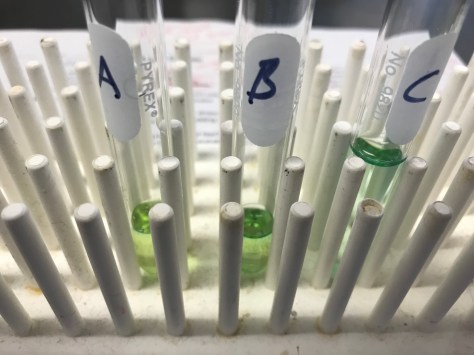
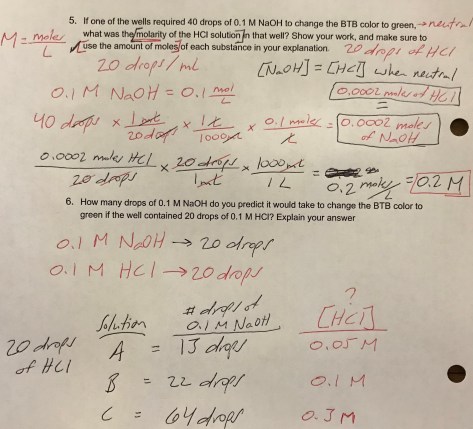
We followed up our work yesterday with the Lesson 89 Titration Lab. Students received the Pre-Lab 89 Titration which we read through as a class. Students then took a few minutes to complete Pre-Lab assignment questions 1-4 which we briefly discussed. Students assembled into groups of 4 and worked through the lab. A picture of one group’s neutralized tubes is shown below, followed by results for periods 2 and 3, as well as combined results.
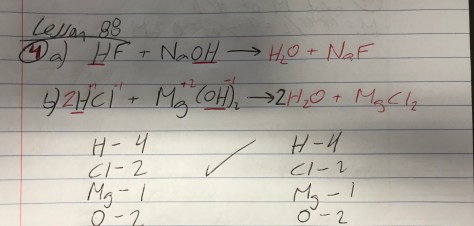
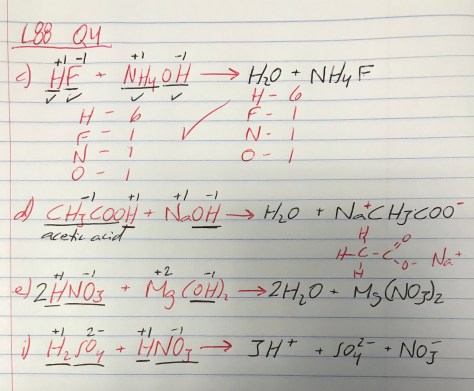
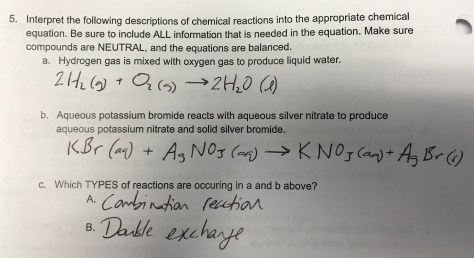
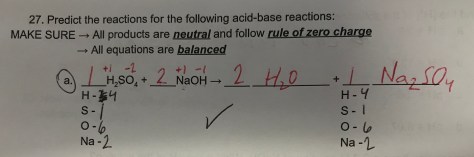
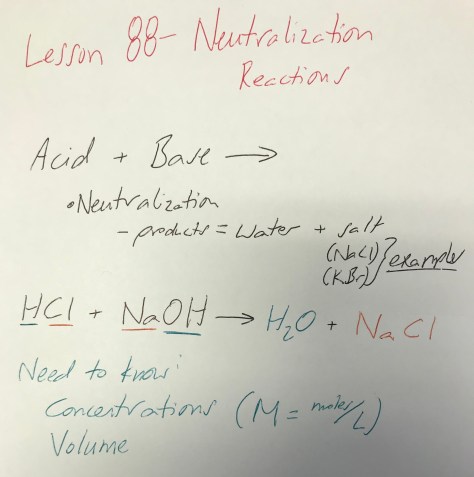
For our first lesson back from Spring Break, we launched in to Lesson 88: Neutralization Reactions. Notes from the lesson are shown below:
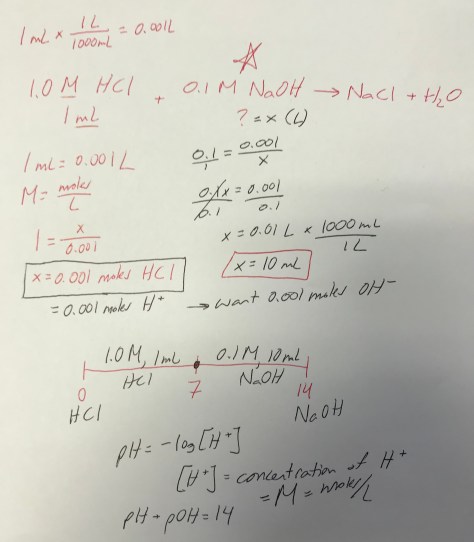
Next, we conducted the lab in the Lesson 88 worksheet as a teacher-led demo (due to material constraints). For homework, students were assigned textbook problems 1-8 from Lesson 88.
We elected to take our time working through Lesson 86. We started the week with the Lesson 86 PowerPoint, connecting molar concentration of H+ or OH- with pH. Students then transitioned to the Lesson 86 Worksheet, working in teams to sort through the Acid-Base Solution Cards used in Lesson 85.
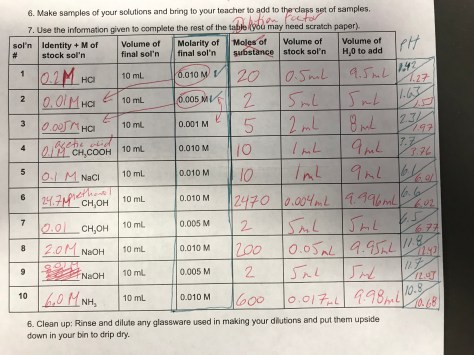
On Wednesday, we powered through the Lesson 86 lab, collecting pH data from 10 different solutions. Students did a fantastic job preparing concentrated stock solutions, diluting stock solutions, and measuring pH with our one functioning digital pH probe. Results from both classes are shown below, with second period results in green and third period results in red.
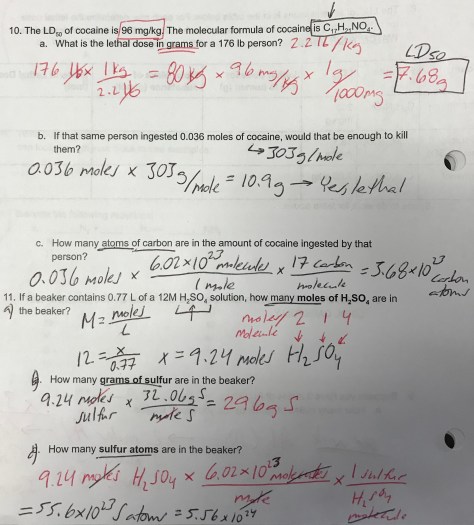
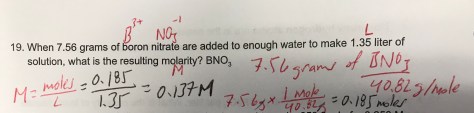
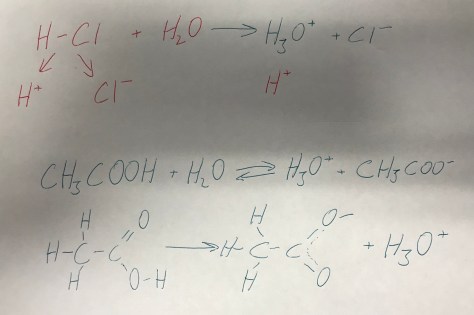
On Thursday, class began with students completing the Chemistry Textbook Pilot Student Survey. After the survey, we returned to the pH lab, analyzing our results in the context of a set of class notes (pictured below). We also practiced calculating pH from molarity and molarity from pH. Students were reminded that Google Chrome can be used as a calculator. Desmos.com offers a nice web-based scientific calculator as well.
We ended the week on a lighter note, celebrating National Teflon Day (April 6) with videos (and notes) about acids and bases that are so strong, their activities fall outside the traditional 0-14 pH scale.
Team: Geologist use an indirect method of dating rocks and fossils called stratigraphy. Stratigraphy is the study of strata on earth. Strata are layers. For this task, you will study a model of earth’s strata.
Observe the beaker of strata provided by Mr. Swart. Which layers are the oldest (has been in the beaker the longest)? If these strata were layers in the earth’s surface, what inferences might you make about the relationship between the depth of the layer and the amount of time that has passed? Answer in notebook.
Consider the three colored markers in the strata. If you found these colored markers in earth’s strata, which would you infer to be oldest? Answer in notebook.
Get the 3 colored envelopes from Mr. Swart. Each envelope matches to 1 of the colored markers in your strata.
Imagine that each envelope represents a fossil discovery. Which “fossil” would be the oldest? Which would have formed most recently? Answer in notebook.
Open the envelopes and observe the fossil pictures in each. In your journal, compare each fossil with each of the others and with modern-day organisms. What similarities and differences do you observe? Answer in notebook.
Individually: Complete the Pangea Gizmo (every student individually) to see how the tectonic plates affect fossils.
Individually: Read and take notes on the article in the packet “Explainer: How a fossil forms” and the Carbon dating activity. Answer in notebook.
Team: Create a poster that you can use to explain to your classmates of how fossils form and how they can be dated. Poster presentation must include the following:








 Science with Swart
You must be logged in to post a comment.