
To conclude the biogeochemical cycle poster project, students each reviewed two posters from groups other than their own. The review consisted of a worksheet with one half containing key items that must be included on each poster for full credit (turned in for participation credit). The lower half of the worksheet included feedback questions that were left with the posters and provided to the groups for feedback. Students then received a take-home quiz consisting of an article about the 2015 Gulf of Mexico dead zone and a quiz with questions connecting the nitrogen, carbon, and water cycles with photosynthesis, cellular respiration, and algal blooms. The quiz is due Monday.
Monthly Archives: January 2016
Molecular Structure and Properties: Chapter 7 Quiz
After the Chapter 7 Quiz, students were treated to the Crash Course: Orbitals video below which explains why electron orbitals, and thus molecules, are shaped the way they are:
Molecular Structure and Properties: Receptor Site Theory
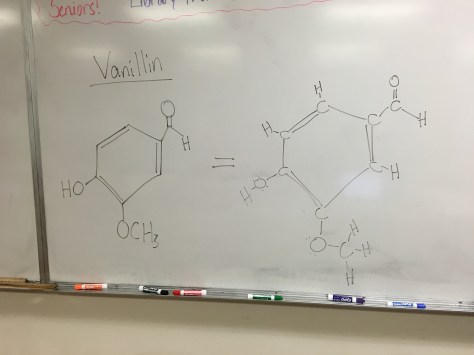
The final lesson of chapter 7 brings together student learning about how the olfactory system (the way we perceive smell) works. The Lesson 41 PowerPoint includes the key vocabulary concept of receptor site theory, where students learn the importance of molecule shape in determining recognition by receptor molecules involved in sensing smell. During class, we discussed how this concept is readily transferred across biology, extending beyond smell to areas like immunology. Students received the Lesson 41 Worksheet, with the option to research their favorite smell, determine whether the olfactory receptor for that smell is known, and to model their favorite smell molecule with MolView rather than construct a poster. Students also learned how to “read” an organic molecule structure traditionally used by chemists (see picture from the whiteboard below). For homework, students may complete any 4 of the textbook questions for this lesson.
Student work:
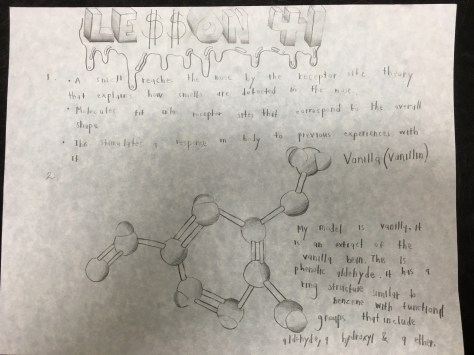
Molecular Structure and Properties: Shape and Smell
For Lesson 40, students worked in small groups to organize a set of 24 cards containing compounds with different shapes and functional groups. The Lesson 40 PowerPoint includes a nice graphic organizer for studying the relationship between molecule name and functional group. The Lesson 40 Worksheet and Card Sort are available for download. For homework, students are assigned questions 1, 2, and 5.
Energy, Matter, and Organization: Biogeochemical Cycle Poster Project
This week, students will work in groups of three students each to create a poster representing biogeochemical cycling. For the project, students will receive a worksheet with 30 different components that must be included in their poster. Students will have access to the class textbook and the class set of laptops to conduct their research. Students will also receive the Nutrient Cycling POGIL worksheet packet that will provide them with additional information about the process of carbon (C), water (H and O), nitrogen (N), and phosphorus (P) cycling. Sulfur is often included as a component of the biogeochemical cycle, frequently appreviated as the CHNOPS cycle. To help keep student projects moving forward, a variety of resources will be posted here for review.
Crash Course: Carbon and Water Cycles
Crash Course: Nitrogen and Phosphorus Cycles
Bozeman Science: Biogeochemical Cycles (includes the Sulfur Cycle)
The Global Carbon Cycle – a website with data about global carbon cycling with actual numbers that need to be added to the student posters.
Water Cycle – USGS website providing a robust review of hydrologic (water) cycle vocabulary, a presentation of the cycle itself, and data students will need to add the actual amount of water stored in various locations on Earth.
Texas A&M University has a website with pages devoted to explaining the Nitrogen Cycle. Additional in-depth information about the Nitrogen Cycle is available on the Nature Education Knowledge Project website.
Phosphorus Cycle – information about the cycle and a nice graphic from the Shmoop University website.
Sulfur Cycle – a presentation provided by North Carolina State University
Ocean acidification has become a major concern as the increasing concentration of carbon being produced has resulted in our ocean water become increasingly acidic. The movie Acid Test: The Global Challenge of Ocean Acidification is freely available online for students who would like to learn more about the consequence of our hydrocarbon-based economy on life in the oceans.
Update 1/12/16: Whiteboard notes from today’s Entry Task connecting biomolecules and biogeochemical cycling (CHNOPS):

Molecular Structure and Properties: Space-Filling Models
Lesson 39 introduces students to the concept of space-filling models. The lesson calls for students to use space-filling models which we do not have access to at our school. Rather than continue to use the ball-and-stick models, students instead used MolView, a free software program available online. Using MolView, students searched for the compounds in the Lesson 39 Worksheet using the search tool. They then visualized the molecules as space-filling models using the van der Waals Spheres option located under the Model tab. Although not particularly helpful, the Lesson 39 PowerPoint is included. For homework, students are assigned questions 3 and 4 from the textbook.
Molecular Structure and Properties: Molecular Shape
We returned to the molecular modeling kits in Lesson 38, this time using the kits to learn about the shape of molecules. We worked through the Lesson 38 PowerPoint, learning vocabulary terms to describe molecular shape. Students then worked in small groups to complete the Lesson 38 Worksheet. For homework, students were assigned textbook problems #1-6. Notes from the whiteboard are shown below:


Energy, Matter, and Organization: Photosynthesis & Cellular Respiration POGILs
For the next three days, students will learn about leaf structure, photosynthesis, and the connection between photosynthesis and cellular respiration. Students will work in pairs to complete two worksheet packets, and those who finish early will have the opportunity to complete one or more related labs.
For day 1, the entry task called for students to answer (through writing) the following:
- What is photosynthesis?
- Why is photosynthesis important?
- Write the equation for photosynthesis (bonus: include pictures!).
Student work is pictured below:


After the share-out, students watched the Crash Course: Plant Cells video (below) which served as a refresher to plant cells and as an introduction to photosynthesis. After the video, students worked in pairs on the Photosynthesis POGIL worksheet packet.
For Day 2, students reviewed the vocabulary terms of exothermic and endothermic within the context of photosynthesis, cellular respiration, and combustion. Notes from the entry task are pictured below.


After the entry task, we watched the video about photosynthesis by Bozeman Science. Students need to know the first 4.5 minutes of content, but the remaining content (which students wanted to watch) is beyond the scope of our class. After the video, students had the remainder of class time to work on the Photosynthesis POGIL Worksheet Packet from yesterday.
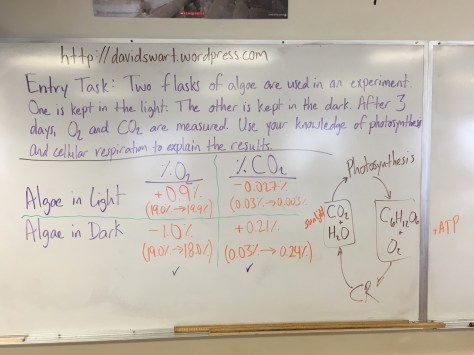
For Day 3, we connected the processes of photosynthesis and cellular respiration first through our entry task and then through a Photosynthesis and Cellular Respiration POGIL worksheet packet. The entry task and white board notes answering the response are pictured below:


For students looking to dig into cellular respiration at the molecular level, the Crash Course and Bozeman Science videos are provided below:
Molecular Structure and Properties: Electron Domains
We began the day with a brief review of Lesson 36 (the last slide of the PowerPoint) before transitioning to the Lesson 37 PowerPoint. Students learned about electron domains and how they affect the shape of a molecule. They then worked in pairs on the Lesson 37 Worksheet, substituting the molecular modeling kits for the entire activity (no candy in our classroom). Students also received a copy of the January homework calendar which outlines the schedule along with assigned homework through the end of the month (and thus the end of the semester). The assigned lesson 37 textbook questions are #3-6, 8, and 9.
Energy, Matter, and Organization: Complete Potato Catalase Lab Report with Extension
Students began the day with an entry task asking them to reflect back on the potato catalase lab from before the break, locate and/or recall how temperature was affected by the reaction, and then to use science thinking to come up with a “why” statement. Students successfully reasoned through the idea that the increased temperature observed during the reaction was attributed to the net release of energy from the bonds breaking from hydrogen peroxide and reforming to produce water and oxygen. Students were then introduced to the vocabulary terms of exothermic and endothermic. After the entry task, we briefly reviewed the Unit 2 calendar, clearly noting the scheduled quizzes, project deliverables, and dissection week. Students were then treated to a job posting showing the clear market demand for individuals skilled at dissection. Students were then released to:
- Work with their lab group to complete and turn in the lab report
- When finished with the lab report, repeat the potato catalase experiment with fresh potato, baked potato, and frozen potato.


 Science with Swart
You must be logged in to post a comment.