
For today’s lesson, students learned how to classify items as matter or not-matter given the following definition of matter as anything that has mass and volume. We reviewed the Lesson 3 PowerPoint and worked through question 1 of the Lesson 3 worksheet as a class. Students then had time to finish the worksheet and answer questions 1-6 from page 12 of the textbook. We concluded with students reading an article titled “What is Chemistry?” and answering the following writing prompt: If you had to pick a career right now, what would you choose? How is chemistry part of that career?
Monthly Archives: September 2015
Cells & Homeostasis: The Inner Life of a Cell
For our entry task today, students had the opportunity to check out a biology textbook. The textbook should stay home, as we will have a class set of books to use at school. Students who did not check out a book will be provided with copies of reading assignments as needed.
Next, we watched a video produced by the BioVisions group at Harvard University. The video, The Inner Life of a Cell, provides a visually amazing introduction of cells to students who may not realize how dynamic cells really are. After the video, students worked together to begin reading chapter 1 of the “purple book” – Inside the Cell. Students used the following A/B Partner Paraphrase Reading strategy, with the goal of reading pages 6-13 of the book:
- Partner A reads one section out loud
- Partner B listens and then summarizes the section out loud back to Partner A
- Partner A then summarizes Partner B’s summary out loud
- Both Partner A and B write down the final summary
The purpose of the reading strategy is to provide students with the opportunity to read aloud and practice saying new vocabulary words, and also to help them distill key ideas through summarization. Students who would like to order their own free copy of Inside the Cell should visit the National Institute of General Medical Sciences website and do so as soon as possible. There are quite a few excellent freebies available from the NIGMS website, including magazines and posters.
We will complete the reading tomorrow and make flash cards tomorrow to help students learn about cell organelles.
Cells & Homeostasis: Systems Quiz
In Biology class, students took their first Friday quiz of the school year today. The quiz included 10 questions covering systems and networks, as well as the Pirate Way values and a quick check-in on how the year is going so far in class. Students were also reminded to check Illuminate to ensure they had received credit for turning in their signed Safety Contract and Student Questionnaire. With schedule changes winding down, we will kick it into high gear next week with our study of cells. Have a great weekend!
Cells & Homeostasis: Social Networking
For our entry task today, students were tasked with constructing a network diagram of the schools they have attended, finishing with Highline High School. The activity served as a team-building exercise (we created a big class network diagram) and helped review key vocabulary introduced yesterday (system, network, node, and edge). Students then used their network diagrams from yesterday’s meet-and-greet activity to create a class social network using a ball of purple and gold “Pirate” yarn. Each student served as a node, and they had to say the name of the student they were tossing the yarn to along with what they shared in common. By the end of the activity, the students were criss-crossed in yarn, practiced each other’s names, used data collected yesterday, and had a clear visual understanding of a network. We wrapped up by watching (or finisihing) Aaron Kobelin’s TED Talk posted yesterday. Students learned that science is a highly collaborative venture, with scientists often working on part of a larger puzzle without actually knowing what the larger puzzle looks like.
We will have a quiz tomorrow – study up!
Matter, Atomic Structure, and Bonding: Introduction to Chemistry
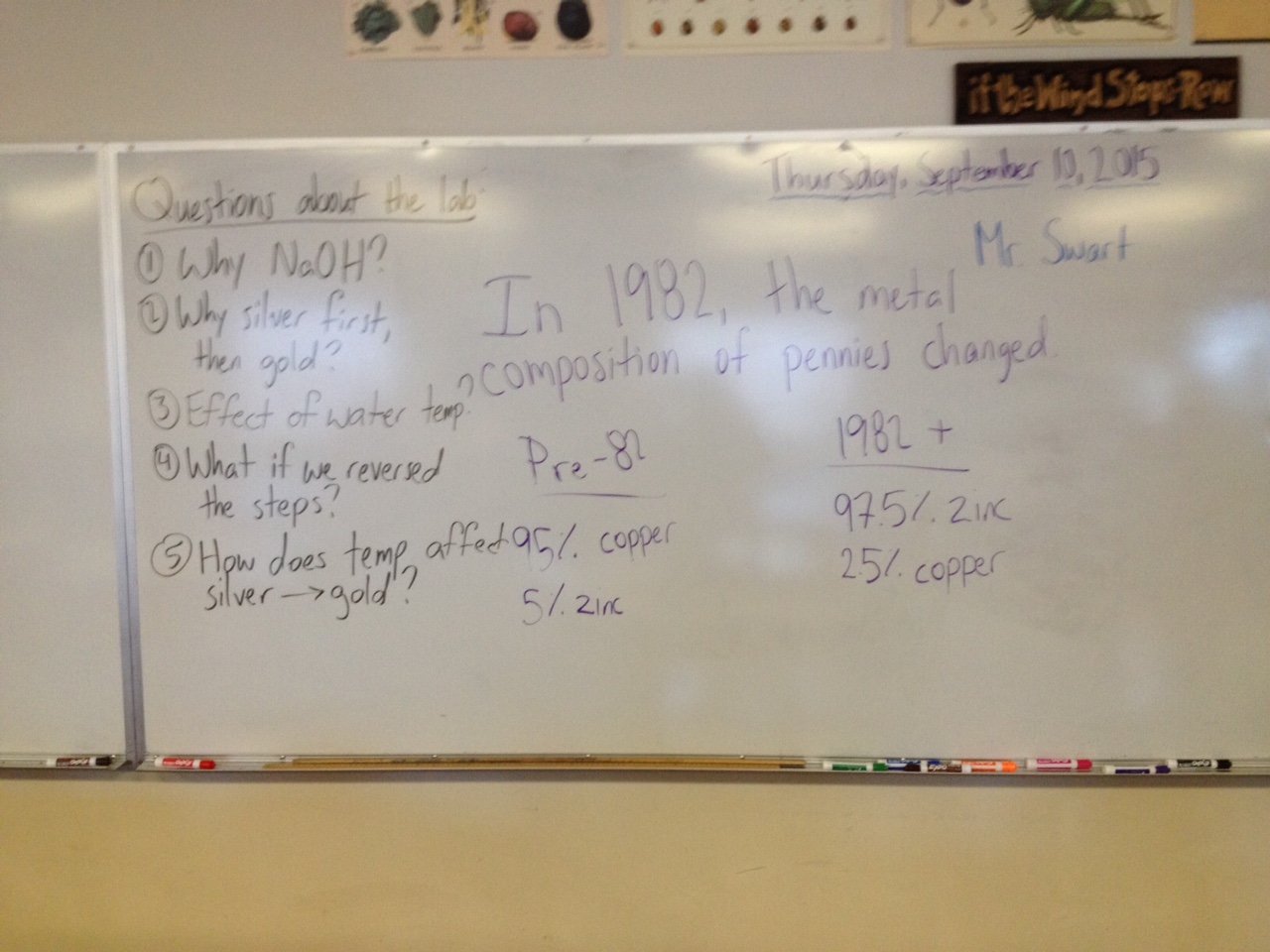
Today in class, we transformed the color of a copper penny to silver and then to gold. Following the steps outlined on page 6 of Lesson 2 of the textbook (A Penny for Your Thoughts), we immersed a 1979 penny (95% copper, 5% zinc) in a warm beaker of sodium hydroxide (3 M, about 40 mL) and zinc shot (enough to cover the bottom of a 150 mL beaker). After watching the penny change color to silver, tongs were used to transfer the penny to cool water. The penny was then transferred back to the hot plate (still set to 4) where it changed to a gold-copper color. The penny was placed back in cool water where it completed the transition to having a gold appearance. Students worked through most of the Lesson 2 worksheet in class. We wrapped up by making a list of questions students had about the experiment (pictured below). Those questions will form the basis for tomorrow’s lesson, where students will begin to probe how and why the penny changed color and whether the penny actually turned to gold. Students will write a hypothesis, carefully conduct the experiment documenting the steps they follow (the procedure), and then documenting the results of their experiment.
Remember, the PowerPoint from Lesson 1 is due tomorrow (9/11) by email.
Due Monday (9/14):
- Complete the Lesson 2 worksheet
- Answer questions 1, 2, 4, 5 on page 8 from Lesson 2
- Read Lesson 3
- Finish writing up the Friday experiment in student lab notebook for Monday check-off.
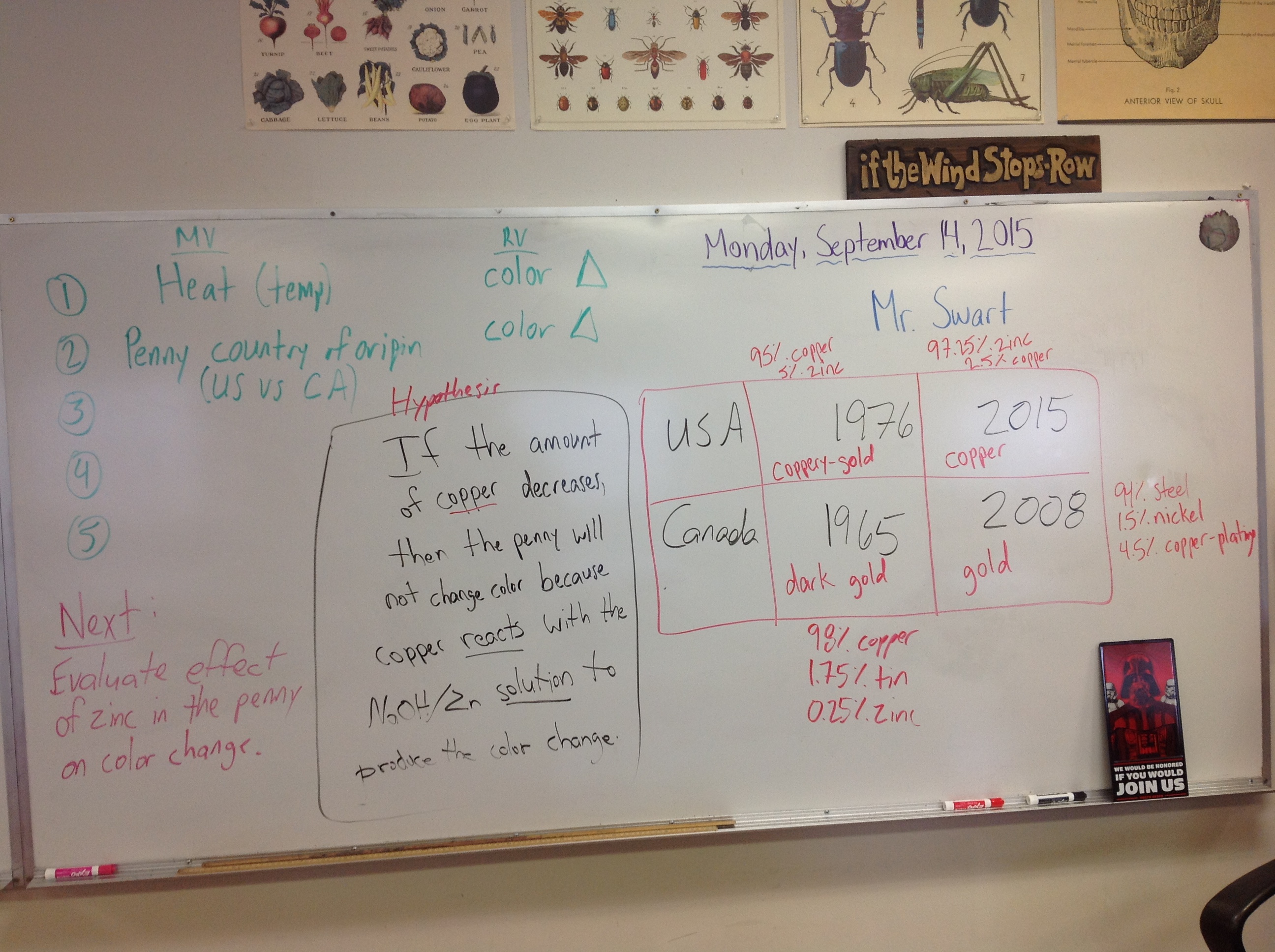
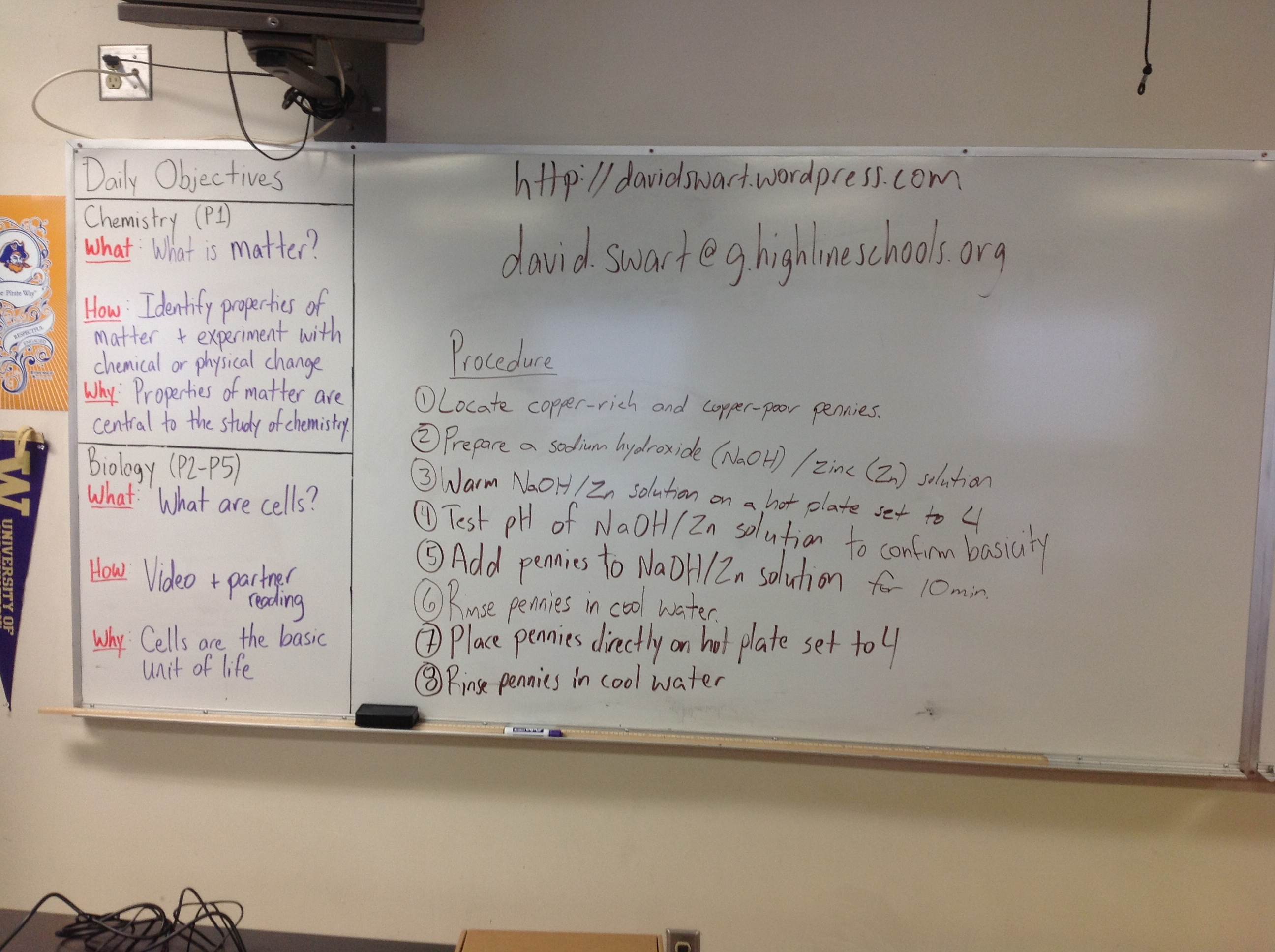
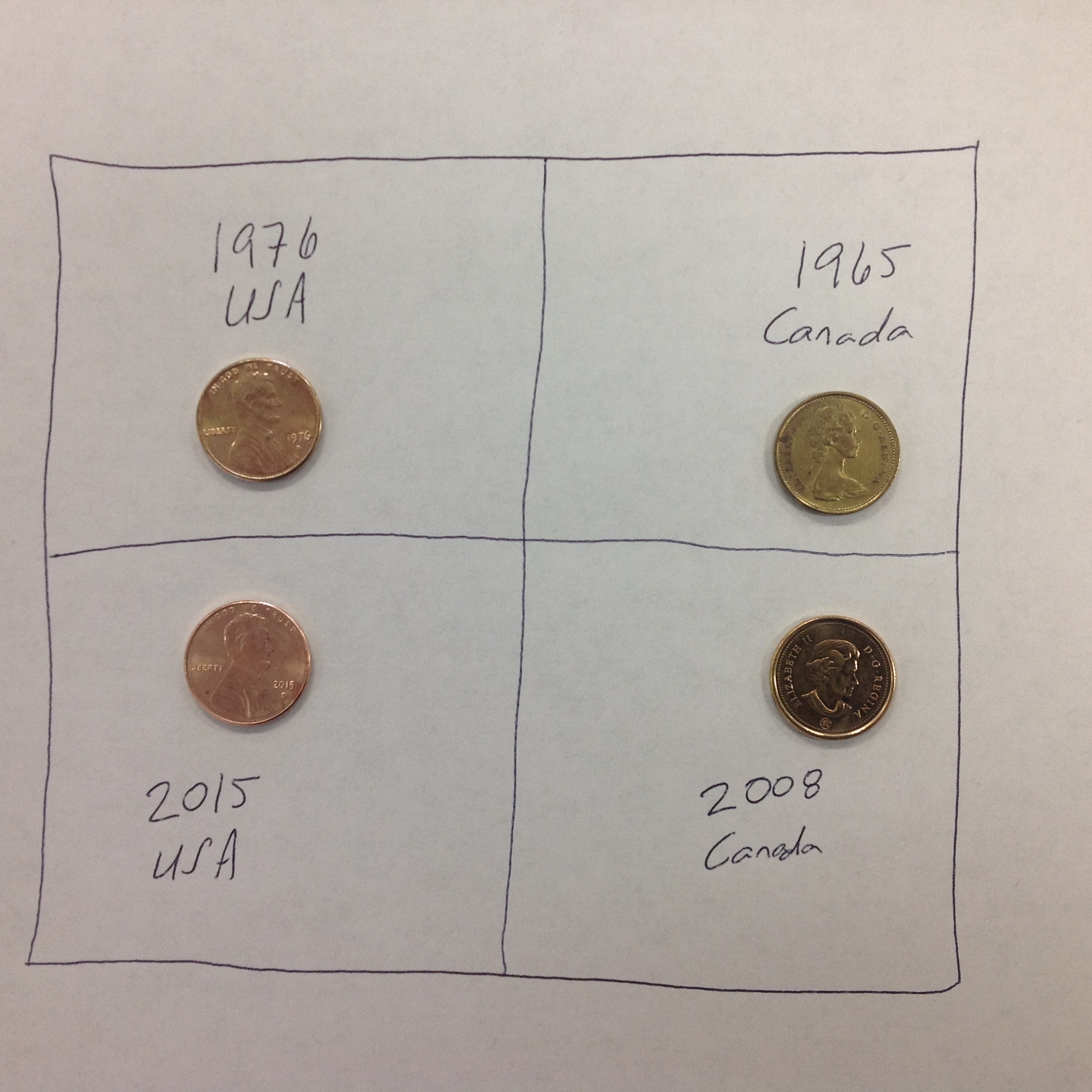
Monday (9/14): We modified the plan from Friday and decided to re-visit the demonstration approach for the Penny Lab. At the beginning of class, students were asked to share their hypothesis for the lab from last Friday. Students worked together to identify the manipulated and responding variables within their hypothesis statements, and a few brave students shared their variables with the class. We decided to use the class period to test whether pennies from the USA (pre-1982 and post-1982) exhibited different properties when placed in sodium hydroxide and zinc compared with pennies from Canada. We used Canadian pennies from 1965 and 2008 based on their differing metal composition (given in the picture below). We also crafted a class hypothesis statement and then wrote down each step of the experiment to document the procedure (below). At the end of the experiment, students described the color change and the pennies were photographed (also below). We wrapped up by noticing the color change in today’s experiment appeared to be inversely proportional to the amount of zinc in the pennies (i.e. the less zinc in the penny, the more gold color it became), thus completing one cycle of the scientific process.
Cells & Homeostasis: Introduction to Networks
Networks and systems are a recurring theme in biology, so today’s lesson focused on introducing students to the topic. For the entry task, students were challenged with writing a short story explaining a picture of a squirrel eating a piece of pizza.
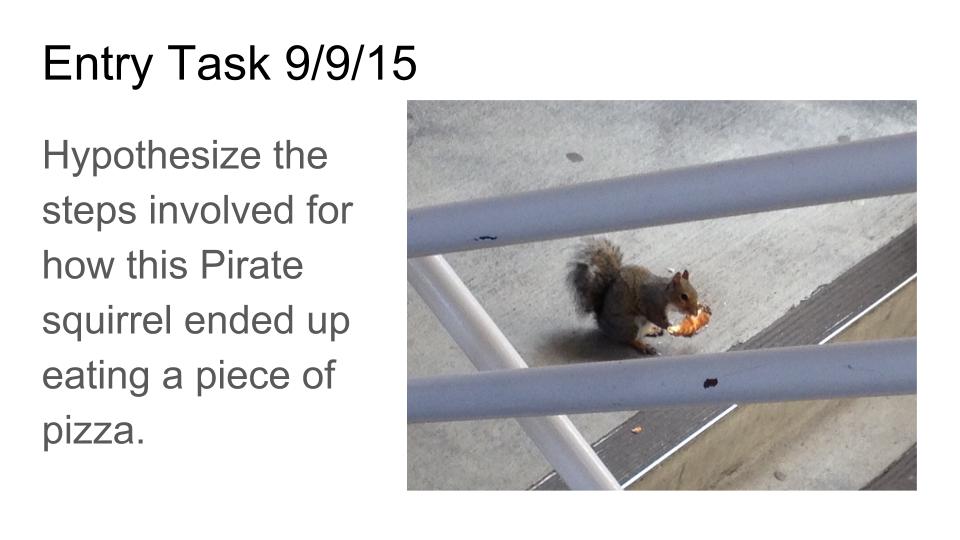
The students then transformed their short stories into network diagrams by identifying the key objects in the story and drawing them as nodes (words inside ovals), then connecting the nodes with edges (lines or arrows describing a relationship between the nodes being connected). We shared out a few stories with the class, creating network diagrams of the student stories. After completing the PBIS lesson for the day, we returned to drawing networks – this time, social networks. Students were tasked with meeting all of the other students in class, identifying one thing in common, and writing the relationship as a network diagram. We will use the network diagrams tomorrow for our social network activity.
Vocabulary:
- System – a collection of nodes and edges
- Node – the objects in a system
- Edge – the relationship between nodes
- Network – a diagram of a system
Students who enjoyed the data collection activity today might want to check out Aaron Kobelin’s TED Talk:
Cells & Homeostasis: Lab Safety
We began class with a TED Talk by Suzanne Lee, the designer we read about last Friday who is using bacteria to grow clothing.
For their entry task, students were asked to write at least four sentences answering: In the future, what would you choose to grow? Why? We practiced A/B structured partner talk and followed that with a class share-out.
After a brief class discussion, we worked through the PBIS lesson for the day, with each class period sharing thoughts about how the Pirate Way looks in the classroom. The 5 Pirate Way values are Positive, Respect, Responsibility, Engaged, and Persistent. After a brief A/B structured partner talk, students provided the following examples of the values in action:
Positive (Period 2)
- Stay focused
- Turn in work
- Turn in work on time
- Assume positive intent
- Help each other
Respect (Period 3)
- No running around
- Listen when others are talking
- Keep hands to yourself
- Assume best intent
- Practice active listening
Responsibility (Period 4)
- Turning in your work
- Arrive in class on time
- Complete your homework
- Bring materials to class and use them appropriately
- Pay attention
- Stay on task
- Knowing what’s going on
Engaged (Period 5)
- Actively participating
- Paying attention
- Active listening
- Staying on task
- Staying focused
We wrapped up with a review of the syllabus (handed out last week), the safety contract (students learned where the equipment is located and should return the signed form tomorrow), and a video about how to use a fire extinguisher:
A few classes finished a bit early and were treated to a video about Algae Girl:
Matter, Atomic Structure, and Bonding: Lab Equipment and Safety
Daily Objectives:
- What: Learn about the tools chemists use
- How: 1. Locate classroom safety equipment and 2. Identify common chemistry equipment
- Why: Pirates practice safe science
Continuing on Friday’s theme of lab safety, we began class with the Lesson 1 worksheet and students worked through Part 1 as the entry task. During that time, I took attendance and used the seating chart feature of Illuminate to create a seating chart for the purpose of quickly learning student names. Next, students watched a quick video showing how to properly use a fire extinguisher:
We then participated in the first day of PBIS lessons (Pirate Hooks!) before launching in to Part 2 of the worksheet. The instructions were modified to fit the realities of our classroom. Because we have storage rooms for equipment and supplies, all of the items in lists A-H were pre-scavenged and arranged in stations around the classroom. Working in groups of four students, groups rotated through four of the eight stations. One student was tasked with taking pictures of each piece of equipment, and each of the four students in the group was responsible for reading the description card and summarizing it for one of the four pieces of equipment at a station. The group will then work together to collate all of the pictures and descriptions into a PowerPoint (or similar) presentation which they must then email me by Friday for credit. At the end of class, students received their textbook to take home and were instructed to cover it as part of their homework.
Tomorrow we will continue the PBIS lesson (the Pirate Way at assemblies, sporting events, and the library) and we will complete the Lesson 1 classroom activity.
Homework:
- Cover textbook (a paper bag cut and taped around the cover works great!)
- Read chapter 1 (pages 1-5)
- Complete the questions on page 5 (#1-8, due Thursday)
- Complete the PowerPoint as a group (email to me by Friday)
- Include the initials of the student who wrote the summary for each piece of equipment
- When emailing the PowerPoint, include the first and last names of each group member as text in the body of the email.
- Turn in a signed copy of the class syllabus and safety contract
- Turn in the student questionnaire
Cells & Homeostasis: Lab-Grown Clothing
We started class with a YouTube clip of Jimmy Fallon and Kevin Delaney releasing energy in candy, making elephant toothpaste, and using smoke to visual air bursts coming from an air cannon:
Next, students completed a questionnaire to better introduce themselves and to provide me with data for the WABS Teacher Externship program I am participating in this year. Students turned in the completed questionnaire, along with the signed syllabus. They also received a folder, wrote their name on it, and placed it in the file cabinet. The folder will help students stay organized throughout the school year and provides students with ready-made organizational strategy for keeping track of classwork. We finished the day with a “popcorn-style” class reading, where each student read a paragraph of an article and then got to pick the next reader. We read an article about lab-grown clothing, where scientist Suzanne Lee is using bacteria to create fabric.
Find out more by watching Suzanne Lee’s TED Talk:
Matter, Atomic Structure, and Bonding: Lab Safety
The theme of the day was lab safety. We started class with a YouTube clip of Jimmy Fallon and Kevin Delaney releasing energy in candy, making elephant toothpaste, and using smoke to visual air bursts coming from an air cannon:
The video naturally led into a talk of lab safety, and students received a Safety Contract to read through. They learned the location of key safety equipment in the classroom and will need to bring the contract back (signed by the student and a parent/guardian) on Tuesday. Next, students completed a questionnaire to better introduce themselves and to provide me with data for the WABS Teacher Externship program I am participating in this year. Students turned in the completed questionnaire, along with the signed syllabus. They also received a folder, wrote their name on it, and placed it in the file cabinet. The folder will help students stay organized throughout the school year and provides students with ready-made organizational strategy for keeping track of classwork. Finally, students had the last few minutes of class to browse through our brand-new chemistry textbook.
We are planning to start our first chemistry lesson on Tuesday, so students need to be sure they have the Safety Contract signed and returned then. Have a wonderful 3-day weekend!
 Science with Swart
You must be logged in to post a comment.