Cells & Homeostasis: Egg Lab Data Day 1

We began the class period with students extending their Egg Lab procedures to include the steps for today.  We discussed how students would repeat the egg washing process, after which they would measure the mass of their eggs.  Eggs were placed in tap water overnight, and tomorrow they will be transferred to various liquids to determine how the eggs will interact with a new environment.

Once all of the eggs were measured and the data were recorded in student lab notebooks, students shared out their starting mass (measured on Friday when the eggs still had their shells) and their “after vinegar” mass.  We entered the data into a spreadsheet and then students calculated the starting and ending averages.  They checked their math against the averages calculated using the spreadsheet program (Google Sheets) as a calculator.  The data is provided below by class period, with student names redacted:

Period 2:

Student Starting Mass (g) – 9/18 After Vinegar Mass (g) – 9/22
#1 63.7 103.8
#2 63.9 107.0
#3 64.6 103.0
#4 66.4 99.2
#5 67.0 107.0
#6 67.7 99.7
#7 63.0 103.5
#8 61.2 97.1
#9 66.9 108.2
#10 63.6 98.4
#11 56.8 87.5
#12 61.3 92.0
#13 66.9 103.8
#14 67.6 107.2
#15 62.9 97.9
#16 62.2 67.4
% change
Average (g) 64.1 98.9 154.3%

Period 3:

Student Starting Mass (g) – 9/18 After Vinegar Mass (g) – 9/22
Student #1 65.5 104.0
Student #2 65.2 98.1
Student #3 64.3 94.6
Student #4 63.8 95.5
Student #5 64.6 98.2
Student #6 65.8 100.7
Student #7 64.6 106.4
Student #8 66.0 105.6
Student #9 64.5 104.3
Student #10 62.0 95.8
Student #11 67.3 108.0
Student #12 65.7 101.2
Student #13 66.4 106.8
Student #14 65.9 98.2
Student #15 62.9 95.1
Student #16 65.6 94.2
Student #17 63.3 101.2
Student #18 66.0 103.2
Student #19 67.0 105.4
Student #20 67.2 71.9
Student #21 63.0 95.5
Student #22 65.9 107.1
Student #23 62.4 97.3
% change
Average (g) 65.0 99.5 153.1%

Period 4:

Student Starting Mass (g) – 9/18 After Vinegar Mass (g) – 9/22
Student #1 57.0 85.4
Student #2 69.1 111.0
Student #3 66.7 99.8
Student #4 64.7 99.8
Student #5 64.1 96.1
Student #6 54.8 87.1
Student #7 61.8 94.1
Student #8 60.4 95.9
Student #9 67.6 105.1
Student #10 57.4 92.0
Student #11 67.9 93.4
Student #12 65.7 109.7
Student #13 67.1 103.0
Student #14 64.0 101.0
Student #15 58.1 90.0
Student #16 65.6 100.1
Student #17 67.2 106.1
Student #18 65.3 104.6
Student #19 60.8 91.6
% change
Average (g) 63.4 98.2 154.8%

Period 5:

Student Starting Mass (g) – 9/18 After Vinegar Mass (g) – 9/22
Student #1 66.4 105.7
Student #2 63.5 93.8
Student #3 61 92.1
Student #4 63.3 98.7
Student #5 65.1 98.9
Student #6 61 91.1
Student #7 64.3 104
Student #8 60.2 95.1
Student #9 59.6 93.1
Student #10 55.7 82.5
Student #11 58.8 87.5
Student #12 60.3 95.1
Student #13 59.4 98.3
Student #14 62 95.5
Student #15 58.5 87.8
Student #16 58.1 85
Student #17 68.8 106.2
Student #18 58.4 95.8
Student #19 58.3 96.1
Student #20 59.1 88.9
Student #21 66 91.3
Student #22 68.3 100.8
Student #23 66 105.3
% change
Average (g) 61.8 95.2 153.9%

Matter, Atomic Structure, and Bonding: The Copper Cycle

We began class by assembling a list of the elements and compounds observed yesterday:

Vial Name Chemical Formula Description
1 Aluminum Al silver pebbles
2 Silicon Si shiny dark silver jagged rocks
3 Zinc Zn bluish-grey with patina
4 Sulfur Si yellow shards, rotten egg smell
5 Zinc Zn corroded
6 Zinc Zn silver frosted corn flakes
7 Sodium Chloride NaCl clear liquid
8 Trisodium Phosphate Na3PO4 clear liquid
9 Sodium Nitrate NaNO3 clear liquid
10 Sodium Fluoride NaF clear liquid
11 Aluminum Chloride AlCl3 misty blue liquid
12 Copper Chloride CuCl2 transparent blue
13 Copper Cu copper colored beads
14 Calcium Sulfate CaSO4 white powder
15 Magnesium carbonate MgCO3 Baking powder (creamy white)
16 Vinegar (acetic acid) C2H4O2 Sour smell, clear liquid
17 Calcium Carbonate CaCO3 Large greyish-white rough rocks
18 Calcium Chloride CaCl2 Compressed white pellets, dusty

Note: The numbers in the chemical formulas should be written as subscripts.

After the review, students received the Lesson 7 worksheet, the copper cycle experimental steps handout, and the Lesson 8 worksheet.  We decided to skip the lesson 7 worksheet because we do not currently have access to reliable fume hoods (required for the copper cycle lab) and because the lesson 8 worksheet includes students responses from the lesson 7 worksheet.  After reviewing the content in the Lesson 7 PowerPoint, we watched two versions of the Copper Cycle Lab on YouTube (below):

Students should read through Lessons 7 and 8 in the textbook and complete the questions at the end of the lessons, and be prepared to ask questions about the content in class tomorrow.

Matter, Atomic Structure, and Bonding: Chemical Names and Symbols

We began the week with Lesson 6, the first lesson Chapter 2.  Students were introduced to the language of chemistry, learning how chemical formulas for compounds are written as collections of elements.  The Lesson 6 PowerPoint defines several important vocabulary terms and prepared students for the lab activity (Lesson 6 worksheet).  For the lab, there 18 different solid and liquid elements and compounds for students to observe (different from those pre-filled on the worksheet).  The observations consumed the remainder of the class period, and students were asked to read Lesson 6 in the textbook in preparation for completing the lesson tomorrow during class.

Cells & Homeostasis: Egg Lab Procedure Writing

Class began with students receiving their graded quizzes from Friday.  We reviewed the correct responses and students learned that their lowest quiz score will be dropped each quarter.  Make-up quizzes are not available, so student attendance on Fridays is very important.  Students also learned about the weekly extra credit opportunity: read a scientific article (available in the classroom magazine collection or online) and write a paragraph explaining what was learned.  The article must be related to the content covered in the most recent quiz, and the paragraph must be turned in prior to the next quiz in order to qualify for five extra credit points.

After the quiz review, we turned to the Egg Lab.  In their lab notebooks, students wrote the steps of the procedure they followed on Friday to measure the starting mass of their eggs and immerse the eggs in vinegar to begin the process of dissolving the eggshell.  Next, students made visual observations of their eggs before putting on gloves and handling their eggs while rinsing them.  Eggs were then placed back in the cups with fresh vinegar, recovered with plastic wrap, and returned to the fume hood for another day.  Students were encouraged to bring a school-appropriate liquid tomorrow as we continue our study of how cells interact with their environment by moving molecules across the cell membrane.

Egg Lab Procedure:

  1. Write name and class period on a cup with a Sharpie.
  2. Measure the mass of one egg with a scale while wearing gloves.  This is the starting mass in grams.
  3. Place the egg in the cup and record the starting mass on the cup.
  4. Pour vinegar over the egg until it is completely covered.
  5. Cover the cup in plastic wrap.
  6. Place the cup inside a fume hood for three days.
  7. Wearing gloves, observe the egg and record observations.
  8. Gently pour vinegar solution into sink, carefully catching egg.
  9. Rinse egg and cup gently with room temperature tap water.
  10. Return egg to cup and repeat steps 4-5.
  11. Place the cup inside a fume hood for one more day.

Cells & Homeostasis: Cell Organelles Quiz

We wrapped up our week of studying cells and their organelles with a quiz.  After the quiz, students received their egg for the egg lab.  The wrote their name, class period, and starting mass (in grams) of their egg on a plastic cup, filled the cup with enough vinegar to cover the egg, and then wrapped plastic wrap over the cup to help seal in the vinegar.  The egg shells quickly began to bubble as the vinegar began dissolving the shells.  We will observe the eggs Monday and continue the egg lab then.  Time permitting, students were treated to another Jimmy Fallon video featuring Kevin Delaney:

Matter, Atomic Structure, and Bonding: Density

Busy day today!  Because of the fire drill yesterday, students used the first few minutes of class to collect data for the lab portion of the Lesson 4 worksheet.  They then finished the worksheet and answered the Lesson 4 questions (#1-11) from page 16 of the textbook.  Finally, students were assigned the Lesson 5 worksheet and questions #1-7 on page 20 of the textbook (we did not cover the Lesson 5 PowerPoint but the content is covered in the textbook).  In preparation for the Chapter 1 quiz tomorrow, students are encouraged to review questions #1-6 on page 21 of the textbook and to work through the Chapter 1 practice quiz.

Matter, Atomic Structure, and Bonding: Mass and Volume

We began class with a brief review of key vocabulary and concepts introduced in Lesson 3 (matter and energy) and then moved on to the Lesson 4 PowerPoint.  Students reviewed the concepts of mass and volume and then received the Lesson 4 worksheet and a reminder that tonight’s homework includes reading Lesson 4 and answering questions 1-11 on page 16 of the textbook.  Students were then provided with the remainder of the class period to complete the lab outlined in the Lesson 4 worksheet.  Unfortunately, the class period concluded abruptly with our first practice fire drill of the school year.  We will complete the lab at the beginning of class tomorrow.  Thanks again for doing such a fantastic job evacuating the building for the fire drill and for behaving appropriately while waiting for the all-clear.  I continue to be extraordinarily impressed with the level of maturity and leadership my chemistry students exhibit on a daily basis.

Cells & Homeostasis: Cell Organelle Networks

Students received their quizzes from last Friday and we reviewed how to analyze network diagrams.  Students learned that when analyzing an edge between two nodes, the arrow of the edge points to the receiving node.  For example, of Student A calls Student B, the students would be nodes, and the edge would start at Student A and point toward Student B.

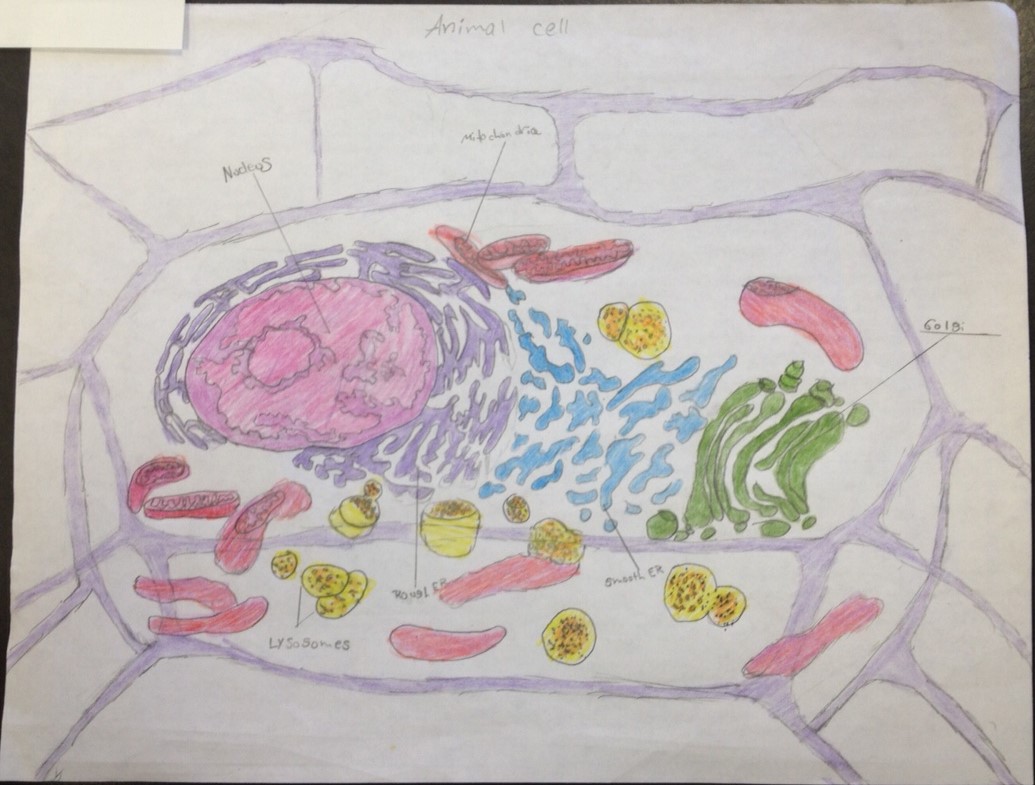
Next, students had time to complete and/or review their organelle flash cards from yesterday.  Students were told yesterday that the flash cards were due today, but with the Illuminate website down for much of the day, students received an extra day to complete the flash cards with the expectation that Illuminate is back up reliably tomorrow.  Students then worked in small groups of 3-4 and were assigned to draw either a plant cell or an animal cell.  First, the drawing must include all of the organelles found in the assigned cell type.  Second, students must research interactions between the organelles.  Finally, students will use their drawing to construct a network diagram, with each organelle serving as a node, and the relationships between the organelles serving as the edges.  Each node must have at least one edge originating from it.  Students were permitted to use all available resources, including the class textbook, the purple book (Inside the Cell), and scientifically reliable websites accessed from their phones.  Students will have the class period tomorrow to complete the project and Chromebooks will be available.  Students are encouraged to research relationships between the organelles as homework this evening.

Student Work Examples:

Plant Cell Organelle Network Diagram
Animal Cell Organelle Network Diagram
Animal Cell with Organelles

Cells & Homeostasis: Organelle Flash Cards

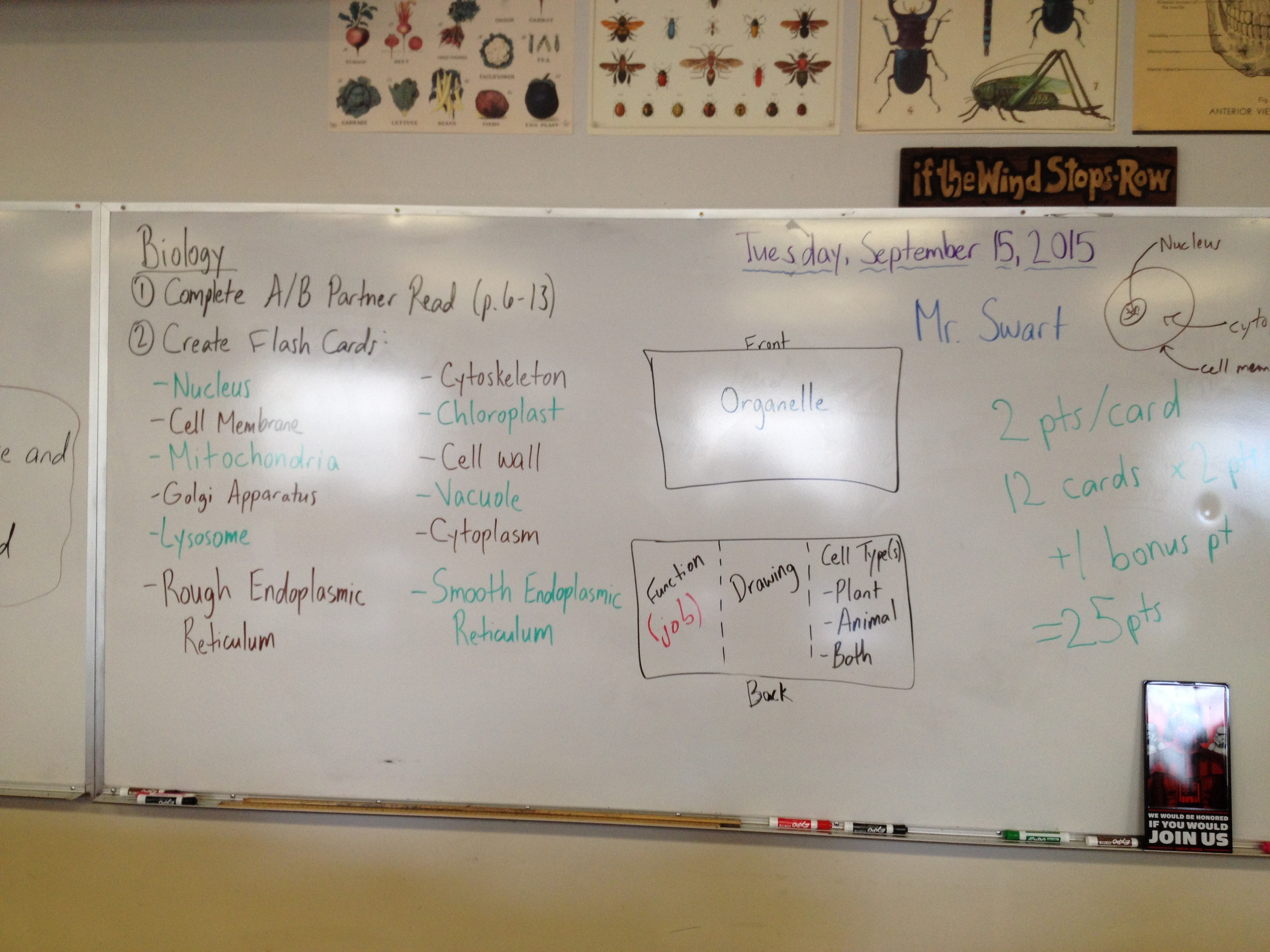
Students had two major tasks today:

  1. Complete the reading from yesterday (pages 6-13 from Inside the Cell), complete with summaries of each section written in the lab notebook for each student.
  2. Create flash cards as shown in the picture below:

organelles

A complete set of 12 flash cards for each student are due at the beginning of class tomorrow (one card for each of the 12 organelles).  Students should use their textbook if they have one at home, the online version of Inside the Cell, and any other scientifically valid resources.  The National Science Foundation has an excellent interactive resource called A Tour of the Cell that students might find useful.