Category Archives: Nature of Science

Testable Experimental Variables

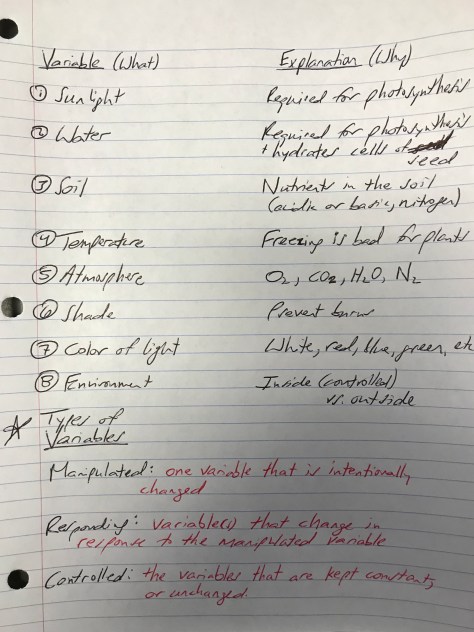
To extend our study of ecology, we will invest the next two weeks reviewing the scientific process through the lens of plant biology.  Our work today will involve identifying testable experimental variables associated with plant seed germination. Tomorrow, students will establish baggie gardens in order to test whether their selected variable impacts seed germination and/or seedling growth.  Our collective data will enable us to make detailed scientific observations and conclusions about factors affecting seed germination, seedling growth, and photosynthesis.  Along the way, students will practice the art of inquiry by:

  • identifying variables (manipulated, responding, and controlled)
  • writing hypothesis statements (using the if…then…because… format)
  • writing a detailed experimental procedure (incorporating the concepts of validity, reliability, repeated trials, and experimental control conditions)
  • recording, organizing, and analyzing detailed observations
  • writing a conclusion statement

Students will be expected to produce a typed lab report which includes a data table and a graph of the data.

Notes from class today:
IMG_1835

Limits of Science

To conclude our mini unit on bioethics and the nature of science, students worked through the Limits of Science work packet.  During the class period, students received 1:1 help from the teacher to facilitate learning and to ensure students were aware of which pieces of work needed to be turned in.  As a reminder, we will be meeting in the PAC to start class tomorrow where we will quickly take attendance (please sit together as a class!) and then the guest speakers will share their experiences.

Nature of Science: Unit 1 Wrap-Up

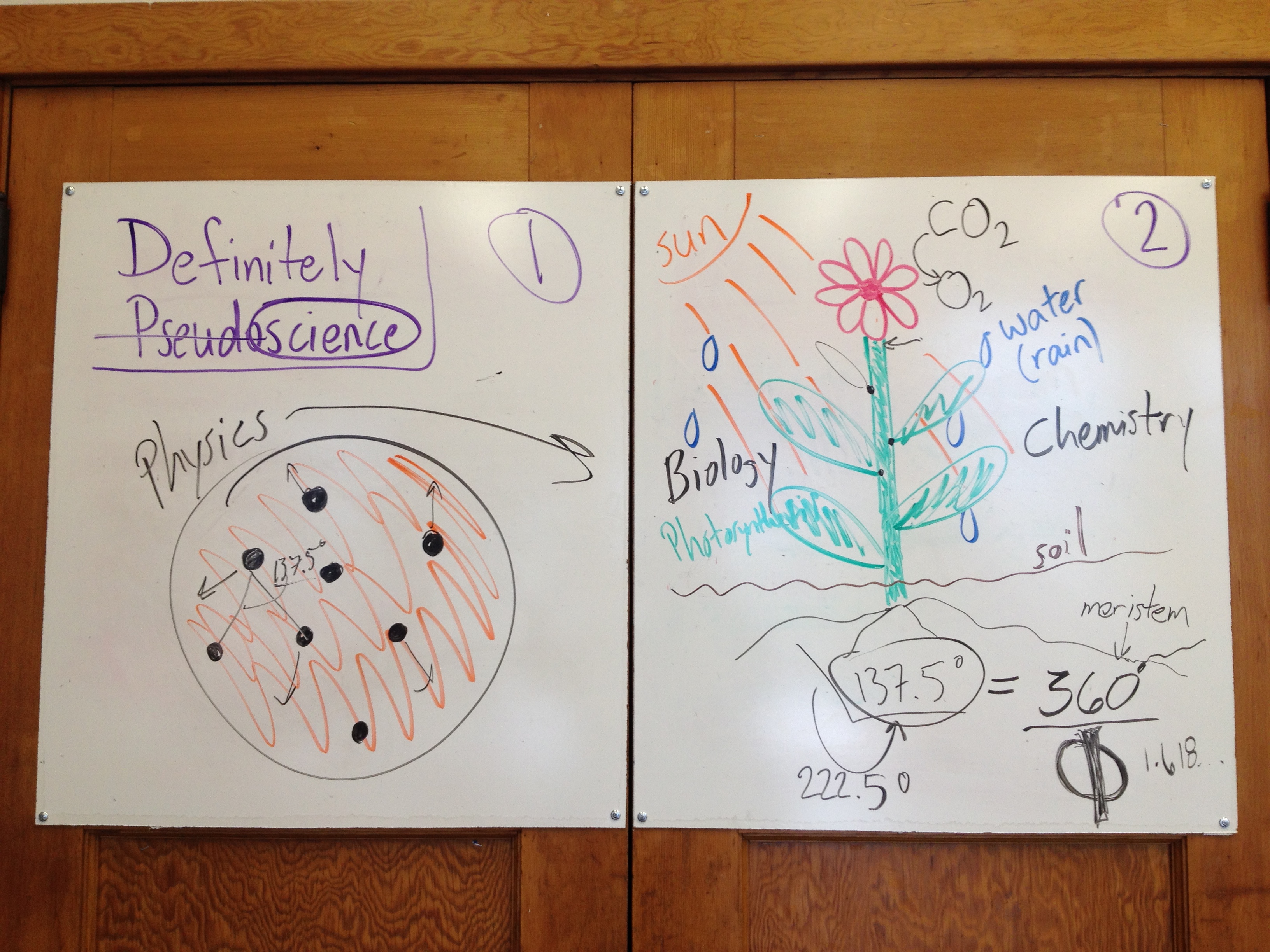
We brought Unit 1 to a close by revisiting the Golden Ratio.  Students were introduced to the concept of “respectful scientific discourse” and practiced sharing their thoughts about whether the Golden Ratio should be considered science or pseudoscience.  Students practiced discourse in groups of 4 multiple times throughout the period.  Between group discussions, we revisited the Golden Ratio.  Students re-watched a segment of the first video (below) and we discussed the effect of the video production (music, narration, images) on their perception of the Golden Ratio as science or pseudoscience.  Students were reminded of the Bill Nye video we watched where they learned that practitioners of pseudoscience often play on our senses and our emotions to try and earn our trust (and our money!).  We then watched a video by Hank Green (SciShow), where the Golden Ratio is presented in a style that might be seen as more credible than the first video.  We concluded the lesson either by watching video segments by Vi Hart (see the September 21 post), or more comprehensibly for the students, through an artistic representation  by the teacher, of how the Golden Ratio manifests in plant growth through the actions of hormones.  As our understanding of plant hormones and genetics grows, it would appear the Golden Ratio is in fact firmly grounded in science, as least with respect to plants.

Video 1

Video 2

Final Model – Teacher Drawing

artistic representation

Nature of Science: Milk Lab Analysis

We concluded the Milk Lab with an analysis of the summaries prepared by my five classes on Day 2 of the Milk Lab.  Students worked in groups of 4 and analyzed the consistency (and inconsistency) of results reported in 5 summary tables.  By working in teams and analyzing results from similar experiments performed by students in other classes, we simulated a scenario scientists practice routinely when evaluating how their own results compare with what is reported in the scientific literature.  We then discussed the results of the analysis in the context of the Milk Lab Explanation document.  We ended class with a quick unit conversion problem.  We worked through the question: how many seconds are in one day?  The answer:

24 hours / 1 day x 60 minutes / 1 hour x 60 second / 1 minute = 86,400 seconds / day

Nature of Science: Number Series in Nature

The plan this week is to wrap up Unit 1: Nature of Science, and transition to Unit 2: Ecology and Systems Biology.  We began Unit 1 with the Milk Lab, and tomorrow we will take some time to revisit the results observed across my 5 classes.  Students will work in small groups to devise strategies to organize the results.  Students will also receive an explanation about why the food coloring swirled the way that it did after addition of soap to the various types of milk tested.  If time permits, we will also practice a few simple unit conversion math problems to help students develop the skills needed to complete the math worksheet from last Tuesday.

The reason for this weekend post is actually to give interested students a chance to preview a few videos before Tuesday.  In that lesson, we will practice “respectful scientific discourse” in the context of a class debate around the Golden Ratio.  Students learned about the Golden Ratio from a video we watched in class, and in lessons the following two days, we watched additional videos which presented the concept of pseudoscience.  The sequencing of these lessons was intentional, and many students seem to agree that the Golden Ratio can be viewed as pseudoscience.  On Tuesday, students will watch another video that explains the Golden Ratio in a different light.  In the video, the presenter refers viewers to a series of videos by Vi Hart.  I strongly encourage students to take the time to watch these videos.  She speaks quickly, but the content is fascinating and just might make you question your position on the Golden Ratio.

Nature of Science: Meters, Liters, and Grams!

Our entry task for the day was to watch The Inner Life of a Cell (below), a video created by the Harvard University group BioVisions.  The video perfectly complemented the reading students did yesterday, bringing to life the processes that occur inside and outside the cells in our bodies.  After the video, we discussed the scale of cells, with students learning that white blood cells are only 6-8 μm in diameter (one micrometer (μm) is equal to one-millionth of a meter).  We then created class lists of tools scientists use.  Each class added to a growing list, and tomorrow we will categorize our large list.  We concluded with a worksheet where students practiced making calculations using metric units.  The base units were introduced through the artistic talents of teacher Pete Hendley (actually, his alter ego KILA META) in his amazing rap video, “Meters, Liters, and Grams.”  Be warned – it will stay with you 😉

UPDATE: Students may skip worksheet questions 10-13.  My attempts to show the math steps actually made the work more confusing for most students.  Please work through problems 1-20 as homework, skipping 10-13.

http://www.youtube.com/watch?v=B_zD3NxSsD8

Nature of Science: An Owner’s Guide to the Cell

As previously mentioned in class, all of the science teachers at school will be off-site at a meeting on Monday, so we will have a substitute.  Students should turn in all work assigned from the previous week at the beginning of class.  Late work may be turned in by the start of class Tuesday for 50% credit.  For Monday, students will be reading a chapter from the purple book titled, “Inside the Cell” which is located in the upper middle cabinet.  We have a limited number of copies, so please treat the book with care and do not take the book out of the classroom.   Students should read the Preface and Chapter 1 (pages 4-19).  After each section, students should briefly share their understanding of the section with their table partner, then write a brief summary of the discussion in their lab notebooks before moving on to the next section.  Students should also complete the Got It? questions on page 19 in their lab notebooks and they may discuss their responses with their table partner.

Students who finish early should log in to one of the class computers and explore the website  A Tour of the Cell, taking notes in their lab notebook.  Alternatively, students may also browse the Scientific American journals (in the cabinet to the left of the Inside the Cell books) and write a brief summary of something they learned – preferably related to ecosystems and ecology.  Have a wonderful day!

Nature of Science: Baloney Detection Kit

With only 35 minutes of class time today, we had just enough time to take our first clicker quiz and then watch Michael Shermer’s video Baloney Detection Kit (below).  Students are asked to complete a worksheet briefly describing each of the 10 points Dr. Shermer discusses and to apply their understanding to the Golden Ratio.  The worksheet is due at the beginning of class on Monday.  Because of all of the schedule changes this week, students will have until next Monday (9/15) to turn in the following work for full credit:

1. Signed syllabus and safety contract

2. Golden Ratio worksheet (p. 62)

3. Eyes of Nye Pseudoscience video worksheet

4. Baloney Detection Kit video worksheet

http://www.youtube.com/watch?v=eUB4j0n2UDU

Nature of Science: Pseudoscience

Today’s entry task asked students to draw their daily class schedule as a network diagram in their lab notebook.  Next, we practiced how to use the clickers for tomorrow’s clicker quiz.  We finished the day learning to differentiate between science and pseudoscience with the help of Bill Nye’s Eyes of Nye Pseudoscience video (watch below).  Students completed a worksheet with questions from the video and were asked to apply their understanding of pseudoscience to what they understand about the Golden Ratio.

http://www.youtube.com/watch?v=XP7MpY-WnSE