
Students used the school Chromebooks to begin typing up their Egg Lab lab reports. Special thanks to our substitute, Mr. Burke, and I look forward to seeing the work students accomplished when I return to class tomorrow.
Category Archives: Homeostasis
Cells & Homeostasis: Membrane Function
Every now and then we have to take a day of class to “sit and get” – a day of class where students learn and review important science concepts designed to help them make sense of their lab observations and use science to explain what they saw. Today was one of those days. Students learned about how the cell membrane works, focusing on the concepts of osmosis and transport. Students should review the Membrane Functions PowerPoint slide deck and commit the vocabulary terms to memory. The aquaporin claymation video included in the slide deck is also provided below for easy access:
Cells & Homeostasis: Egg Lab Data Day 4
We concluded the Egg Lab with one final day of data collection. After students turned in the quiz they received yesterday, they had the opportunity to measure the mass of their egg one last time before making final observations. Some students elected to boil their egg, others dissected their egg, and some did both. Students noticed how some of the liquids turned the egg membrane a certain color, taking on the color of the liquid the egg had been in. Others noticed the cytoplasm also turned the same color as the membrane. Some students found the consistency of the egg cytoplasm to be very watery, while others had a more viscous consistency. Brave students also smelled the inside of their dissected eggs, finding them to smell like vinegar and perhaps also like the liquid they tested their egg in (chocolate milk and vinegar had a particularly memorable smell). These observations will enable students to update their models of membrane activity as we continue through the unit. Students were reminded to read pages 76-80 of the reading packet from Wednesday so that they are prepared to learn about the scientific concepts behind cell membrane activity on Monday. Students will also share out their final egg mass on Monday, and the class data will be posted then for analysis. Students will apply their learning from the lab, the reading, and our classroom discussions, as well as their analysis of the lab data to a lab report they will write next week.
Cells & Homeostasis: Egg Lab Data Day 3
On this third day of data collection for the egg lab, students observed their eggs after 24 hours in the liquid they chose yesterday. Students once again gently rinsed their eggs and cups, then measured and recorded the mass. The eggs were placed back in the cups and then filled with tap water for one final day. Students shared out their egg mass data and we began crafting a model to help fit their observations. We focused on the eggs in corn syrup (they shriveled) and in distilled water (several popped), with students beginning to reason through what may have entered and left the egg across the cell membrane. We concluded with students receiving the Friday quiz to work on as homework and to help them focus their reading from the packet that went home yesterday. Students who complete the quiz as homework will have the opportunity to boil their egg in class tomorrow and observe the process of an egg boiling without a shell.
Cells & Homeostasis: Egg Lab Data Day 2
Class began with a brief review of where we left off yesterday with the Egg Lab, followed by students writing today’s steps of the experimental procedure. After being checked off for having written out the steps, students put on gloves and carefully rinsed their eggs and cups. They took the mass of their eggs (the “after water – 9/23” mass) and recorded it in their lab notebooks. Finally, they chose one of the offered liquids (distilled water, 30% salt water, 50% corn syrup, 10% dish soap, or canola oil) or used a student-supplied school-appropriate liquid. Liquid was added to the cup (enough to cover the egg) and the cups were scattered around the room for observation.
After adding the liquid, students shared out their egg mass data along with their selected liquid. The data were collated and will be available as an Excel file for analysis on Friday. The students then toured the room, making observations about the eggs after they had been in liquid for 15-20 minutes. During the last few minutes of class, students began thinking about how they would draw a model to represent the movement of matter across the cell membrane. Students also received a reading packet and are responsible for reading pages 76-80 before the quiz on Friday. Students were encouraged to look through the reading this evening and to come to class prepared with questions to discuss during class tomorrow.
Cells & Homeostasis: Egg Lab Data Day 1
We began the class period with students extending their Egg Lab procedures to include the steps for today. We discussed how students would repeat the egg washing process, after which they would measure the mass of their eggs. Eggs were placed in tap water overnight, and tomorrow they will be transferred to various liquids to determine how the eggs will interact with a new environment.
Once all of the eggs were measured and the data were recorded in student lab notebooks, students shared out their starting mass (measured on Friday when the eggs still had their shells) and their “after vinegar” mass. We entered the data into a spreadsheet and then students calculated the starting and ending averages. They checked their math against the averages calculated using the spreadsheet program (Google Sheets) as a calculator. The data is provided below by class period, with student names redacted:
Period 2:
| Student | Starting Mass (g) – 9/18 | After Vinegar Mass (g) – 9/22 | |
| #1 | 63.7 | 103.8 | |
| #2 | 63.9 | 107.0 | |
| #3 | 64.6 | 103.0 | |
| #4 | 66.4 | 99.2 | |
| #5 | 67.0 | 107.0 | |
| #6 | 67.7 | 99.7 | |
| #7 | 63.0 | 103.5 | |
| #8 | 61.2 | 97.1 | |
| #9 | 66.9 | 108.2 | |
| #10 | 63.6 | 98.4 | |
| #11 | 56.8 | 87.5 | |
| #12 | 61.3 | 92.0 | |
| #13 | 66.9 | 103.8 | |
| #14 | 67.6 | 107.2 | |
| #15 | 62.9 | 97.9 | |
| #16 | 62.2 | 67.4 | |
| % change | |||
| Average (g) | 64.1 | 98.9 | 154.3% |
Period 3:
| Student | Starting Mass (g) – 9/18 | After Vinegar Mass (g) – 9/22 | |
| Student #1 | 65.5 | 104.0 | |
| Student #2 | 65.2 | 98.1 | |
| Student #3 | 64.3 | 94.6 | |
| Student #4 | 63.8 | 95.5 | |
| Student #5 | 64.6 | 98.2 | |
| Student #6 | 65.8 | 100.7 | |
| Student #7 | 64.6 | 106.4 | |
| Student #8 | 66.0 | 105.6 | |
| Student #9 | 64.5 | 104.3 | |
| Student #10 | 62.0 | 95.8 | |
| Student #11 | 67.3 | 108.0 | |
| Student #12 | 65.7 | 101.2 | |
| Student #13 | 66.4 | 106.8 | |
| Student #14 | 65.9 | 98.2 | |
| Student #15 | 62.9 | 95.1 | |
| Student #16 | 65.6 | 94.2 | |
| Student #17 | 63.3 | 101.2 | |
| Student #18 | 66.0 | 103.2 | |
| Student #19 | 67.0 | 105.4 | |
| Student #20 | 67.2 | 71.9 | |
| Student #21 | 63.0 | 95.5 | |
| Student #22 | 65.9 | 107.1 | |
| Student #23 | 62.4 | 97.3 | |
| % change | |||
| Average (g) | 65.0 | 99.5 | 153.1% |
Period 4:
| Student | Starting Mass (g) – 9/18 | After Vinegar Mass (g) – 9/22 | |
| Student #1 | 57.0 | 85.4 | |
| Student #2 | 69.1 | 111.0 | |
| Student #3 | 66.7 | 99.8 | |
| Student #4 | 64.7 | 99.8 | |
| Student #5 | 64.1 | 96.1 | |
| Student #6 | 54.8 | 87.1 | |
| Student #7 | 61.8 | 94.1 | |
| Student #8 | 60.4 | 95.9 | |
| Student #9 | 67.6 | 105.1 | |
| Student #10 | 57.4 | 92.0 | |
| Student #11 | 67.9 | 93.4 | |
| Student #12 | 65.7 | 109.7 | |
| Student #13 | 67.1 | 103.0 | |
| Student #14 | 64.0 | 101.0 | |
| Student #15 | 58.1 | 90.0 | |
| Student #16 | 65.6 | 100.1 | |
| Student #17 | 67.2 | 106.1 | |
| Student #18 | 65.3 | 104.6 | |
| Student #19 | 60.8 | 91.6 | |
| % change | |||
| Average (g) | 63.4 | 98.2 | 154.8% |
Period 5:
| Student | Starting Mass (g) – 9/18 | After Vinegar Mass (g) – 9/22 | |
| Student #1 | 66.4 | 105.7 | |
| Student #2 | 63.5 | 93.8 | |
| Student #3 | 61 | 92.1 | |
| Student #4 | 63.3 | 98.7 | |
| Student #5 | 65.1 | 98.9 | |
| Student #6 | 61 | 91.1 | |
| Student #7 | 64.3 | 104 | |
| Student #8 | 60.2 | 95.1 | |
| Student #9 | 59.6 | 93.1 | |
| Student #10 | 55.7 | 82.5 | |
| Student #11 | 58.8 | 87.5 | |
| Student #12 | 60.3 | 95.1 | |
| Student #13 | 59.4 | 98.3 | |
| Student #14 | 62 | 95.5 | |
| Student #15 | 58.5 | 87.8 | |
| Student #16 | 58.1 | 85 | |
| Student #17 | 68.8 | 106.2 | |
| Student #18 | 58.4 | 95.8 | |
| Student #19 | 58.3 | 96.1 | |
| Student #20 | 59.1 | 88.9 | |
| Student #21 | 66 | 91.3 | |
| Student #22 | 68.3 | 100.8 | |
| Student #23 | 66 | 105.3 | |
| % change | |||
| Average (g) | 61.8 | 95.2 | 153.9% |
Cells & Homeostasis: Egg Lab Procedure Writing
Class began with students receiving their graded quizzes from Friday. We reviewed the correct responses and students learned that their lowest quiz score will be dropped each quarter. Make-up quizzes are not available, so student attendance on Fridays is very important. Students also learned about the weekly extra credit opportunity: read a scientific article (available in the classroom magazine collection or online) and write a paragraph explaining what was learned. The article must be related to the content covered in the most recent quiz, and the paragraph must be turned in prior to the next quiz in order to qualify for five extra credit points.
After the quiz review, we turned to the Egg Lab. In their lab notebooks, students wrote the steps of the procedure they followed on Friday to measure the starting mass of their eggs and immerse the eggs in vinegar to begin the process of dissolving the eggshell. Next, students made visual observations of their eggs before putting on gloves and handling their eggs while rinsing them. Eggs were then placed back in the cups with fresh vinegar, recovered with plastic wrap, and returned to the fume hood for another day. Students were encouraged to bring a school-appropriate liquid tomorrow as we continue our study of how cells interact with their environment by moving molecules across the cell membrane.
Egg Lab Procedure:
- Write name and class period on a cup with a Sharpie.
- Measure the mass of one egg with a scale while wearing gloves. This is the starting mass in grams.
- Place the egg in the cup and record the starting mass on the cup.
- Pour vinegar over the egg until it is completely covered.
- Cover the cup in plastic wrap.
- Place the cup inside a fume hood for three days.
- Wearing gloves, observe the egg and record observations.
- Gently pour vinegar solution into sink, carefully catching egg.
- Rinse egg and cup gently with room temperature tap water.
- Return egg to cup and repeat steps 4-5.
- Place the cup inside a fume hood for one more day.
Cells & Homeostasis: Cell Organelle Networks
Students received their quizzes from last Friday and we reviewed how to analyze network diagrams. Students learned that when analyzing an edge between two nodes, the arrow of the edge points to the receiving node. For example, of Student A calls Student B, the students would be nodes, and the edge would start at Student A and point toward Student B.
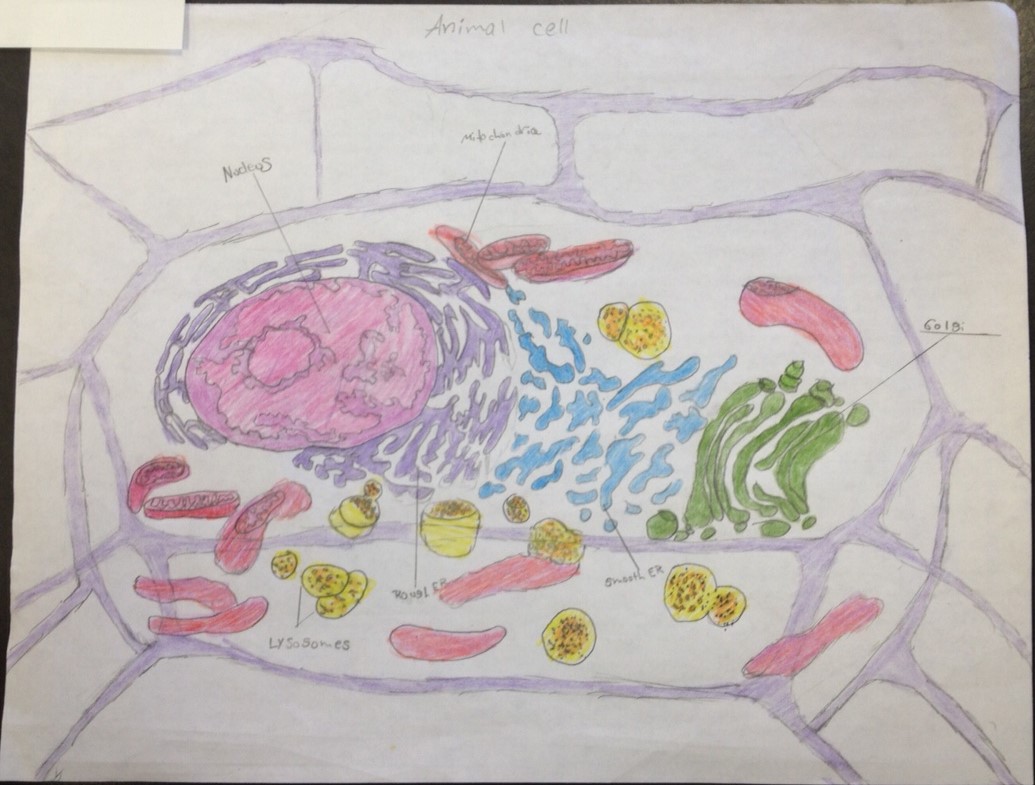
Next, students had time to complete and/or review their organelle flash cards from yesterday. Students were told yesterday that the flash cards were due today, but with the Illuminate website down for much of the day, students received an extra day to complete the flash cards with the expectation that Illuminate is back up reliably tomorrow. Students then worked in small groups of 3-4 and were assigned to draw either a plant cell or an animal cell. First, the drawing must include all of the organelles found in the assigned cell type. Second, students must research interactions between the organelles. Finally, students will use their drawing to construct a network diagram, with each organelle serving as a node, and the relationships between the organelles serving as the edges. Each node must have at least one edge originating from it. Students were permitted to use all available resources, including the class textbook, the purple book (Inside the Cell), and scientifically reliable websites accessed from their phones. Students will have the class period tomorrow to complete the project and Chromebooks will be available. Students are encouraged to research relationships between the organelles as homework this evening.
Student Work Examples:


Cells & Homeostasis: Lab Safety
We began class with a TED Talk by Suzanne Lee, the designer we read about last Friday who is using bacteria to grow clothing.
For their entry task, students were asked to write at least four sentences answering: In the future, what would you choose to grow? Why? We practiced A/B structured partner talk and followed that with a class share-out.
After a brief class discussion, we worked through the PBIS lesson for the day, with each class period sharing thoughts about how the Pirate Way looks in the classroom. The 5 Pirate Way values are Positive, Respect, Responsibility, Engaged, and Persistent. After a brief A/B structured partner talk, students provided the following examples of the values in action:
Positive (Period 2)
- Stay focused
- Turn in work
- Turn in work on time
- Assume positive intent
- Help each other
Respect (Period 3)
- No running around
- Listen when others are talking
- Keep hands to yourself
- Assume best intent
- Practice active listening
Responsibility (Period 4)
- Turning in your work
- Arrive in class on time
- Complete your homework
- Bring materials to class and use them appropriately
- Pay attention
- Stay on task
- Knowing what’s going on
Engaged (Period 5)
- Actively participating
- Paying attention
- Active listening
- Staying on task
- Staying focused
We wrapped up with a review of the syllabus (handed out last week), the safety contract (students learned where the equipment is located and should return the signed form tomorrow), and a video about how to use a fire extinguisher:
A few classes finished a bit early and were treated to a video about Algae Girl:
Cells & Homeostasis: Critter Diagram
Welcome back, Pirates! It was nice to meet so many new people today. With 20 minute periods, our accomplishments were limited to taking attendance, handing out the course syllabus, previewing the class website, and creating a critter diagram. The critter diagram helps students share a bit about themselves with me and also introduces them to a technique for organizing information. Next week, we will learn about systems and networks, and the critter diagram will provide students with a reference for discussing the concepts of nodes and edges in a network.
 Science with Swart
You must be logged in to post a comment.