Category Archives: Homeostasis

Energy, Matter, and Organization: Unit Review

We began class with a reminder that the semester ends next Thursday, January 28.  Students were informed that if they have a current grade of a C or better, they will be able to participate in an extra credit opportunity (the nervous system project) to be explained tomorrow.  Student projects will determine which groups are able to dissect sheep brains next week.  Students with a D or below will work in small groups with me this week to help them catch up.  Students who still have a D or below as of Tuesday next week will continue to catch up on required classwork and will not participate in the dissection lab.  There will be a Unit 2 Final Exam on Thursday (1/28).

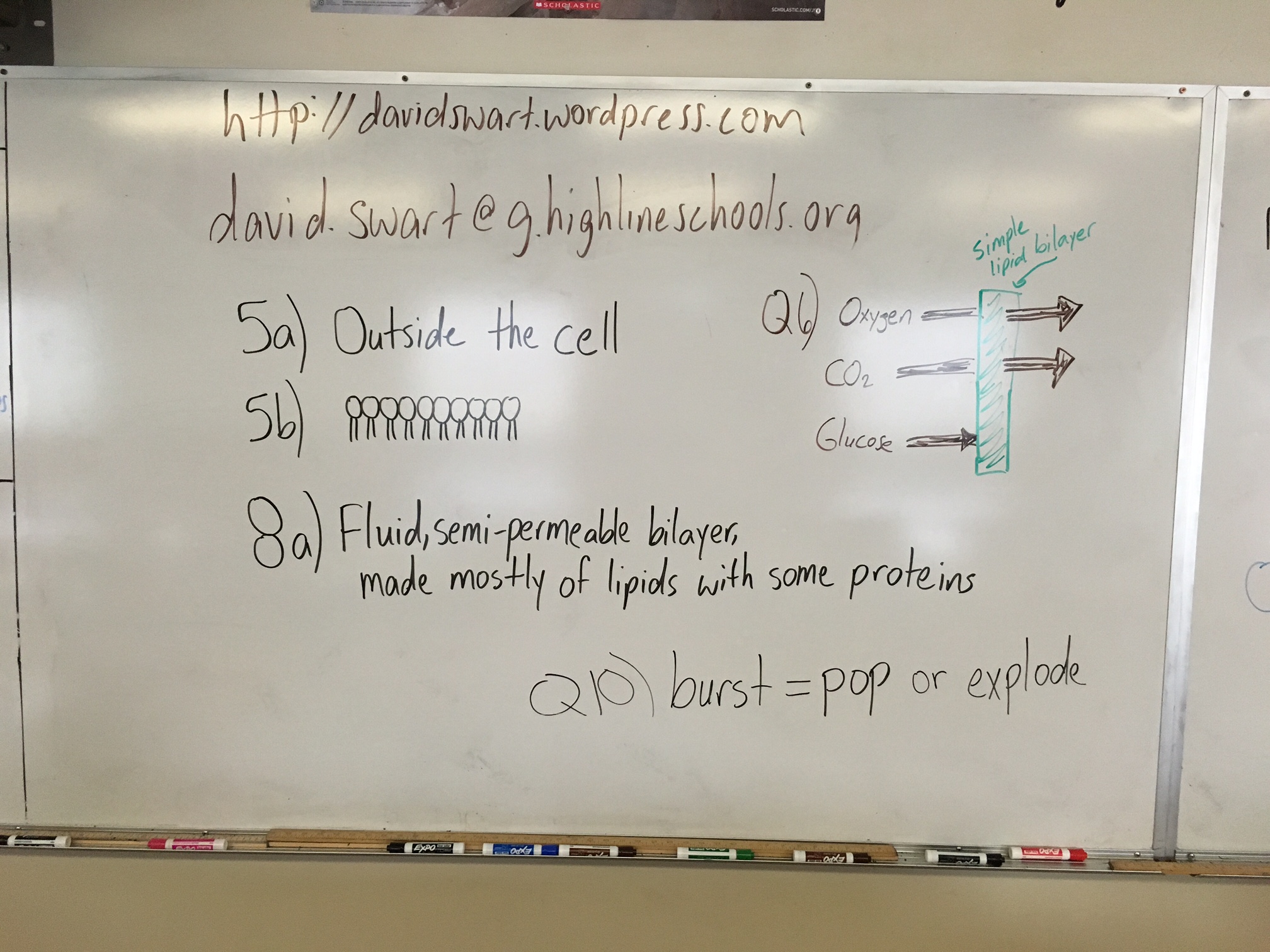
Students then had the next 20 minutes to complete the take-home quiz from Friday (only about 1/4 of students in all of my classes used the three-day weekend to complete the quiz).  After the quiz, we reviewed two of the more challenging questions, connecting the path that explains why excess fertilizer used by farmers near the Mississippi River ends up contributing to the dead zone in the Gulf of Mexico.  Links to pictures shown in class, as well as pictures of the white board notes are provided below.

Map of the Gulf of Mexico showing bordering states

Image of the dead zone (red = very little oxygen, blue = normal oxygen) in the Gulf of Mexico

Map of the United States highlighting the location of the Mississippi River (in red)

White Board Class Notes:

Energy, Matter, and Organization: Nutrient Cycling Quiz

To conclude the biogeochemical cycle poster project, students each reviewed two posters from groups other than their own.  The review consisted of a worksheet with one half containing key items that must be included on each poster for full credit (turned in for participation credit).   The lower half of the worksheet included feedback questions that were left with the posters and provided to the groups for feedback.  Students then received a take-home quiz consisting of an article about the 2015 Gulf of Mexico dead zone and a quiz with questions connecting the nitrogen, carbon, and water cycles with photosynthesis, cellular respiration, and algal blooms.  The quiz is due Monday.

Energy, Matter, and Organization: Organizing and Summarizing

We used our time in class today to organize and summarize learning thus far on Unit 2.  Students have had several assignments and many needed some additional time to complete their work.  The goal by the end of class was to identify all of the work from the unit, summarize the key findings into a narrative, and store the work in student folders that will be kept in the classroom.  The folders will serve as a portfolio and as an organizational tool.  They will also allow students to easily present their work on the current unit during the Student-Led Conferences scheduled for this evening (from 2:30-6:00) and tomorrow (from 4:00-7:30).  Tomorrow we will share out as a class and come up with a common narrative to help students retain our learning over the long 5-day Thanksgiving weekend.

Energy, Matter, and Organization: Feedback

We continued our learning from the Google Classroom by focusing on the last question in the worksheet that asked students to consider the effect of temperature on metabolism.  We watched the the “squirrel” segment (from 41:40 to 50:00 of the Can We Live Forever? video from NOVA scienceNOW).  Students then updated their answers to question 6 from yesterday’s worksheet.  The the last half of class, students worked in pairs to complete part 1 of the Keeping a Balance worksheet.  They reviewed homeostasis and negative feedback, applying their learning to the scenario of a car adjusting speed in an effort to maintain the set point speed (the speed limit speed of 55 mph).

Energy, Matter, and Organization: Why Can’t You Hold Your Breath Forever?

We are giving Google Classroom a try for the first time in Biology class.  After clicking the link, students should enter the class code written on the white board, which will grant them access to the “classroom” automatically in the future.  Once there, students should access the Biology classroom and select the “Why Can’t You Hold Your Breath Forever” assignment.  The assignment consists of four pages of reading from the textbook, followed by a Google Doc worksheet.  After “turning in” the worksheet, the remainder of the class period can be used to review the ocean acidification content linked to yesterday’s post.

Energy, Matter, and Organization: Connecting CO2 and pH with Exercise

We began class with a discussion of of the reading from yesterday.  The discussion focused on helping students understand how to read the questions, how to formulate a response, and the expectation of the quality and depth of thinking expected of a high school student of biology.  Notes from the white boards are pictured below:

After the discussion, students conducted an experiment designed to test the effect of exercise on the amount of carbon dioxide exhaled.  The experiment introduced students to the concept of cellular respiration (vocabulary they will learn soon) by studying the intersection of the cardiovascular and respiratory body systems.  Students measured pH as a surrogate measure of carbon dioxide output by exhaling into a straw placed in a cup of distilled water.  To measure pH, students used probeware connected to hand-held computers.  They measured the pH of the water before and after exercise, writing down their procedure and optimizing the procedure during the class period.  Students obtained data demonstrating a correlation between exhaled carbon dioxide and decreasing pH.

Students wishing to understand the chemistry behind our experiment should visit NOAA’s Ocean Acidification website.  The Smithsonian Institute also has an excellent collection of content explaining ocean acidification that includes some videos about how sea life is affected by increasing carbon dioxide in the atmosphere.

Energy, Matter, and Organization: Stepping Up the Pace

Last week, students were introduced to body systems.  They watched a video showing how the human body reacts under extreme conditions, and then researched body systems involved in the scenarios they saw in the video.  This week, we began with a reading from the class textbook.  The reading introduces students to the concept of homeostasis and feedback loops, while introducing those feedback loops in the context of specific body systems.  Students read page 177, and then pages 229-236, answering questions 2a-d on page 178.  Students finishing early also answered question 3, and then were challenged with searching for the mechanism behind the cycle they wrote about in question 2d.  The directions were also written on the white board and are shown below: