
For today’s lesson, students were tasked with their first reading assignment from our official Biology textbook. The assignment called for students to read The Breath of Life essay on pages 236-239 in the textbook. After reading each paragraph, students were instructed to write a short summary sentence about the main idea of the paragraph. Students needing additional time will be able to complete the assignment after the quiz tomorrow. Students who finished early were instructed to continue reading the next essay in the textbook. Credit will be given to students who complete the notes by the end of class tomorrow.
Category Archives: Energy
Exercise Lab
For the second day of our new unit, students began class by answering the following entry task:
In your lab notebook, explain why you can’t hold your breath forever.
A class share-out of the entry task enabled students to reason through the processes of photosynthesis and cellular respiration, learning new vocabulary to apply to the processes. Class notes are shown below:
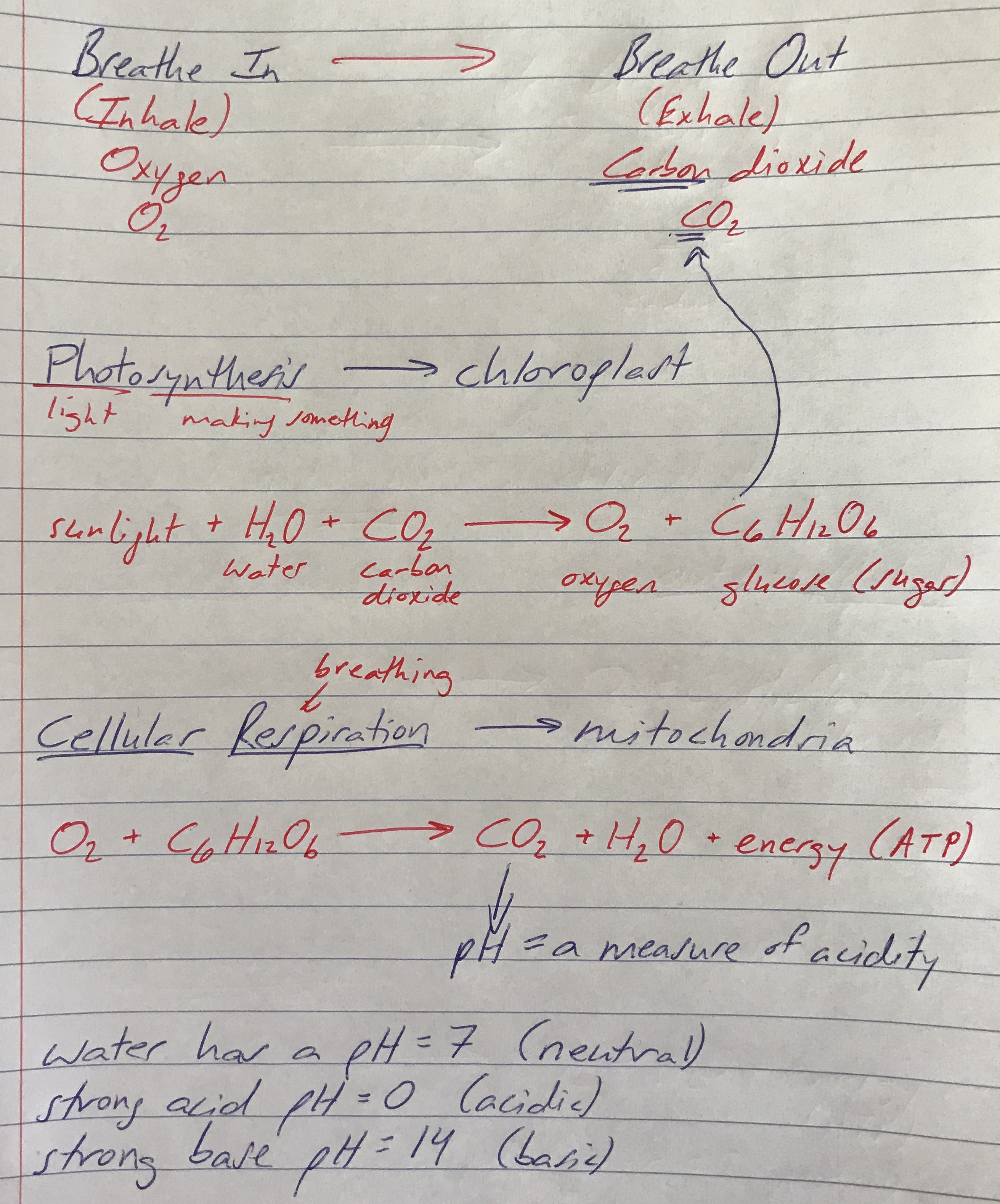
Next, we discussed the connection between carbon dioxide and pH, and then students observed a demonstration for how to use probeware to measure pH and temperature. Students wrote down the following procedure in their lab notebooks:
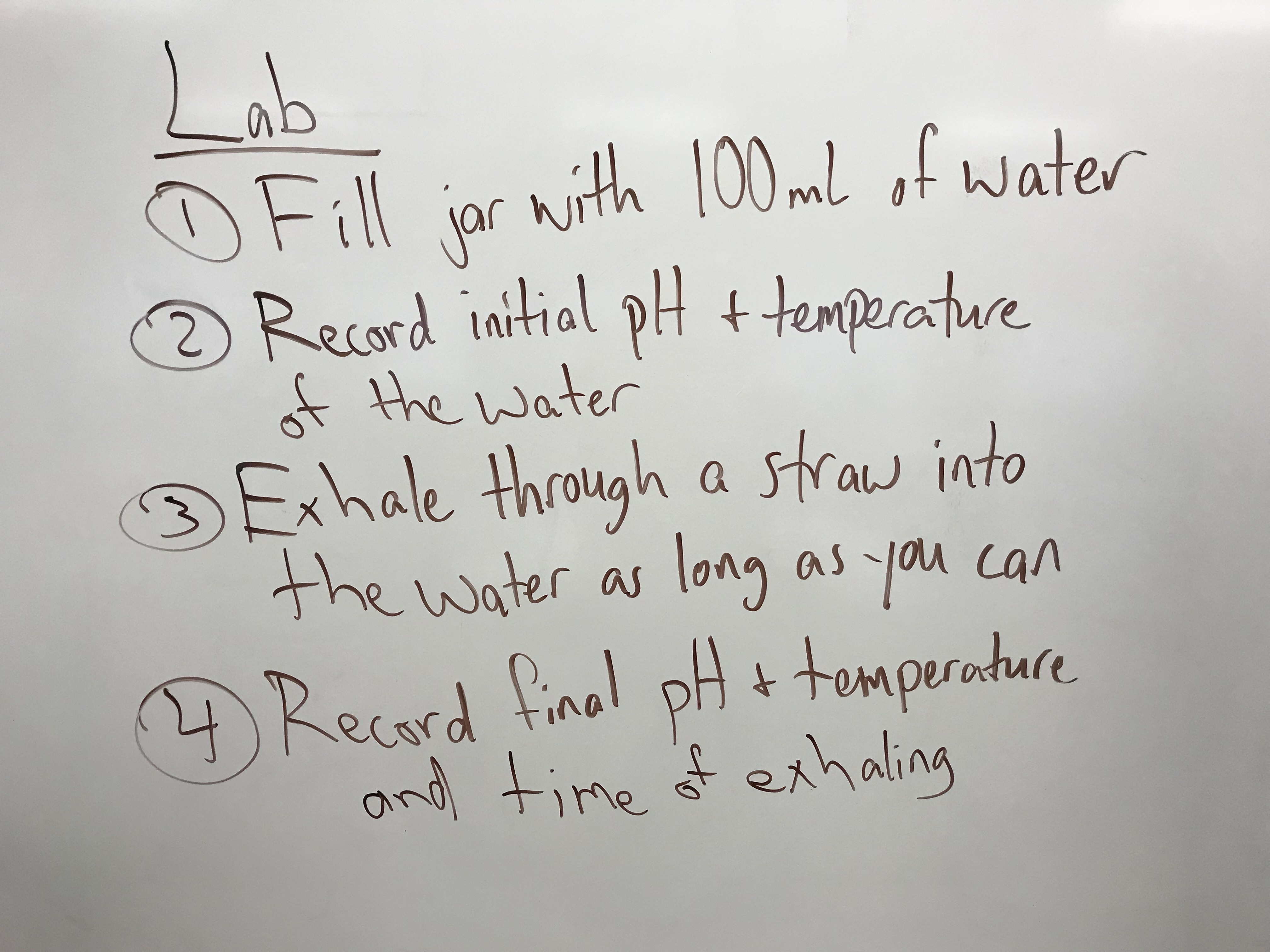
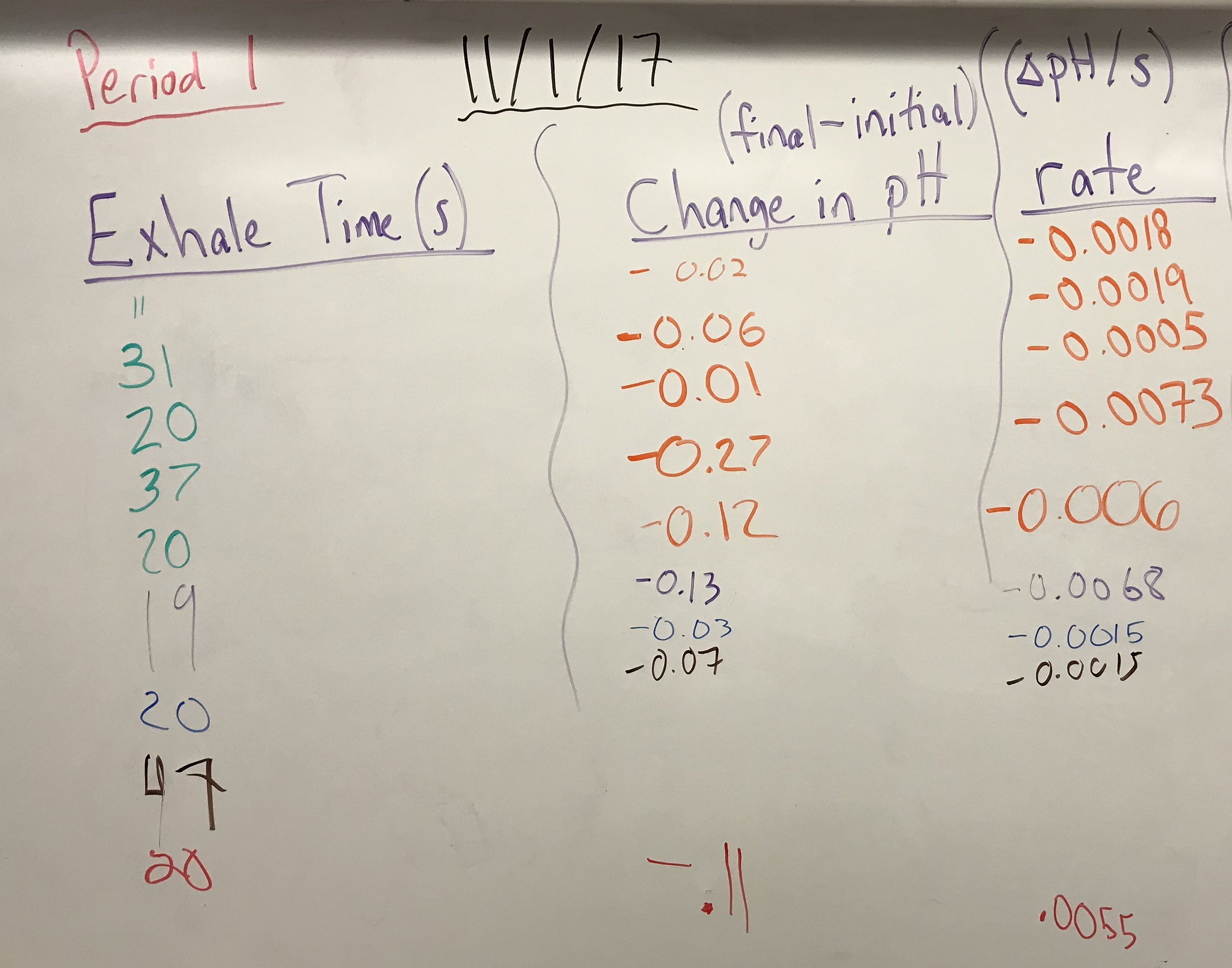
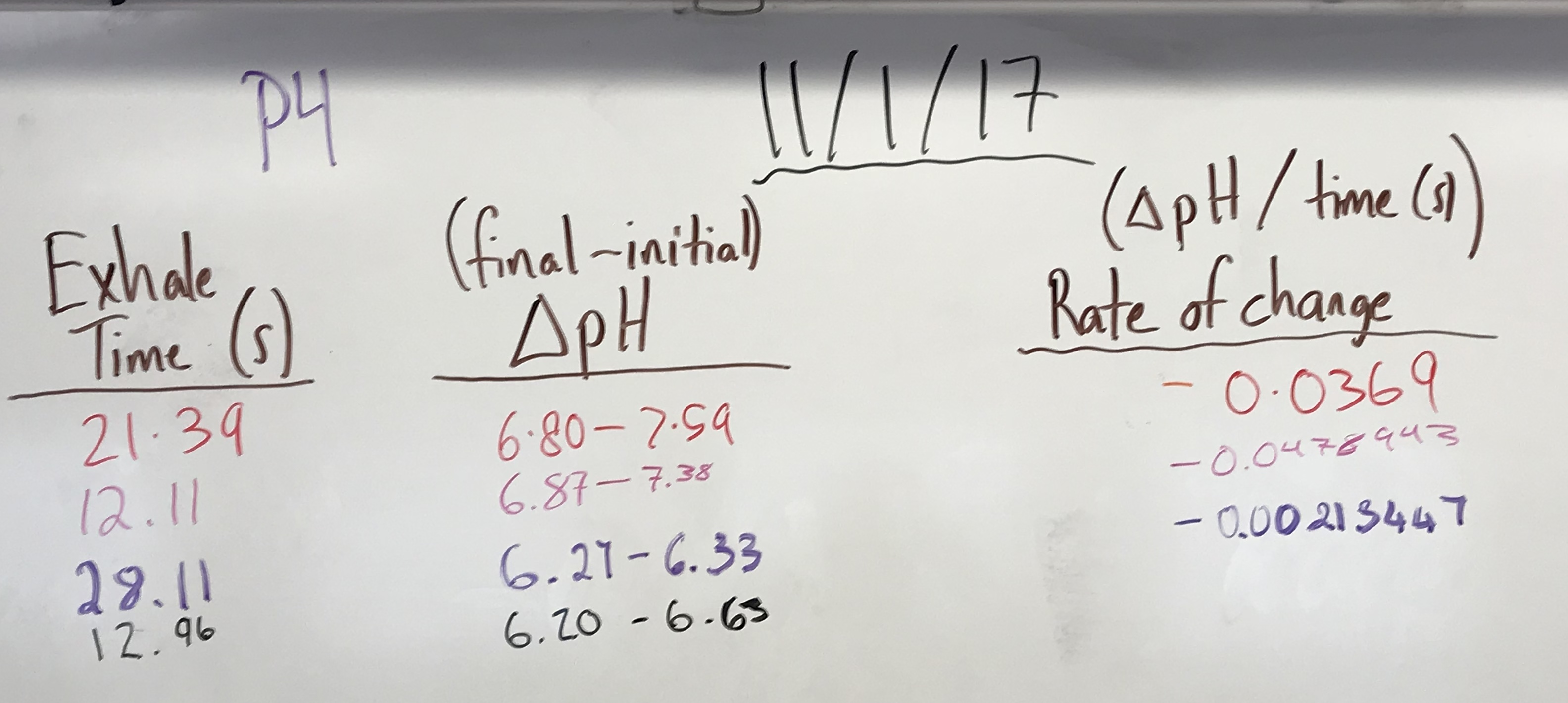
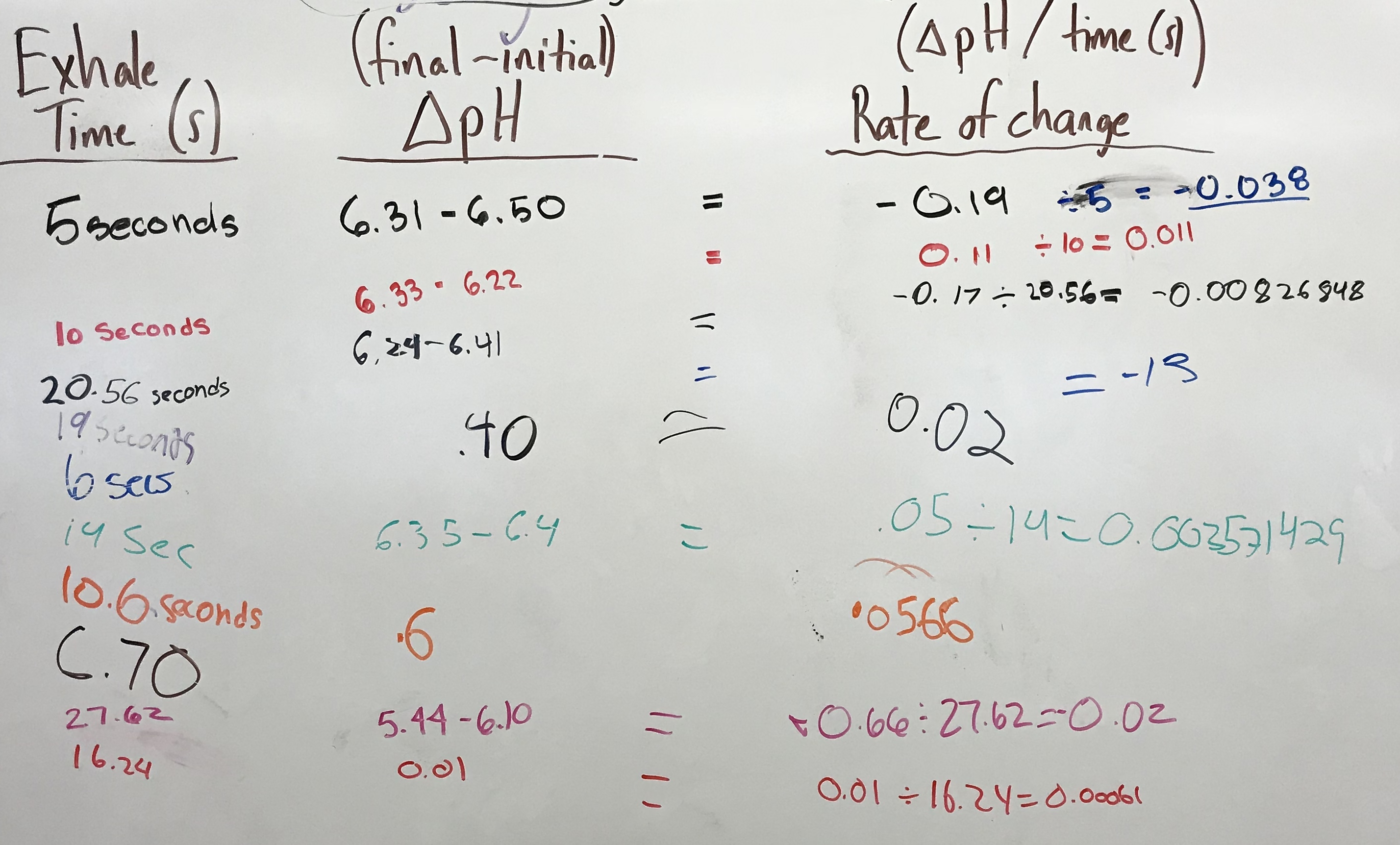
After completing the lab, students processed their data and recorded it on the white board for everyone to see. Not everyone had time to record their data, so the class data sets pictured below will be revisited soon:
Introduction
We kicked off Unit 2 with the following entry task:
In your notebook, make three columns with the following titles:
Carbohydrate Lipid Protein
List as many foods as you can in the appropriate columns.
Next, students were shown an image of a traditional Thanksgiving meal and we discussed the components of the meal, placing each food item in the appropriate food category. Students then used this thinking as they took the Unit 2 Pre-Assessment which called on them to label the parts of a cheeseburger and place those food parts into the food categories from the entry task. The remainder of the Pre-Assessment asked students to explain the processes of digestion, absorption, and biosynthesis.
Students who completed the Pre-Assessment early were able to spend the remainder of the class period finalizing their Egg Lab reports (due tomorrow by midnight).
Energy, Matter, and Organization: PSSC Marine Tech Visit
Mr. Joe Weiss from the PSSC Marine Tech Lab visited with students today to share information about the Marine Science & Technology program he offers at the Marine Tech Lab down at Seahurst Park. Mr. Weiss explained the program (his PowerPoint presentation provides an excellent overview), answered student questions, and provided materials about PSSC for interested students to review and discuss with their counselors here at HHS. Students are also encouraged to visit the PSSC website to learn more about all of the different programs offered.
After, we reviewed the concepts likely to be included on the Unit 2 Exam scheduled for Thursday next week. Students may prepare one page of notes (notebook paper, front and back) to use on the exam. Specifically, students should review:
- the 4 classes of biomolecules (including the subunits and atoms comprising the subunits)
- negative feedback
- potential and kinetic energy
- the connection between matter and energy
- conservation of energy and matter
- inputs and outputs of cellular respiration, photosynthesis, and combustion
- how to write a scientific explanation using a claim, evidence (data), and scientific reasoning
Energy, Matter, and Organization: Unit Review
We began class with a reminder that the semester ends next Thursday, January 28. Students were informed that if they have a current grade of a C or better, they will be able to participate in an extra credit opportunity (the nervous system project) to be explained tomorrow. Student projects will determine which groups are able to dissect sheep brains next week. Students with a D or below will work in small groups with me this week to help them catch up. Students who still have a D or below as of Tuesday next week will continue to catch up on required classwork and will not participate in the dissection lab. There will be a Unit 2 Final Exam on Thursday (1/28).
Students then had the next 20 minutes to complete the take-home quiz from Friday (only about 1/4 of students in all of my classes used the three-day weekend to complete the quiz). After the quiz, we reviewed two of the more challenging questions, connecting the path that explains why excess fertilizer used by farmers near the Mississippi River ends up contributing to the dead zone in the Gulf of Mexico. Links to pictures shown in class, as well as pictures of the white board notes are provided below.
Map of the Gulf of Mexico showing bordering states
Image of the dead zone (red = very little oxygen, blue = normal oxygen) in the Gulf of Mexico
Map of the United States highlighting the location of the Mississippi River (in red)
White Board Class Notes:


Energy, Matter, and Organization: Nutrient Cycling Quiz
To conclude the biogeochemical cycle poster project, students each reviewed two posters from groups other than their own. The review consisted of a worksheet with one half containing key items that must be included on each poster for full credit (turned in for participation credit). The lower half of the worksheet included feedback questions that were left with the posters and provided to the groups for feedback. Students then received a take-home quiz consisting of an article about the 2015 Gulf of Mexico dead zone and a quiz with questions connecting the nitrogen, carbon, and water cycles with photosynthesis, cellular respiration, and algal blooms. The quiz is due Monday.
Energy, Matter, and Organization: Photosynthesis & Cellular Respiration POGILs
For the next three days, students will learn about leaf structure, photosynthesis, and the connection between photosynthesis and cellular respiration. Students will work in pairs to complete two worksheet packets, and those who finish early will have the opportunity to complete one or more related labs.
For day 1, the entry task called for students to answer (through writing) the following:
- What is photosynthesis?
- Why is photosynthesis important?
- Write the equation for photosynthesis (bonus: include pictures!).
Student work is pictured below:


After the share-out, students watched the Crash Course: Plant Cells video (below) which served as a refresher to plant cells and as an introduction to photosynthesis. After the video, students worked in pairs on the Photosynthesis POGIL worksheet packet.
For Day 2, students reviewed the vocabulary terms of exothermic and endothermic within the context of photosynthesis, cellular respiration, and combustion. Notes from the entry task are pictured below.


After the entry task, we watched the video about photosynthesis by Bozeman Science. Students need to know the first 4.5 minutes of content, but the remaining content (which students wanted to watch) is beyond the scope of our class. After the video, students had the remainder of class time to work on the Photosynthesis POGIL Worksheet Packet from yesterday.
For Day 3, we connected the processes of photosynthesis and cellular respiration first through our entry task and then through a Photosynthesis and Cellular Respiration POGIL worksheet packet. The entry task and white board notes answering the response are pictured below:
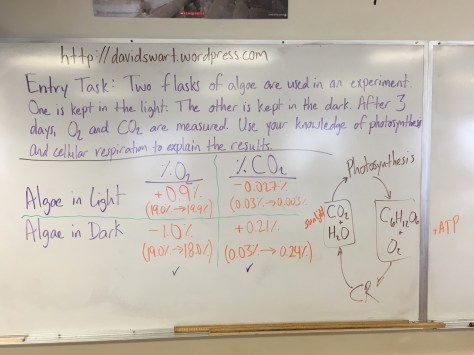


For students looking to dig into cellular respiration at the molecular level, the Crash Course and Bozeman Science videos are provided below:
Energy, Matter, and Organization: Complete Potato Catalase Lab Report with Extension
Students began the day with an entry task asking them to reflect back on the potato catalase lab from before the break, locate and/or recall how temperature was affected by the reaction, and then to use science thinking to come up with a “why” statement. Students successfully reasoned through the idea that the increased temperature observed during the reaction was attributed to the net release of energy from the bonds breaking from hydrogen peroxide and reforming to produce water and oxygen. Students were then introduced to the vocabulary terms of exothermic and endothermic. After the entry task, we briefly reviewed the Unit 2 calendar, clearly noting the scheduled quizzes, project deliverables, and dissection week. Students were then treated to a job posting showing the clear market demand for individuals skilled at dissection. Students were then released to:
- Work with their lab group to complete and turn in the lab report
- When finished with the lab report, repeat the potato catalase experiment with fresh potato, baked potato, and frozen potato.


Energy, Matter, and Organization: Potato Catalase Lab Conclusion
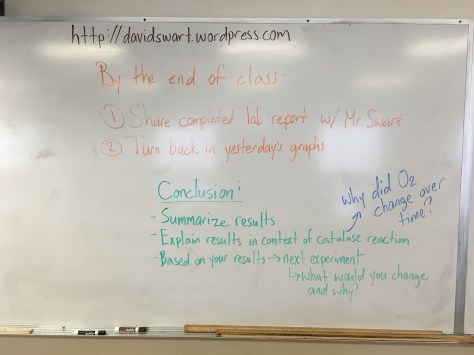
We wrapped up the calendar year with students working with their groups to write the conclusion section of the potato catalase lab report. The picture below provides guidance for writing the conclusion. When finished, students shared their lab report with the teacher and turned in their individually completed paper graphs.
Energy, Matter, and Organization: Potato Catalase Lab Analysis
We continued our work from yesterday, with students re-grouping to share the data from the lab (and creating T-charts of the data) and using it to create graphs using graph paper. Students then analyzed the graphs to answer questions about what the data demonstrated. The analysis questions were intended to help prepare students for the types of questions they might see on the Biology End Of Course Exam in May, as well as deeper questions that better reflect the thinking of highly capable high school students. For example, students were pushed to describe the enzyme’s rate of activity (the rate of change in their graph). Students have learned how to calculate the slope of a line in algebra, but it is not necessarily a concept students readily apply to biology. Students who finished continued working on their lab reports using the Chromebook, creating digital versions of their data tables and a few even created graphs in Google Sheets and copied them over to their Google Doc lab report. Students will finish the lab reports tomorrow.


 Science with Swart

You must be logged in to post a comment.