Category Archives: Cells

Cells & Homeostasis: Egg Lab Procedure Writing

Class began with students receiving their graded quizzes from Friday.  We reviewed the correct responses and students learned that their lowest quiz score will be dropped each quarter.  Make-up quizzes are not available, so student attendance on Fridays is very important.  Students also learned about the weekly extra credit opportunity: read a scientific article (available in the classroom magazine collection or online) and write a paragraph explaining what was learned.  The article must be related to the content covered in the most recent quiz, and the paragraph must be turned in prior to the next quiz in order to qualify for five extra credit points.

After the quiz review, we turned to the Egg Lab.  In their lab notebooks, students wrote the steps of the procedure they followed on Friday to measure the starting mass of their eggs and immerse the eggs in vinegar to begin the process of dissolving the eggshell.  Next, students made visual observations of their eggs before putting on gloves and handling their eggs while rinsing them.  Eggs were then placed back in the cups with fresh vinegar, recovered with plastic wrap, and returned to the fume hood for another day.  Students were encouraged to bring a school-appropriate liquid tomorrow as we continue our study of how cells interact with their environment by moving molecules across the cell membrane.

Egg Lab Procedure:

  1. Write name and class period on a cup with a Sharpie.
  2. Measure the mass of one egg with a scale while wearing gloves.  This is the starting mass in grams.
  3. Place the egg in the cup and record the starting mass on the cup.
  4. Pour vinegar over the egg until it is completely covered.
  5. Cover the cup in plastic wrap.
  6. Place the cup inside a fume hood for three days.
  7. Wearing gloves, observe the egg and record observations.
  8. Gently pour vinegar solution into sink, carefully catching egg.
  9. Rinse egg and cup gently with room temperature tap water.
  10. Return egg to cup and repeat steps 4-5.
  11. Place the cup inside a fume hood for one more day.

Cells & Homeostasis: Cell Organelles Quiz

We wrapped up our week of studying cells and their organelles with a quiz.  After the quiz, students received their egg for the egg lab.  The wrote their name, class period, and starting mass (in grams) of their egg on a plastic cup, filled the cup with enough vinegar to cover the egg, and then wrapped plastic wrap over the cup to help seal in the vinegar.  The egg shells quickly began to bubble as the vinegar began dissolving the shells.  We will observe the eggs Monday and continue the egg lab then.  Time permitting, students were treated to another Jimmy Fallon video featuring Kevin Delaney:

Cells & Homeostasis: Cell Organelle Networks

Students received their quizzes from last Friday and we reviewed how to analyze network diagrams.  Students learned that when analyzing an edge between two nodes, the arrow of the edge points to the receiving node.  For example, of Student A calls Student B, the students would be nodes, and the edge would start at Student A and point toward Student B.

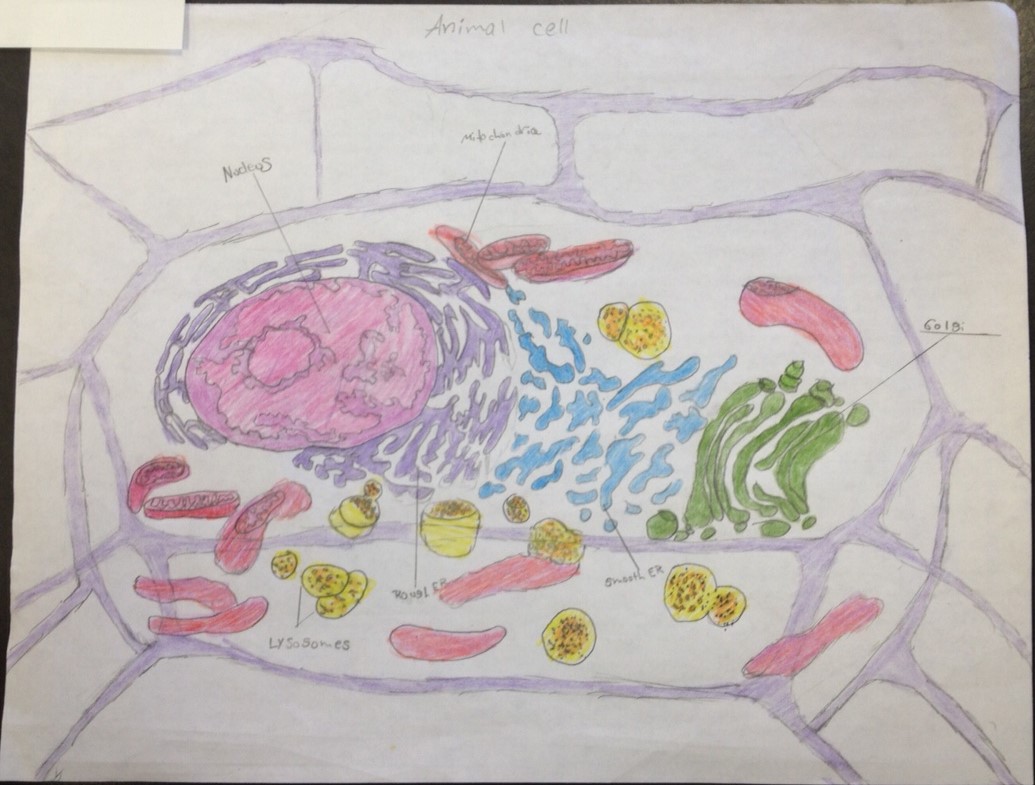
Next, students had time to complete and/or review their organelle flash cards from yesterday.  Students were told yesterday that the flash cards were due today, but with the Illuminate website down for much of the day, students received an extra day to complete the flash cards with the expectation that Illuminate is back up reliably tomorrow.  Students then worked in small groups of 3-4 and were assigned to draw either a plant cell or an animal cell.  First, the drawing must include all of the organelles found in the assigned cell type.  Second, students must research interactions between the organelles.  Finally, students will use their drawing to construct a network diagram, with each organelle serving as a node, and the relationships between the organelles serving as the edges.  Each node must have at least one edge originating from it.  Students were permitted to use all available resources, including the class textbook, the purple book (Inside the Cell), and scientifically reliable websites accessed from their phones.  Students will have the class period tomorrow to complete the project and Chromebooks will be available.  Students are encouraged to research relationships between the organelles as homework this evening.

Student Work Examples:

Plant Cell Organelle Network Diagram
Animal Cell Organelle Network Diagram
Animal Cell with Organelles

Cells & Homeostasis: Organelle Flash Cards

Students had two major tasks today:

  1. Complete the reading from yesterday (pages 6-13 from Inside the Cell), complete with summaries of each section written in the lab notebook for each student.
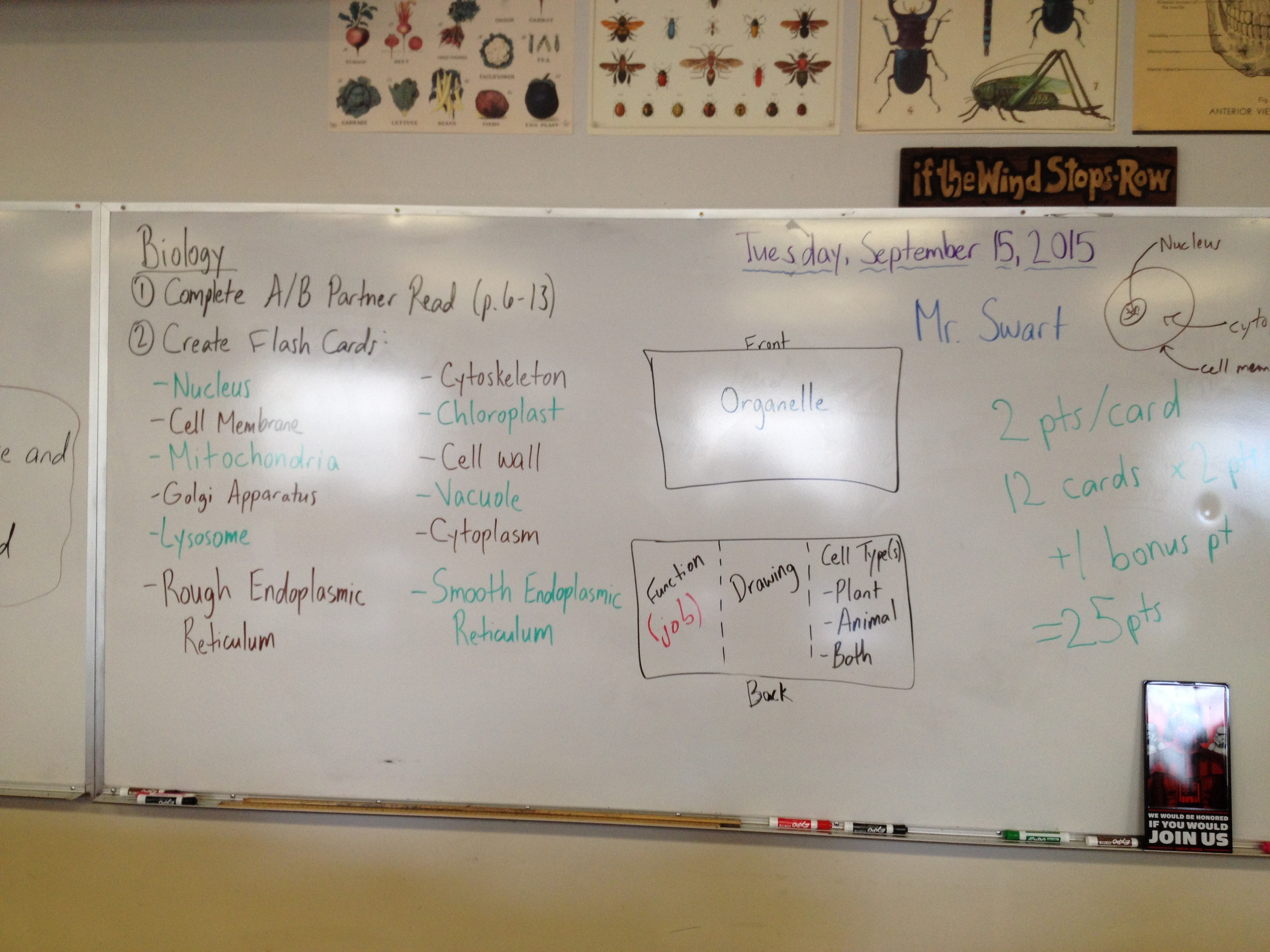
  2. Create flash cards as shown in the picture below:

organelles

A complete set of 12 flash cards for each student are due at the beginning of class tomorrow (one card for each of the 12 organelles).  Students should use their textbook if they have one at home, the online version of Inside the Cell, and any other scientifically valid resources.  The National Science Foundation has an excellent interactive resource called A Tour of the Cell that students might find useful.

Cells & Homeostasis: The Inner Life of a Cell

For our entry task today, students had the opportunity to check out a biology textbook.  The textbook should stay home, as we will have a class set of books to use at school.  Students who did not check out a book will be provided with copies of reading assignments as needed.

Next, we watched a video produced by the BioVisions group at Harvard University.  The video, The Inner Life of a Cell, provides a visually amazing introduction of cells to students who may not realize how dynamic cells really are.  After the video, students worked together to begin reading chapter 1 of the “purple book” – Inside the Cell.  Students used the following A/B Partner Paraphrase Reading strategy, with the goal of reading pages 6-13 of the book:

  • Partner A reads one section out loud
  • Partner B listens and then summarizes the section out loud back to Partner A
  • Partner A then summarizes Partner B’s summary out loud
  • Both Partner A and B write down the final summary

The purpose of the reading strategy is to provide students with the opportunity to read aloud and practice saying new vocabulary words, and also to help them distill key ideas through summarization.  Students who would like to order their own free copy of Inside the Cell should visit the National Institute of General Medical Sciences website and do so as soon as possible.  There are quite a few excellent freebies available from the NIGMS website, including magazines and posters.

We will complete the reading tomorrow and make flash cards tomorrow to help students learn about cell organelles.

Cells & Homeostasis: Lab Safety

We began class with a TED Talk by Suzanne Lee, the designer we read about last Friday who is using bacteria to grow clothing.

For their entry task, students were asked to write at least four sentences answering: In the future, what would you choose to grow?  Why?  We practiced A/B structured partner talk and followed that with a class share-out.

After a brief class discussion, we worked through the PBIS lesson for the day, with each class period sharing thoughts about how the Pirate Way looks in the classroom.  The 5 Pirate Way values are Positive, Respect, Responsibility, Engaged, and Persistent.  After a brief A/B structured partner talk, students provided the following examples of the values in action:

Positive (Period 2)

  • Stay focused
  • Turn in work
  • Turn in work on time
  • Assume positive intent
  • Help each other

Respect (Period 3)

  • No running around
  • Listen when others are talking
  • Keep hands to yourself
  • Assume best intent
  • Practice active listening

Responsibility (Period 4)

  • Turning in your work
  • Arrive in class on time
  • Complete your homework
  • Bring materials to class and use them appropriately
  • Pay attention
  • Stay on task
  • Knowing what’s going on

Engaged (Period 5)

  • Actively participating
  • Paying attention
  • Active listening
  • Staying on task
  • Staying focused

We wrapped up with a review of the syllabus (handed out last week), the safety contract (students learned where the equipment is located and should return the signed form tomorrow), and a video about how to use a fire extinguisher:

A few classes finished a bit early and were treated to a video about Algae Girl:

Cells & Homeostasis: Critter Diagram

Welcome back, Pirates!  It was nice to meet so many new people today.  With 20 minute periods, our accomplishments were limited to taking attendance, handing out the course syllabus, previewing the class website, and creating a critter diagram.  The critter diagram helps students share a bit about themselves with me and also introduces them to a technique for organizing information.  Next week, we will learn about systems and networks, and the critter diagram will provide students with a reference for discussing the concepts of nodes and edges in a network.

Energy, Matter, and Organization: Quiz Review

On Friday, students received their scored quizzes back.  We reviewed how the quiz was scored, and students had the opportunity to ask questions about the quiz content.  Students then had the remainder of the class period to check grades in Illuminate, identify missing assignments, and then to locate and print missing assignments to complete over the Winter Break.  School will resume on Monday, January 5.

Over the break, I strongly encourage my students to spend 20 minutes each day reading about biology topics related to energy, matter, and organization.  Students should write a one-paragraph summary of each page of reading they complete (cite the source!) and return the summary paragraphs for 5 points of extra credit per paragraph.  The reading should be related to our current unit of study, so look for credible scientific articles about:

  • how cells obtain and use energy (photosynthesis, cellular respiration, and metabolism)
  • how the chemical elements are organized into biomolecular structures (proteins, carbohydrates, lipids, and nucleic acids)
  • how cell organelles are involved in the metabolism (anabolism and catabolism) of biomolecular structures to maintain homeostasis inside and outside the cell
  • how diet impacts the function of an organism at the level(s) of cells, tissues, organs, or the whole organism

Need help locating credible scientific sources?  Visit the Keep Learning! page for a list of websites (scroll down).

Energy, Matter, and Organization: Cellular Respiration – Day 2

We continued our work modeling cellular respiration, picking up where we left off yesterday.  Although 2nd and 3rd periods were shortened because of a fire drill, students in periods 1, 4, and 5 were also able to watch the short video below describing the action of the enzyme ATP synthase.  We will have a comprehensive quiz tomorrow covering the topics of body systems, organelles (with heavy emphasis on the cell membrane), and energy.