
We continued our learning from the Google Classroom by focusing on the last question in the worksheet that asked students to consider the effect of temperature on metabolism. We watched the the “squirrel” segment (from 41:40 to 50:00 of the Can We Live Forever? video from NOVA scienceNOW). Students then updated their answers to question 6 from yesterday’s worksheet. The the last half of class, students worked in pairs to complete part 1 of the Keeping a Balance worksheet. They reviewed homeostasis and negative feedback, applying their learning to the scenario of a car adjusting speed in an effort to maintain the set point speed (the speed limit speed of 55 mph).
Category Archives: Biology
Cells & Homeostasis: Extreme Environments
Today’s lesson focused on bridging student learning about extremophiles and our field trip set for this coming Monday. We set our sights on defining “extreme environments”, learning about what makes an environment extreme and also about how some organisms are specially adapted to live in such environments. The PowerPoint introduced students to the concept of a Bell-Shaped Curve, challenged them to articulate their own ideas about what constitutes extreme, and then provided an opportunity for discussion around how statisticians define “normal” and whether our own perspective about whether something is extreme necessarily involves judging an individual who looks or acts extreme. We concluded the lesson after slide 26 and will complete the slide deck tomorrow.
Cells & Homeostasis: Environmental Science Center Info Session
We spent the class period in the library today preparing for the field trip to Seahurst Park. Christine and Jarrett from the Environmental Science Center met with the students. Students completed a questionnaire designed to help ESC prepare for the trip. Then they divided into two groups and competed against each other in “The Algae Game.”
Cells & Homeostasis: Egg Lab Data Day 1
We began the class period with students extending their Egg Lab procedures to include the steps for today. We discussed how students would repeat the egg washing process, after which they would measure the mass of their eggs. Eggs were placed in tap water overnight, and tomorrow they will be transferred to various liquids to determine how the eggs will interact with a new environment.
Once all of the eggs were measured and the data were recorded in student lab notebooks, students shared out their starting mass (measured on Friday when the eggs still had their shells) and their “after vinegar” mass. We entered the data into a spreadsheet and then students calculated the starting and ending averages. They checked their math against the averages calculated using the spreadsheet program (Google Sheets) as a calculator. The data is provided below by class period, with student names redacted:
Period 2:
| Student | Starting Mass (g) – 9/18 | After Vinegar Mass (g) – 9/22 | |
| #1 | 63.7 | 103.8 | |
| #2 | 63.9 | 107.0 | |
| #3 | 64.6 | 103.0 | |
| #4 | 66.4 | 99.2 | |
| #5 | 67.0 | 107.0 | |
| #6 | 67.7 | 99.7 | |
| #7 | 63.0 | 103.5 | |
| #8 | 61.2 | 97.1 | |
| #9 | 66.9 | 108.2 | |
| #10 | 63.6 | 98.4 | |
| #11 | 56.8 | 87.5 | |
| #12 | 61.3 | 92.0 | |
| #13 | 66.9 | 103.8 | |
| #14 | 67.6 | 107.2 | |
| #15 | 62.9 | 97.9 | |
| #16 | 62.2 | 67.4 | |
| % change | |||
| Average (g) | 64.1 | 98.9 | 154.3% |
Period 3:
| Student | Starting Mass (g) – 9/18 | After Vinegar Mass (g) – 9/22 | |
| Student #1 | 65.5 | 104.0 | |
| Student #2 | 65.2 | 98.1 | |
| Student #3 | 64.3 | 94.6 | |
| Student #4 | 63.8 | 95.5 | |
| Student #5 | 64.6 | 98.2 | |
| Student #6 | 65.8 | 100.7 | |
| Student #7 | 64.6 | 106.4 | |
| Student #8 | 66.0 | 105.6 | |
| Student #9 | 64.5 | 104.3 | |
| Student #10 | 62.0 | 95.8 | |
| Student #11 | 67.3 | 108.0 | |
| Student #12 | 65.7 | 101.2 | |
| Student #13 | 66.4 | 106.8 | |
| Student #14 | 65.9 | 98.2 | |
| Student #15 | 62.9 | 95.1 | |
| Student #16 | 65.6 | 94.2 | |
| Student #17 | 63.3 | 101.2 | |
| Student #18 | 66.0 | 103.2 | |
| Student #19 | 67.0 | 105.4 | |
| Student #20 | 67.2 | 71.9 | |
| Student #21 | 63.0 | 95.5 | |
| Student #22 | 65.9 | 107.1 | |
| Student #23 | 62.4 | 97.3 | |
| % change | |||
| Average (g) | 65.0 | 99.5 | 153.1% |
Period 4:
| Student | Starting Mass (g) – 9/18 | After Vinegar Mass (g) – 9/22 | |
| Student #1 | 57.0 | 85.4 | |
| Student #2 | 69.1 | 111.0 | |
| Student #3 | 66.7 | 99.8 | |
| Student #4 | 64.7 | 99.8 | |
| Student #5 | 64.1 | 96.1 | |
| Student #6 | 54.8 | 87.1 | |
| Student #7 | 61.8 | 94.1 | |
| Student #8 | 60.4 | 95.9 | |
| Student #9 | 67.6 | 105.1 | |
| Student #10 | 57.4 | 92.0 | |
| Student #11 | 67.9 | 93.4 | |
| Student #12 | 65.7 | 109.7 | |
| Student #13 | 67.1 | 103.0 | |
| Student #14 | 64.0 | 101.0 | |
| Student #15 | 58.1 | 90.0 | |
| Student #16 | 65.6 | 100.1 | |
| Student #17 | 67.2 | 106.1 | |
| Student #18 | 65.3 | 104.6 | |
| Student #19 | 60.8 | 91.6 | |
| % change | |||
| Average (g) | 63.4 | 98.2 | 154.8% |
Period 5:
| Student | Starting Mass (g) – 9/18 | After Vinegar Mass (g) – 9/22 | |
| Student #1 | 66.4 | 105.7 | |
| Student #2 | 63.5 | 93.8 | |
| Student #3 | 61 | 92.1 | |
| Student #4 | 63.3 | 98.7 | |
| Student #5 | 65.1 | 98.9 | |
| Student #6 | 61 | 91.1 | |
| Student #7 | 64.3 | 104 | |
| Student #8 | 60.2 | 95.1 | |
| Student #9 | 59.6 | 93.1 | |
| Student #10 | 55.7 | 82.5 | |
| Student #11 | 58.8 | 87.5 | |
| Student #12 | 60.3 | 95.1 | |
| Student #13 | 59.4 | 98.3 | |
| Student #14 | 62 | 95.5 | |
| Student #15 | 58.5 | 87.8 | |
| Student #16 | 58.1 | 85 | |
| Student #17 | 68.8 | 106.2 | |
| Student #18 | 58.4 | 95.8 | |
| Student #19 | 58.3 | 96.1 | |
| Student #20 | 59.1 | 88.9 | |
| Student #21 | 66 | 91.3 | |
| Student #22 | 68.3 | 100.8 | |
| Student #23 | 66 | 105.3 | |
| % change | |||
| Average (g) | 61.8 | 95.2 | 153.9% |
Cells & Homeostasis: Cell Organelles Quiz
We wrapped up our week of studying cells and their organelles with a quiz. After the quiz, students received their egg for the egg lab. The wrote their name, class period, and starting mass (in grams) of their egg on a plastic cup, filled the cup with enough vinegar to cover the egg, and then wrapped plastic wrap over the cup to help seal in the vinegar. The egg shells quickly began to bubble as the vinegar began dissolving the shells. We will observe the eggs Monday and continue the egg lab then. Time permitting, students were treated to another Jimmy Fallon video featuring Kevin Delaney:
Cells & Homeostasis: Organelle Flash Cards
Students had two major tasks today:
- Complete the reading from yesterday (pages 6-13 from Inside the Cell), complete with summaries of each section written in the lab notebook for each student.
- Create flash cards as shown in the picture below:
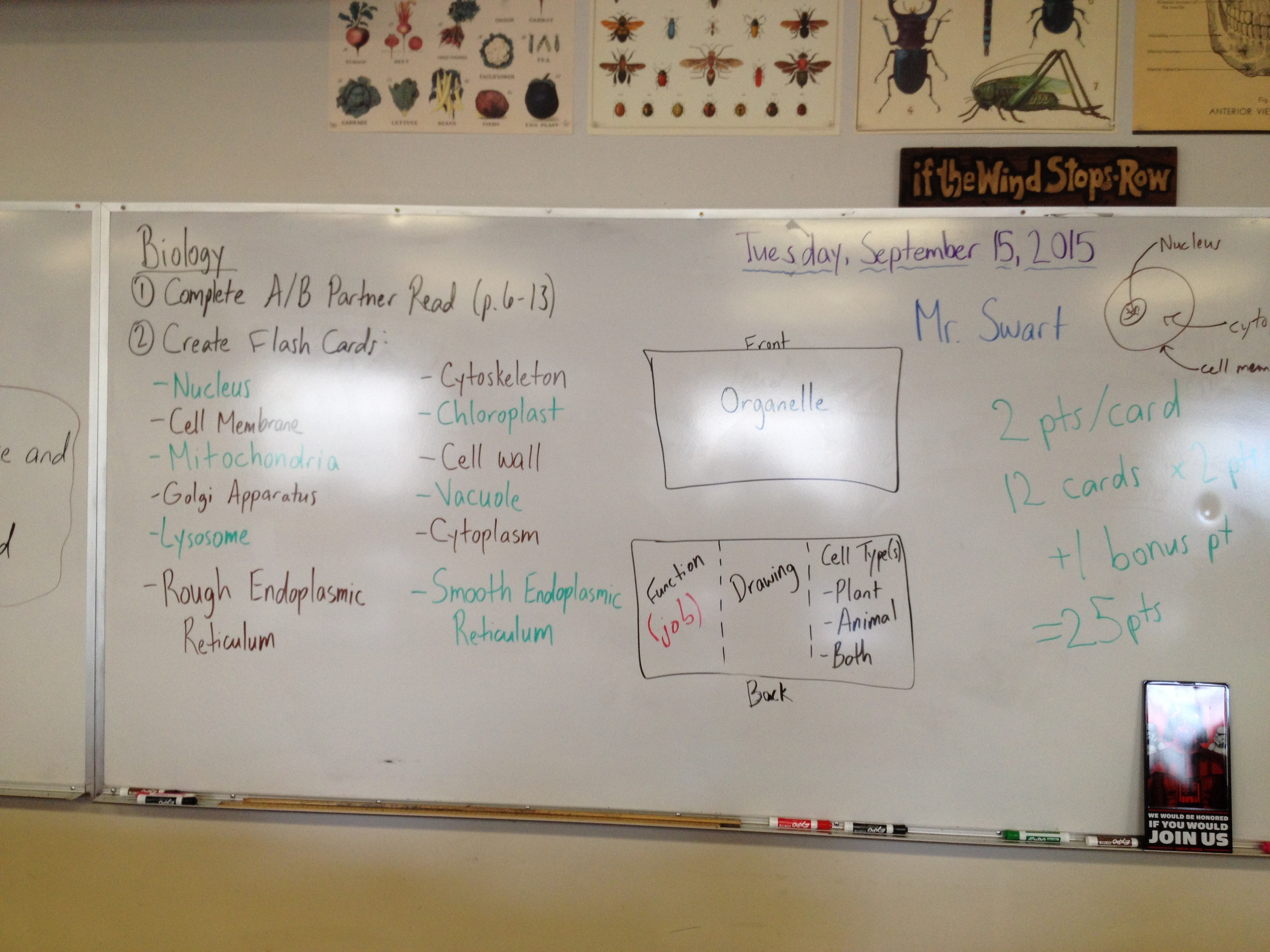
A complete set of 12 flash cards for each student are due at the beginning of class tomorrow (one card for each of the 12 organelles). Students should use their textbook if they have one at home, the online version of Inside the Cell, and any other scientifically valid resources. The National Science Foundation has an excellent interactive resource called A Tour of the Cell that students might find useful.
Cells & Homeostasis: The Inner Life of a Cell
For our entry task today, students had the opportunity to check out a biology textbook. The textbook should stay home, as we will have a class set of books to use at school. Students who did not check out a book will be provided with copies of reading assignments as needed.
Next, we watched a video produced by the BioVisions group at Harvard University. The video, The Inner Life of a Cell, provides a visually amazing introduction of cells to students who may not realize how dynamic cells really are. After the video, students worked together to begin reading chapter 1 of the “purple book” – Inside the Cell. Students used the following A/B Partner Paraphrase Reading strategy, with the goal of reading pages 6-13 of the book:
- Partner A reads one section out loud
- Partner B listens and then summarizes the section out loud back to Partner A
- Partner A then summarizes Partner B’s summary out loud
- Both Partner A and B write down the final summary
The purpose of the reading strategy is to provide students with the opportunity to read aloud and practice saying new vocabulary words, and also to help them distill key ideas through summarization. Students who would like to order their own free copy of Inside the Cell should visit the National Institute of General Medical Sciences website and do so as soon as possible. There are quite a few excellent freebies available from the NIGMS website, including magazines and posters.
We will complete the reading tomorrow and make flash cards tomorrow to help students learn about cell organelles.
Cells & Homeostasis: Introduction to Networks
Networks and systems are a recurring theme in biology, so today’s lesson focused on introducing students to the topic. For the entry task, students were challenged with writing a short story explaining a picture of a squirrel eating a piece of pizza.
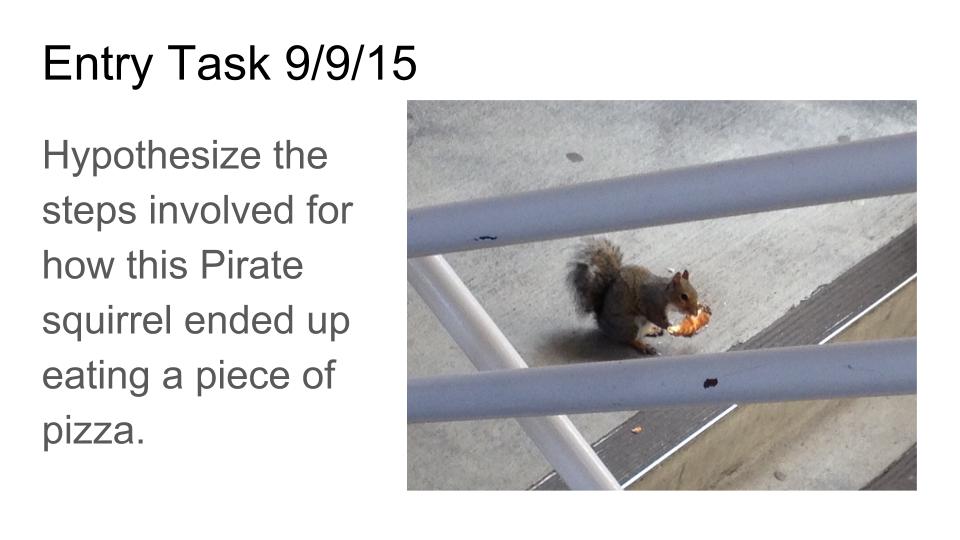
The students then transformed their short stories into network diagrams by identifying the key objects in the story and drawing them as nodes (words inside ovals), then connecting the nodes with edges (lines or arrows describing a relationship between the nodes being connected). We shared out a few stories with the class, creating network diagrams of the student stories. After completing the PBIS lesson for the day, we returned to drawing networks – this time, social networks. Students were tasked with meeting all of the other students in class, identifying one thing in common, and writing the relationship as a network diagram. We will use the network diagrams tomorrow for our social network activity.
Vocabulary:
- System – a collection of nodes and edges
- Node – the objects in a system
- Edge – the relationship between nodes
- Network – a diagram of a system
Students who enjoyed the data collection activity today might want to check out Aaron Kobelin’s TED Talk:
Cells & Homeostasis: Lab Safety
We began class with a TED Talk by Suzanne Lee, the designer we read about last Friday who is using bacteria to grow clothing.
For their entry task, students were asked to write at least four sentences answering: In the future, what would you choose to grow? Why? We practiced A/B structured partner talk and followed that with a class share-out.
After a brief class discussion, we worked through the PBIS lesson for the day, with each class period sharing thoughts about how the Pirate Way looks in the classroom. The 5 Pirate Way values are Positive, Respect, Responsibility, Engaged, and Persistent. After a brief A/B structured partner talk, students provided the following examples of the values in action:
Positive (Period 2)
- Stay focused
- Turn in work
- Turn in work on time
- Assume positive intent
- Help each other
Respect (Period 3)
- No running around
- Listen when others are talking
- Keep hands to yourself
- Assume best intent
- Practice active listening
Responsibility (Period 4)
- Turning in your work
- Arrive in class on time
- Complete your homework
- Bring materials to class and use them appropriately
- Pay attention
- Stay on task
- Knowing what’s going on
Engaged (Period 5)
- Actively participating
- Paying attention
- Active listening
- Staying on task
- Staying focused
We wrapped up with a review of the syllabus (handed out last week), the safety contract (students learned where the equipment is located and should return the signed form tomorrow), and a video about how to use a fire extinguisher:
A few classes finished a bit early and were treated to a video about Algae Girl:
Cells & Homeostasis: Critter Diagram
Welcome back, Pirates! It was nice to meet so many new people today. With 20 minute periods, our accomplishments were limited to taking attendance, handing out the course syllabus, previewing the class website, and creating a critter diagram. The critter diagram helps students share a bit about themselves with me and also introduces them to a technique for organizing information. Next week, we will learn about systems and networks, and the critter diagram will provide students with a reference for discussing the concepts of nodes and edges in a network.
 Science with Swart
You must be logged in to post a comment.