
All posts by David Swart

High school science teacher

Weeks 34-35 – Types of Exposure

When we consider chemical exposure, it’s important to think about frequency: how often will exposure occur?  Imagine you are at the gas station.  It’s a warm day, and as you fill you fill your tank with gas, you smell the faint scent of gasoline vapor in the air.  As you wrap up and put the nozzle back on the pump, a few drops of gas fall from the nozzle, thus preparing the scene for the next person.  You just experienced an acute inhalation exposure to gasoline vapor.

  • Acute: exposure to a chemical for 24 hours or less

Thankfully for you, it is a low-level exposure; you will be fine.  For the attendant who has been working at the gas station for the last few years, every time they tidy up the pumping area (take out the garbage, change out the soapy water for washing windshields, sweep up litter, and spread kitty litter to absorb larger gas spills) they are experiencing chronic exposure to inhaled gasoline vapors.

  • Chronic: exposure to a chemical for more than 3 months

When it rains, those drops of gasoline are washed down into the sewers and are carried out into Puget Sound.  Fish swimming in the area come into contact with the gasoline, absorbing it through their eyes and skin and inhaling it through their gills.  The gasoline evaporates when the weather turns sunny again, so the fish are only exposed for a few days (sub-acute exposure).

  • Sub-acute: exposure to a chemical for 1 month or less

Birds in the area feed on the gasoline-exposed fish.  It takes a few months for the birds to fully metabolize the gasoline ingested with the fish (sub-chronic exposure).

  • Sub-chronic: exposure to a chemical between 1 to 3 months

Your turn to show what you know.  Complete the Types of Exposure Google Form and then return to Weeks 34-35 – How Much Is Too Much? and continue working.
Weeks 34-35 – Lactase Persistence

Welcome to Weeks 34 and 35!  We continue our study of evolution, and specifically co-evolution, by focusing on the enzyme lactase.  You have two weeks to complete this work.  The recommended weekly work schedule is provided below.  You must complete the weekly attendance check-in, but you are welcome to adjust the learning schedule to meet your own needs.

Week 34 (recommended)

  1. Week 34 Attendance Check-In (required by 10am 5/15)
  2. What is an Enzyme? (Google Form assignment)
  3. Enzyme Lab-At-Home (Learning required, Lab Report optional)

Week 35 (recommended)

  1. Week 35 Attendance Check-In (required by 10am 5/22)
  2. Got Lactase? (Google Form assignment)
  3. What’s Wrong with Claire? (Gizmo notes in Google Doc)

You did it!  Just to make sure, here’s a checklist of items you must complete this week by Sunday, May 24 at 11:59pm:

  • Week 34 Attendance Check-In (school district requirement)
  • Week 35 Attendance Check-In (school district requirement)
  • Enzyme Google Form (worth 15 assignment points)
  • Optional Enzyme Lab Report (worth 40 lab report bonus points)
  • Got Lactase? Google Form (worth 15 assignment points)
  • Enzymes STEM Case Gizmo Google Doc Notes (worth 10 assignment points)

Remember, you can email me any time.  Office hours for Science are Tuesdays from 11am-12pm and Thursdays from 1pm-2pm.  Check your student Gmail for Zoom instructions.

Don’t forget to complete the Week 34 and Week 35 Bonus Credit Opportunities!  Check out the amazing artwork students are submitting as part of the Week 35 Bonus Credit Opportunity.


Weeks 34-35 – Toxin Research

Now that we understand some of the variables involved with evaluating exposure to toxic chemicals, it’s time to move forward with the Toxin Research Project.  The first step is to decide which toxin you want to research.  You are welcome to select anything of interest to you, as long as you can identify a specific molecule in the PubChem (NCBI) database AND you can find an appropriate LD50 for the molecule.

For inspiration, the websites below can help get you started:

For this part of your work, you need to create a Google Slides document.  All of your Toxin Research Project work will go into the Google Slides.  Instructions for completing this part of the work:

  1. Create a Google Slides document
  2. Title the document “Toxin Research Project – Your Name”
    • Example: Toxin Research Project – Pierre Swart
  3. Slide 1 must include:
    1. Name of the molecule
    2. A link to the PubChem database entry.
    3. An image of the molecular structure.
    4. How someone might be exposed to the molecule (i.e. a specific food, drink, plant, animal, type of work, a location in the environment where it naturally occurs, etc).
    5. The LD50 for the molecule (including species and route of administration) most relevant to the route and type of exposure you selected.

The molecule name, image, and LD50 for the molecule should all be found in the PubChem database.  If you select a toxin from the list above, the linked article will provide you with information about exposure to the molecule.  If you pick a toxin not on the list, you will need to do that research on your own.

Need help?  You have options:

  1. Click here and watch a video of Mr. Swart guiding you through the process of conducting the research to complete Slide 1.  You will also be provided with an example of Slide 1.
  2. Attend office hours on Tuesday and/or Thursday
  3. Email Mr. Swart with specific and detailed questions.

Finally, I would like to be able to post these online to share with each other.  Please be creative in your layouts and make sure your name is not actually on the slide anywhere.  Your name should only be in the title of the document.  Have fun!

When finished with Slide 1, return to Weeks 34-35 – How Much Is Too Much? and continue working.

Weeks 34-35 – How Much is Too Much?

Welcome to Weeks 34 and 35!  It is finally time to answer that age-old question: How much is too much? If I had a dollar for every time a student asked me, “Can I eat it?” after watching a chemical reaction in a lab…I could personally fund the Week 34 Bonus Credit Opportunity question (scroll way down to find it!).   We all know the answer is always, “No food or drinks in the lab!”  But why?  This week, you will be able to find out for yourself.  You have two weeks to complete this work.  The recommended weekly work schedule is provided below.  You must complete the weekly attendance check-in, but you are welcome to adjust the learning schedule to meet your own needs.  Also, for anyone working on the Unit 4 Honors Project, this lesson comprises an important section of that project.

Week 34 (recommended)

  1. Week 34 Attendance Check-In (required by 10am 5/15)
  2. Routes of Exposure (Google Form assignment)
  3. Types of Exposure (Google Form assignment)
  4. Toxin Research (Google Slide assignment, slide 1)
  5. Limiting Reactants Revisited (optional lab report)

Week 35 (recommended)

  1. Week 35 Attendance Check-In (required by 10am 5/22)
  2. Toxicology (Google Slide assignment, slide 2)
  3. Toxin LD50 Calculations (Google Slide assignment, slide 3)
  4. Graph of LD50 (Google Slide assignment, slide 4)
  5. Toxin Research Project Check-In (Google Form required)

You did it!  Just to make sure, here’s a checklist of items you must complete this week by Sunday, May 24 at 11:59pm:

  • Weekly Attendance Check-In (school district requirement)
  • Routes of Exposure Google Form (worth +10 assignment points)
  • Types of Exposure Google Form (worth +10 assignment points)
  • Optional Lab  Report (worth +50 bonus lab report points)
  • Slide 1 of Toxin Research Project (worth +10 project points)
  • Slide 2 of Toxin Research Project (worth +10 project points)
  • Slide 3 of Toxin Research Project (worth +10 project points)
  • Slide 4 of Toxin Research Project (worth +10 project points)

Remember, you can email me any time.  Office hours for Science are Tuesdays from 11am-12pm and Thursdays from 1pm-2pm.  Check your student Gmail for Zoom instructions.

Don’t forget to complete the Week 34 and Week 35 Bonus Credit Opportunities!  Check out the amazing artwork students are submitting as part of the Week 35 Bonus Credit Opportunity.

Weeks 34-35 – Enzyme Lab-At-Home

Ready to step up your enzyme game?  Begin by watching the Enzymes video by Mr. Anderson:

Now that you have been introduced to the enzyme catalase, it is time to see catalase in action through this installment of Lab@Home.

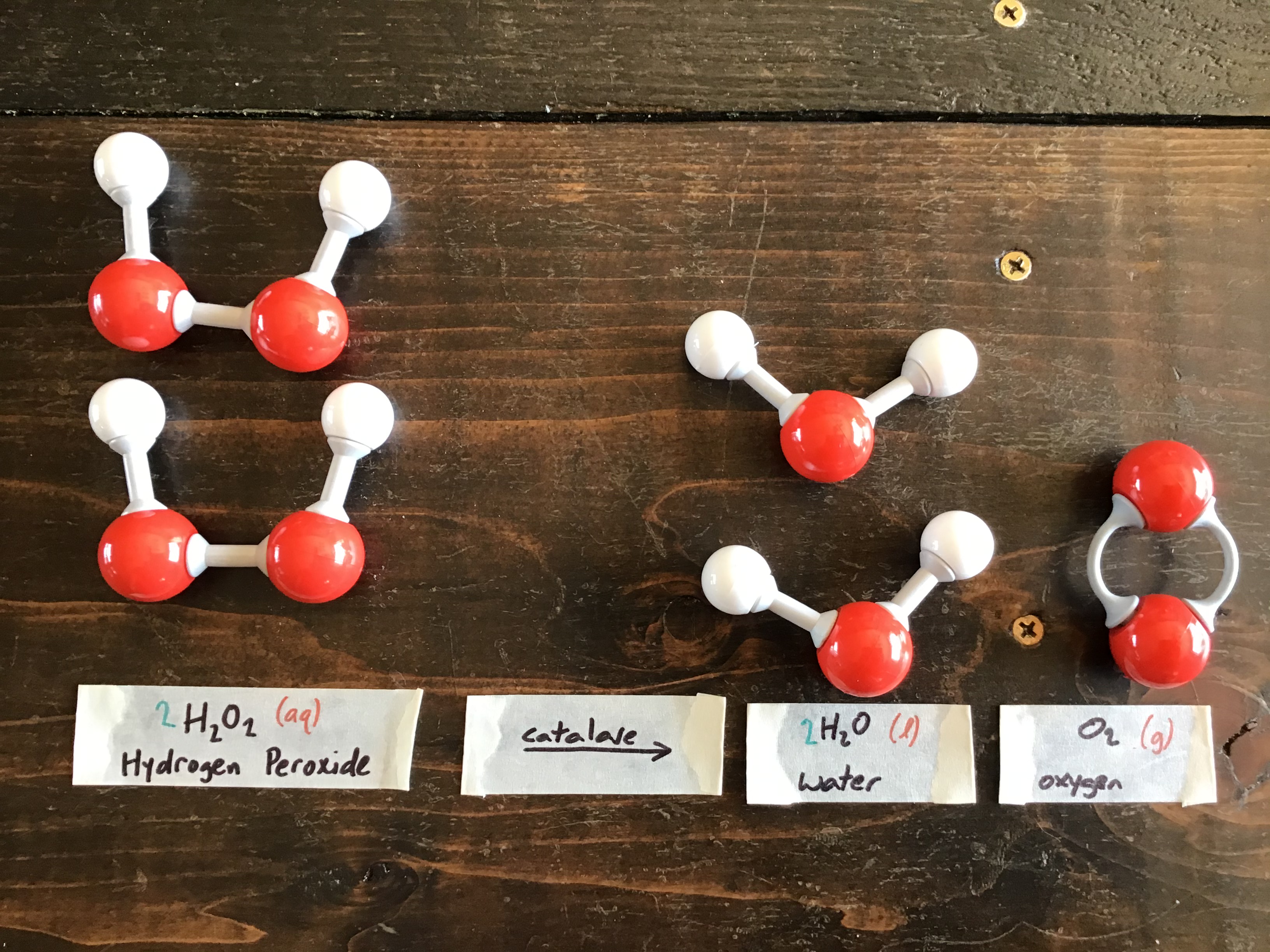
In this video, you will observe the enzyme catalase reacting with hydrogen peroxide (the substrate) to produce water and oxygen gas.  The hydrogen peroxide is an aqueous solution consisting of 3% H2O2 and 97% H2O.  The picture below depicts a balanced chemical equation along with models of the reactant (H2O2) and products (H2O and O2):

For the experiment, 10 mL of H2O2 was pipetted into each of 3 test tubes.  Next, 5 g of finely diced potato was added into each test tube.  Before being minced, potato #1 was kept at room temperature, potato #2 was baked in an oven for 30 minutes at 450 °F (232 °C), and potato #3 was frozen for 60 minutes at -20 °C.  The 5 g of baked potato was kept at room temperature until the experiment started.  The 5 g of frozen potato was returned to the freezer until just before the experiment.

If you have access to a potato and hydrogen peroxide, then you can do this lab at home and dazzle your family.  You don’t need any fancy equipment, just do your best to keep the experimental conditions similar.  If not, watch the video below carefully.  Either way, whether you conduct the experiment yourself, or follow along with the video, write up the experiment into a lab report and submit it for up to +40 bonus points in the lab report section of your semester grade.  Let me repeat: this is worth +40 bonus points, which means it is not required, but highly encouraged!  If you would like to work with a partner, you may as long as it is clear who did which parts of the report and the work is equally shared.

For full credit, the lab report should consist of:

  • Title: Potato Catalase Experiment
  • Student Name(s) – two students max with work clearly labeled
  • Introduction section: Explain the purpose of the lab.  Include your understanding of catalase.  What was the manipulated variable (what we intentionally changed)?  What were the responding variables (what we observed)?  What variables were controlled?
  • Procedure section: Include a numbered list of every step needed to conduct this experiment.  Have a friend or family member review the procedure and attempt to follow it.  If they get lost, fill in the missing steps!
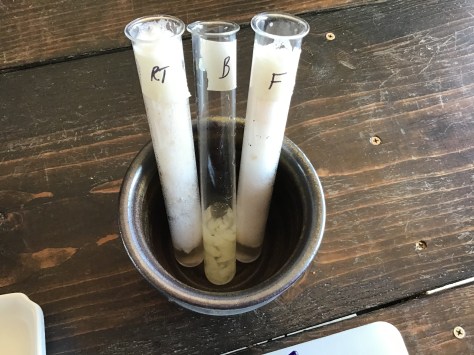
  • Results section: Include observations of which samples produced oxygen gas bubbles.  Record the time it took for the bubbles to reach the top of the tubes.  Include the starting and ending temperatures (given in °C).  If you are using the data from the experiment in the video, include and explain the picture below:
Potato Catalase Experiment
RT = Room Temp, B = Baked, F = Frozen
  • Discussion section: Explain why some, but not all, samples produced oxygen gas bubbles.  Include the words enzyme, substrate, products, and denatured.  Is the reaction exothermic, isothermic, or endothermic?  How do you know?  Explain the results: how did the manipulated variable affect the responding variables?  Why?  What were three possible sources of error?  Based on what you learned, what would be your next experiment to further your learning?

Need some help setting up your lab report?  Click the link and then select File > Make a Copy and get to it!

Return to the Weeks 34-35 – Lactase Persistence post and continue our work for the week.

Week 33 – Mole Ratios

By now you are all wizards at balancing equations.  You know the number of atoms of each element must be the same on the reactant (left) side of the arrow as on the product (right) side of the arrow.  Let’s use a reaction you should be familiar with from the conservation of mass lab (Lesson 71): aqueous calcium chloride reacts with aqueous sodium carbonate to produce solid calcium carbonate and aqueous sodium chloride:


Here’s the balanced equation:

CaCl2(aq) + Na2CO3(aq) → CaCO3(s) + 2NaCl(aq)

Quick vocabulary review and a piece of important new learning:

  • (aq) means aqueous (in water)
  • (s) means solid
  • In a chemical equation, the arrow points from the reactants toward the products.  As written above, the reactants are on the left and the products are on the right.
  • The letters represent element symbols from the periodic table
  • The numbers represent subscripts and coefficients.
    • Subscripts are the small integers (whole numbers) to the lower right of an element symbol and they cannot be changed.  Subscripts tell how many atoms of each element are present in a given molecule.  In the equation above, the small 2 after Cl tells us there are two chlorine atoms bonded with 1 calcium atom in one molecule of CaCl2.
    • Coefficients are the regular-sized integers to the left of a molecule.  This is new and important: Coefficients tell us the correct mole ratio in which the reactants combine to form the products.  In the equation above, we now know that one mole of aqueous calcium chloride reacts with one mole of with aqueous sodium carbonate to produce one mole of solid calcium carbonate and two moles of aqueous sodium chloride.

Another example: N2(g) + 3H2(g) → 2NH3(s)  This equation tells us that one mole of nitrogen gas reacts with 3 moles of hydrogen gas to produce one mole of solid ammonia.

Even more examples:


Your turn!  Complete the Mole Ratios Google Form before returning to Week 33 – Stoichiometry to continue working.

Week 33 – Bonus Credit Opportunity

Looking to earn some bonus credit and boost your grade?  You’ve come to the right place!  Each week, you will have the opportunity to earn bonus credit for completing extra learning about science…or practicing a scientific skill.

This week’s bonus credit opportunity is called…Write a Procedure.  To earn credit this week, you have to write out the procedure for how to make something you love to eat, using ingredients you currently have access to.  No special trips to the store!  It doesn’t have to be a complicated procedure, but it does have to be extremely detailed.  When you think you are finished, ask someone at home to read the procedure to you.  Follow each step exactly as it is written.  Can you make your food item?  If more detail is required, revise your procedure and try again.  When you have enough detail to complete the task, take a picture of your food item and upload it to the Google Form.  The finished Procedure and uploaded picture together earn you +20 bonus points in the Lab Report category.  Click here and fill out the Google Form.

Week 33 – Percent Yield

So far this week, we’ve learned that the coefficients of balanced equations provide us with mole ratios, which we can then use to predict the amount of products generated by reactants in a chemical reaction.  Once we have a theoretical value for the amount of reactant we will generate (our theoretical yield), we can then run the  experiment and measure how much reactant we actually recover (our actual yield).  By comparing the theoretical and actual yeilds, we can calculate our percent yield: how much reactant we are able to recover given real-world experimental constraints.

In the Going Through the Mole Tunnel section, we investigated the reaction of copper with silver nitrate to produce silver and copper nitrate.  We went on to calculate the number of moles of copper and silver nitrate we would have to combine to produce 30 g of silver.  Now, imagine we actually did that experiment and our recovery of pure silver was 28.5 g.  What was our percent yield of silver?

  • Theoretical yield of silver = 30 g
  • Actual yield of silver = 28.5 g

Percent yield = (actual yield) / (theoretical yield) x 100%

For our experiment: Percent yield = 28.5 / 30 x 100% = 95%

Not bad!  Our actual yield was only 5% less than our theoretical yield.  Why wasn’t the percent yield 100%?  Experimental error!  Maybe we mis-measured one of our reagents.  Maybe we used a solution that wasn’t prepared as accurately as it should have been.  Maybe our balance needs to be re-calibrated, or the volume measured by our beaker wasn’t perfectly accurate.

Another example:

Your turn!  Complete the Percent Yield Google Form before returning to Week 33 – Stoichiometry to continue working.

Week 33 – Biological Warfare and the Co-Evolutionary Arms Race

For the final part of our work this week, it’s time for college!  Visit the UC Berkeley Understanding Evolution website and complete the following:

  1. In your Week 33 Google Doc, create a section titled “UC Berkeley Understanding Evolution”
  2. Read through the Co-evolution section (page 20) and answer the following question:
    • How are Acacia plants and ants an example of co-evolution?
  3. Read through the Case Study of Co-evolution section (page 21 and page 22) and answer the following questions:
    • Explain the co-evolutionary relationships between Red Squirrels, Crossbilled Birds, Lodgepole Pines.
  4. Read through the Biological warfare and the co-evolutionary arms race case study. Click the link to go to the first slide.  There are 12 slides total.  Read through the slides, then answer the following questions:
    • What is co-evolution?
    • How do living and non-living environments shape organisms through natural selection?
    • How do evolutionary trade-offs restrict adaptation?
    • How can we use the methods of science to answer questions about the natural world?

Return to the Week 33 – Co-Evolution post and continue our work for the week.

Week 33 – Summary

To wrap up our learning, here are a selection of excellent videos about our topic for this week’s learning: stoichiometry.  In the textbook, we have covered content corresponding to lessons 91-93.  I highly encourage everyone to read through those lessons.  While the exercises will not be entered into Synergy, if you want to try some of the practice problems, email me your work and I will be happy to look it over and provide feedback.

Return to Week 33 – Stoichiometry and make sure you have everything complete for the week.