We’ve reached the end our our learning this school year. Appropriate, perhaps, that we end where we began: in the stars. Way back in Unit 1, you learned that stars fuse lighter elements like hydrogen and helium to form heavier elements up through iron. Elements with more protons than iron are created when stars go supernova. Plants and animals (yep – humans are animals) are made of star stuff – we are quite literally the product of exploding stars.
We also conducted flame tests, showing that metal cations are responsible for producing specific colors of flame when ionic compounds are burned. Now we understand that our perception of color is a result of photoreceptors in our eyes being capable of detecting specific wavelengths of electromagnetic radiation. When those receptors are activated, they send information to our brain which then decodes the signal into our perception of light and color.
When we look up at the stars, we are looking back in time, as it takes time for light to travel from its source to our eyes here on Earth. The more distant the object, the further back in time we see. It’s not too hard to imagine there might be organisms billions of light-years away that witnessed the supernova (singular) or supernovae (plural) that launched the atoms within you and me toward our remote location within the Milky Way galaxy. The force of gravity eventually caused those atoms to coalesce to form our Sun and the planets that orbit it, including the Earth. After 4.5 billion years, here we are, studying the stars:
Anyone who would like to invest further in their understanding of the stars should email me for a copy of the handout that goes along with the Star Spectra Gizmo. This activity is purely optional and available for your own personal growth. It will not be entered in the grade book.
Welcome to Week 38! For our final lesson of the 2019-20 school year, you will be exploring the connection between light and color. Whether you are taking physics or any of our other science electives next year, this lesson will be a great preview. Let’s get to it!
That’s it! No new assignments this week (spoiler alert: no new assignments next week either). Please make sure you have everything turned in by June 19. It has been my absolute pleasure teaching you chemistry this year. What a year to remember!
Remember, you can email me any time. Office hours for Science are Tuesdays from 11am-12pm and Thursdays from 1pm-2pm. Check your student Gmail for Zoom instructions.
Our live are largely built around the rising and setting of the Sun in the sky each day. Our biology is intimately connected to this via our circadian rhythms:
Have you ever wondered what would happen if the Sun just suddenly blinked out of existence? When would you know? Turns out, it takes time for light to travel from the Sun to the Earth. We’ve just learned that light travels at a constant speed, c, in a vacuum like outer space. We know that c = 3.0 x 10⁸ m/s. To calculate how long it takes light to travel from the Sun to Earth, we need to know the distance between the two. While the orbit of Earth around the Sun is not a perfect circle, on average the Earth is about 93 million miles (mi) from the Sun. Time for some math!
Have: c = 3.0 x 10⁸ m/s and distance = 93 x 106 mi
Want: Time it takes light to travel from the Sun to Earth
Need: Connection between meters (m) and miles (mi)
Another quick Google search tells us there are 1609.34 meters in 1 mile. We are in business!
Calculation: (93 x 106 mi) x (1609.34 m / 1 mi) x (1 s / 3.0 x 10⁸ m) = 499 s
Analysis: It takes about 499 seconds for light to travel from the Sun to the Earth! Divide 499 by 60 and that gives us about 8.3 minutes. So if the Sun blinked out right now, at this very instant, we wouldn’t know until 8.3 minutes from now. The Sun is our nearest star, and it still takes 8.3 light-minutes for its light to reach us.
The second closest star to Earth is called Alpha Centauri. Alpha Centauri is actually a triple star system (three stars in orbit around each other) located approximately 4.37 light-years from Earth. Traveling at the speed of light, c, it would take 4.37 years to reach Alpha Centauri. How many miles away is that?
4.37 light-years x (365 days / 1 year) x (24 hours / 1 day) x (60 minutes / 1 hour) x (60 seconds / 1 minute) x (3.0 x 10⁸ meters / second) x (1 mile / 1609.34 meters) = 2.57 x 10¹³ miles, or 25.7 trillion miles away!
That’s a long way! It also means that if you look at Alpha Centauri in a telescope (or just look in the right part of the night sky), you are actually seeing light that left the star system 4.37 years ago. You are literally looking back in time! In fact, every time you look up in the night sky, you are looking back in time.
If traveling 4.37 years at the speed of light seems like a long time, don’t despair. The distance from Earth to the nearest planet outside our solar system is a bit less. Discovered in 2016, the planet Proxima Centauri b orbits Alpha Centauri and is “only” about 4.2 light-years from Earth.
Last week, MIT Technology Reviewannounced the likely discovery of an Earth-like planet around a Sun-like star. (To be more accurate, and to give you a sense of how the scientific process works, the exoplanet was observed, the findings were written up into a scientific article and submitted to the scientific journal Astronomy & Astrophysics on October 16, 2019, and after successfully completing the peer-review process, the article was accepted for publication on May 3, 2020 and then published by the journal on June 4, 2020. Here is the link to the published article.) The exoplanet is named KOI-456.04 and is 3,140 light-years from Earth.
While humanity hasn’t yet engineered a solution for how to accelerate a large spacecraft to near the speed of light, the video below introduces some important concepts regarding near light-speed travel.
Finally, if you think a bit more about the idea that looking at the stars is like looking back in time, the same hold true for Earth. An alien pointing a telescope at Earth would be looking back in time at Earth as it was when the light left Earth. If the alien is currently 65 million light-years from Earth, then the light they are observing today through their telescope left Earth 65 million years ago. Is there a sufficiently powerful telescope that would allow the alien to actually see dinosaurs on Earth? So glad you asked!
Every year when we do dissections, there are always students who are shocked to find out they are absolutely fascinated by anatomy. In fact, the students who are often the most reluctant before the dissection lab tend to be the most excited about it by the end. Understanding the anatomy of different animals not only helps us better understand the world around us, it helps us better understand ourselves. An appreciation of animal anatomy can open our minds to considering a variety of career paths. Science and Medicine have vast numbers of careers that require varying levels of understanding anatomy: doctors, nurses, veterinarians, dentists, scientists, and all of the technical staff that support them. But there are so many other careers out there. Chefs and Head Cooks have to understand how to prepare different cuts of meat. Butchers are even closer to the source: they are experts in the field of removing meat from a source animal and providing those cuts for us to eat.
It’s important to understand where our food comes from, and to appreciate the people who make it possible for us to eat without having to go out and catch our own food. In the future, the career of butcher may transform into a career of food scientist specializing in the production of lab-grown meat. Check out that future career below:
When we think about light, we think about what can be seen. If you’ve ever looked through a prism, you understand that white light is actually a collection of all the colors of the rainbow. The visible spectrum consists of all of the light that we can see with our eyes. Let’s go back to the rainbow. The acronym ROYGBIV is a helpful way of remember the colors of the rainbow in “order” where R=red, followed by Orange, Yellow, Green, Blue, Indigo, and Violet. It turns out that red light has a wavelength range of 620-750 nanometers (nm), while violet light has a wavelength range of 380-450 nm. Remember, the shorter the wavelength, the greater the energy. Therefore, because violet light has a shorter wavelength than red light, violet light is higher energy than red light. We have specialized photoreceptor cells in our eyes that are excited by specific wavelengths of light. When white light strikes an object, some wavelengths of light are absorbed by the object while other wavelengths are reflected. The color of an object is actually the wavelength of light that object does not absorb! When reflected light is detected by our eyes, we see color.
Now for the really interesting part: visible light only comprises a small part of the larger electromagnetic spectrum. The shortest wavelength of electromagnetic radiation is on the scale of 10-12 cm (smaller than the diameter of an atom). Remember, the shorter the wavelength, the greater the energy. Photons with the shortest wavelength are called gamma rays and they are powerful enough to shred DNA. We learned about gamma (γ) rays earlier in the school year during our study of nuclear decay (Lesson 15). Viewing the night sky with gamma ray detectors gives us a very different perspective about the structure of space compared to looking with our eyes.
At the other end of the electromagnetic spectrum are the radio waves, with wavelengths on the scale of 104 cm (the height of the Statue of Liberty). Radio waves are emitted by stars and planets and can be detected with radio telescopes. When the night sky is scanned using a radio telescope, we once again see structures in space that are invisible to our eyes.
To learn more about the visible spectrum, gamma rays, radio waves, and all the rest of the electromagnetic spectrum, visit NASA’s Tour of the Electromagnetic Spectrum and prepare to be amazed with the richness of the Universe!
Welcome to Week 38! For our final lesson of the 2019-20 school year, you will be dissecting a fetal pig…from a distance! If our school year had not abruptly changed, you would have had the opportunity to dissect a fetal pig during biology class. With distance learning comes distance dissection. Let’s get to it!
That’s it! No new assignments this week (spoiler alert: no new assignments next week either). Please make sure you have everything turned in by June 19. It has been my absolute pleasure teaching you biology this year. What a year to remember!
Remember, you can email me any time. Office hours for Science are Tuesdays from 11am-12pm and Thursdays from 1pm-2pm. Check your student Gmail for Zoom instructions.
Welcome to Week 37! This week, we will tackle the topic of acids and bases.
Last week was the latest in a long string of really tough weeks for our country. Rather than try making a light-hearted video introduction, I am simply asking you to visit the Future Voter registration page on the Washington Secretary of State website. You can register to vote as early as age 16, and then you will be able to vote once you turn 18. Vote for the country you want and vote in every single election. While you are waiting to turn 18, remember that every dollar you spend is also a vote in support of wherever your money was spent. Be intentional with who you choose to give your money to. Your vote is your voice – scream!
You did it! Just to make sure, here’s a checklist of items you must complete this week by Sunday, June 7 at 11:59pm:
Week 37 Attendance Check-In (school district requirement)
pH Concepts (worth +10 assignment points)
pH Analysis Gizmo (worth +20 assignment points)
Optional pH lab (worth +40 bonus lab points)
Remember, you can email me any time. Office hours for Science are Tuesdays from 11am-12pm and Thursdays from 1pm-2pm. Check your student Gmail for Zoom instructions.
Don’t forget to complete the Week 37 Bonus Credit Opportunity! For a complete list of all of the bonus credit opportunities, bonus assignments, and bonus lab reports offered during distance learning, click here.
If you have access to some red cabbage and a few household solutions, you have what it takes to prepare the cabbage juice indicator shown in both Tyler DeWitt’s “magic trick” and Mr. Swart’s Week 36 introduction video. Either way, earn up to 40 bonus points in the lab portion of your grade by documenting your efforts to:
Prepare red cabbage indicator
Observe after adding baking soda to the indicator
Observe after adding an acid to the indicator
Observe after adding a base to the indicator
Observe after adding an acid to the indicator, followed by baking soda
Observe after adding a base to the indicator, followed by baking soda
To earn the full bonus credit, document all of your work as a lab report and share it with Mr. Swart at david.swart@g.highlineschools.org. Before you begin, review the Week 34-35 bonus credit lab report post and recall what happens when you mix baking soda and vinegar (an acid) – it gets messy! That post includes videos, lab report requirements, and lab report templates you are welcome to use as appropriate. Have fun!
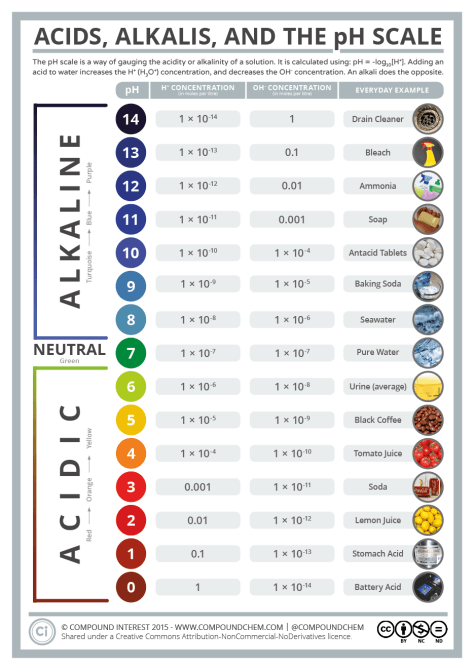
The words acid, base, and neutral are all familiar. By now in your schooling you have probably learned that water is a neutral substance, lemon juice is an acid, and bleach is a base. You may have been introduced to the pH scale where you learned that water has a pH of 7, while acids have a pH of between 0 and less than 7 and bases have a pH of greater than 7 up to 14. In fact, the pH of lemon juice is around 2.0, while the pH of bleach is around 12.6. Lemon juice is a fairly strong acid, while bleach is a strong base. Your blood has a pH of 7.4, making it slightly basic.
So what exactly makes something an acid or base? Why are some acids and bases stronger than others? Click the image below (or just click here) and read all about the relationship between hydrogen ion (H+) concentration and pH.
Next, watch the video below from Mr. Anderson at Bozeman Science:
We conclude our study of evolution with at a look at our own evolved humanity. Watch the video below, focusing your attention on both the evolution-related content as well as on the types of jobs you see people doing. Can you imagine yourself pursuing any of the careers shown? After watching the video, complete the Origin of Humans Google Form assignment with questions about the video. The video is also embedded in the Google Form assignment so you can easily reference it when answering the questions.
Next, it’s time to visit the Australian Museum. The staff there have assembled an amazing collection of resources to extend your learning about human evolution. Before you go, here’s the assignment:
Read an article from the collection.
Summarize your learning about the article in the Human Evolution Google Form.
Repeat steps 1 and 2, but with an article from a different group of articles. For example, if you read an article from the first group (Becoming human), your next two articles must be from other groups (for example, Where do we fit in? and Meet the family).

 Science with Swart
You must be logged in to post a comment.