All posts by David Swart

High school science teacher

Physical Anthropologist

Physical Anthropologist

Directions:

  • Individually: In the BSCS Biology textbook, read and follow directions for Physical Anthropologists on pgs 47-49 through #2g but skipping b and d.
  • Individually: Write notes on Interview with a Physical Anthropologist in your notebook
  • Team: Observe, measure, and compare mystery bones, record in data table (2a 1-2)
  • Individually: Write explanation (2a 3)
  • Individually: Read “Primates Show Change Across Time” essay on textbook p. 110
  • Team: Discuss questions 2c 1 and 2
  • Individually: Write your ideas in response to questions 2c 1 and 2
  • Individually: Write inference
  • Individually: Complete the Skull Analysis Gizmo
  • Team: Prepare a presentation to share with the class:
    1. Description of their career
    2. Hominid Fossils
      • Summarize evidence you found
        • Indicating change over time
        • Indicating relatedness of early and modern hominids

Developmental Biologist

Developmental Biologist

Instructions:

  • Individually: Read and follow directions for developmental biologist through 2d on pages 45-47 of the BSCS Biology textbook.
  • Individually: Write notes on Interview with Developmental Biologist
  • Team: Arrange the embryo drawings in order, compare with answer key, discuss questions in 2d.
  • Individually: Write explanations to questions in 2d.
  • Individually: Once you’ve completed 2d, read “How DNA provides evidence for evolution” and answer these questions in your notebook:
    • Where is DNA located and what does it do?
    • How is DNA used as evidence for evolution?
  • Team: Complete the Molecular Connection (cytochrome C) activity in packet.
  • Team: Prepare the poster for presenting with the class:
    1. Description of their career
    2. Embryology
      • What you learned from studying different stages of embryos from different organisms and how information is used as evidence for evolution
    3. DNA Comparison of Cytochrome C
      • Share the cladogram and explain how it was constructed
      • Summary about how DNA analysis contributes evidence to the theory of evolution

Evidence for Change

Welcome to the Evidence for Change across Time activity!  As part of our Evolution Project, you were tasked with identifying careers associated with the study of evolution.  We will expand on what you learned about those careers in this activity.  You will be assigned to one of four careers.  Your job: complete the assigned tasks for your career.  Some parts of the activity should be completed as a team.  Other parts are to be completed individually, with the understanding that the members of your group are available for consultation.  You are expected to actively engage in your own learning and to share your learning with others.

For this project, you will be assigned to a team of 3 or 4 students.  Each team will receive a folder.  Please keep the  materials in the folder organized as they will be used by students in multiple classes.  You are expected to sit with your team this week and use class time efficiently.  Please do not ask to change groups.  You will present your work Friday, so your research and presentations must be completed and assembled before class begins Friday.

This work will count as your Evolution Unit Final Exam.  To receive credit, you must complete all individual and group work, document all of your research, and turn in all of your documentation in addition to preparing and sharing your findings during the presentation.  This will be your final grade for third quarter.  Late work will not be accepted.

Once you receive your assignment, it’s time to go to work!

Evolutionary Biologist

Evolutionary Biologist

Directions:

  • Individually: Read and follow ALL directions for Evolutionary Biologists on pgs 44-45 of the BSCS Biology Textbook.
  • Make sure the following information is written in your notebook:
    • Notes on Interview with an Evolutionary Biologist
    • Notes/diagrams of dissection
    • Coloring sheets complete
    • Answer to question 2e (pg 45)
    • Notes from essay, “Evidence for Evolution: Vestigial structures” Not the one in the book
    • Answer to question 3a (pg 45)
    • Answer to question 4 a-b (pg 45)
  • Team: Create a poster that you can use to explain to your classmates of how fossils form and how they can be dated. Use the half-slip in your packet that explains exactly what needs to be in your final presentation.
    1. Description of their career
    2. How each of the following is evidence for evolution
      • Comparison of chicken dissection wing with bat wing and human hand diagrams
      • Description of vestigial structures (what, why & how)
      • Description of homologous structures (what, why & how)

Earth History Timeline

Now that students better understand how scientists use radiometric dating to determine the age of physical items and structures, it is time to look into the deep history of Earth.  Students should research the following events, determine when they occurred, and construct a timeline of the events:

  • First dinosaurs
  • Formation of Mount Rainier
  • First hominids
  • Break up of Pangea
  • First vertebrates
  • First life (bacteria)
  • First modern humans
  • First oxygen in the atmosphere
  • First land plants
  • First animals

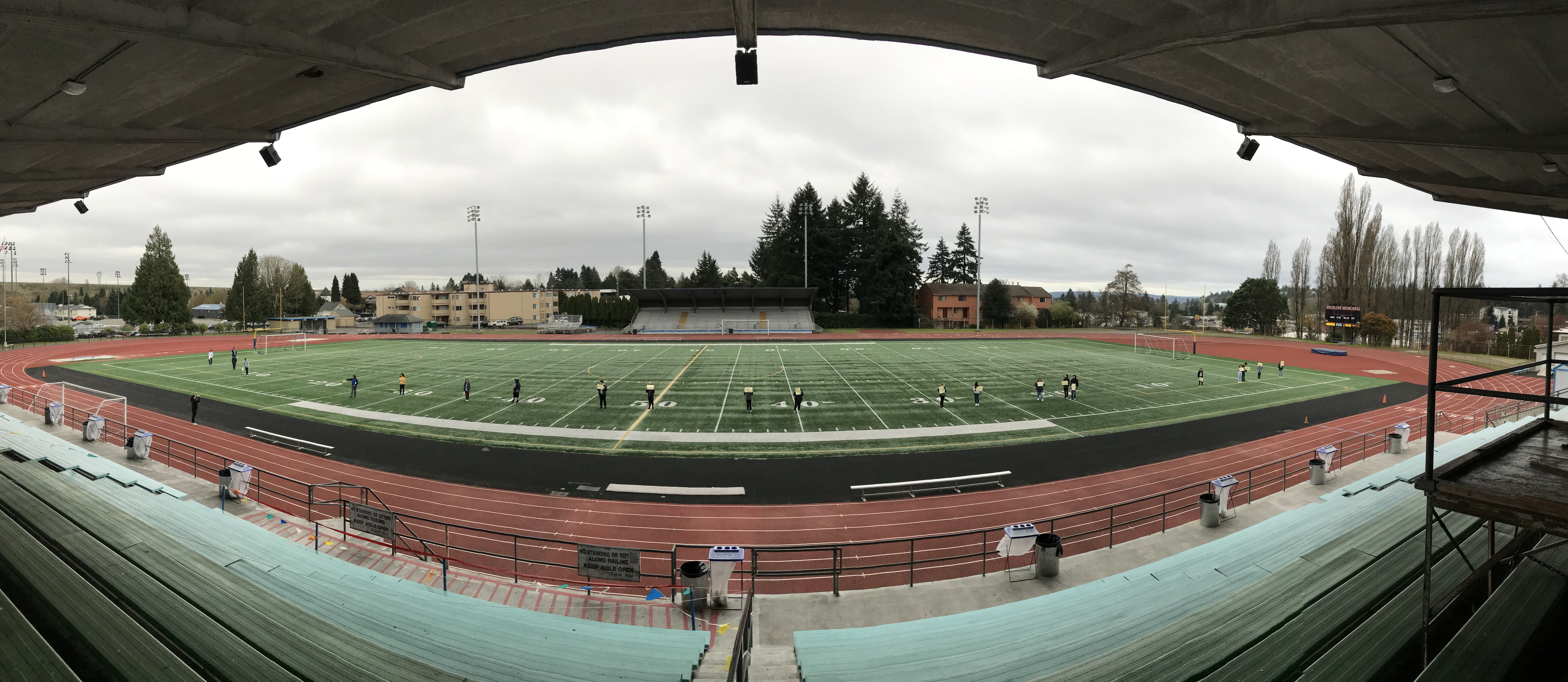
On Friday, we made a timeline of the last billion years of Earth history on the football field:

IMG_1553
1st Period Timeline
4th Period Timeline
6th Period Timeline

After we debriefed the timeline exercise back in the classroom, if time permitted, students watched one of the two videos below:

There’s Mounting Evidence The African Continent Is Splitting in Two

Homework Review

Before we dive too deeply into pH, we take today to brush up on unit conversion and scientific notation using the Unit Conversions 2 – Scientific Notation and Significant Digits Gizmo.  Students who needed additional time and/or help with homework had the opportunity to work in small groups and with the teacher.  At the end of class, students who want the opportunity to re-take the chapter 15 quiz received the Chapter 15 Quiz Retake Ticket as homework.  The packet requires students to show their work as they solve problems and the packet must be completed correctly before students may retake the quizStudents who want to retake the Chapter 15 quiz must do so after school on Monday, April 2.

Acid and Base Theory

We extended our learning about acids and bases by learning and applying the Arrhenius and Bronsted-Lowry definitions via the Lesson 85 PowerPoint, the Lesson 85 worksheet, and the Acid-Base Solution Card sort activity.  For homework, students were assigned textbook problems #1-8 from Lesson 85.

Students who would like to further their understanding of Bronsted-Lowry acids and bases are encouraged to watch the Khan Academy video provided below:

Radiometric Dating

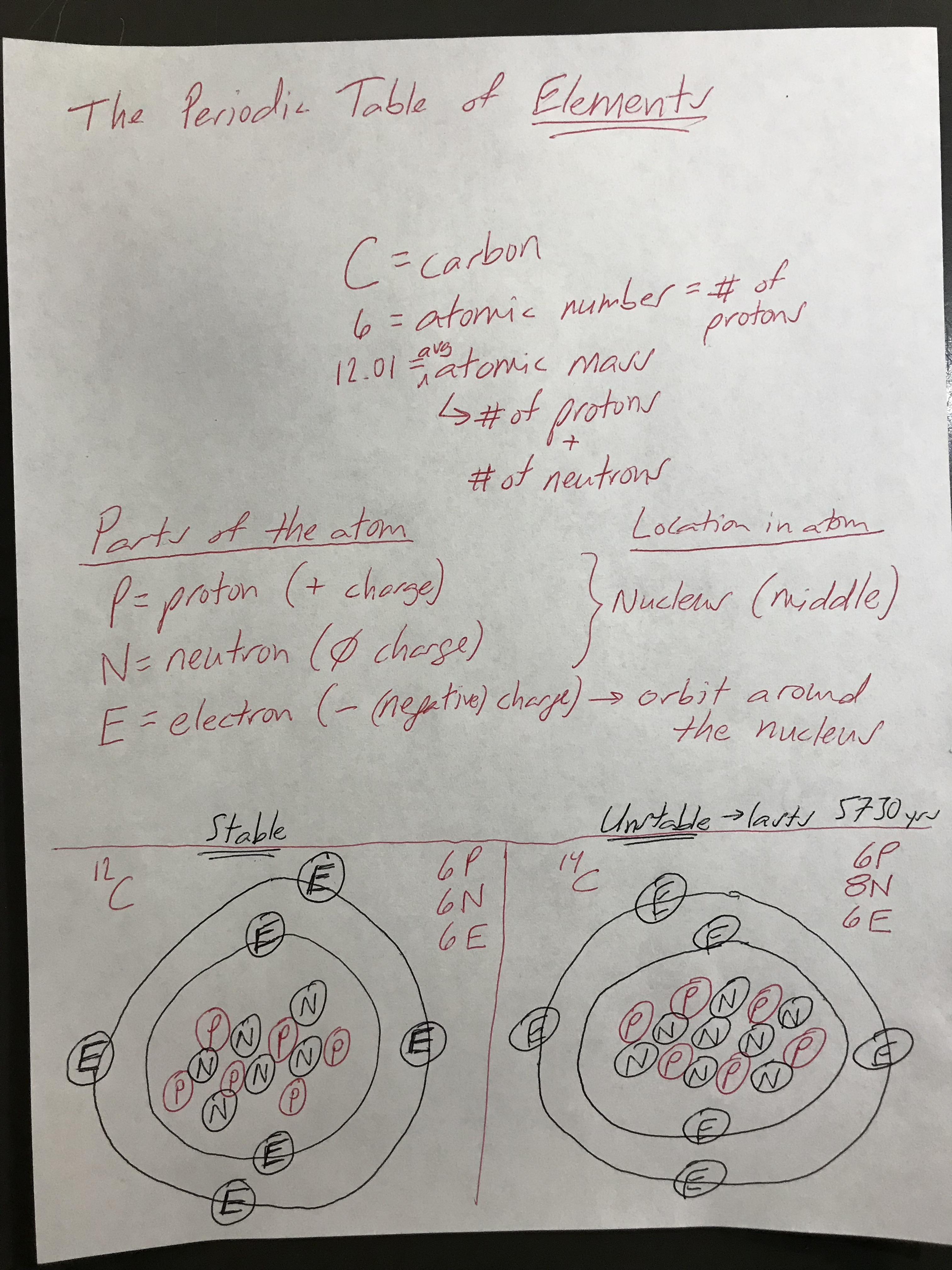
Last week, we learned about Darwin’s voyage and how he collected data to formulate his theory of evolution.  We went on to study biological classification, using the system devised by Linneaus way back in 1735.  Previously, we learned that scientists collecting were able to date common ancestors of humans to over 3 million years ago.  Our work over the next few days will be to learn how scientists use radiometric dating to estimate the age of really old samples.  We will begin an introduction to chemistry, focusing our efforts on understanding the difference between carbon-12 and carbon-14 atoms.  Class notes are pictured below:

Next, we will watch a video introducing radiocarbon dating:

After the video, we will begin the Radioisotopes Activity.  We will read through the first few pages, and then tomorrow students will work with a partner to complete the activity which is anticipated to wrap up by Wednesday.

Acids and Bases

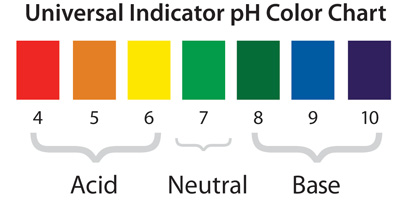
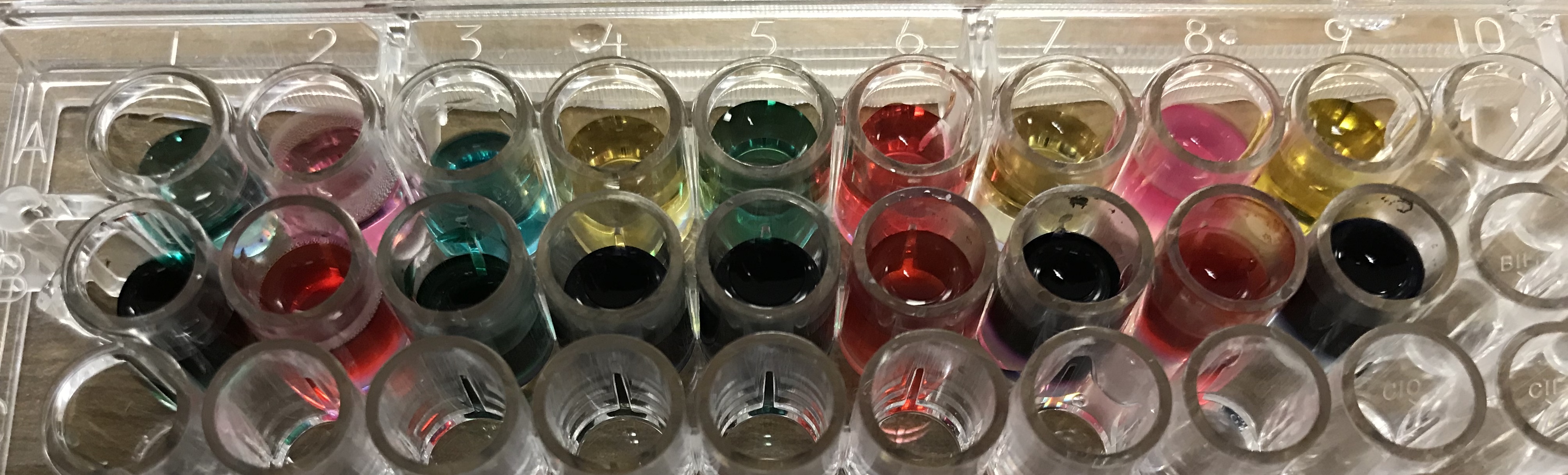
For the first lesson of chapter 16, students were formally introduced to acids and bases via a lab.  We began class with the Lesson 84 PowerPoint which included a starter question helping students connect acid/base chemistry with the biology of heartburn.  After learning about indicators, chemical solutions that change color in response to changes in pH, we reviewed the Lesson 84 worksheet.  For Part 1, students were instructed to number the nine solutions in order, with the number on the worksheet corresponding to one of nine numbered flasks containing the indicated solution. An image of the lab setup is shown below:

After students complete the lab portion of Part 1, they were instructed to return to their seats to complete the Part 1 analysis questions.  We will share out results as a class, and if time permits, conduct Part 2 as a teacher-led demonstration.

Universal Indicator Chart


Red cabbage indicator chart

Example of student results with indicators – samples are arranged #1-9 in rows A and B, with cabbage juice indicator in row A and universal indicator in row B.

Part 1 Student Results

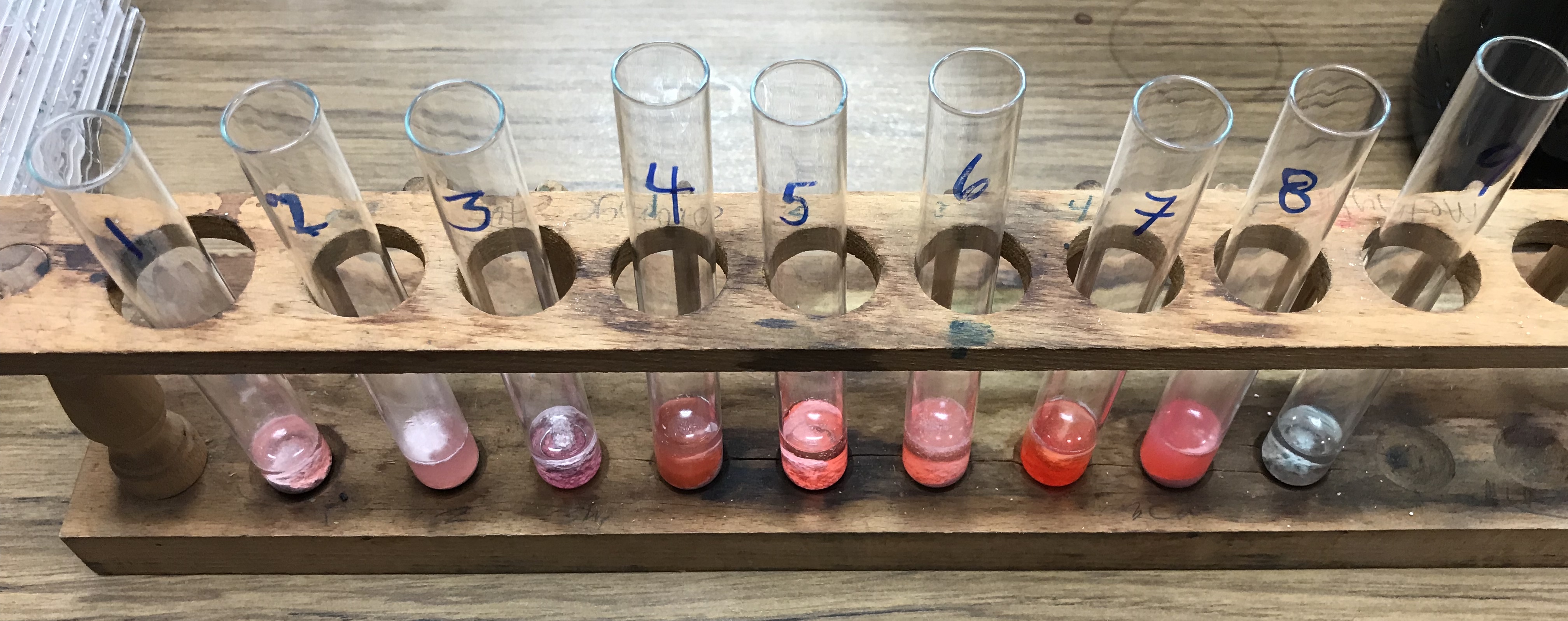
Results from the teacher-led demonstration for Part 2 are shown below:

Acidic solutions reacted with the calcium carbonate antacid tablets (Tums).