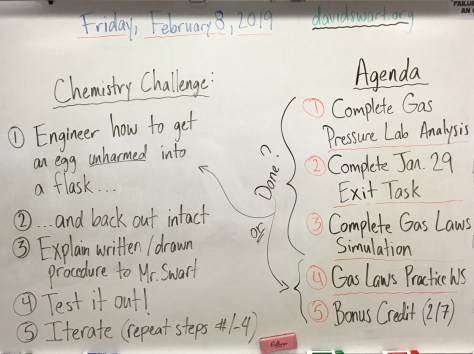
With Snowpocolypse on the horizon, rather than introduce the Combined Gas Law, students had the class period to complete unfinished assignments, practice the gas laws, or attempt the chemistry challenge. For convenience, here are links to:
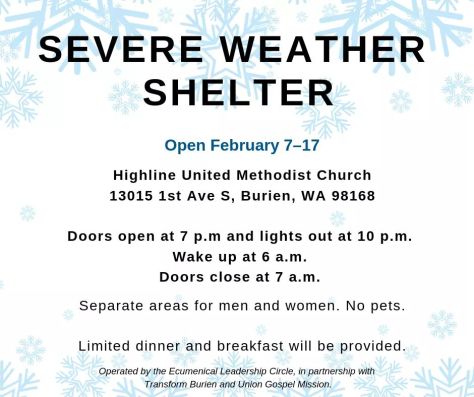
Please stay warm and safe this weekend. If you or anyone you know needs help staying warm, please see the flyer below (distributed by Highline Public Schools Central Office).
Our work today involves revisiting the gas pressure lab from last week (handout available in class), with an emphasis on:
Working efficiently in class
Cultivating relationships with new seat partners
Acquiring robust experimental data for each part of the activity (robust = pressure of >100 for each data point)
Average = (Trial 1 + Trial 2) / 2
Robust analysis that includes evidence obtained from the lab. Keep asking yourself “why?” and then include “because” statements. You have reached the limit of your understanding when you run out of “because” statements.
HHS Days of Respect Student Survey (2nd period) – Available in both English and Spanish
Bonus Learning (and Credit) Opportunities!
With more snow in the forecast, it is possible we will miss additional school days next week. Here are a bunch of ways you can score bonus credit – up to and including dropping your first mini-quiz score! Disclaimer: all work must be original, with sources cited using APA format (Citation Machine can help!)
Make a video of one of the three Gas Pressure Lab activities. Explain what the activity is modeling, how the data were collected, what the results were, and deeply analyze the results in the context of n, T, V, and P. Videos must be posted to YouTube and the link emailed to Mr. Swart. Quality video submissions will earn +3 bonus points on the last mini-quiz (max of 3 people/team). Winning videos will be linked to the class website and team members will have the option of bonus points or dropping their mini-quiz score.
Make a poster of one of the four Gas Laws we have learned so far (Avogadro’s Law, Boyle’s Law, Charles’ Law, and Gay-Lussac’s Law). Poster most include the name of the law, the equation, trends (example: as Pressure increases, Volume decreases), and an example problem with the solution. The poster must be colorful and big enough for the name of the law and the equation to be seen from across the room. Quality posters will earn +3 bonus points on the last mini-quiz (max of 2 people/team). Winning posters will be displayed in class and team members will have the option of bonus points or dropping their mini-quiz score.
Get creative! Write a piece of fiction, create a game, code a spreadsheet, paint a picture, you name it! Explain one or more of the gas laws using your creativity to help make our work engaging for others. Quality original work will be displayed in class and team members (3/group max) will have the option of adding 3 bonus points or dropping their mini-quiz score.
Get analytical! Find a moment from your life experience, your favorite book, movie, video game, etc. Write at least one solid paragraph explaining the moment as it relates to one or more of the gas laws and earn +3 bonus points on the last mini-quiz.
Investigate the scientists behind the gas laws. Who were Avogadro, Boyle, Charles, and Gay-Lussac? Write a brief biography of one or more of these scientists explaining when and where they lived, what led them into science, how they discovered their laws, and what additional contributions they made to science. Finally, explain at least one specific way that scientist’s gas law has improved our understanding of the world or contributed to a technological innovation. Quality submissions earn +1 bonus point per scientist on the last mini-quiz. Submissions must be your own writing and references must be cited using APA format to earn credit. Need help with citations? Try Citation Machine.
For our work today, students have the class period to complete their analysis of yesterday’s activity and then they can work in pairs to complete the Gas Laws Simulation and accompanying guided work packet.
Notes From Class:
Students received a handout with notes explaining how to convert between Fahrenheit, Celsius, and Kelvin (temperature units). The answer key for the questions within the notes is shown below:
Our mini-unit began with a brief silent video introducing the Gas Laws. Students were tasked with making written observations and then we held a class discussion and produced a chart of what they Know, Think They Know, and Need to Know. Next, students were introduced to Robert Boyle, one of the great chemistry scientists from history who contributed greatly to our understanding of Gas Laws. The video can be accessed by clicking here and using the passcode provided in class.
The lesson concluded with an activity in which students worked in groups to simulate the movement of gas molecules, calculating how a change in variables (temperature, volume, and pressure) affects the rate of molecule collisions.
For the final 10 minutes of class, students completed the 1st Semester Reflection (Exit Task) and received back their graded Unit 2 Exam.
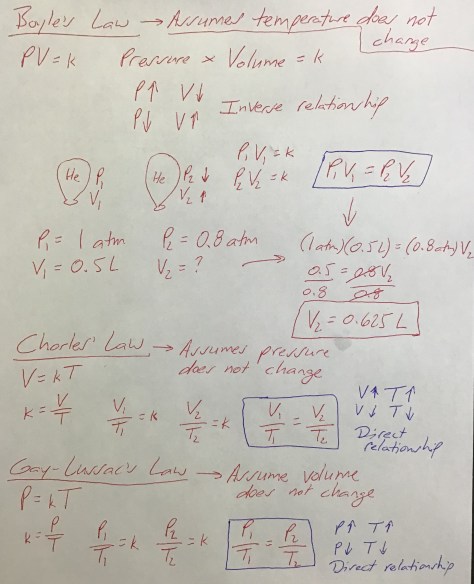
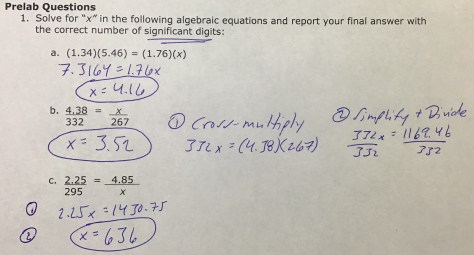
Updated 1/30 – For the second day of the lesson, we reviewed the gas laws and reviewed basic algebra skills to help prepare for making calculations with the gas laws. Class notes are shown below, and the slide deck with important definitions covered thus far are available as a PowerPoint (unit 3 vocabulary).
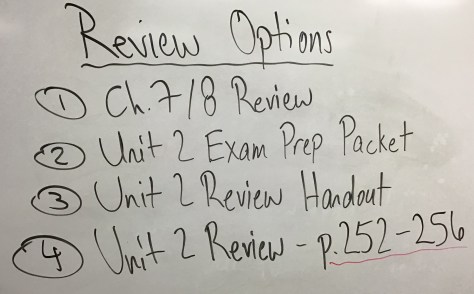
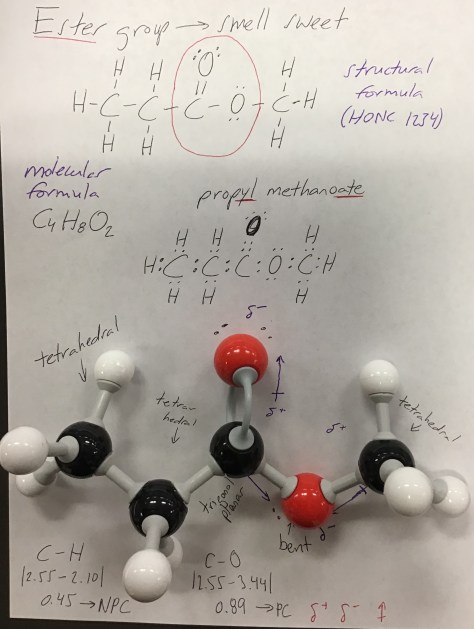
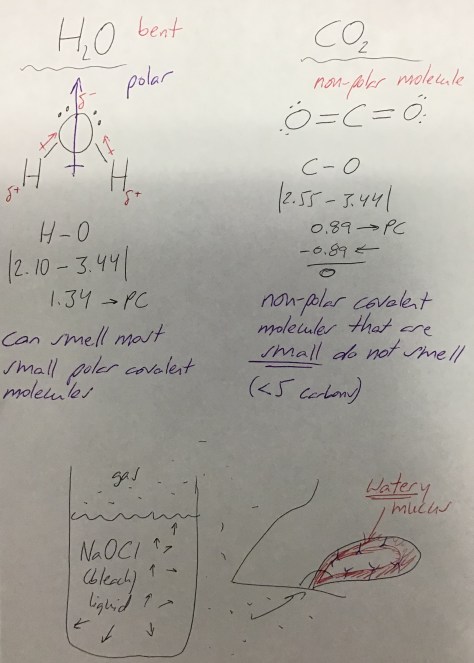
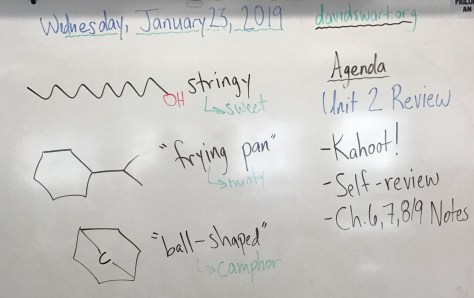
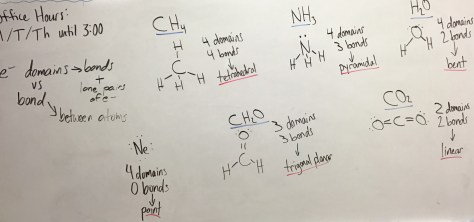
Our review today consisted of a Kahoot! which covered the 20 multiple choice questions from the unit 2 review section in the textbook, followed by a review of functional group structures and smells. Notes from the whiteboard are pictured below:
There are a variety of resources provide below to enhance your understanding of scientific notation and plenty of opportunities to practice those skills.
There are a variety of resources provide below to enhance your understanding of SI Units of Measure (also called the Metric System) and Dimensional Analysis (also called Unit Conversion), and plenty of opportunities to practice those skills.
Reading Resources (with practice problems):
Appendix A (pages A0-A1 for SI Units of Measure, and pages A16-17 for Dimensional Analysis) in our textbook
There are a variety of resources provide below to enhance your understanding of ratios and proportions, and plenty of opportunities to practice those skills.
There are a variety of resources provide below to enhance your understanding of calculating averages (also called the mean) and how to graph, and plenty of opportunities to practice those skills.



 Science with Swart
You must be logged in to post a comment.