
Weeks 34-35 – Routes of Exposure

This week, you will be researching the question, How much is too much?  To begin, we will consider the four ways we can be exposed to a toxic substance:

  • Inhalation: breathing a toxic substance in through your mouth or nose
  • Absorption: skin or eye contact with a toxic substance
  • Ingestion: eating or drinking a toxic substance
  • Injection: puncture wound where the skin is pierced and a toxic substance is introduced into the body

In the high school science lab, we have a variety of ways to minimize risk to exposure to toxic substances.

  • Inhalation: Work with toxic gases in the fume hood, circulate air through open doors and windows, use the fan system in the room to circulate fresh air.
  • Absorption: Wear goggles to protect eyes, wear gloves to protect hands, wear aprons to protect bodies, wear long-sleeved shirts and pants to protect arms and legs, wear closed-toe shoes to protect feet.
  • Ingestion: Never, ever eat or drink in the lab.  This one is by far the hardest for students to understand.  Take a look at your bedroom – is it spotless?  How about your bathroom?  Odds are, both could use a good cleaning.  Assume the same with the lab space.  Never, ever eat or drink in the lab.  Assume something toxic was spilled on your lab bench the class before and the clean-up job was less-than-perfect.  It is easy to touch a contaminated bench top with your hands, then use your hands to eat or drink, thus causing you to inadvertently ingest a toxic substance.  For obvious reasons, this is why we never, ever, eat or drink anything produced in the lab.  Even if it were perfectly safe outside the lab, inside the lab we must always assume the labware used to conduct the experiment was previously contaminated with something toxic.  Rant over.
  • Injection: Never pick up broken glassware without proper safety equipment (i.e. gloves, tongs) as a toxic substance on the surface of broken glassware can enter your body if the glassware cuts you.

Your turn to show what you know.  Complete the Routes of Exposure Google Form and then return to Weeks 34-35 – How Much Is Too Much? and continue working.
Weeks 34-35 – What is an Enzyme?

For starters, what is an enzyme?  From Simple English Wikipedia: Enzymes are protein molecules in cells which work as biological catalysts. Enzymes speed up chemical reactions in the body, but do not get used up in the process, therefore can be used over and over again. Almost all biochemical reactions in living things need enzymes.

To learn more about Enzymes, watch the video below and then complete the Enzymes Google Form assignment.  Note: after you submit the form, view your score.  You can re-submit the form if needed to improve your score.  Just make sure you improve your learning as well!

Take a breather from all that hard work and play a game of Google PAC-MAN.

Return to the Weeks 34-35 – Lactase Persistence post and continue our work for the week.

Weeks 34-35 – Toxicology

Toxicology is the the scientific study of the adverse effects of chemical substances on the living organism (Merriam-Webster).  In Slide 1, you identified the chemical structure of a toxin molecule.  In Slide 2, you will further define the biochemical properties of the molecule.  To begin, click on the link in Slide 1 and return to the PubChem database entry for your toxin molecule.

Instructions for Slide 2:

  • Add Slide 2 to your Google Slides deck and title it “Toxicology”
  • On Slide 2, answer the following:
    • How does the toxin interact with the human body?
      • Explain effects on the body as a whole, on specific organs, and at the cellular level.
      • Does the toxin act directly on cells, and if so, how?
      • Is the toxin metabolized by the kidneys or liver, and if so, how?
    • Are there treatments available for people who are exposed to the toxin?
      • If yes, how do treatments to the toxin work? Explain the mechanism of action for each treatment:
        • Does the treatment act against the toxin directly?
        • Does the treatment act on the body to protect against the toxin?
        • Does the treatment act on a metabolite produced after the toxin is metabolized by the liver or kidneys?
      • If no, look for evidence of failed treatments.
      • If you can’t find any information at all regarding treatment, propose a treatment and explain your thinking.

Need help?  You have options:

  1. Click here and watch a video of Mr. Swart guiding you through the process of conducting the research to complete Slide 2.  You will also be provided with an example of Slide 2.
  2. Attend office hours on Tuesday and/or Thursday
  3. Email Mr. Swart with specific and detailed questions.

When finished with Slide 2, return to Weeks 34-35 – How Much Is Too Much? and continue working.

Weeks 34-35 – Graph of LD50

For the final slide of the Toxin Research Project, you will create a graph of the LD50 data from Slide 3.  You have many different options for creating the line graph, some of which include:

Instructions for Slide 4:

  • Add Slide 4 to your Google Slides deck and title it “Graph of LD50
  • Add your graph to Slide 4.  A complete graph includes:
    • Graph Title
    • X-axis Label (body mass (kg))
    • Y-axis Label (lethal dose (mass units from LD50 numerator))
    • Three coordinates (x,y) = (body mass, lethal dose) from Slide 3
    • A line connecting the three points
  • Determine the slope of the line.  What does it mean?

Need help? Click here for an example of a graph created using Google Sheets.

You did it!  Congratulations on completing the Toxin Research Project.  Be sure to share your Google Slides with Mr. Swart at david.swart@g.highlineschools.org and you should also share your hard work with everyone at home!

When finished, return to Weeks 34-35 – How Much Is Too Much? and continue working.

Week 34 – Bonus Credit Opportunity

Looking to earn some bonus credit and boost your grade?  You’ve come to the right place!  Each week, you will have the opportunity to earn bonus credit for completing extra learning about science…or maybe “just” thinking what you would do with a pile of cold hard cash.

This week’s bonus credit opportunity is called…Invest in Your Future.  We all dream about what we might do if we won the lottery.  It’s a great way to unshackle ourselves from our current realities and think about what we might do if we had a pile of money.  For this week’s bonus credit opportunity, I want to know  exactly what you would do with $100,000.  How would you invest in your future?  I want specifics!  “Save for college” is a phrase, not a paragraph.  Where would you attend college and what would you major in?  “Buy a car” – what kind and why?  “Start a business” – what kind and why?  “Invest in the stock market” – which stocks and why?  Click here and fill out the Google Form.  That’s it!  +10 bonus in the Assignment category.

Weeks 34-35 – What’s Wrong with Claire?

To conclude our learning about enzymes, complete the Enzymes STEM Case Gizmo.  This is a new type of Gizmo – everything is self-contained within the simulation.  No packet to complete!  Work through the STEM Case to find out what’s wrong with Claire.  Hint: it has something to do with her enzymes!  To receive credit for the assignment:

  1. Create a Google Doc titled “What’s Wrong with Claire? – Your Name” (example: What’s Wrong with Claire? – Pierre Swart)
  2. Copy and your first Hypothesis statement from the Gizmo and paste it into your Google Doc
  3. Repeat step 2 each time you revise your hypothesis
  4. Briefly explain what was wrong with Claire
  5. Take a screenshot of the Case Completed screen
  6. Share the Google doc with Mr. Swart at david.swart@g.highlineschools.org

Return to the Weeks 34-35 – Lactase Persistence post and continue our work for the week.

Weeks 34-35 – Types of Exposure

When we consider chemical exposure, it’s important to think about frequency: how often will exposure occur?  Imagine you are at the gas station.  It’s a warm day, and as you fill you fill your tank with gas, you smell the faint scent of gasoline vapor in the air.  As you wrap up and put the nozzle back on the pump, a few drops of gas fall from the nozzle, thus preparing the scene for the next person.  You just experienced an acute inhalation exposure to gasoline vapor.

  • Acute: exposure to a chemical for 24 hours or less

Thankfully for you, it is a low-level exposure; you will be fine.  For the attendant who has been working at the gas station for the last few years, every time they tidy up the pumping area (take out the garbage, change out the soapy water for washing windshields, sweep up litter, and spread kitty litter to absorb larger gas spills) they are experiencing chronic exposure to inhaled gasoline vapors.

  • Chronic: exposure to a chemical for more than 3 months

When it rains, those drops of gasoline are washed down into the sewers and are carried out into Puget Sound.  Fish swimming in the area come into contact with the gasoline, absorbing it through their eyes and skin and inhaling it through their gills.  The gasoline evaporates when the weather turns sunny again, so the fish are only exposed for a few days (sub-acute exposure).

  • Sub-acute: exposure to a chemical for 1 month or less

Birds in the area feed on the gasoline-exposed fish.  It takes a few months for the birds to fully metabolize the gasoline ingested with the fish (sub-chronic exposure).

  • Sub-chronic: exposure to a chemical between 1 to 3 months

Your turn to show what you know.  Complete the Types of Exposure Google Form and then return to Weeks 34-35 – How Much Is Too Much? and continue working.

Weeks 34-35 – Lactase Persistence

Welcome to Weeks 34 and 35!  We continue our study of evolution, and specifically co-evolution, by focusing on the enzyme lactase.  You have two weeks to complete this work.  The recommended weekly work schedule is provided below.  You must complete the weekly attendance check-in, but you are welcome to adjust the learning schedule to meet your own needs.

Week 34 (recommended)

  1. Week 34 Attendance Check-In (required by 10am 5/15)
  2. What is an Enzyme? (Google Form assignment)
  3. Enzyme Lab-At-Home (Learning required, Lab Report optional)

Week 35 (recommended)

  1. Week 35 Attendance Check-In (required by 10am 5/22)
  2. Got Lactase? (Google Form assignment)
  3. What’s Wrong with Claire? (Gizmo notes in Google Doc)

You did it!  Just to make sure, here’s a checklist of items you must complete this week by Sunday, May 24 at 11:59pm:

  • Week 34 Attendance Check-In (school district requirement)
  • Week 35 Attendance Check-In (school district requirement)
  • Enzyme Google Form (worth 15 assignment points)
  • Optional Enzyme Lab Report (worth 40 lab report bonus points)
  • Got Lactase? Google Form (worth 15 assignment points)
  • Enzymes STEM Case Gizmo Google Doc Notes (worth 10 assignment points)

Remember, you can email me any time.  Office hours for Science are Tuesdays from 11am-12pm and Thursdays from 1pm-2pm.  Check your student Gmail for Zoom instructions.

Don’t forget to complete the Week 34 and Week 35 Bonus Credit Opportunities!  Check out the amazing artwork students are submitting as part of the Week 35 Bonus Credit Opportunity.


Weeks 34-35 – Toxin Research

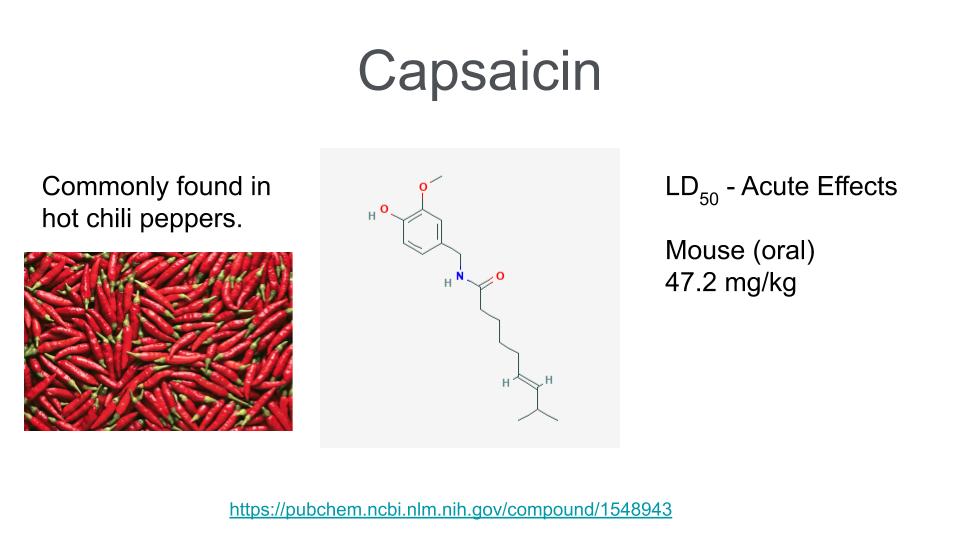
Now that we understand some of the variables involved with evaluating exposure to toxic chemicals, it’s time to move forward with the Toxin Research Project.  The first step is to decide which toxin you want to research.  You are welcome to select anything of interest to you, as long as you can identify a specific molecule in the PubChem (NCBI) database AND you can find an appropriate LD50 for the molecule.

For inspiration, the websites below can help get you started:

For this part of your work, you need to create a Google Slides document.  All of your Toxin Research Project work will go into the Google Slides.  Instructions for completing this part of the work:

  1. Create a Google Slides document
  2. Title the document “Toxin Research Project – Your Name”
    • Example: Toxin Research Project – Pierre Swart
  3. Slide 1 must include:
    1. Name of the molecule
    2. A link to the PubChem database entry.
    3. An image of the molecular structure.
    4. How someone might be exposed to the molecule (i.e. a specific food, drink, plant, animal, type of work, a location in the environment where it naturally occurs, etc).
    5. The LD50 for the molecule (including species and route of administration) most relevant to the route and type of exposure you selected.

The molecule name, image, and LD50 for the molecule should all be found in the PubChem database.  If you select a toxin from the list above, the linked article will provide you with information about exposure to the molecule.  If you pick a toxin not on the list, you will need to do that research on your own.

Need help?  You have options:

  1. Click here and watch a video of Mr. Swart guiding you through the process of conducting the research to complete Slide 1.  You will also be provided with an example of Slide 1.
  2. Attend office hours on Tuesday and/or Thursday
  3. Email Mr. Swart with specific and detailed questions.

Finally, I would like to be able to post these online to share with each other.  Please be creative in your layouts and make sure your name is not actually on the slide anywhere.  Your name should only be in the title of the document.  Have fun!

When finished with Slide 1, return to Weeks 34-35 – How Much Is Too Much? and continue working.