Week 36 – Molarity

If you’ve ever made ice tea and decided it needs more sugar, you understand the importance of solution concentration.  Add too little sugar and the sugar concentration is too low to make the ice tea pleasantly sweet.  Add too much sugar and the ice tea just tastes like sugar water because the sugar concentration is too high.  Somewhere in there is the ice tea Goldilocks zone – just the right amount of sweet.  If you have access to water, a measuring cup, a glass, some tea, some sugar, and a teaspoon: fill a glass with one cup (8 ounces) of cold water, add one bag of tea, and let it steep while you continue working.


Back to our lesson: we need to understand the concept of molarity which is defined as the concentration of dissolved substances in a solution, expressed in moles of solute per liter of solution.  We use M as the unit of molarity (M = mol/L).  We already know how to calculate moles from grams, so just take moles and divide by volume (in liters) to calculate molarity.  Here’s an easy example question: glucose has a molar mass of 180 g/mol.  If 90 g of glucose is added to 1 L of water, calculate the molarity of the solution.  Answer: 90 g x 1 mol / 180 g = 0.5 mol, 0.5 mol / 1 L = 0.5 M.  The molarity of the solution is 0.5 M.


Here’s a harder example question: A 20 fluid ounce bottle of Dr. Pepper contains 64 grams of sugar (high fructose corn syrup).  Determine the molarity of sugar Dr. Pepper.

To approach this question, we need to know some additional pieces of information.  Ultimately, we need our answer in units of M, or mol/L.  So we need to convert ounces to liters and we need the molar mass of high fructose corn syrup.

Key information:

  • 1 L = 33.814 fluid ounces
  • High fructose corn syrup consists of glucose and fructose, both of which have a molar mass of 180 g/mol.

Answer: First, let’s convert 64 grams of sugar to moles: 64 g x (1 mol / 180 g) = 0.36 mol of sugar.  Next, let’s convert 20 ounces to liters: 20 ounce x (1 L / 33.814 ounces) = 0.59 L.  Finally, we just need to divide moles by liters to calculate molarity: 0.36 mol / 0.59 L = 0.61 M.


Let’s turn our attention back to the tea we started making at the beginning of this lesson and wrap this up with a more challenging practice problem.  Question: If we add one teaspoon of table sugar to our 8 ounce glass of tea, what is the molarity of the solution?

Key information:

  • 1 L = 33.814 fluid ounces
  • molar mass of table sugar (sucrose) = 342 g/mol
  • 1 teaspoon of table sugar = 4.2 grams

Answer: Let’s begin by calculating the number of moles of sucrose (table sugar) added to the tea.  One teaspoon = 4.2 grams of sucrose.  4.2 grams x (1 mole / 342 g) = 0.0123 mol of sucrose.  Next, let’s convert 8 ounces to liters: 8 ounces x (1 L / 33.814 ounces) = 0.237 L.  Finally, to calculate molarity (M), divide moles by liters: 0.0123 mol / 0.237 L = 0.052 M.


Time to show what you know!  Complete the Week 36 – Molarity Google Form assignment and then return to Week 36 – Solution Concentration and continue working.
Week 36 – Dichotomous Key Project

One month ago, we planted our vegetable garden.  It was the reward for several weeks of arduous labor (about which my kids are still complaining).  This week, we will observe together the miracle of biology: after a little more than 4 weeks, what began as a tiny little seed is now a plant with interesting and complex structures, well on its way to maturing into something that will produce food for us in a few months.  From the perspective of the plant, feeding us isn’t the goal.  The plant has domesticated humans by convincing us to cultivate it, thus ensuring the plant and its offspring survive for future generations.  Same with cats and dogs – we like to pretend we’re in charge, but really the creatures we love as “pets” have actually been stunningly successful at domesticating humans and getting us to feed, shelter, love, and protect them.  Who is really in charge?

But I digress!  Back to plants and our work for the week.  Your job is to look through the pictures of individual plants from the garden.  The pictures show the plants after 3 weeks of growth (they were taken last weekend).  The plants are labeled so you will know what you are looking at.  Take notes about the characteristics of the plants – you will need those notes to construct a dichotomous key.  (Click here for a refresher about dichotomous keys).  Your goal for the week is create a tool that can be used by a vegetable gardener to know which plants will produce which vegetable and to help the gardener know which plants are weeds and should be removed from the garden.

Instructions:

  1. Observe the pictures of garden vegetable plants after 3 weeks of growth (from seeds).  The same pictures in the link are also provided here as a slide show.  Use whichever is easiest for you.

    This slideshow requires JavaScript.

  2. Record (write down!) detailed observations in a Google Doc titled “Vegetable Garden Dichotomous Key – Your Name”.  This means, make a list of the 25 plants.  Write down detailed observations of each plant.  Your observations will serve as your evidence for how you construct your dichotomous key.
  3. In your Google Doc, organize the plants into groups based on similarities.
  4. In your Google Doc, create a dichotomous key to determine the identity of each plant through a series of questions.  Look for differences between the groupings of plants you created and then write the differences into questions.  For example, if you have a group of pink plants (which you do not!) while the rest are green, Question 1 might be: Is the plant pink?  If yes, go to question 2.  If no, go to Question 3.  Note: you can construct a flowchart instead if you find that easier. 
  5. Need help? Click here for a Dichotomous Key Project example.
  6. When finished, Share the Doc with Mr. Swart at david.swart@g.highlineschools.org

Return to Week 36 – Inferring with Evidence and continue working.
Week 36 – Mint Plant Cuttings

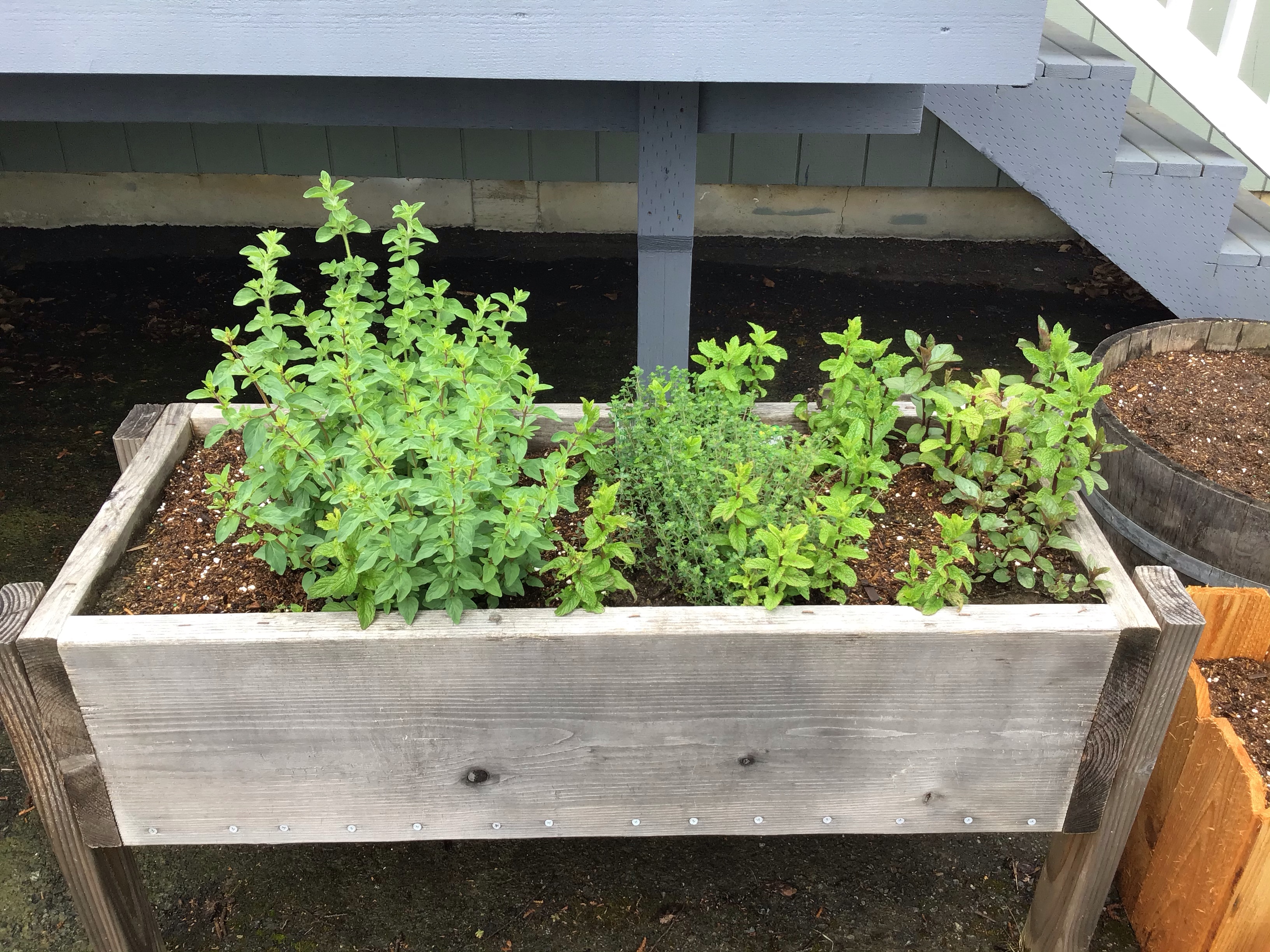
Looking to grow some new plants for free?  If you know someone with an herb garden, ask for a couple of mint cuttings.  Wrap the ends of the cut mint plants in a moist paper towel and place them in a plastic bag.  As quickly as possible, transfer the cut off the lower leaves and place the stem in water.  Add water as needed to ensure the stem stays submerged.  After about a week, your mint will sprout roots!  Let the roots grow for a few more days, then transplant the mint cutting to soil.  You have a new mint plant!

Here’s a photo of our small herb garden:

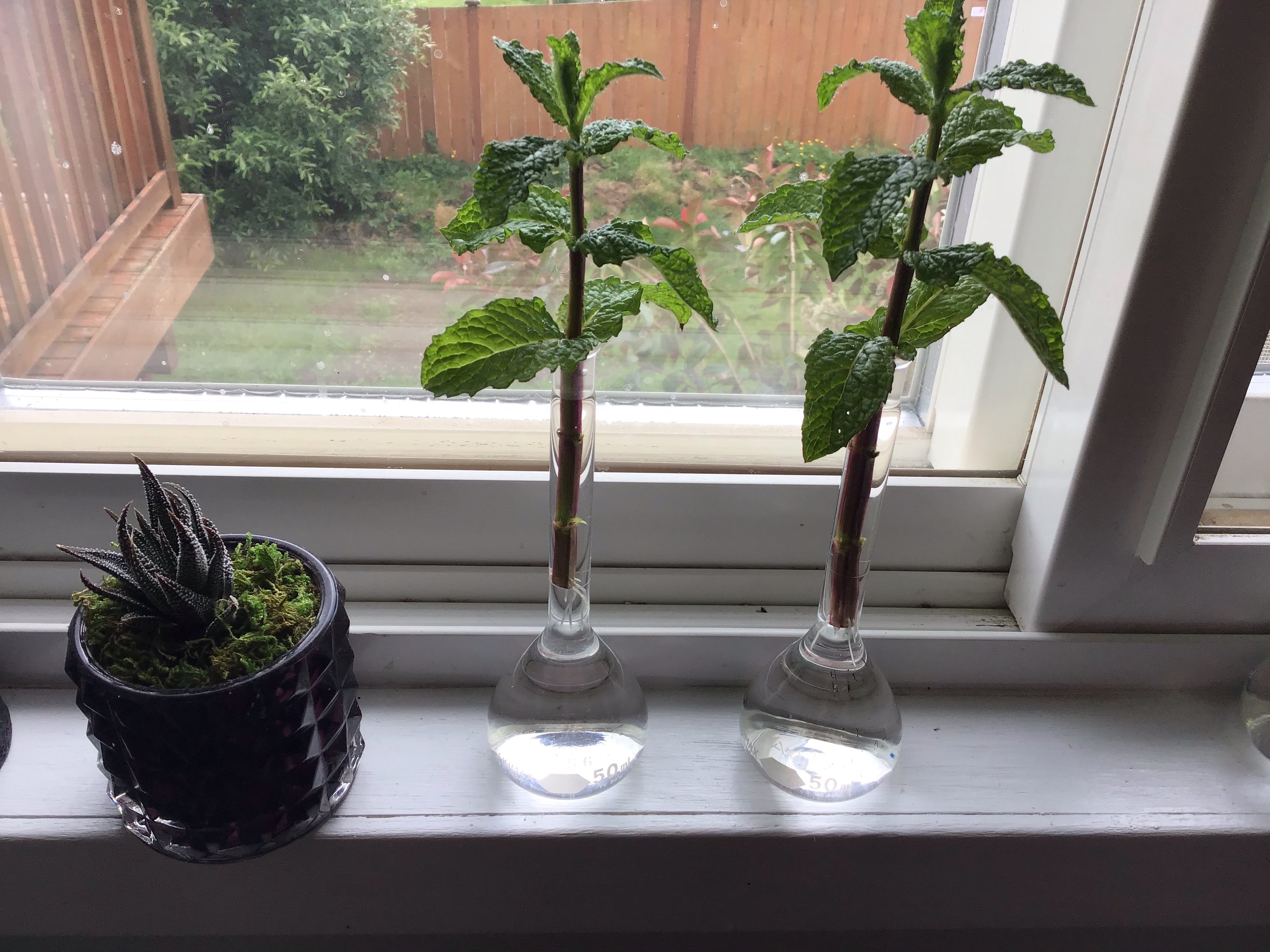
Using clean scissors, I cut the top 6 inches off of some mint plants, removed the lower leaves, and placed them in containers of water.

A week later, the mint cuttings had roots!  I’ll give them another few days to grow roots and then transplant them outside in our expanded herb garden barrel.

Week 35 – Student Art of Science Gallery

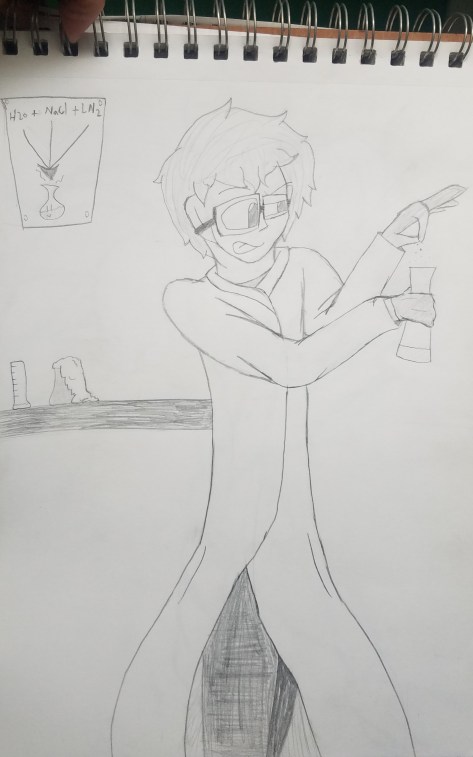
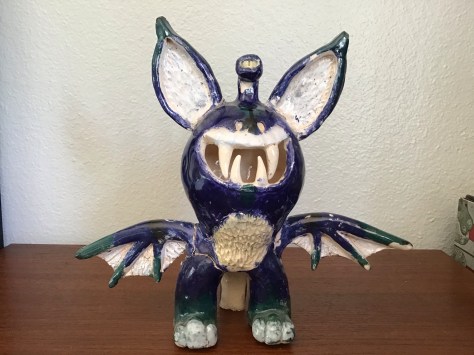
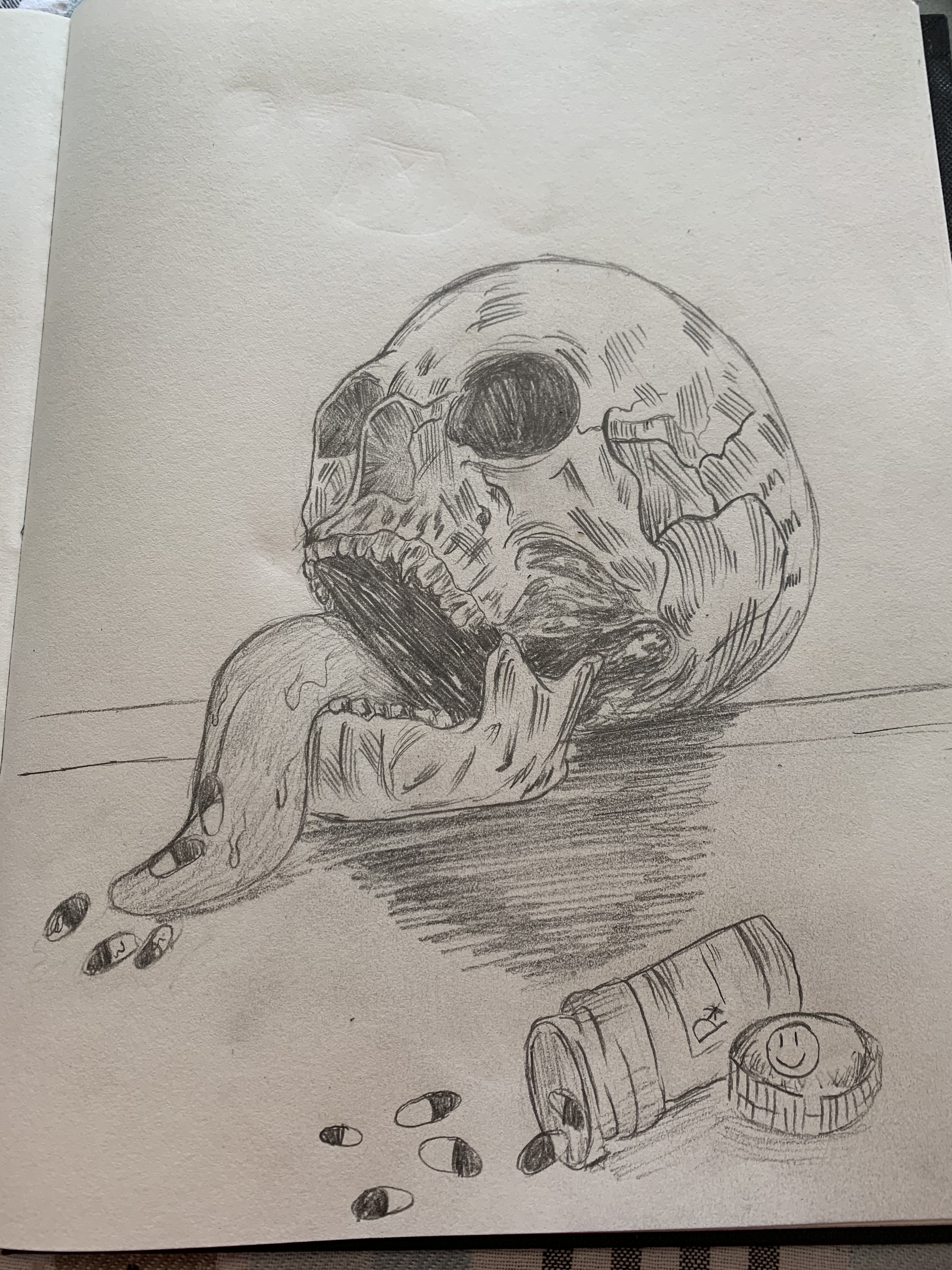
We have such talented artists among us!  The art below was created by students as part of the Week 35 Bonus Credit Opportunity.  Students who submit original artwork for bonus credit have the option of allowing it to be displayed publicly (not required to earn bonus credit) and the only requirement is student names may not be visible to protect privacy.

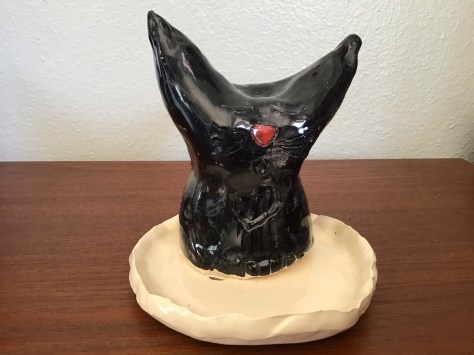
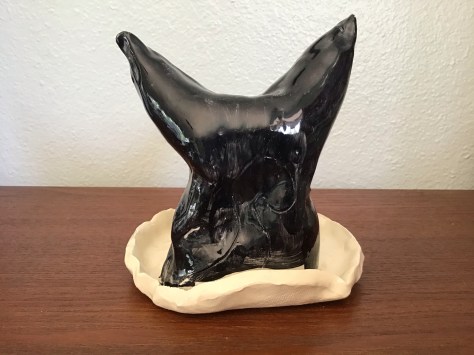
LD50
Is This Too Much
Is This Too Much?
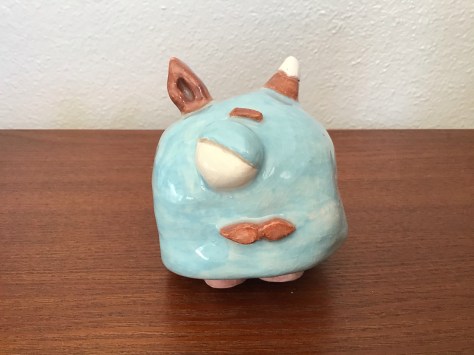
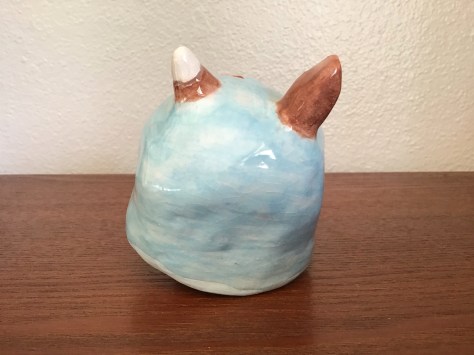
The Third Eye
The Third Eye

Week 35 – Bonus Credit Opportunity

Looking to earn some bonus credit and boost your grade?  You’ve come to the right place!  Each week, you will have the opportunity to earn bonus credit for completing extra learning about science.

This week’s bonus credit opportunity is called…The Art of Science.  Create a piece of art themed around our current unit of work.  Any format is fine, as long as it is school-appropriate and can be uploaded to the Week 35 Bonus Credit Opportunity Google Form.  If you are willing to share your work publicly, please make sure your name is not visible.  Have fun and be creative!

Weeks 34-35 – Limiting Reactants Revisited

Last week, you were introduced to the concept of limiting reactants.  In a chemical reaction, the limiting reactant is the chemical that is completely used up in the process of creating products.  When the limiting reactant is gone, the reaction ends.  Let’s imagine the chemical reaction of sodium bicarbonate (baking soda) and acetic acid (vinegar):

NaHCO3(s) + C2H4O2(aq) → NaC2H3O2(aq) + H2O(l) + CO2(g)

Let’s first notice that this equation is already balanced.  It does not require any coefficients to have equal numbers of atoms of each element on both sides of the equation.  One mole of solid sodium bicarbonate NaHCO3(s) reacts with one mole of aqueous acetic acid C2H4O2(aq) to produce one mole of aqueous sodium acetate NaC2H3O2(aq), one mole of liquid water H2O(l), and one mole of carbon dioxide gas CO2(g).

To determine how much of each substance we need to actually conduct this experiment, let’s calculate the molar masses of sodium bicarbonate and acetic acid:

  • NaHCO3 = 22.99 + 1.008 + 12.01 + (16.00 x 3) = 84.01 g/mol
  • C2H4O2 = (12.01 x 2) + (1.008 x 4) + (16.00 x 2) = 60.06 g/mol

Therefore, if we wanted to react one mole of sodium bicarbonate with one mole of acetic acid, we would need to combine 84.01 g of sodium bicarbonate with 60.06 g of acetic acid.  Easy!  We also know that we will produce one mole of carbon dioxide gas in this reaction – there will be bubbles!  Thinking back to our work with gas laws in Unit 3, we know that one mole of any gas at standard temperature and pressure will occupy a volume of 22.4 L.  So there will be a lot of gas bubbles!  Here is the reaction:

What did you observe?  Hopefully you noticed the geyser of bubbles – that was hard to miss!  Did you also notice the white solid material at the bottom of the flask?  That shouldn’t be there if the reactants fully reacted as expected.  The science tells us that one mole of sodium bicarbonate will fully react with one mole acetic acid.  Why was there so much unreacted sodium bicarbonate remaining?  Why was acetic acid the limiting reactant in this chemical reaction?

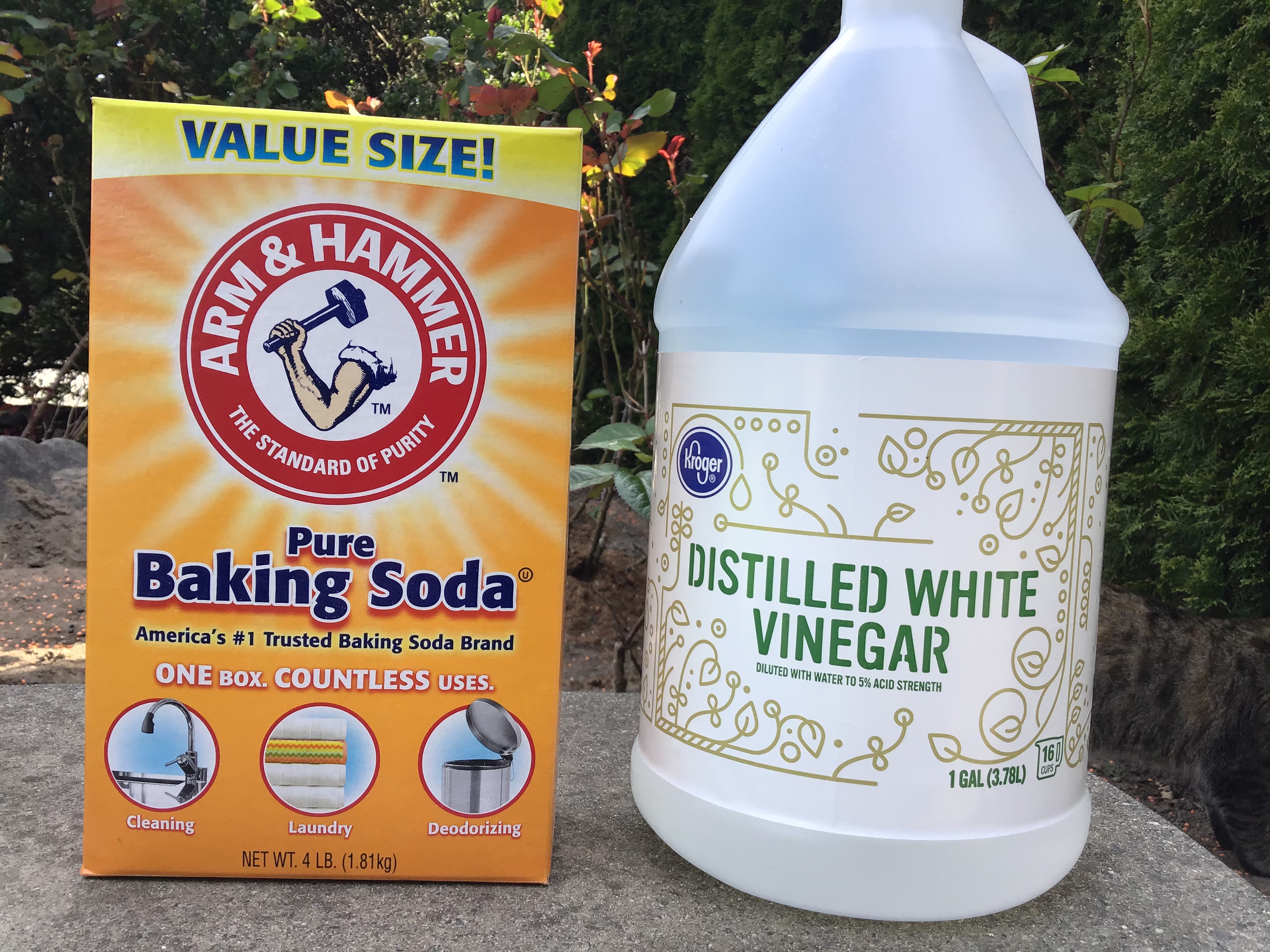
To answer this question, we need to look closely at our reactant labels:

The baking soda is pure sodium bicarbonate.  The distilled white vinegar has some fine print that says “distilled with water to 5% acid strength” – in other words, the distilled white vinegar actually contains 5% acetic acid and 95% water!  In our balanced equation, we assumed we were using 100% acetic acid, not 5% acetic acid.  Because 5% is 1/20 of 100%, we need to combine 20 times more of the 5% acetic acid (60.06 g x 20 = 1201.2 g) with 84.01 g of sodium bicarbonate to fully react both chemicals.  Or, we could keep the amount of acetic acid the same (60.06 g) and use 20 times less of the sodium bicarbonate (84.01 g / 20 = 4.2 g).  Let’s do that instead, to keep the amounts of each reagent reasonable:

What did you observe?  Can you explain it?  As we wind down the school year, this is an opportunity for you to earn credit in the lab report section of your chemistry grade.  This is an optional assignment and will be worth 50 bonus points. If your grade is not where you want it, and your lab report scores have been less than amazing, this is your chance to make up a lot of ground.  Please take advantage of it.

Lab Report Requirements:

    • Purpose: What are we trying to accomplish with this lab?
    • Procedure: Write out the steps, in order and in detail, that were followed in this experiment.
    • Results: What exactly did you observe?  Be clear, be descriptive, and include images if possible.
    • Conclusion: Clearly explain the results.  Include the concepts of chemical reaction, reactants, products, molar mass, and limiting reactant.

Note: If you have access to baking soda and vinegar and a safe space to work, you are welcome to substitute your own experimental data for what you were provided above.

Need some help setting up your lab report?  The links below will give you either a highly structured template specific to this lab, or a more generic template applicable to any lab report.  If you decide to use either one, click the link and then select File > Make a Copy and get to it!

Finally, if you have read all the way down to this point, enjoy!

When finished, return to Weeks 34-35 – How Much Is Too Much? and continue working.
Weeks 34-35 – The Evolution of Lactose Tolerance

Now that we better understand enzymes and how they work, it is time to focus on the enzyme lactase.  The substrate for lactase is lactose, a sugar commonly found in milk.  While you were briefly introduced to lactase in the previous work for this week, the video below will provide you with many important insights.

After watching the video, complete the Got Lactase? Google Form assignment.

Return to the Weeks 34-35 – Lactase Persistence post and continue our work for the week.

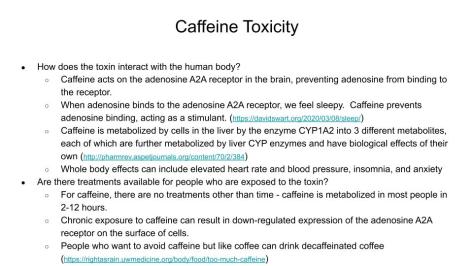
Weeks 34-35 – Toxin LD50 Calculations

For the final research part of the Toxin Research Project, it’s time to answer the question: how much is too much?  To answer that question, you need to research how much of your toxin is in a “standard dose” of your toxin.  “Standard dose” can be hard to find, and is often provided as a range.  For example, a “standard dose” of caffeine might be 100-200 mg per “dose” with a dose being an 8 ounce cup of coffee or a 12 ounce can of soda.  In that case, split the difference and use 150 mg as the standard dose for caffeine.  Buckle up – this is often the hardest part of this project.  Be persistent!  If “standard dose” doesn’t work as a search term, try “amount per serving” and see if that works.

Instructions for Slide 3:

  • Add Slide 3 to your Google Slides deck and title it “Toxin LD50 Calculations”
  • On Slide 3, answer the following:
    • Click the PubChem link to your toxin from Slide 1
    • Locate the molecular weight (synonym for molar mass) in PubChem and enter it on Slide 3
    • Using the molar mass and the LD50 (from Slide 1), calculate the lethal dose of the toxin for humans of three different masses and show your calculation work on the slide:
      • 10 kg
      • 30 kg
      • 75 kg
    • How many “standard doses” of the toxin does it take to reach the lethal dose for a person of mass 10 kg?  30 kg?  75 kg?

Here’s a video of my efforts to determine the “standard dose” of capsaicin per jalapeno pepper:

Need help bring these concepts together?  From the video above, we learned that the average jalapeño contains 2.24 mg of capsaicin.  Here is an example calculation for how many jalapeños a 75 kg person would have to eat to reach the lethal dose for capsaicin (identified in Slide 1 as 47.2 mg/kg):

75 kg x (47.2 mg capsaicin / 1 kg) x (1 jalapeños / 2.24 mg capcaisin) = 1580 jalapeños

When finished with Slide 4, return to Weeks 34-35 – How Much Is Too Much? and continue working.