Structural Formulas

We continued our work from yesterday, adding three additional scents for students to smell and connect with molecular formulas.  Students learned that two molecules can have the same molecular formula but smell very differently.  One compound smelled like rum extract, the other smelled like stinky cheese.  This created a powerful and memorable moment for students to remember the concept of isomers.  Key definitions for the day:

Structural Formula – A drawing or diagram that a chemist uses to show how the atoms in a molecule are connected. Each line represents a covalent bond.

Isomers – Molecules with the same molecular formula but different structural formulas

For the class period, students worked through the Lesson 29 worksheet and then were assigned Lesson 29 problems 5-7 from the textbook as homework.
Enzymes

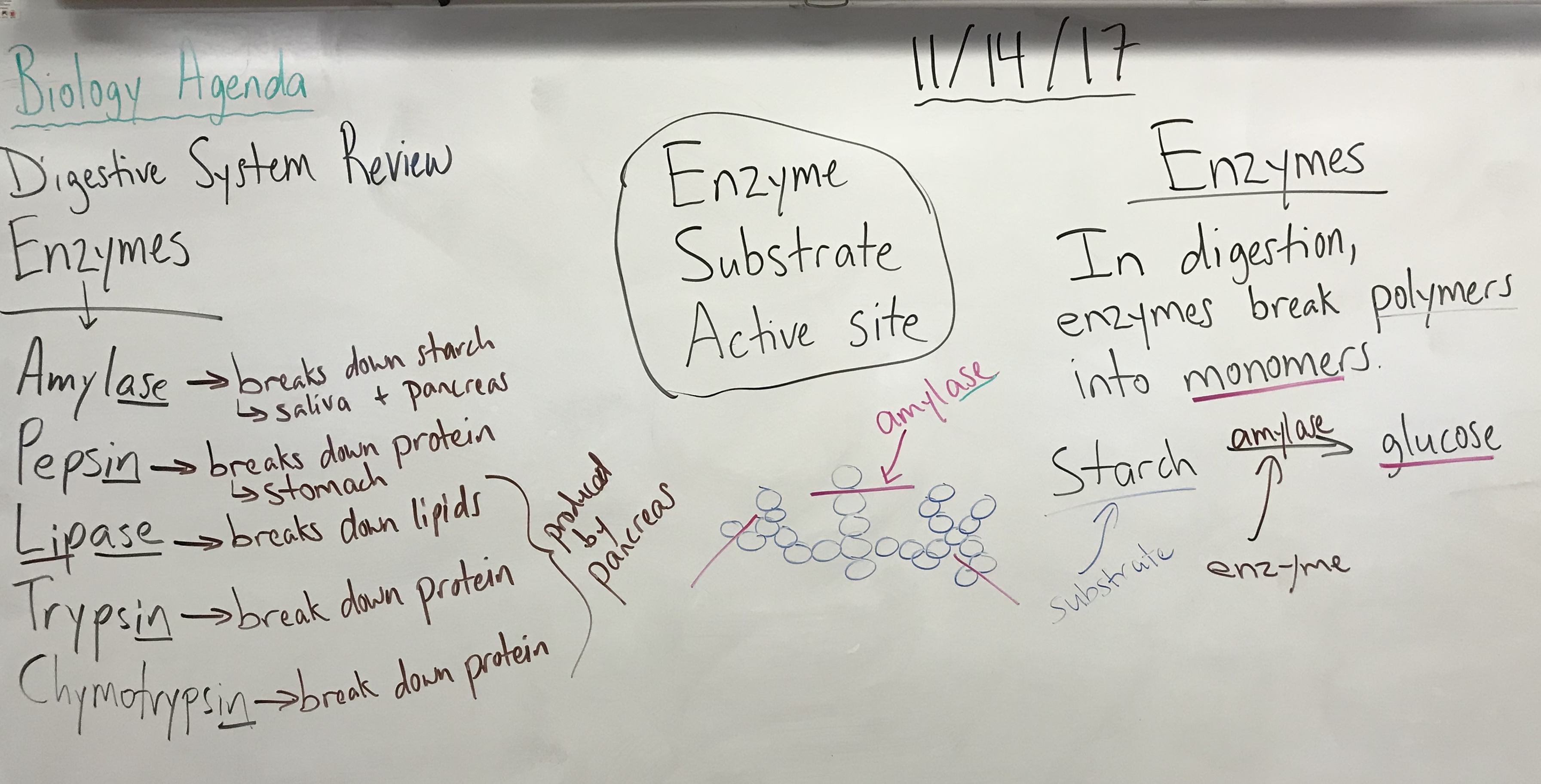
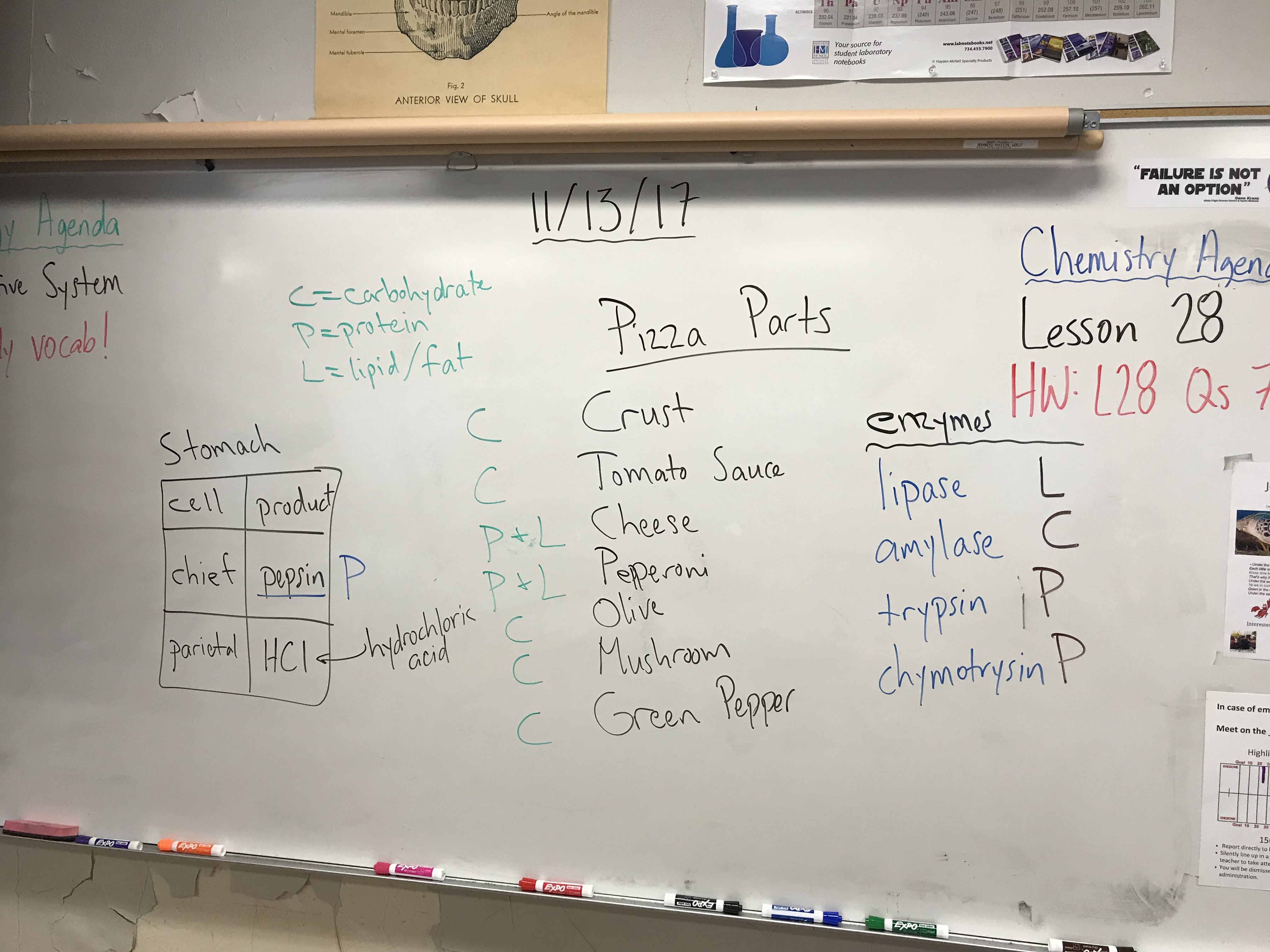
We began class with a vocabulary review from yesterday.  Students completed Activity D problem #3 where they matched 11 digestion related vocabulary words with the correct definitions.  Next, we reviewed the enzymes from yesterday’s lesson to reinforce vocabulary and to review where in the body the enzymes work and which biomolecules they act on.  Notes from the white board are shown below:

For today’s lesson, we furthered our study of enzymes by watching the Amoeba Sisters video below:

After the video, students had time to work on the video worksheet in class and were instructed to finish it as homework.

Digestion

We continued our study of enzymes and digestion by focusing specifically on the process of digestion today.  Students all received a handout with an image of the digestive system, and then we labeled the parts and took notes on the process of digestion while watching the video below:

Additional notes from the whiteboard are shown below:

Molecular Formulas

For our first lesson of Unit 2, students were asked to respond to the following entry task:

  • What do you think is happening when you smell something?
  • Why do you think we have a sense of smell?

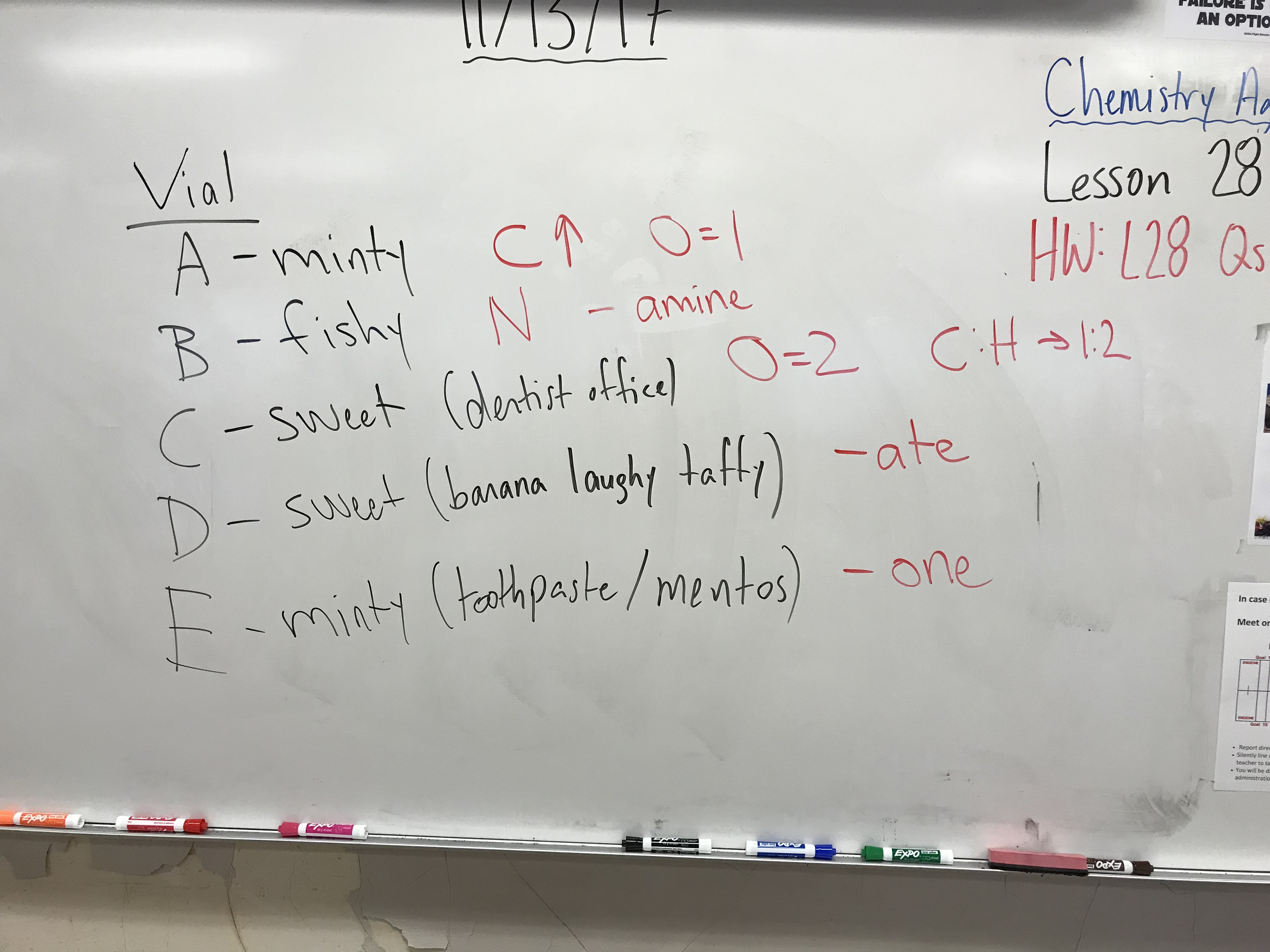
After a class share-out, students all participated in an activity where they smelled five different scents and then compared their observations as a class.  Based on the class results, students made connections between molecular formulas, chemical names, and scents (fishy, minty, or sweet).  After completing the Lesson 28 Worksheet, students were assigned problems 7-9 from Lesson 28 of the textbook as homework.

Notes from the whiteboard are shown below:

Biomolecules

Class began with the following entry task:

Use the Item Bank (H20, CO2, ATP, O2, C6H12O6):

  1. Which are inputs of cellular respiration?
  2. Which are outputs?
  3. Write the equation for cellular respiration

The entry task launched our brief review of cellular respiration, photosynthesis, and chemical potential energy stored in glucose and transferred to ATP.

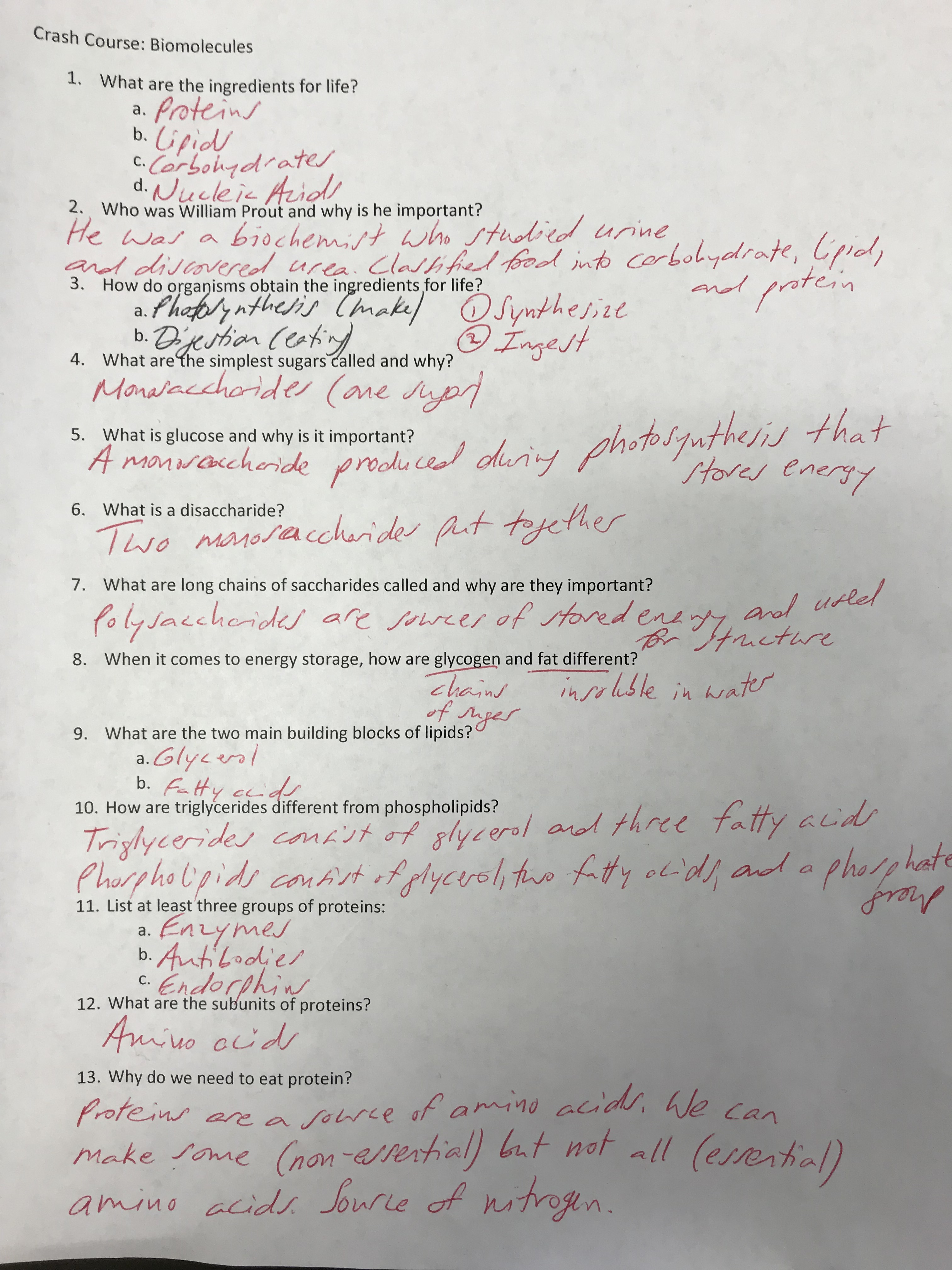
After taking notes, the discussion transitioned to a recognition that while humans can eat glucose directly by consuming plants, humans can also obtain energy by eating other animals that eat plants.  For example, when we eat beef, we are ingesting protein and fat (lipids) produced by a cow that ate grass.  That led us to the Biological Molecules Crash Course video (below) and the associated worksheet.  Each student was assigned one question from the handout to answer, and then students combined answers in a class share-out at the end of class.  A completed copy of the worksheet is also provided below.


November 8 – Updated

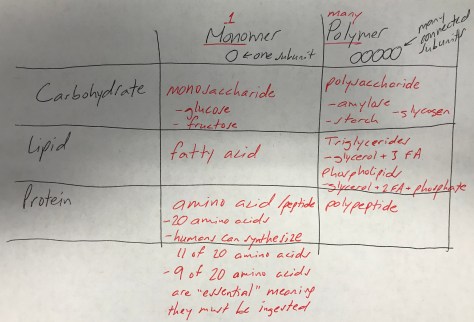
Our study of biomolecules continued with students working in groups of three to read about carbohydrates, lipids, and fats.  Each student read one section, and then all three shared what they learned with the other students in the group so that each student was able to complete one worksheet.  At the end of class, we re-grouped and created the summary table shown below:

IMG_0745

Food – Our Body’s Source of Energy

At this point in our study of enzymes and digestion, students have learned how plants capture the energy in sunlight and store it as chemical potential energy in glucose molecules.  Animals (and plants!) metabolize glucose using cellular respiration, transferring the chemical potential energy from glucose to ATP (adenosine triphosphate), the energy currency of cells.  Photosynthesis takes place in chloroplasts, while cellular respiration occurs in mitochondria.

In The Breath of Life reading, students learned how the respiratory system of humans enables gas exchange, with the lungs inhaling oxygen and exhaling carbon dioxide.  The gas exchange occurs within the alveoli, thin-walled sacs inside the lungs.  The reading introduced the concept of feedback systems, focusing on the special nerve cells in the cardiovascular and nervous systems that can sense changes in pH.  As carbon dioxide builds up, the blood becomes more acidic, and the lungs are forced to exhale to rid the body of carbon dioxide which then brings the pH back to normal levels.

For today’s lesson, we once again turned to our textbook and students were instructed to read pages 328-332 and complete the associated worksheet.  The assigned reading was titled Food: Our Body’s Source of Energy and Structural Materials.  Now that students understand the link between photosynthesis (chemical potential energy stored in glucose), cellular respiration (glucose metabolized to transfer the energy in glucose to ATP), and the larger connection with the respiratory and cardiovascular systems, it is time to learn more about how the digestive system makes use of the variety of foods available to us.  It is time to think beyond glucose.

The Breath of Life

For today’s lesson, students were tasked with their first reading assignment from our official Biology textbook.  The assignment called for students to read The Breath of Life essay on pages 236-239 in the textbook.  After reading each paragraph, students were instructed to write a short summary sentence about the main idea of the paragraph.  Students needing additional time will be able to complete the assignment after the quiz tomorrow.  Students who finished early were instructed to continue reading the next essay in the textbook.  Credit will be given to students who complete the notes by the end of class tomorrow.

Exercise Lab

For the second day of our new unit, students began class by answering the following entry task:

In your lab notebook, explain why you can’t hold your breath forever.

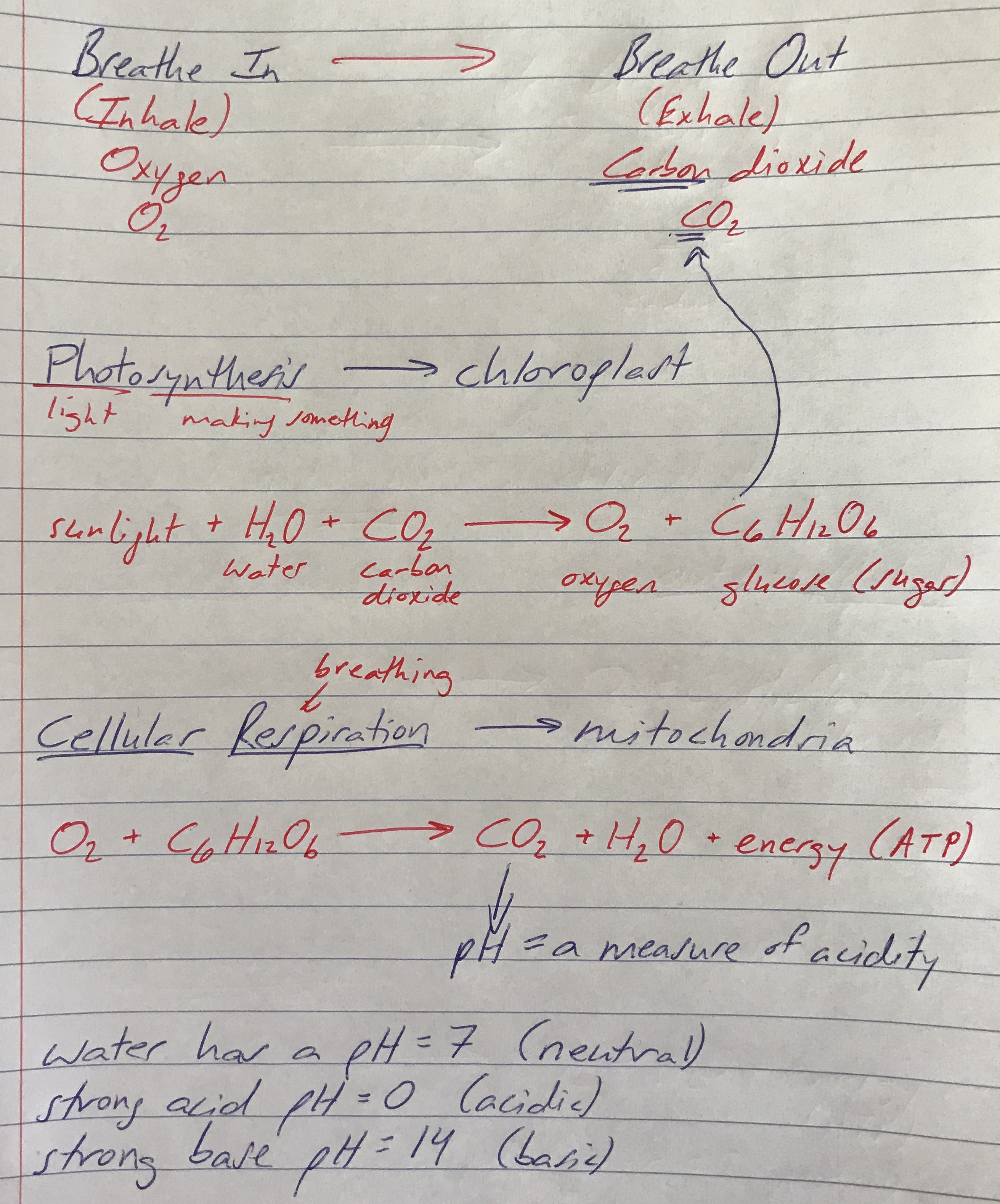
A class share-out of the entry task enabled students to reason through the processes of photosynthesis and cellular respiration, learning new vocabulary to apply to the processes.  Class notes are shown below:

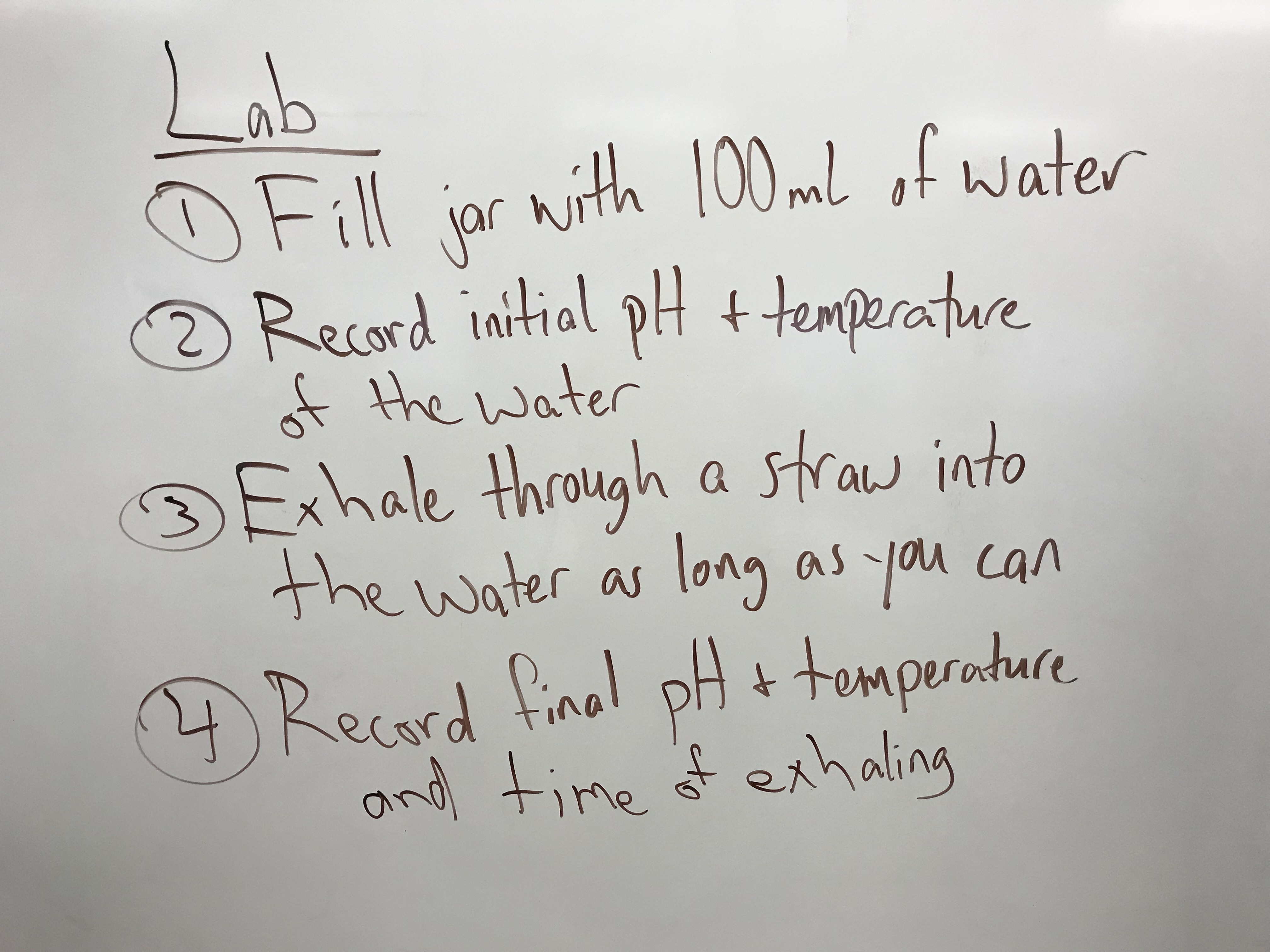
Next, we discussed the connection between carbon dioxide and pH, and then students observed a demonstration for how to use probeware to measure pH and temperature.  Students wrote down the following procedure in their lab notebooks:

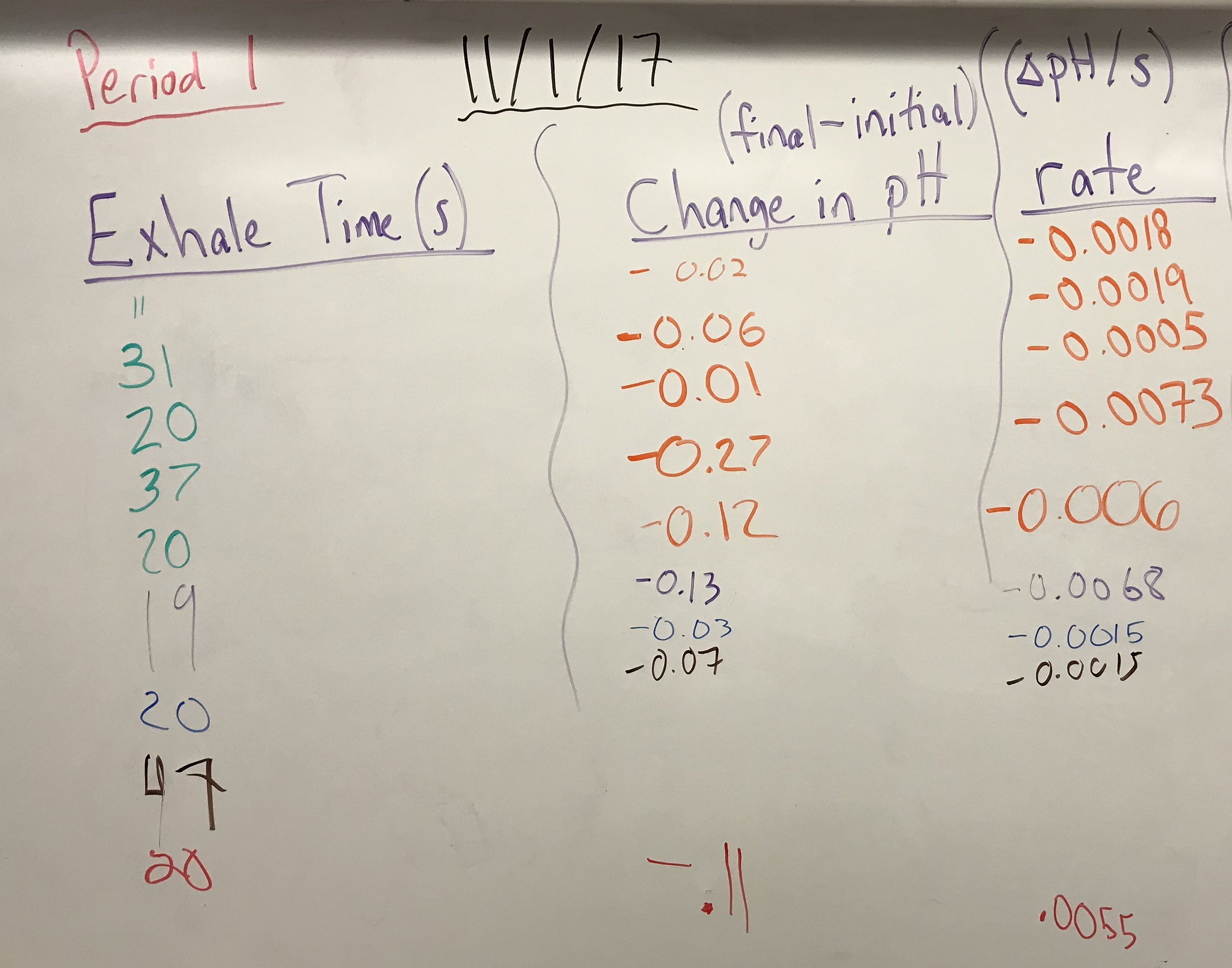
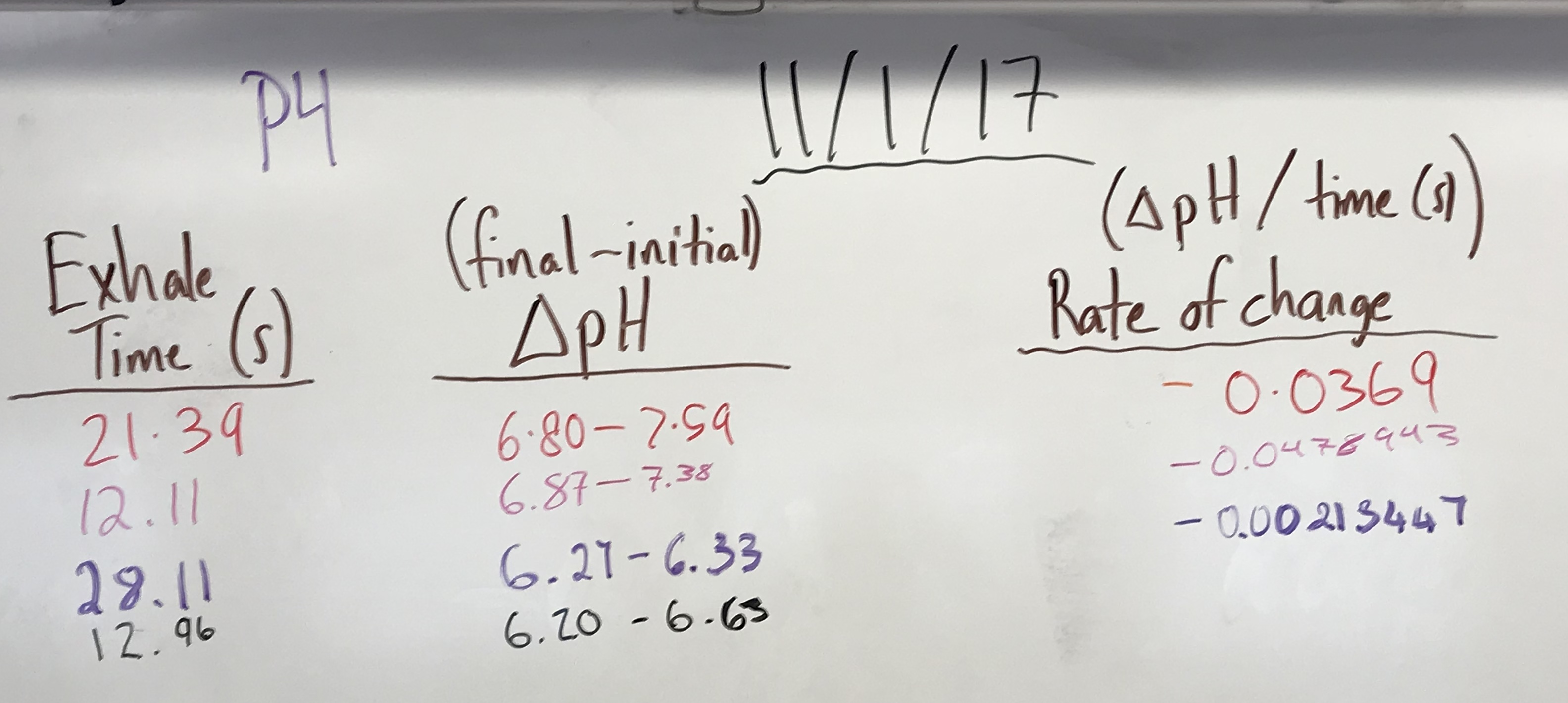
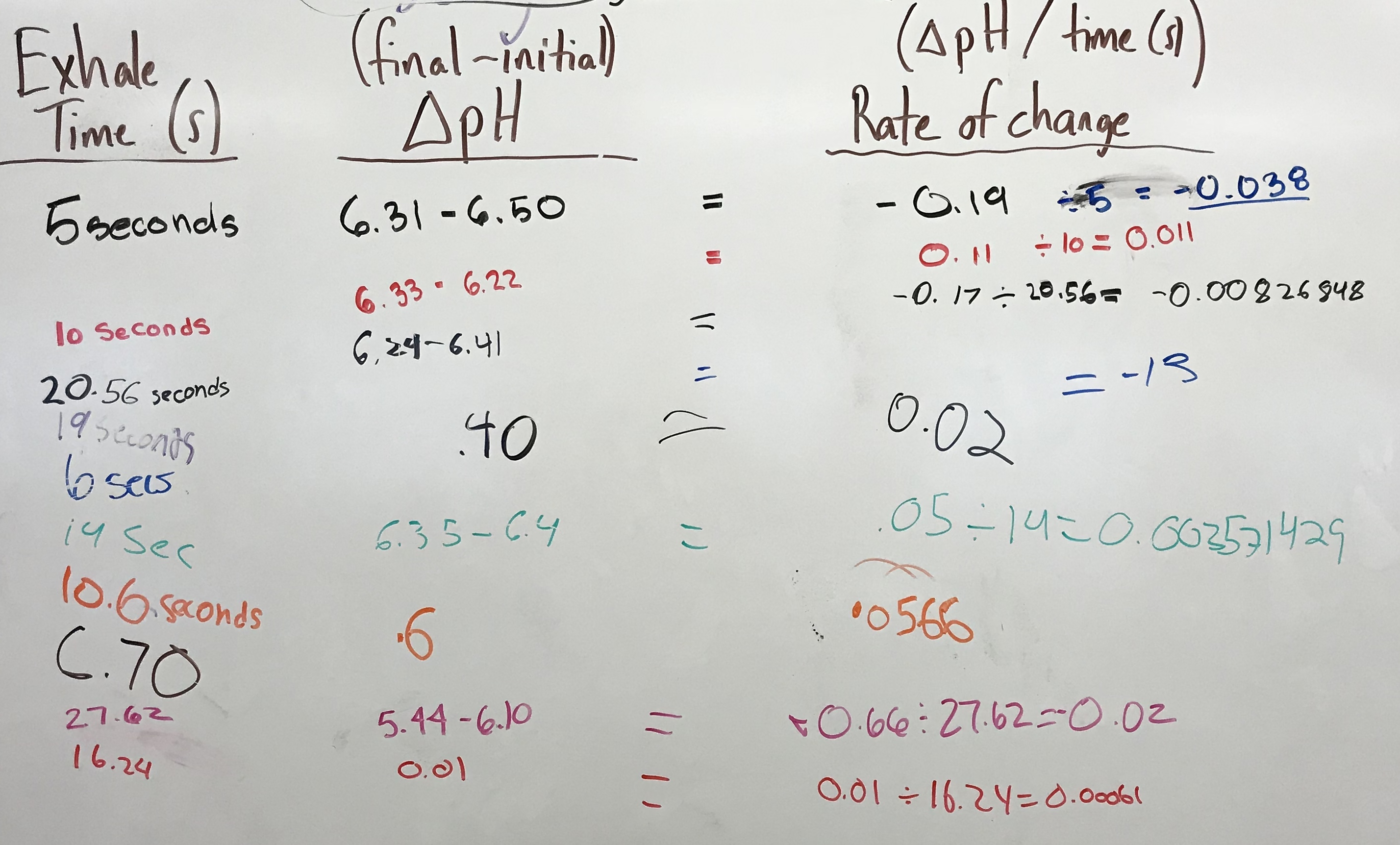
After completing the lab, students processed their data and recorded it on the white board for everyone to see.  Not everyone had time to record their data, so the class data sets pictured below will be revisited soon:

Period 1
Period 4
Period 6